
When you're navigating the complexities of immigration, academic admissions, or legal matters, your birth certificate is a cornerstone document. If it isn't in English, you can't just hand over the original. You need a certified translation—a precise English version of your birth certificate that includes a signed statement from a professional translator guaranteeing its accuracy. This isn't just a suggestion; it's a strict requirement for authorities like United States Citizenship and Immigration Services (USCIS), and getting it right is crucial for your application's success.
Why a Perfect Translation Is Non-Negotiable
Let's imagine a real-world scenario. A family from Brazil is applying for their Green Cards. They've spent months gathering documents, filling out forms, and saving for fees. Their entire case depends on proving their family relationships, and their children's birth certificates are the primary evidence.
To an agency like USCIS, there is zero room for error. A birth certificate translation isn’t just about changing words from Portuguese to English. It’s about creating an official, legally sound document that an immigration officer can trust completely. A tiny mistake—a misspelled name, a swapped day and month, or a missing note about a seal—can bring the entire application to a halt, causing frustrating delays.
Understanding What "Certified Translation" Really Means
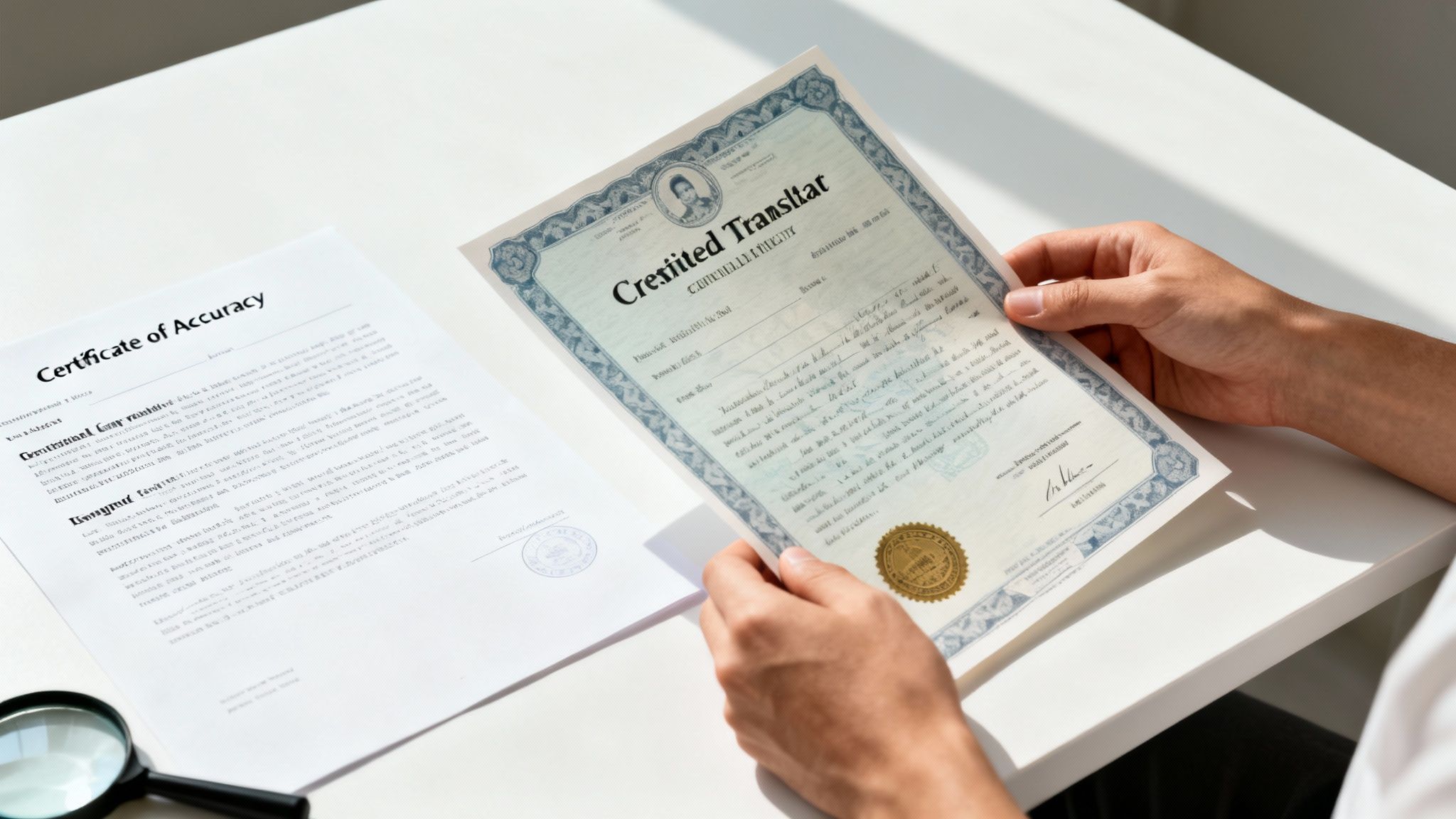
When you hear the term "certified translation," it doesn't mean a special government stamp. It simply refers to a translation that comes with a formal statement called a "Certificate of Accuracy" or "Translator's Attestation." This is not something a bilingual friend or family member can provide for official purposes.
This signed statement is what gives the translation its legal power. It confirms three key things:
- The translation is a complete and accurate copy of the original document.
- The translator is fluent in both the original language and English.
- It includes the translator's name, signature, contact information, and the date.
Without this certificate, your translated birth certificate is just an unofficial piece of paper with no legal value.
USCIS has a strict policy for incomplete or inaccurate translations. An error isn't a minor issue; it's a direct path to a Request for Evidence (RFE), which can easily add months of delay to your application.
To keep you on the right track, here is a simple checklist of what USCIS requires.
USCIS Certified Translation Requirements: A Simple Checklist
This table breaks down the essential elements USCIS demands for any translated document. Use it to ensure your birth certificate translation will be accepted without any issues.
| Requirement | What It Means in Simple Terms | Why It Matters |
|---|---|---|
| Full English Translation | Every single word on the original document must be translated—this includes all stamps, seals, and handwritten notes. | An incomplete translation might look like you're hiding information, which can lead to suspicion and rejection. |
| Translator's Certification | A separate, signed statement from the translator or translation company is mandatory. | This "Certificate of Accuracy" is the legal guarantee that the translation is accurate and the translator is qualified. |
| Translator Competence | The certificate must state that the translator is fluent in both the source language and English. | USCIS needs proof that the translation was done by a skilled professional, not just someone with basic language skills. |
| No Self-Translation | You cannot translate your own birth certificate, even if you are perfectly bilingual. | This rule prevents conflicts of interest and ensures the translation is objective and unbiased. |
Getting these four points right is the foundation of a successful submission.
The Scale of Official Submissions
The sheer volume of applications puts immense pressure on government systems, which is why the rules are so strict. For instance, in 2025, USCIS was managing a significant number of family-based petitions, many of which rely on foreign birth certificates to prove relationships. As we look toward 2026, these high volumes are expected to continue.
The rules for 2025 are clear: every document not in English must be submitted with a complete English translation and a proper Certificate of Accuracy. Trying to cut corners here is a recipe for rejection, forcing you to start over. This is why working with a professional service that understands all the specific USCIS translation requirements is an essential step toward building a strong, successful application.
This guide will walk you through everything, from preparing your document for translation to what the final certified package should contain, giving you the confidence to submit documents that get approved the first time.
Getting Your Document Ready for a Flawless Translation
The quality of your final translation begins with one simple step: the quality of the document you provide. A professional translator can only work with what they can clearly see. A blurry photo or a poorly cropped scan creates an immediate problem. Your goal is to create a perfect digital copy of your original birth certificate, ensuring every detail—stamps, seals, handwritten notes, and watermarks—is visible.
If an official at USCIS compares the translation to the original and can't find a detail because it was cut off or blurry in your copy, it raises an instant red flag. This small mistake can easily trigger a Request for Evidence (RFE), putting your entire case on hold.
Using Your Phone to Get a Perfect Copy
You don’t need a fancy scanner; your smartphone is powerful enough to do the job right. However, just snapping a quick picture often results in shadows, glare, and skewed angles that make the document hard to read.
Here are practical tips for getting a perfect, scan-quality image:
- Use Natural, Even Light: Find a spot near a window with indirect daylight. Lay your birth certificate on a flat, plain surface like a table. This minimizes shadows. Never use your phone's flash—it creates harsh glare that can hide important details.
- Shoot from Directly Above: Hold your phone parallel to the document. Avoid taking the photo at an angle, which distorts the text. A straight, top-down shot is what you need.
- Fill the Frame, but Don't Crop: Get close enough so the document fills most of your screen, but make sure all four corners and every edge are visible. It's a common mistake to accidentally cut off a signature or stamp, which results in an incomplete translation.
- Do a Quick Quality Check: Before sending, zoom in on the picture. Can you read the smallest print clearly? Are the official seals and stamps easy to see? If it looks blurry to you, it will be a problem for the translator.
What’s the Best File Format to Send?
Once you have a crisp, clear image, save it in the right format. If you have a physical birth certificate, getting it into a clean, machine-readable format is a huge help. You can learn how to convert PDFs to searchable OCR text, which can speed things up for your translator.
In general, these file formats provide the best results:
- PDF: This is the best option. It preserves the document's formatting and is universally accepted by all agencies.
- High-Quality JPG: If you took a photo, make sure you save it as a high-resolution JPG.
Key Takeaway: It is your responsibility to provide a complete and legible copy of the original document. A translation agency cannot translate what it cannot see. A dark, cropped, or blurry file is one of the most common and avoidable reasons for translation delays.
By taking a few extra minutes to prepare your document, you set the stage for a smooth, fast, and accurate birth certificate translation. This simple prep work is your first step toward getting your application approved without issues.
What Happens After You Submit Your Document?
Ever wonder what goes on after you upload your document? A meticulous, professional process begins to turn your birth certificate into a certified translation that USCIS and other authorities will accept.
Once your document arrives, a project manager reviews it for legibility and confirms the project details. Then, it's assigned to a professional translator who is a native speaker of the target language and specializes in official civil certificates. This requires an expert who understands the specific legal terms and formatting of these records.
This simple graphic shows how you can best prepare your document to get the process started smoothly.
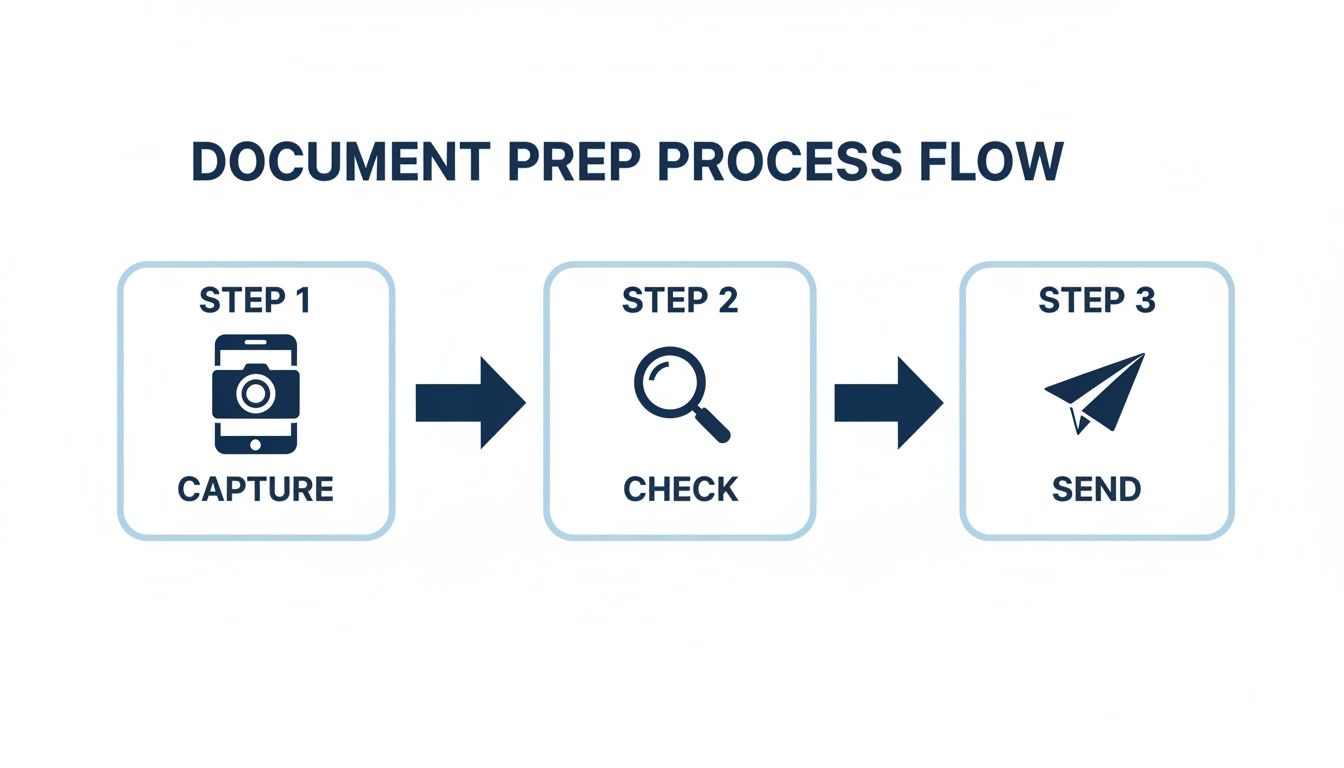
As you can see, a clear picture is the foundation for an accurate translation. Taking a moment to check your document before sending it makes all the difference.
Crafting the Translation and Assembling the Final Package
The translator's primary job is to create an exact mirror of your birth certificate in English. This is more than just swapping words; they carefully replicate the original layout, ensuring that everything from the position of seals and stamps to the structure of tables is preserved.
Nothing is overlooked. Here’s how they handle tricky elements:
- Stamps and Seals: These are described within the translation using notes in brackets, like
[Seal of the Civil Registry of Lima, Peru]or[Illegible signature], to account for every mark on the page. - Formatting: The final translation will visually match the original document. This side-by-side consistency makes it easy for an official to verify the information.
- Word-for-Word Accuracy: Certified translations must be a complete and literal rendering of the source text. There is no room for summaries or interpretations.
After the translation is drafted, it moves to a quality check. A second linguist proofreads the document to catch any typos or errors in crucial details like names, dates, or places. This ensures it's perfect before certification.
The final package you receive is a complete set of documents, which includes:
- A copy of the original birth certificate you provided.
- The full, meticulously formatted English translation.
- The Certificate of Accuracy, a signed statement on official letterhead confirming the translation is complete and accurate and that the translator was qualified.
This three-part bundle is exactly what USCIS and other official U.S. agencies require.
Certified vs. Sworn vs. Notarized: What’s the Difference?
These terms can be confusing, but for any application within the United States, the distinction is simple.
A certified translation is the standard for U.S. official use. It’s a high-quality translation that comes with a signed Certificate of Accuracy from the translation provider. This is what you need for USCIS.
A sworn translation is a different system used in many countries in Europe and South America. In those countries, a translator is officially “sworn in” by a court or government body. While it's required there, it has no special status in the U.S.
And what about a notary stamp? A notary public only verifies the identity of the person who signed the document; they do not validate the translation's quality. USCIS does not require notarization, so it’s usually an unnecessary extra cost. You can learn more about the differences between a certified and notarized translation.
Key Takeaway: For U.S. immigration or any other official purpose in the U.S., a certified translation is what you need. Don't worry about sworn translators or pay extra for notarization unless a specific, non-USCIS agency has requested it.
Understanding this process helps you know what to expect. For a standard one-page document like a birth certificate, you can typically expect a 24-hour turnaround. Clear, upfront pricing means you'll know the full cost right away—no hidden fees, no surprises.
Common Mistakes That Can Derail Your Application
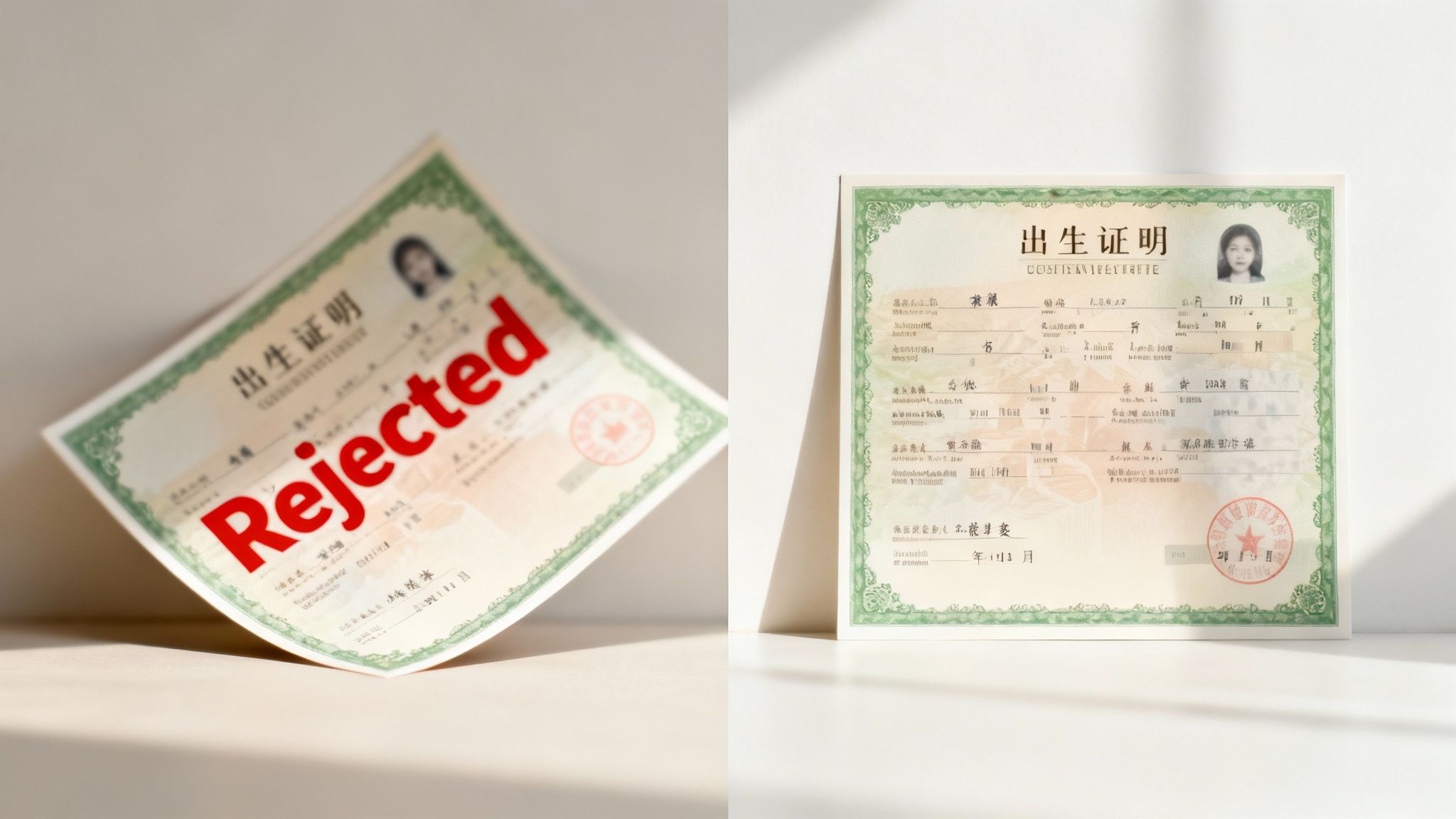
Navigating the paperwork for immigration, university admissions, or other legal matters is stressful. The last thing you need is a small, preventable error on your birth certificate translation to halt the entire process.
For example, imagine your USCIS application lists your name as "Maria Garcia," but the translated birth certificate reads "María García." That single accent mark can be enough for an officer to issue a Request for Evidence (RFE), causing months of delays while you sort it out. Knowing what can go wrong helps you make sure everything goes right.
Using Friends or Family for Translations
It’s tempting to ask a bilingual friend or relative to handle your translation to save money. Unfortunately, this is a major red flag for USCIS and other official agencies. They view it as a conflict of interest because a friend or family member is not an impartial party. Official bodies require the translation to be done by a competent, neutral third party who can formally certify their work.
The Pitfalls of Free Online Translation Tools
Using a free online translator like Google Translate may seem like a quick fix, but for official documents, it’s a recipe for disaster. Machine translation tools fail in several critical ways:
- They miss context. These tools don't understand the specific legal terminology on a birth certificate, often leading to incorrect or awkward translations.
- They lose nuance. Subtleties in names, regional terms, and official titles are almost always lost.
- They provide no certification. An automated translation is just text. It does not come with the legally required Certificate of Accuracy, making it useless for any official submission.
A machine-generated translation can never replace the precision and legal attestation of a professional human translator. Submitting a document translated by an online tool will be rejected.
Overlooking Small but Crucial Details
When it comes to birth certificate translations, every detail matters. The reviewing official will meticulously compare your translation against the original. Any discrepancy can raise doubts. A classic example is date formatting. If your birth certificate shows a date as 10/05/2001 (May 10th in most of the world), an amateur might incorrectly write it in the U.S. format, leading it to be read as October 5th. A professional translator knows how to clarify this to avoid confusion.
Another common mistake is ignoring stamps, seals, or handwritten notes. Everything on the original document must be accounted for in the translation, even if it's just a note like [Illegible stamp] or [Signature]. Leaving these out makes the translation incomplete and unacceptable. We cover more of these issues in our guide to common translation mistakes.
Not Verifying the Final Document
Once you receive the translated document, your job isn’t done. You are the final line of defense, as you are the only one who can instantly spot-check critical personal details.
Take a few minutes to carefully review the final document. Look for:
- Correct spelling of all names: Yours, your parents', and the city of birth.
- Accurate dates: Your date of birth and the certificate's issue date.
- Correct numbers: The certificate or registration number must be transcribed perfectly.
A reputable translation agency will quickly correct any errors you find at no extra charge. Catching a typo before you submit your application can save you from months of bureaucratic headaches.
To make it even easier, here’s a quick-reference table of the most common mistakes and how to avoid them.
Top 5 Birth Certificate Translation Mistakes and Fixes
| Common Mistake | Why It's a Problem | How to Fix It |
|---|---|---|
| DIY or Family Translations | USCIS and other authorities require an impartial translator; family and friends are considered biased. | Always use a professional, third-party translation service that provides a proper certification statement. |
| Using Google Translate | Machine translations lack legal context, are often inaccurate, and come with no Certificate of Accuracy. | Hire a human translator who understands the nuances of legal documents and can certify their work. |
| Incomplete Translation | All text, including stamps, seals, and handwritten notes, must be translated or noted (e.g., [illegible]). |
Provide a clear, high-quality scan of the entire document and confirm with your translator that everything will be included. |
| Name & Date Errors | A single misspelled name or incorrectly formatted date can trigger a Request for Evidence (RFE), causing long delays. | Carefully proofread the final translation yourself. Check every name, date, and number before submitting. |
| Missing Certification | The translation is legally invalid without a signed statement from the translator attesting to its accuracy and their competence. | Ensure your translation provider includes a formal Certificate of Translation Accuracy with every document. |
By keeping these points in mind, you can ensure your translated birth certificate is flawless and ready for submission.
When You Need More Than Just an Immigration Translation
While immigration is a primary reason for certified translations, the need for a perfectly translated birth certificate extends far beyond USCIS. It serves as your official identity document in many of life's biggest moments, each with its own strict rules.
For example, an international student accepted into a U.S. university must provide a flawless birth certificate translation to the admissions office. Credential evaluation services like World Education Services (WES) are incredibly meticulous. They need it to verify the student's identity and age, often matching it against academic transcripts. A small error can stall enrollment or jeopardize scholarships.
Beyond the University Campus
The need for this precision appears in many other official contexts. Here are a few real-world situations:
- State Licensing Boards: A doctor, nurse, or engineer from another country seeking to practice in the U.S. must prove their identity to a state board. A certified birth certificate translation is a standard requirement.
- International Adoptions: For families navigating the complex process of international adoption, a certified translation of the child's birth certificate is essential for legal proceedings at home and abroad.
- Applying for a U.S. Passport: If you were born overseas to U.S. citizen parents, you'll need a certified translation of your foreign birth certificate when applying for your first American passport.
- Court Proceedings: In legal cases that cross borders—such as inheritance disputes or divorce—courts demand certified translations of all vital records. A birth certificate is often the foundational document.
In every scenario, the stakes are high. The official reviewing your document, whether a university registrar or a judge, must be able to trust it completely.
The Growing Need for Official Translations
Our world is more connected than ever, and global mobility has created a massive demand for professional translation. This isn't just a minor trend; it reflects how intertwined our legal, professional, and personal lives have become.
The global translation services market hit USD 956.81 billion in 2025 and is projected to exceed USD 1.18 trillion by 2035. The legal and judicial sector alone is expected to claim over 25.5% of that market by then, driven by the need for accurate translations of documents like birth certificates. You can explore these translation market statistics on redokun.com.
This data shows that having a reliable translation expert is becoming a necessity. From a certified translation of your marriage certificate for a spousal visa to your university diploma, the need for perfect documents is constant.
Why Professional Services Are a Universal Requirement
Ultimately, it doesn’t matter if you're submitting paperwork to USCIS, a university, or a court. The fundamental requirement is always the same: you need a translation that is accurate, complete, and professionally certified. A professional service understands the subtle differences in what various institutions demand. Getting familiar with the pricing and process for these services will help you prepare for any of these scenarios. Your certified birth certificate translation is the key that unlocks opportunities and allows you to move forward with your goals.
Answering Your Top Questions About Birth Certificate Translations
Even after explaining the process, a few key questions always come up. When you're dealing with a document as important as your birth certificate, you want to be certain you have every detail right. Let's clear up the most common points of confusion.
Does USCIS Need the Translation to Be Notarized?
No. USCIS is very clear that a certified translation does not need to be notarized.
What they do require is the "Certificate of Accuracy." This is the signed statement from the translator or translation agency guaranteeing that the translation is a complete and accurate version of the original. For any U.S. immigration filing, this certification is all that is needed. While some other institutions might ask for a notary stamp, it’s an unnecessary extra step for USCIS.
Can I Just Translate My Own Birth Certificate?
Definitely not. You should never translate your own birth certificate or ask a friend or family member to do it, no matter how fluent they are. USCIS and other authorities consider this a conflict of interest. The system is built on the principle that the translation comes from a neutral, skilled third party to ensure objectivity.
An impartial translation is a non-negotiable requirement. Submitting a self-translated document is one of the fastest ways to get a rejection.
Hiring a professional service is how you get the formal Certificate of Accuracy that makes the translation legally valid.
What's the Difference Between a Certified and a Sworn Translation?
This point confuses many people, but for U.S. purposes, the difference is simple.
- A certified translation is the standard in the United States. It’s a translation that includes a signed Certificate of Accuracy from the translator or company. This is what you need for USCIS.
- A sworn translation is a system used in other countries, particularly in Europe and South America. In that system, a translator is officially appointed or "sworn in" by a government body. This carries no special legal weight in the U.S.
For any document you're submitting to a U.S. agency, a certified translation is the correct choice. Understanding the full scope of USCIS translation services will ensure you meet all requirements correctly.
How Much Does This Usually Cost and How Long Does It Take?
Cost and timing can vary, but a reputable service will be transparent about pricing. Look for a flat-rate model for standard documents like birth certificates to avoid surprise fees.
For a typical one-page birth certificate, TranslateDay charges $19 per page at its standard rate. This includes the certified digital copy and the Certificate of Accuracy. Most professional translators also guarantee a 24-hour turnaround for documents up to three pages. If you're in a rush, expedited options are usually available. For a clear breakdown, it's a good idea to check a provider's official page on pricing and turnaround times.
At TranslateDay, we specialize in providing fast, accurate, and USCIS-guaranteed certified translations. Our straightforward process and expert translators ensure your documents are perfectly prepared for any official use.