
When you need to share your health records across different languages, you're dealing with the translation of medical documents. This isn't just about swapping words from one language to another; it's a specialized process of converting complex medical reports, patient histories, and other health-related paperwork with absolute precision. This service is crucial whether you're seeking medical care in a new country, navigating an insurance claim from abroad, or fulfilling strict immigration requirements. At its core, it's about making sure your critical health information is understood perfectly, without a single detail getting lost in translation.
The High Stakes of Medical Translation
Imagine trying to explain a complex diagnosis to a doctor in a new country using only a tourist phrasebook. You might manage the basics, but what about the nuances? The specific allergies, the exact dosages, the subtle symptoms—all of these critical details could easily be misunderstood. This is the exact problem that professional medical translation solves, eliminating dangerous guesswork.
This is a field where there's no room for "close enough." It demands translators who are not just bilingual, but also fluent in the dense terminology of medicine. They need to know the difference between "hypertension" and "hypotension" and understand the context behind every term. A simple mistake could lead to anything from a denied insurance claim to a serious, even life-threatening, medical error.
Why Accuracy Is Non-Negotiable
When you're dealing with official bodies like immigration agencies, courts, or insurance companies, there is zero tolerance for mistakes. This is why they almost always require a certified translation. A certified translation is a guarantee that the document is a true and accurate reflection of the original, accompanied by a signed statement from the translator or translation company.
Here are a few real-world examples where this matters:
- For Immigration: When you apply for a Green Card, USCIS (U.S. Citizenship and Immigration Services) mandates that all foreign-language medical examination records be translated into English to confirm you meet the country's health-related requirements.
- For Legal Cases: In a personal injury lawsuit, your translated hospital records are vital pieces of evidence. Imagine a car accident in Mexico. Your translated medical reports from the local clinic are essential to prove the extent of your injuries in a U.S. court.
- For Insurance Claims: If you're a traveler who needed emergency surgery abroad, your insurance company will need professionally translated medical bills and reports before they'll process your reimbursement.
The need for this level of precision has fueled major growth in the language services industry. The global translation market is projected to reach an incredible $75 billion by 2026. Medical translation is a huge piece of that pie, driven by global mobility and the universal need for clear healthcare communication.
A professional service ensures that every single detail, from diagnoses to dosages, is conveyed with perfect accuracy. To get a better sense of how this specialized vocabulary is handled, take a look at our detailed guide on translating medical terms.
Common Medical Documents That Require Translation
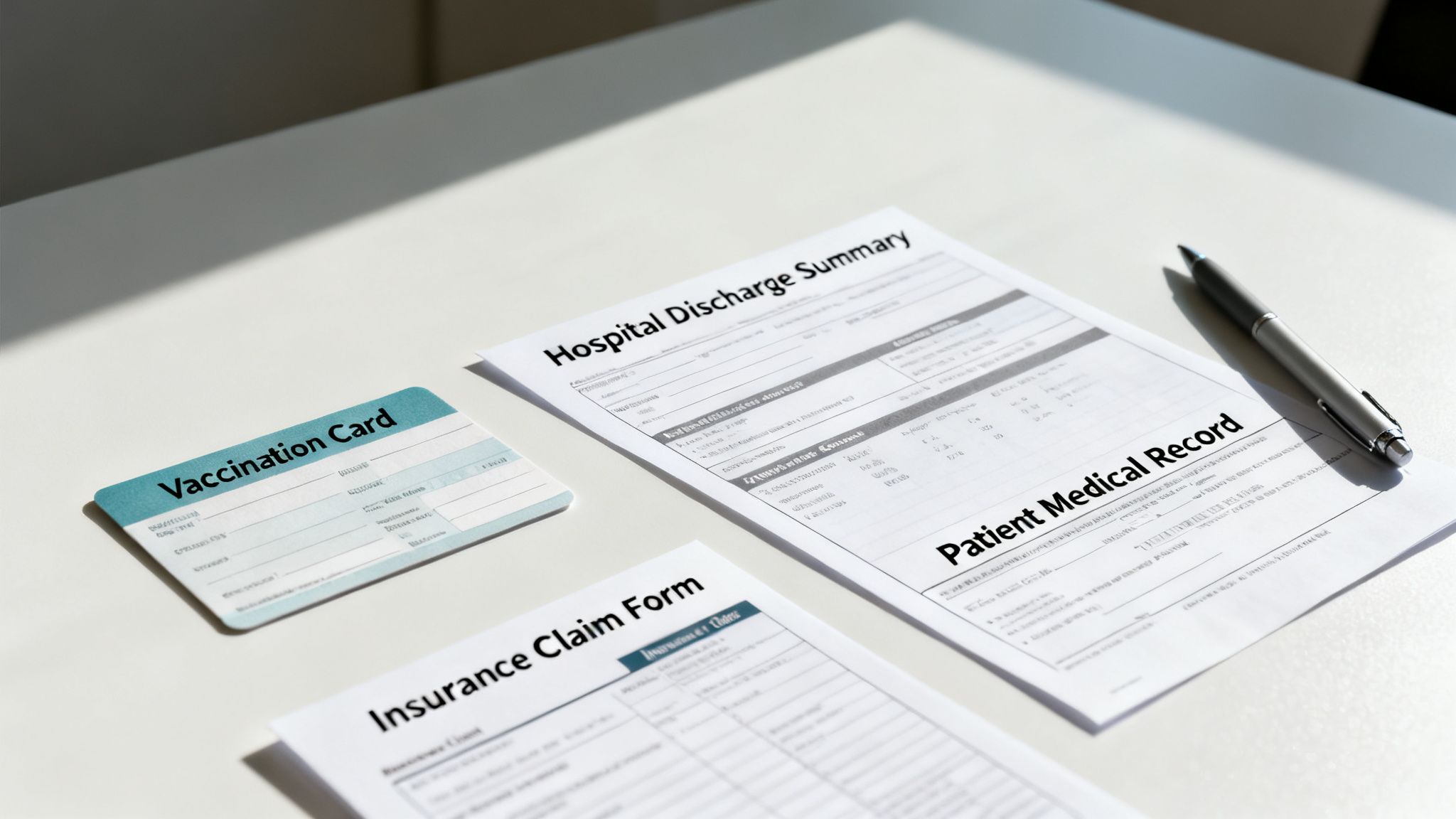
The need for translation of medical documents often pops up when you least expect it. One day you’re planning an immigration application, the next you're dealing with an unexpected medical issue while traveling abroad. Knowing which documents are commonly requested can save you a world of stress and prevent frustrating delays.
Think of these documents as your official health story. A precise, professional translation makes sure that story is told correctly, whether it’s being read by an immigration officer, an insurance adjuster, or a new doctor. Accuracy isn't just a detail—it's everything.
Patient Records and Medical Histories
This is the big one. Your complete patient record is the comprehensive story of your health, covering everything from past diagnoses and treatments to your doctor’s personal notes. It's often the most detailed and most frequently requested document. For example, when applying for a U.S. Green Card, USCIS requires a medical exam. If you have any pre-existing conditions, you’ll need to provide your complete medical history from your home country. A certified translation of these records is an absolute must to prove you meet the health standards. Our guide to certified translation services dives deeper into why this formal certification is so non-negotiable.
Hospital Discharge Summaries and Surgical Reports
If you're ever hospitalized, you'll leave with a discharge summary detailing your stay, the treatment you received, and crucial instructions for follow-up care. When this happens in a foreign country, getting that summary translated becomes your top priority. Let’s say you had an emergency appendectomy while vacationing in Spain. Once you’re back home, your primary care physician needs that Spanish discharge summary and the surgical report to understand exactly what happened. A professional translation ensures nothing is lost, which is critical for your continued care.
Vaccination and Immunization Records
These records are the gatekeepers for so many of life’s big steps: immigration, enrolling in school, and even certain jobs. They are the official proof that you're protected against specific diseases. Consider a student from Brazil hoping to attend a U.S. university. The university’s health services office will require their immunization records to be translated from Portuguese into English. Without a certified translation, they can't confirm compliance with vaccination policies, and the student can't register for classes.
Insurance Claim Forms and Medical Bills
Filing an insurance claim for healthcare you received overseas demands absolute precision. Your insurance company needs to know exactly what services were rendered and what they cost, all in a language they understand. If you needed emergency care in Japan, your U.S. insurance provider won't even look at the Japanese hospital bills until they're professionally translated into English. Clear, accurate translations are the only way to get your claim processed and reimbursed in a timely manner. For more on this process, see our breakdown of translation pricing and turnaround times.
Here’s a quick reference table showing which documents are typically needed for common situations.
Medical Documents and Their Common Uses for Translation
| Document Type | Common Use Case | Why Certification Is Critical |
|---|---|---|
| Patient Medical History | Immigration (e.g., USCIS Green Card), Specialist Consultations | Proves health admissibility and provides a complete background for new doctors. USCIS requires certified translations. |
| Hospital Discharge Summary | Insurance Claims, Continuity of Care with Primary Doctor | Explains procedures performed and follow-up needed. Insurance companies reject non-certified, unclear documents. |
| Surgical Report | Legal Cases (e.g., personal injury), Second Opinions | Provides a detailed, technical account of a procedure, which is essential evidence for legal and medical experts. |
| Vaccination/Immunization Record | University/School Enrollment, Immigration, Certain Employment | Confirms compliance with mandatory health requirements. Institutions will not accept uncertified translations. |
| Medical Bills/Invoices | Insurance Reimbursement, Tax Deductions | Justifies costs for services rendered. Insurers need a clear, official translation to process the claim. |
| Prescription Information | Traveling, Doctor Visits Abroad | Ensures a pharmacist or doctor understands the medication, dosage, and purpose to avoid dangerous interactions. |
Understanding these requirements ahead of time can make a world of difference, turning a potentially confusing process into a straightforward task.
Understanding Certified Translation for Medical Documents
When an official body like USCIS, a court, or an insurance company asks for a certified translation, they're not just asking for the words to be changed from one language to another. What they really need is a formal, legally-binding assurance that the translation is both complete and entirely accurate.
This assurance comes in the form of a Certificate of Translation Accuracy. It’s a separate statement signed by the translator or a representative from the translation company. Think of it as a professional's sworn oath on the quality of their work, confirming that the translated document is a faithful and precise mirror of the original. This certificate is what gives the document its official weight and is why certified translations are mandatory for most legal, immigration, and insurance claims.
Certified vs. Notarized: What’s the Difference?
It’s incredibly common for people to mix up "certified" and "notarized" translations, but they are fundamentally different things. Getting this wrong can lead to serious headaches and rejected documents.
- A certified translation is all about the quality and accuracy of the work. The signed certificate vouches for the content itself.
- A notarized translation only verifies the identity of the person who signed the certificate.
A notary public simply watches the translator sign the document and then applies their official stamp. They don't read the translation, they don't check it for accuracy, and they certainly don't have any medical expertise. Their seal just confirms a signature is legitimate. While some institutions may ask for notarization as an extra step, the core requirement is always the certification of accuracy.
The Real-World Impact of Certification
Let's say you're applying for a Green Card and need to submit your medical history. To save a bit of cash, you ask a bilingual friend to handle the translation. The problem? Without a formal Certificate of Translation Accuracy from a professional service, USCIS will almost certainly reject your application. That one simple mistake can set you back months and force you to start all over again.
The need for properly certified documents is only growing. Projections show that by 2026, the demand for healthcare translation will rise significantly, thanks to the global spread of telemedicine and digital health records. This trend underscores just how critical it is to use translation services that meet the strict standards of bodies like the FDA and USCIS. To dive deeper into the specifics, check out our in-depth article on what a certified translation is and why it’s so critical for your official needs.
How We Protect Your Sensitive Health Information Under HIPAA
When you hand over medical documents for translation, you're trusting us with some of your most private information. We get it. That's why protecting your data isn't just a policy—it’s the absolute foundation of our entire process for the translation of medical documents.
Your privacy is shielded by a critical U.S. law: the Health Insurance Portability and Accountability Act (HIPAA). You can think of HIPAA as a strict set of rules that legally binds healthcare providers and their partners, like us, to protect your sensitive health data. For us, compliance is a legal and ethical promise we take very seriously.
Our "Digital Armored Car" Approach
We treat your documents like they're in a digital armored car, from the moment you upload them to the second the final translation is securely delivered. Every single step is designed to lock down your information and ensure total confidentiality.
Here’s how we make that happen:
- Secure, Encrypted Platforms: When you upload a file, it travels through an encrypted connection, much like how banks protect your financial data online. This makes your files completely unreadable to anyone trying to intercept them.
- Strict Confidentiality Agreements: Every translator on our team signs a legally binding non-disclosure agreement (NDA). This obligates them to maintain absolute confidentiality. No exceptions.
- Controlled Access: Only the essential people working on your translation—the translator and a quality reviewer—can access your files. Your data is never shared or stored where it shouldn't be.
Handling sensitive medical documents means understanding the legal and ethical duties to protect patient data, which should always be outlined in a company's Privacy Policy.
Peace of Mind Is Part of the Service
At the end of the day, our security measures are all about giving you complete peace of mind. We believe the rigor we apply to protecting your privacy should match the precision we dedicate to the translation itself. From your first click to the final delivery, your sensitive health information is handled with the highest level of care and security. This commitment means you can focus on what matters—your immigration case, your academic application, or your health—without a second thought about your data's safety.
For more details on how we handle specific documents, take a look at our dedicated medical records translation services.
Your Medical Translation Journey: From Upload to Delivery
Getting your medical documents translated can feel like a daunting task, but knowing what to expect can make all the difference. We’ve broken down our process into a clear, secure, and predictable path to turn a potentially stressful job into a simple one. From the moment you send us your files to when you get the finished translation back, every single step is built around accuracy, security, and getting it done quickly.
It all starts with getting your documents ready. Think of it this way: the clearer the original, the cleaner the translation. Before you send anything over, make sure any scans or photos of your medical records are high-resolution. You want to avoid any blurry text or edges that get cut off. Once your files are good to go, the submission process is both simple and secure.
The Step-by-Step Translation Process
Our workflow isn’t just about getting the words right; it’s about handling your sensitive information with the respect it deserves, from start to finish.
Secure Document Upload: The first thing you'll do is upload your files (like PDFs or JPEGs) through our secure online portal. This isn't just a simple upload; it uses encryption to lock down your data from the very first click.
Expert Translator Assignment: As soon as we have your documents, we get to work. Your project is assigned to a professional translator who lives and breathes medical terminology. We hand-pick the right person for the job, matching an expert who has experience with your specific document type, whether it’s a hospital discharge summary or a detailed patient history for USCIS.
Rigorous Quality Review: Once the initial translation is done, it’s not finished. A second professional translator steps in to review the entire document. This peer-review step is absolutely critical for catching any subtle errors and ensuring the final text is 100% accurate and sounds right in the new language.
This diagram shows how we keep your information locked down at every stage of the process.
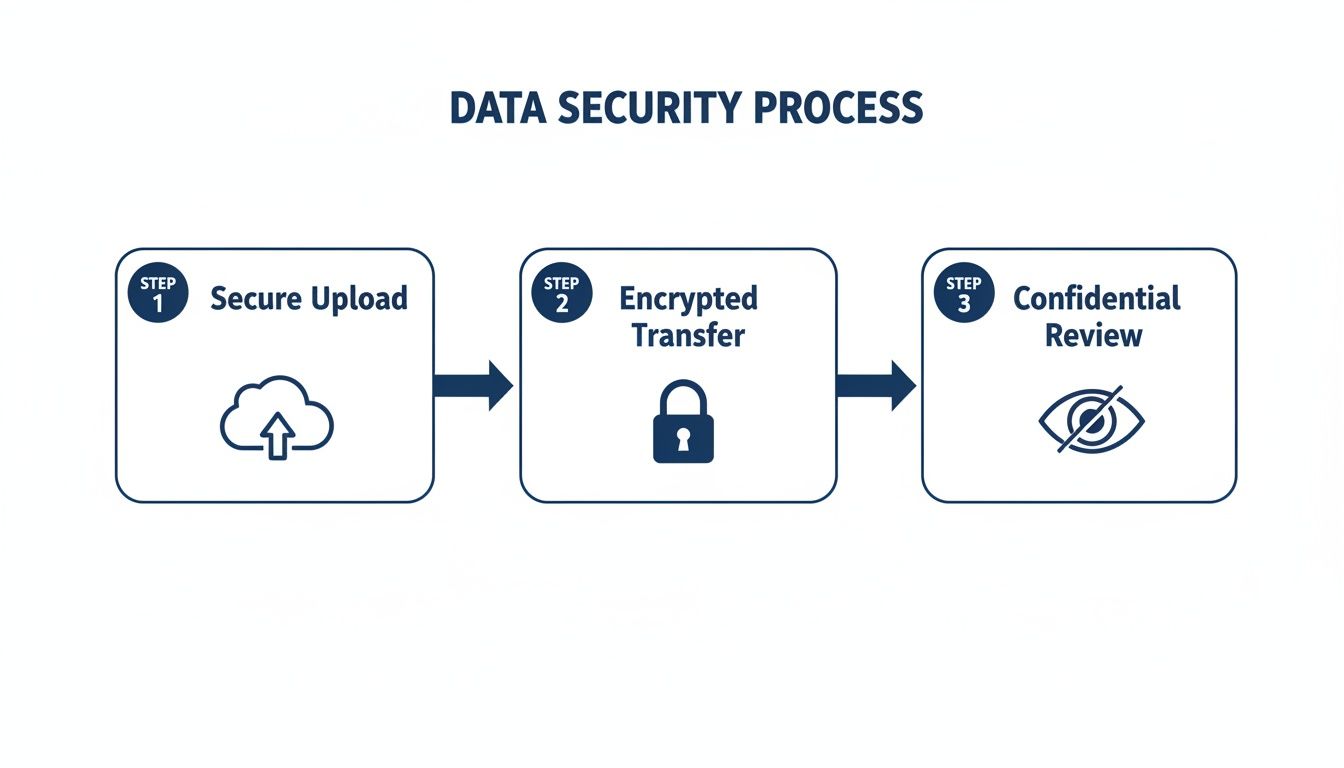
From secure uploads and encrypted transfers to a completely confidential review, your private data stays that way.
Turnaround Times and Delivery
We get it. Deadlines for immigration, legal cases, or medical appointments don't wait. That’s why we offer a standard 24-hour turnaround for documents of 1-3 pages. If you have a larger project or are in a real time crunch, we have expedited options available to make sure you hit your deadline without the extra stress. Your final certified translation will be delivered as a professional, print-ready PDF, which includes the signed Certificate of Translation Accuracy. It’s ready for immediate submission to any official organization, no extra steps needed. If you want to learn more, take a look at our guide on translation pricing and turnaround.
Choosing the Right Service for Your Medical Translation
Picking a translation service for something as sensitive as a medical document can be a bit nerve-wracking. A lot is riding on it, after all. The best partner isn't just someone who knows another language; they're providing a service built on precision, security, and a rock-solid guarantee that your documents will be accepted by places like USCIS.
Think of it like choosing a medical specialist. You wouldn't just pick anyone. You'd want someone with the right credentials, a transparent process, and a history of success. Your personal documents deserve that same level of care.
A Practical Checklist for Your Decision
Before you hand over your documents, it's worth asking a few direct questions. The answers will tell you a lot about who you're dealing with and whether you can trust them with this critical task.
Do you guarantee USCIS acceptance? For anything related to immigration, this is the first and most important question. A professional service will offer a 100% acceptance guarantee for their certified translation services. No ifs, ands, or buts.
Are you a member of the American Translators Association (ATA)? Membership in the ATA is a strong signal that a provider is serious about professional standards and ethics. It's a good indicator of their commitment to quality.
Is your pricing clear and upfront? You should never be surprised by hidden fees. Look for a simple, per-page rate so you know exactly what you’ll be paying from the start. You can get a sense of what that looks like by reviewing our own pricing and turnaround times.
How do you protect my data? Your medical history is incredibly private. Make sure the provider uses encrypted systems for uploads and has strict confidentiality agreements in place to keep your information safe, fully in line with HIPAA guidelines.
Red Flags to Watch For
Knowing what to look for is only half the battle; you also need to know what to avoid. Be very skeptical of any service that relies entirely on machine translation without a qualified human expert reviewing every word. AI tools are getting better, no doubt, but they still struggle with the subtle context and specific terminology found in medical records. A small mistake here could lead to a rejected application or, far worse, a dangerous misunderstanding of your health information.
The global life sciences translation market is expected to grow significantly by 2026. As this market growth analysis points out, while AI will play a role, human oversight will remain essential for context and accuracy, especially with patient histories. Cutting this corner can lead to serious penalties and even patient harm. By asking the right questions and keeping an eye out for these red flags, you can feel confident you're choosing a reliable partner for your translation of medical documents.
Your Medical Translation Questions, Answered
When you’re dealing with something as important as medical records, it’s natural to have questions. Let's walk through some of the most common ones we hear from clients, so you know exactly what to expect.
How Much Does It Cost to Translate My Medical Records?
We keep our pricing simple and transparent—no hidden fees, no surprises. The cost to translate medical documents is a flat $23 per page, with a page defined as up to 250 words.
What does that flat rate get you? Everything you need, all in one package:
- Expert Human Translation: A professional with experience in medical terminology will handle your documents.
- Certificate of Translation Accuracy: This is the signed statement that USCIS and other official bodies require, and it's included automatically.
- Preserved Formatting: We make sure the layout of your translated document mirrors the original as closely as possible.
You can get an instant quote on our website to see the final cost before you even place an order.
How Long Will It Take to Get My Translated Documents Back?
Time is often critical, especially when you're facing deadlines for immigration, legal cases, or medical appointments. For most standard documents between 1-3 pages, we offer a 24-hour turnaround. If you're in a real pinch or have a much larger set of records, just let us know. We have expedited options to make sure you get what you need, right when you need it.
Can I Just Use Google Translate for USCIS Medical Documents?
Absolutely not. This is a common question, but the answer is a firm "no." Official organizations like USCIS have a non-negotiable requirement for a certified translation. This means a professional human translator must do the work and provide a signed Certificate of Translation Accuracy, which a machine simply can't do. Beyond that, automated tools often make critical errors with complex medical terms, which would lead to an immediate rejection of your application. Stick with professional certified translation services—it's the only way to ensure acceptance.
What Kind of Files Can I Send for Translation?
We aim to make this part as hassle-free as possible. You can upload your documents in just about any common format.
We regularly work with:
- PDFs
- DOCX (Microsoft Word files)
- JPEG and PNG (even clear photos from your phone work great!)
As long as the text is legible, we can handle it. We’ll deliver your final, certified translation back to you as a high-quality PDF, ready to be printed or submitted digitally.
Ready to work with a translation partner you can count on? At TranslateDay, we provide accurate, secure, and prompt translations that are guaranteed to be accepted by USCIS and other major institutions.


