
When you're dealing with medical documents for official purposes, there's absolutely no room for error. A single mistake in translating medical terms can create a domino effect, impacting a patient's health, an immigration case with U.S. Citizenship and Immigration Services (USCIS), or even a court proceeding. This isn't your average translation job; it's a highly specialized field where precision is everything. This guide offers practical, actionable advice to help you navigate the process for your immigration, legal, or academic needs.
Why Precision Matters When Translating Medical Terms

Think of a surgeon performing a delicate procedure. Every movement is calculated, deliberate, and built on years of focused training. Translating a medical document requires that same level of accuracy. This is not a task for a general translator or a piece of software. It’s a high-stakes process where one wrong word can lead to serious consequences, especially when submitting documents for a Green Card application or an urgent legal case.
The High Stakes of Medical Language
A patient’s medical history, clinical trial results, or prescription instructions aren't just words on a page. They are critical records that directly shape health outcomes, legal verdicts, and official decisions.
For example, imagine Maria is applying for U.S. citizenship and needs to submit her medical examination records from her home country. A small error in translating a symptom on her medical report could raise red flags with USCIS, leading to long delays or even putting her entire application at risk. Similarly, a mistranslated dosage instruction could cause a serious medical crisis for a patient.
Before we dive deeper, it helps to be clear on the difference between transcription and translation. Transcription is about converting speech to text, but translation is about conveying meaning from one language to another—a task that becomes exponentially more difficult in a medical setting.
The challenges are huge and go way beyond just being bilingual. A professional medical translator has to wrestle with:
- Complex Terminology: Medical language is a minefield of eponyms (conditions named after people), acronyms, and hyper-specific terms that often have no direct equivalent in another language.
- Cryptic Abbreviations: A doctor's shorthand notes might use abbreviations that are common in one country but mean nothing—or worse, something entirely different—in another.
- Cultural Nuances: How someone describes pain or symptoms can be tied to their cultural background. A skilled translator needs to capture that subtle context, not just the literal words.
Certified Translation as the Gold Standard
For anything official—immigration, legal matters, or university applications—a certified translation is non-negotiable. This is much more than a simple translation; it's a formal process where a translator or translation agency provides a signed statement attesting to the accuracy and completeness of the translation. This statement, often called a Certificate of Accuracy, makes the translation official.
This signed certification acts as a seal of trust and legal validity. It tells institutions like USCIS that the information they’re looking at is dependable. It turns your foreign-language document into an official record you can submit with total confidence.
Getting these basics right is the first step. It ensures your medical documents get the professional care they demand, protecting both your health and your future.
The Hidden Dangers of Inaccurate Medical Translations
When it comes to medical translations, a small mistake is never just a typo. It’s a potential crisis. An inaccurate translation can set off a devastating chain reaction, affecting a person's health, legal rights, and ability to get through official red tape. It’s not just about a communication breakdown; we're talking about real-world harm.
Think about a patient from Brazil who needs surgery in the United States. His medical history, all in Portuguese, clearly states he has a severe allergy to "sulfonamidas" (sulfonamides). If a translator who's out of their depth—or worse, an automated tool—misses this or gets it wrong, the surgical team might use a sulfa-based antibiotic. The result? A life-threatening allergic reaction that was 100% preventable.
This isn't some made-up horror story. It shows exactly why asking a bilingual friend or plugging sensitive documents into a free online translator is a terrible gamble. The stakes are just too high. The risks generally fall into three big categories.
Patient Safety on the Line
The most immediate and frightening danger of a bad translation is the threat to patient care. A single word, translated incorrectly, can lead directly to physical harm.
- Incorrect Medication and Dosages: Imagine mistranslating dosage instructions from "once daily" to "three times a day." That simple error can cause an overdose. Confusing similar-sounding drug names is another common pitfall that can lead to a patient getting the wrong medicine.
- Misunderstood Diagnoses: If a pathology report describing a "benign" tumor gets translated as "malignant," it can trigger immense emotional distress and lead to aggressive, unnecessary treatments. The other way around is even more dangerous.
- Overlooked Allergies and Conditions: Just like in our sulfonamides example, failing to accurately translate a patient's known allergies, chronic conditions, or history of surgical complications can cause severe, sometimes fatal, reactions.
Legal and Financial Fallout
Beyond the clear health risks, translation errors can open up a world of legal and financial trouble for everyone involved. A flawed medical document can completely undermine someone's case in a variety of official situations.
Take a personal injury lawsuit, for example. An accurately translated expert medical report is the bedrock of proving the extent of the injuries. A shoddy translation can weaken the whole claim, possibly getting the case thrown out or resulting in a much smaller settlement. A simple language mistake suddenly becomes a major financial loss.
A mistranslated document isn't just inaccurate—it's invalid. For legal and insurance purposes, it can be viewed as unreliable evidence, jeopardizing your ability to receive compensation, prove a disability, or get coverage for a medical procedure.
Administrative and Immigration Roadblocks
For countless people, translating medical records is a non-negotiable step in their immigration process. U.S. Citizenship and Immigration Services (USCIS), for instance, demands certified translations of all foreign-language documents, which absolutely includes medical examination records.
An inaccurate or uncertified translation can bring an application to a dead stop. USCIS officers are trained to look for inconsistencies, and a poorly translated document is a massive red flag. This often leads to a Request for Evidence (RFE), which can add months of delays and a ton of stress to an already grueling process. In the worst-case scenario, it can even be a factor in an application's denial, forcing families to start from scratch. If you're going through this, you need to be aware of the common mistakes in medical translations that can derail your case.
All of these risks point to one critical truth: a professional, certified translation isn't an optional upgrade. It's an absolute necessity for ensuring safety, legal standing, and a smooth administrative journey.
Decoding the Complex Language of Medicine
Translating medical terms isn’t just about swapping words from one language to another; it's about accurately decoding a highly specialized language filled with nuance and risk. This complexity goes far beyond basic vocabulary, presenting unique challenges that can easily trip up even the most advanced automated software or an untrained translator.
Let's break down why this is such a minefield and why getting it right is non-negotiable.
Eponyms, Acronyms, and the Perils of "Literal"
One of the first hurdles you encounter is eponyms. These are the diseases, symptoms, or medical devices named after a person, like Alzheimer's disease or Parkinson's disease. The problem? They often don't have a direct, literal translation. In some countries, they might be known by a completely different name, and only a specialist would know the correct local equivalent.
Then there's the alphabet soup of acronyms and abbreviations. A simple term like "CBC" is instantly recognizable as a "Complete Blood Count" in a U.S. hospital. But take that same acronym to a clinic in Spain or Germany, and you’ll likely be met with blank stares. A professional translator has to know the standard, localized term to avoid potentially dangerous confusion.
The Devil Is in the Details: Subtle but Critical Differences
Beyond the obvious jargon, medical language is packed with terms that look similar but mean wildly different things. A translator has to grasp the clinical distinction between a "symptom" (what a patient feels, like nausea) and a "sign" (what a doctor observes, like a rash).
Mixing these up can completely alter the meaning of a medical report, derailing a diagnosis or treatment plan. It’s this level of precision that makes all the difference.
A professional medical translator doesn't just convert words—they translate clinical context. They have to understand the underlying medical concepts to make sure the final document is not only linguistically perfect but also medically sound.
As you can imagine, a single error can trigger a domino effect, leading to serious consequences.
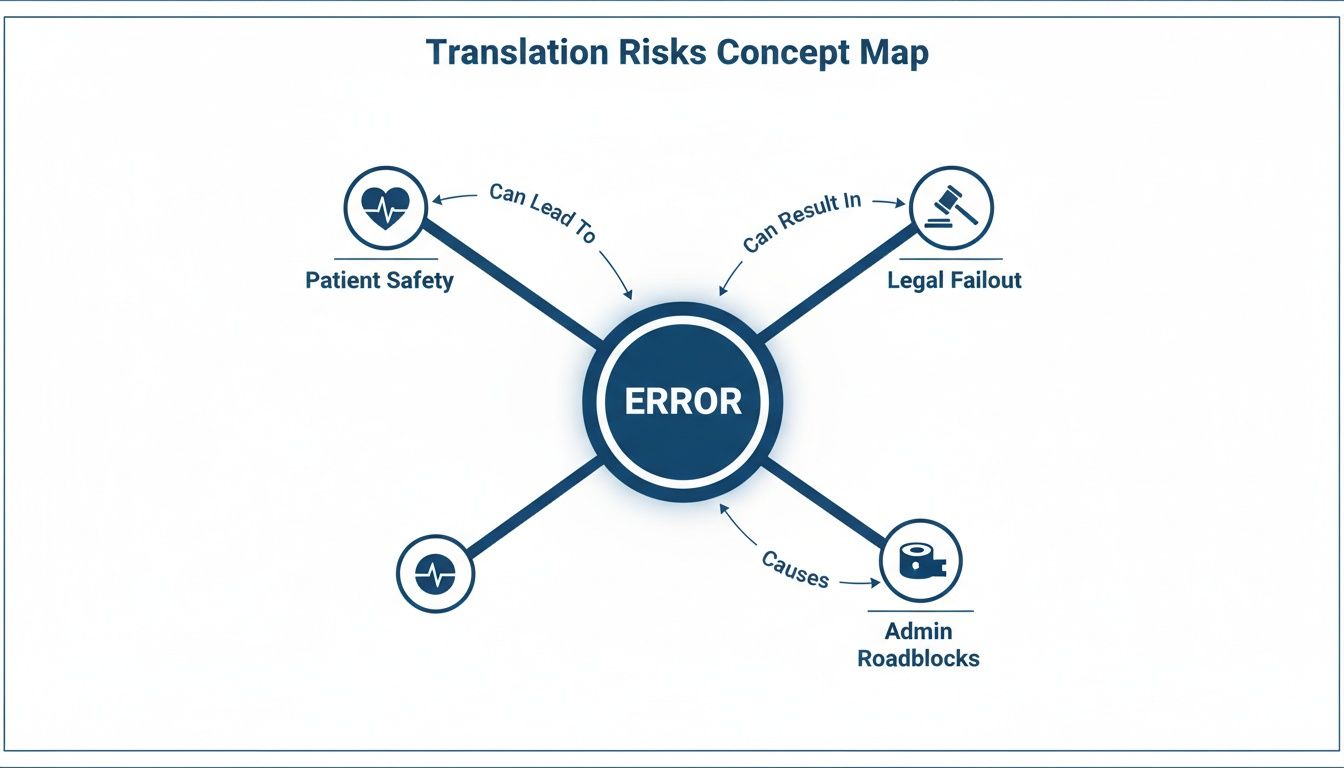
The key takeaway here is that these risks are all interconnected. A mistranslation that impacts patient safety will almost certainly create legal and administrative headaches down the line.
Navigating Cultural Context and Global Standards
It's not just the technical terms. Even the way a patient describes their pain is steeped in cultural context. A literal translation of "sharp, stabbing pain" might not carry the same clinical weight in another language where a different descriptor is more common. A truly skilled translator knows how to navigate these cultural nuances to convey the patient's experience accurately.
This is precisely why the technical translation segment of the life sciences market is booming. The demand for accurate, context-aware translation of complex medical documents is massive, especially since so many terms lack a direct one-to-one equivalent. This has led to the development of terminology standards like MedDRA (Medical Dictionary for Regulatory Activities), which are essential for maintaining consistency in global clinical trials and regulatory filings. You can find more insights on the life sciences translation market and its incredible growth.
To see these challenges in action, take a look at a few common pitfalls.
Common Pitfalls in Translating Medical Terms
This table shows just how easily things can go wrong with a literal or machine translation versus a professional, context-aware one.
| Medical Term | Potential Mistranslation (Literal/Machine) | Correct Professional Translation & Explanation |
|---|---|---|
| Eponym like "Parkinson's Disease" | "Enfermedad de Parkinson" (Direct) | "Parálisis Agitante" (Historical/Contextual). While the direct translation is common, the historical term "shaking palsy" has its own equivalent. A professional translator knows which term is most appropriate for the specific audience and context, ensuring clarity. |
| Acronym like "CBC" | "CBC" (Untranslated) or nonsensical literal translation | "Hemograma Completo". Translating the acronym literally is meaningless. An expert instantly recognizes "CBC" and provides the standard medical term used in the target language (e.g., Spanish), which is crucial for lab work. |
| Subtle Nuance between "Allergy" and "Intolerance" | Using the terms interchangeably | "Alergia" vs. "Intolerancia". Confusing an "allergy" (an immune system reaction) with an "intolerance" (often a digestive issue) is a critical clinical error. A professional understands this distinction and uses the precise term to prevent misdiagnosis. |
As you can see, navigating these intricacies requires a deep, layered understanding of medicine, culture, and language. It's a highly specialized skill that ensures every single word in your medical document is accurate, clear, and safe.
Understanding Certified Medical Translations for Official Use
When you need to hand over a medical document for any official reason, a simple word-for-word translation just won't cut it. The organization on the receiving end—be it a university, a courtroom, or a government agency like USCIS—needs ironclad proof that the translation is both accurate and complete. This is exactly why a certified translation is so critical.
A certified translation isn't just the translated text. It comes with a signed statement from the translator or translation agency, often called a "Certificate of Translation Accuracy." This certificate is their professional pledge, confirming the translation is a faithful and correct version of the original document. It’s a formal stamp of quality and accountability.
This certification is what gives your translated medical records their official weight.
What Certification Really Means for You
Think of that Certificate of Translation Accuracy as a professional's seal of approval. It signals to anyone reading the document that a qualified expert handled the translation and stands firmly behind their work. This is absolutely crucial in high-stakes situations where a single word can change everything.
For instance, when applying for a Green Card, USCIS has a strict requirement for certified translations of all foreign-language documents, including things like medical exam reports. That certification tells the immigration officer the information they're reading is reliable, which can help you avoid frustrating delays or a dreaded Request for Evidence (RFE).
In short, certification elevates a simple translation into an official document that can hold its own against strict legal and administrative scrutiny. It erases any doubt about the document's integrity and ensures it gets accepted without a hitch.
Is a Notarized Translation Different?
You might also come across the term "notarized translation," and it's easy to get them mixed up. It's important to know they serve two very different purposes, and you don't always need notarization.
- Certified Translation: This is all about the accuracy of the translation. The translator or company signs off, vouching for the quality of their work.
- Notarized Translation: This is about verifying the identity of the person who signed the certificate. A Notary Public watches them sign and adds an official stamp, confirming the signer is who they claim to be. The notary isn't checking the translation itself.
While some institutions might ask for notarization for certain legal or academic paperwork, USCIS typically doesn't require it for immigration filings. A standard certified translation is usually all you need. You can explore more about the specific certifications and standards in medical translation to see what’s right for your case.
When Is a Certified Medical Translation Required?
Certification is non-negotiable anytime your medical documents are being used for official, legal, or administrative reasons. Trying to get by with an informal or uncertified translation is a huge gamble that often leads to rejection and expensive delays.
Here are the most common situations where you absolutely need one:
- Immigration Applications: When you're submitting foreign medical exam records to USCIS for a visa, Green Card, or citizenship.
- Legal Proceedings: If you're using medical reports as evidence in a personal injury lawsuit, a disability claim, or a workers' compensation case.
- Academic Admissions: For international students submitting health records or vaccination histories to a U.S. university or college.
- Healthcare Continuity: When sharing a patient's medical history from another country with a new doctor or hospital in the U.S. to ensure they get safe and effective care.
In every one of these scenarios, a professional certified translation service provides the assurance you need that your documents are accurate, trustworthy, and ready for official review.
How to Prepare Your Medical Documents for Translation
Getting your medical records translated doesn’t need to be a headache. A little bit of prep work on your end can make the entire process faster, smoother, and far more accurate. Think of it this way: when you help your translator, you’re really helping yourself get the highest quality result. This is especially true for critical documents going to USCIS or a new medical specialist.
It’s just like getting ready for a doctor’s visit. The more organized you are and the clearer the information you provide, the better the outcome. The same principle applies here.
Start with High-Quality Digital Copies
The single most important step you can take is to provide a clear, readable source document. It’s the foundation for everything that follows.
- Scan with Care: If you can, use a scanner to create high-resolution digital copies. If a phone is your only option, lay the document on a flat surface with plenty of light. Make sure there are no shadows, and check that the image is sharp, not blurry.
- Check for Completeness: Quickly flip through the pages to ensure no text is cut off. It's easy to miss important details in the margins, headers, or footers.
- Decipher Handwritten Notes: We all know about doctors' handwriting. If there are crucial handwritten notes, do your best to make them out. Providing a typed-out clarification for any hard-to-read words can prevent a major misunderstanding down the line.
A fuzzy or incomplete document is a huge obstacle. Sending a crystal-clear copy is the best way to guarantee your translation is spot-on.
Provide Essential Context and Information
A great translator doesn't just swap words; they convey the meaning behind them. You can help them nail the context by providing a few key details upfront.
First, always state the purpose of the translation. Is it for a USCIS application? An insurance claim? Or for a consultation with a new doctor? This context is crucial because it tells the translator which specific terminology and formatting to use for the intended audience.
A translation for a USCIS officer, for instance, has different structural requirements than a document meant for a clinical trial in another country. Specifying the purpose ensures the final document is fit for its intended use and won't be rejected.
It’s also a good idea to provide a simple glossary if your records have unique names, specific locations, or uncommon abbreviations. Just a short list with the correct spellings ensures everything stays consistent, especially if you have multiple documents.
Understand the Process and Timelines
Finally, knowing what to expect regarding confidentiality and turnaround times can make the whole experience feel much more manageable. Any credible translation service will operate under a strict confidentiality agreement to protect your personal health information. Your data should always be handled securely, from the moment you upload it to the final delivery.
As for timing, a standard one-to-three-page document—like a birth certificate or vaccination record—can often be translated and certified within 24 hours. Longer, more complex files like a full patient history or a detailed surgical report will naturally take a bit more time. To get a better idea, you can learn more about the different medical translation requirements and categories.
By putting in a little effort to prepare your documents, you’re paving the way for a smooth process that results in the accurate, reliable translation you need.
How We Guarantee Accuracy and Confidentiality in Your Translation
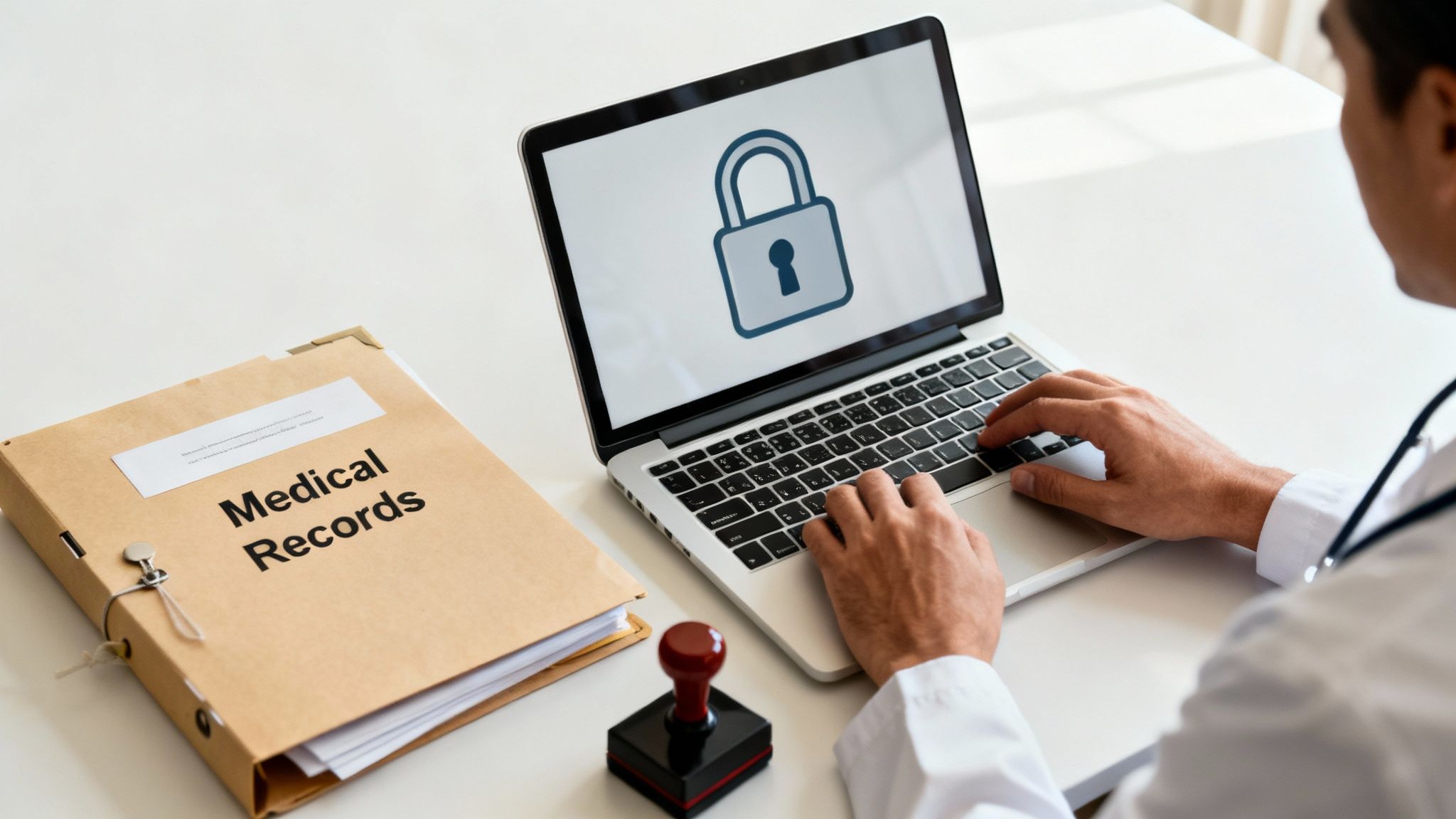
Now that you've seen just how high the stakes are when translating medical terms, the next logical step is finding a translation partner you can trust. This isn't just about finding someone who speaks two languages; it's about securing accuracy, confidentiality, and complete reliability. Your sensitive health information and official documents are far too important to risk on an automated tool.
At TranslateDay, we believe this work demands a human touch. That's why every single translation is handled by a professional translator who has real-world experience in the medical field. We never use machine translation for certified documents because we understand that precision and nuance are everything. It’s all backed by a rigorous quality assurance workflow to double-check every detail before it gets to you.
This commitment to human expertise is exactly why the demand for skilled medical translation services is on the rise. In fact, the growth of the medical translation industry globally shows a clear trend: the world recognizes that when it comes to health, there’s no room for error.
Our Commitment to Your Privacy
Let's be clear: medical records are deeply personal. Protecting your confidentiality isn't just a policy for us—it's the foundation of our service. From the second you upload a file to our secure platform, your data is shielded by strict privacy protocols and end-to-end encryption.
Our entire process is built to give you peace of mind. We handle your documents with the same level of discretion and care you’d expect from your own doctor.
A Process Built for Speed and Reliability
We get it. Deadlines for USCIS applications, specialist appointments, or legal matters are often non-negotiable. Our workflow is designed from the ground up to deliver fast, precise translations without ever cutting corners on quality.
- Fast Turnaround: For documents up to 3 pages, we offer a 24-hour turnaround, helping you meet even the tightest deadlines.
- Expert Translators: We match your documents with translators who have proven expertise in medical terminology.
- Simple Online Process: Just upload your files from any device. You’ll receive a certified, ready-to-use translation back, hassle-free.
We believe in total transparency. You can see a full breakdown of our structured approach on our pricing and turnaround information page.
Guaranteed USCIS Acceptance: If you're submitting documents for immigration, this is a big one. We guarantee that USCIS will accept our certified translations. This promise removes a huge piece of the stress from your application puzzle, so you can submit your paperwork with confidence.
Ultimately, our goal is to be the dependable solution you need for your most critical documents. We blend specialized human expertise with a secure, efficient process to deliver the accurate and timely translations you require.
Your Top Medical Translation Questions, Answered
When you're dealing with medical documents, a lot of practical questions come up. We get it. To help you navigate the process with confidence, here are some straightforward answers to the questions we hear most often.
Can My Bilingual Friend Just Translate My Medical Records for USCIS?
It's a tempting thought, for sure, but the answer is a firm no. USCIS and other official bodies require a translation that is not only accurate but also completely impartial. A friend or family member, no matter how fluent, has a built-in conflict of interest.
Think of it this way: official agencies need to trust that the translation is a faithful, unbiased copy of the original. A certified translation from a neutral professional provides that guarantee, preventing the risk of your application being rejected or delayed over a questionable translation.
What's the Real Difference Between Certified and Notarized Translations?
This is a common source of confusion, but the distinction is actually quite simple. It all comes down to what is being verified.
- A certified translation is all about accuracy. The translator or agency provides a signed statement (a "Certificate of Accuracy") swearing that the translation is a true and complete rendering of the original document. This is what USCIS and most other institutions care about.
- A notarized translation is all about identity. A Notary Public simply watches the translator sign the certificate and then stamps it to confirm the signer's identity. The notary doesn't speak the language or check the quality of the translation itself.
For nearly all immigration and medical purposes in the United States, certification is the non-negotiable part.
How Long Will It Take to Get My Medical Document Translated?
This really depends on how long and complex your document is. For shorter, more standard records—think vaccination cards or a single-page doctor's note (usually 1-3 pages)—a professional service can often turn around a certified translation in as little as 24 hours.
Of course, a multi-page hospital record or a dense surgical report will take more time. The key is ensuring absolute accuracy, which can't be rushed. For a precise estimate, it’s always best to check the service's pricing and turnaround information.
What Should I Expect to Pay for Medical Document Translation?
Most professional services charge either per word or, more commonly, a flat rate per page. The industry standard for a "page" is typically up to 250 words. This model is great because it gives you a clear, upfront cost with no surprises.
For instance, a one-page medical report will have one fixed price. This simple, transparent approach takes the guesswork out of budgeting and helps you plan accordingly for your application.
At TranslateDay, we bring the expertise, speed, and reliability you need to handle your medical translations correctly. Our team of expert human translators ensures your documents are precise, certified, and ready for any official submission.
Request a certified translation today and move forward with total peace of mind.