
Translating medical terms isn't like translating a menu; a single mistake in a patient’s file, a clinical trial document, or a medical report for a USCIS application can have serious consequences. We're talking about misdiagnoses, legal trouble, or a rejected immigration file. Medical translation is a specialized field that demands deep knowledge of complex terms, regulatory rules, and cultural nuances, especially when official documents are involved. This guide provides practical, actionable steps for anyone needing a certified medical translation for immigration, legal, or academic purposes.
Why Getting Medical Terminology Right Is a Big Deal
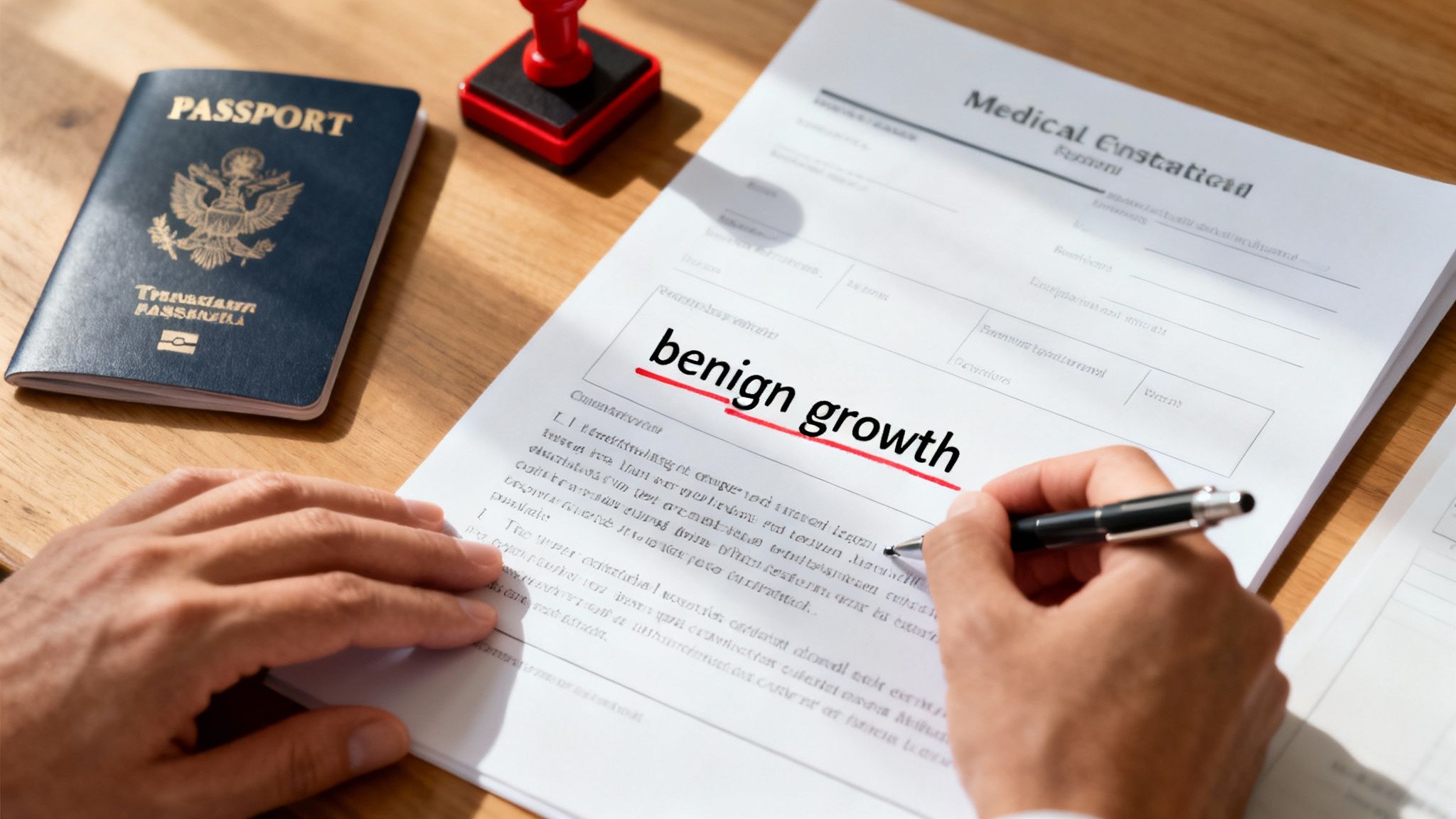
Let's paint a picture. Maria is applying for her Green Card and needs to submit her medical history to U.S. Citizenship and Immigration Services (USCIS), the government agency that handles immigration cases. Her doctor back home noted a "crecimiento benigno"—a completely harmless "benign growth." But a quick, cheap translation turns that into "malignant tumor." Suddenly, her application has a massive red flag. Maria now faces invasive questions, stressful delays, and possibly even a denial—all because of one poorly translated phrase. This isn't just a "what if" scenario; it’s a real risk when the stakes are this high.
Patient Safety and Getting the Right Treatment
Above all else, accuracy is about patient safety. A mistranslated prescription could easily switch "take once daily" to "take every hour," putting someone at risk of an overdose. Getting a patient’s allergy information wrong could be fatal. When translations are precise, doctors can see the full picture of a patient's health history, which is essential for making the right diagnosis and creating an effective treatment plan.
Inaccurate translations can quickly spiral into serious problems:
- Wrong Diagnoses: Mixing up similar-sounding but opposite conditions like "hypertension" (high blood pressure) and "hypotension" (low blood pressure) can lead to completely wrong treatments.
- Incorrect Medical Care: An error in translating medication dosage or frequency can cause direct harm.
- Harmful Drug Reactions: Failing to accurately list a patient's allergies or current medications can result in dangerous, even life-threatening, interactions.
Legal and Immigration Roadblocks
For official agencies like USCIS, accuracy isn't just a suggestion—it's a legal requirement. If you’re applying for a Green Card, visa, or citizenship, your medical exam records are a key part of your file. If those documents aren't in English, USCIS demands a certified translation.
A certified translation is more than just a simple word-for-word document. It’s an official record that includes a signed statement from the translator or translation company. This statement, often called a "Certificate of Accuracy," confirms that the translation is a complete and true copy of the original.
A certified translation serves as an official guarantee that the medical information you've submitted is a true and faithful copy of the original. Without it, USCIS will reject your documents flat out, bringing your entire application to a grinding halt.
This is why turning to a professional service is so important. They provide that essential guarantee, shielding you from expensive delays and legal headaches. Their expertise ensures that every single term, from a simple vaccination record to a complex diagnosis, is translated correctly. As technology evolves, new tools are emerging to help bridge these language gaps; you can see how Multilingual AI in healthcare is playing a role.
In the end, whether you're preparing for a doctor's appointment or an immigration interview, professional translation is the only reliable path to clarity, compliance, and peace of mind.
Navigating the Complex World of Medical Language
Translating medical documents isn't like translating a novel or a business email. It's a high-stakes discipline where a single slip-up can have serious consequences. Think of a medical translator less as a linguist and more as a detective—they have to understand the science, the patient's story, and the cultural context behind every single word. This kind of specialized work is a minefield of unique challenges that most other translators never face.
The need for this expertise is skyrocketing. The global market for medical translation services is on a steep climb, projected to hit USD 6.42 billion by 2028, with a strong growth rate of 6.5% annually since 2021. This isn't just a business trend; it’s driven by real-world needs. For example, the rise of medical tourism means more patients are crossing borders for affordable care. Without a perfectly translated medical history, a routine procedure in another country could quickly become a communication nightmare.
The Problem with Medical Shorthand: Abbreviations and Acronyms
One of the first major hurdles is the alphabet soup of abbreviations and acronyms that doctors and nurses use every day. While this shorthand makes communication faster in a clinical setting, it’s a huge headache for translation. A single acronym can mean completely different things depending on the specialty or even the specific hospital.
Take "CBC." Most people in healthcare know it as a "complete blood count." But in another chart, it might stand for "chronic back pain." A generalist translator could easily grab the wrong meaning, creating a patient record that is dangerously misleading.
It gets even trickier with terms that have no direct counterpart in another language. "NPO," a common instruction from the Latin nil per os ("nothing by mouth"), needs to be translated into a clear, unmissable command that a nurse or patient in another country will understand instantly. This isn't just about language skills; it's about deep medical know-how.
Eponyms and the Global Pharmacy Puzzle
Another layer of complexity comes from eponyms—medical terms named after people, like Parkinson's disease or the Foley catheter. While some of these are recognized worldwide, many are not. A skilled translator needs to know when to keep the eponym and when to swap it for the descriptive medical term used in the target country.
Brand-name drugs are a similar puzzle. A medication sold under one name in the United States could have a completely different name somewhere else, even with the exact same active ingredient.
For instance, the pain reliever most Americans know as Tylenol is sold as Paracetamol in the UK and many other countries. A literal translation of "Tylenol" would mean nothing to a pharmacist in London. It could cause serious confusion about a patient's medication history.
A professional translator will identify the active ingredient (acetaminophen) and use the correct brand or generic name for the target region. This simple step is crucial for preventing medication errors.
Why Context and Culture Are Non-Negotiable
Medical language is more than just technical jargon; it's steeped in culture. The way patients describe pain, their views on mental health, or their comfort level with certain treatments can vary wildly around the world. A direct, word-for-word translation might be technically accurate but culturally tone-deaf or just plain confusing.
Think about a mental health questionnaire. In cultures where mental illness carries a heavy stigma, patients often describe their symptoms in physical terms—headaches, stomach pains, or fatigue—instead of emotional ones. A culturally fluent translator picks up on these nuances, ensuring the final document accurately portrays the patient's condition in a way the new doctor will understand. This is vital for a correct diagnosis.
Beyond just the words on the page, the entire system of medical classification presents a challenge. Staying current with complex systems requires ongoing education, like understanding ICD-10 coding updates, which is essential for accurate medical records and billing.
Getting the Numbers Right: Units of Measurement
Finally, precision in medical translation comes down to the numbers. Different countries use different systems for just about everything, from body temperature (Celsius vs. Fahrenheit) to blood sugar levels (mg/dL vs. mmol/L).
A translator's job isn't done after they've handled the words in a lab report; they must also convert every measurement accurately. Forgetting to convert a blood glucose reading from the U.S. standard of mg/dL to the international standard of mmol/L could lead a doctor to dangerously misinterpret the result. This painstaking attention to detail isn’t optional—it's a fundamental part of keeping patients safe.
Common Medical Terms And Their Translation Pitfalls
You really start to see why professional expertise is so critical in medical translation when you look at the errors in action. It's one thing to talk about the risks in theory, but it’s another thing entirely to see how one seemingly small mistake can completely warp a diagnosis or a set of patient instructions. This is exactly where the gap between a quick, automated translation and a professional, human-powered one becomes a serious matter of safety and legal standing.
Automated tools, for all their speed, just can’t grasp the nuances. They stumble over context, regional dialects, and the subtle but critical differences between terms that look similar on the surface. What you often get is a literal, word-for-word output that might seem correct at a glance but is medically nonsensical or, even worse, dangerous. The language of medicine is incredibly complex, as this chart helps to illustrate.
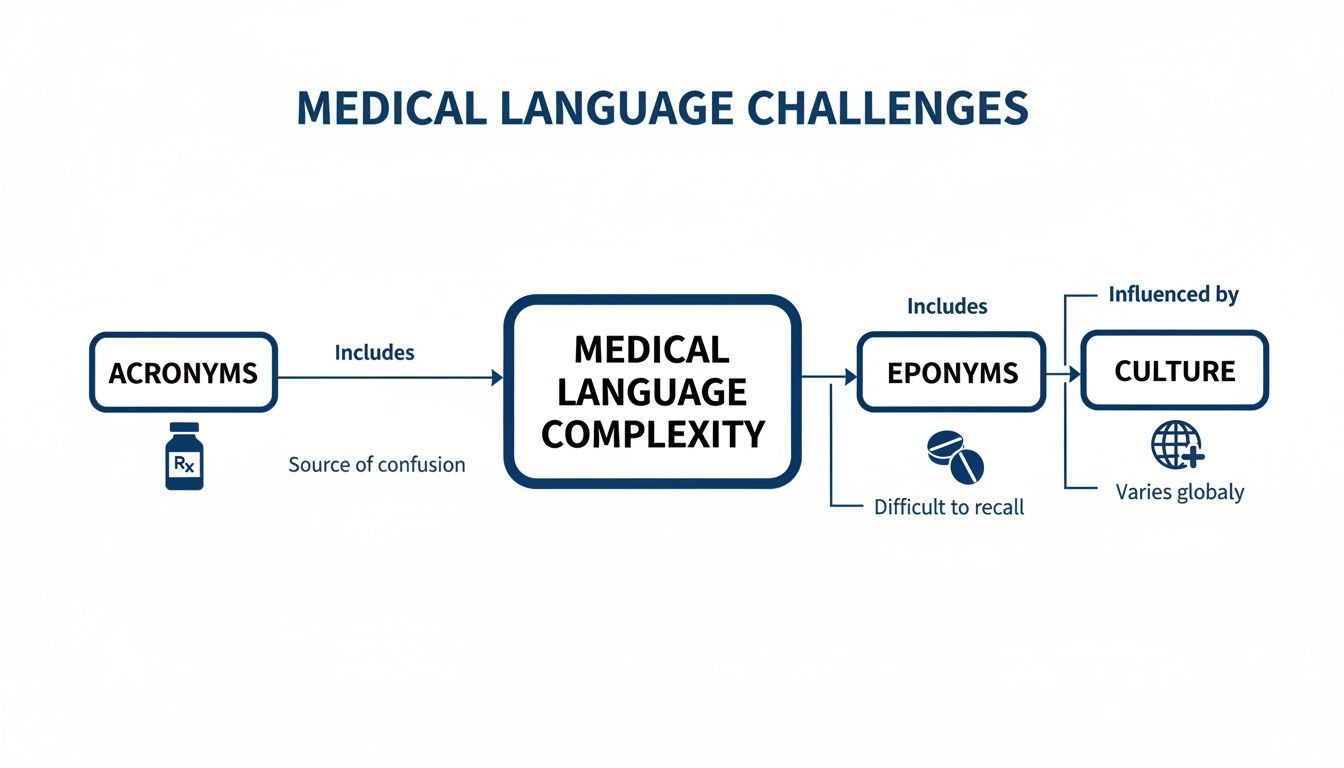
This visual guide shows how acronyms, eponyms, and cultural norms are all tangled together, creating hurdles that demand far more than a simple language conversion. For anyone submitting medical documents for official review, relying on a system that can't navigate these challenges is a huge gamble. If you want to dig deeper into these limitations, exploring the differences between machine translation vs. human translation offers some crucial perspective.
Common Translation Errors To Avoid
To make these risks more tangible, let's walk through some real-world examples. Picture this: you’re submitting a medical report to USCIS or an insurance company. A single translation error can set off a chain reaction of problems, from denied claims to serious questions about your health and history.
The table below is a snapshot of just how easily things can go wrong. It highlights common medical terms, their frequent mistranslations by automated tools or non-specialists, and the correct professional alternative. This is where you see just how much context matters.
| English Medical Term | Common Mistranslation (Literal/Machine) | Correct Professional Translation (Example) | Why It Matters (The Risk of Error) |
|---|---|---|---|
| Benign Tumor | Tumor Benigno (Direct but can lack reassuring context) | Crecimiento no canceroso (Non-cancerous growth) | The word "tumor" alone can cause instant alarm. The professional translation immediately clarifies its non-threatening nature, preventing panic or red flags in an immigration medical review. |
| Hypertension | Hipertensión (Correct, but context is key) | Presión arterial alta (High blood pressure) | While technically accurate, using the common layperson's term is often clearer and safer for patient instructions. It ensures they understand the condition without needing to know medical jargon. |
| Mild Heart Attack | Ataque al corazón suave (Soft heart attack) | Infarto de miocardio leve (Mild myocardial infarction) | The literal translation sounds nonsensical and dangerously downplays the event's seriousness. The correct term precisely describes the medical event's severity, ensuring proper follow-up care. |
| Drug History | Historia de drogas (History of illegal drugs) | Historial de medicamentos (Medication history) | This is a critical—and common—error. The mistranslation implies illegal substance abuse, which could have severe legal and immigration consequences. The correct term refers strictly to prescribed medications. |
| Take Once Daily | Tomar una vez al día (Correct, but can be ambiguous) | Tomar un comprimido cada 24 horas (Take one tablet every 24 hours) | Precision is everything in dosage. Specifying "every 24 hours" instead of "daily" eliminates any doubt and prevents a patient from taking doses too close together, which is a major safety risk. |
As you can see, a simple translation isn't so simple after all. These examples show that the goal isn't just to find an equivalent word, but to convey the correct medical meaning.
Why These Mistakes Happen
These kinds of errors don't occur because one language is "wrong." They happen because medical communication is a specialized field that demands much more than just swapping words from a dictionary. A true professional understands:
- Medical Concepts: A translator must know the difference between a condition and its symptoms, or a procedure and a diagnosis.
- Audience Awareness: Is the translation for a doctor or a patient? The language, tone, and terminology have to be adjusted for who will be reading it.
- Regulatory Standards: Official documents for bodies like USCIS have strict requirements for both terminology and certification that must be met.
When you submit a document for a Green Card application, academic credentialing, or a legal case, you are trusting its accuracy with your future. A professional certified translation is your safeguard, ensuring every term is conveyed correctly and protecting you from the costly, stressful consequences of a preventable mistake.
When You Absolutely Need A Certified Medical Translation
So, how do you know when a standard translation just won’t cut it? It’s a crucial question. Submitting the wrong type of document can get you an instant rejection from government agencies, universities, and courts.
A certified translation isn't just about switching languages; it’s a formal, legally recognized document. It comes with a signed statement from the translator or translation agency—often called a "Certificate of Accuracy"—that vouches for the translation being a complete and faithful version of the original. Think of it as a guarantee of quality and accountability for any official use.
Immigration and USCIS Requirements
If you're dealing with the U.S. immigration system, this is a big one. U.S. Citizenship and Immigration Services (USCIS) is crystal clear on its policy: any document not in English must come with a full English translation that is certified as accurate. There’s no wiggle room here.
This rule applies to all sorts of medical documents you might need:
- Medical Examination Records: A must-have for Green Card applications (Form I-485) to show you meet health standards.
- Vaccination Records: You'll need these to prove you've had the required shots.
- Psychiatric Evaluations: These are sometimes required for specific asylum or waiver cases.
- Hospital Records: Often used to back up claims for medical waivers or other petitions.
Handing over a non-certified translation is one of the easiest ways to get a Request for Evidence (RFE), which can stall your case for months. USCIS needs to be absolutely sure your medical history is presented accurately and completely.
A USCIS officer isn’t a doctor or a linguist. The certification is their proof that a qualified professional stands behind the translation, giving them the confidence to move your case forward.
Legal Proceedings and Insurance Claims
The need for certified documents doesn’t stop at immigration. In the legal and insurance worlds, they're just as critical. Imagine a personal injury lawsuit where the key medical evidence comes from another country. To be admissible in court, that hospital report or disability assessment must have a certified translation.
The same goes for insurance. If you're filing a health or travel insurance claim for treatment you got overseas, the company will demand certified translations of your medical bills and reports. It’s their way of preventing fraud and confirming the treatments before cutting a check.
Academic and Professional Licensing
The stakes for precise translation of medical terms are incredibly high when it comes to education and professional licensing.
Here are a few real-world examples:
- A doctor trained abroad who wants to get a medical license in the U.S. will need certified translations of their medical school transcripts.
- A scientist submitting a clinical study to an international journal needs a perfect translation so their research is taken seriously.
- A student applying to an American medical school might need their health and immunization records translated and certified as part of the admission process.
In these fields, getting the medical terminology right is everything—it’s the bedrock of professional credibility. If you're trying to figure out what level of certification you need, you can learn more about the differences between a certified and notarized translation to make sure you get it right the first time.
Your Step-By-Step Guide To Getting Medical Documents Translated
Trying to get a medical document translated can feel overwhelming, especially when you’re up against a tight deadline for a USCIS application or have an urgent healthcare need. But it doesn't have to be a stressful process. With a clear plan, you can tackle the steps confidently and make sure you end up with an accurate, certified document that’s ready to go.
This guide breaks down the entire process into simple, manageable phases, so you know exactly what to do.
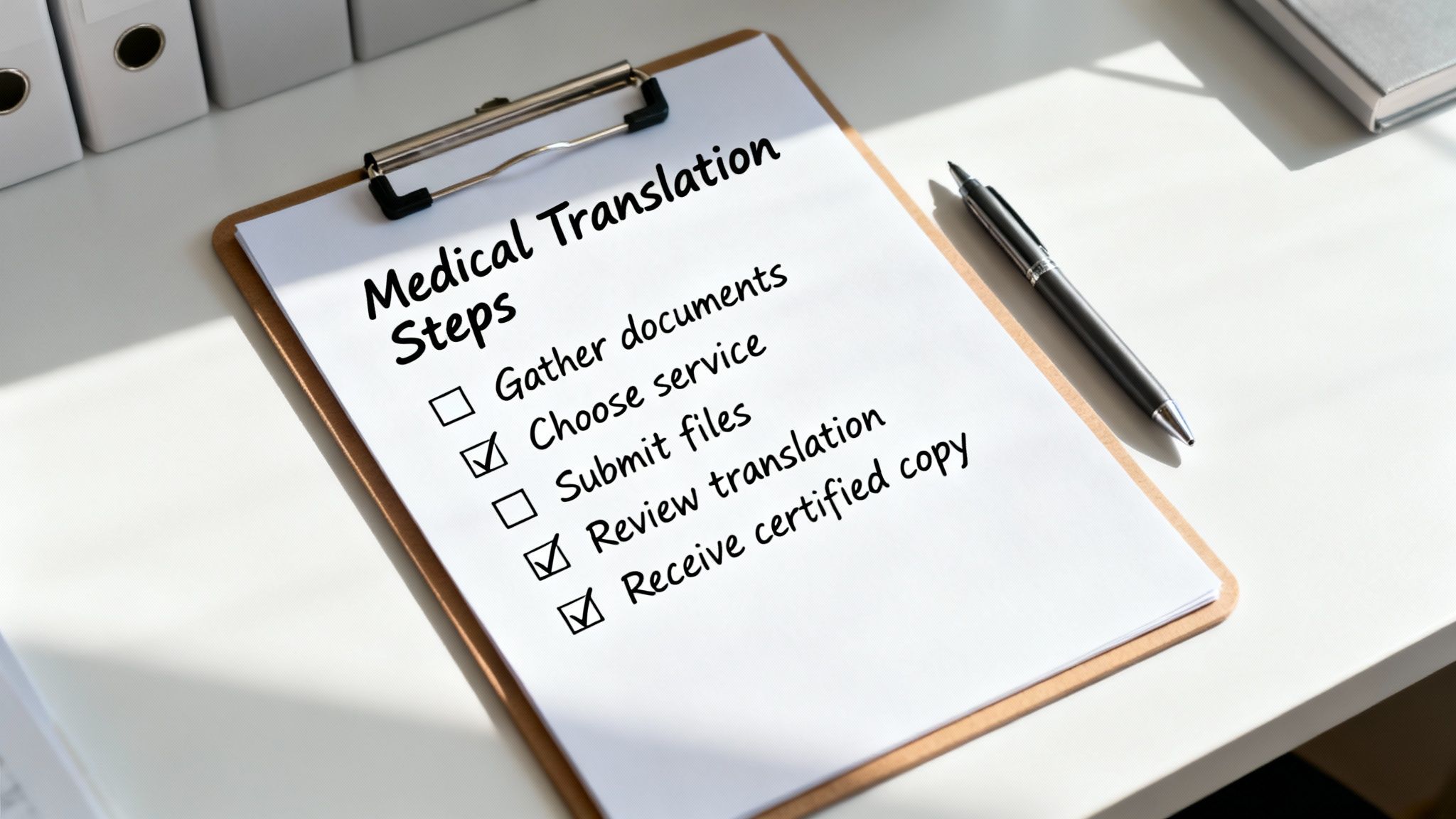
Step 1: Gather And Prepare Your Documents
Before you even start looking for a translator, the first thing to do is get all your paperwork in order. Make sure you have the complete, final versions of your medical records, lab results, or hospital discharge summaries. If you can, provide high-quality scans or digital copies—blurry or cut-off text is a surefire way to cause errors and delays.
Here’s a quick checklist to help you prepare:
- Clarity: Is all the text legible? This is especially important for handwritten notes from doctors.
- Completeness: Double-check that you haven't missed any pages from the report.
- Context: If you know of any tricky abbreviations or specific terms, jot them down. You can pass these notes along to your translation provider to avoid any confusion.
Step 2: Choose A Reputable Translation Service
This is easily the most critical part of the process. You need a provider who specializes in certified translations, particularly for official uses like immigration or legal matters. Don't just fall for the cheapest or fastest option you find online without doing a little digging first.
Look for these key signs of a trustworthy service:
- USCIS Acceptance Guarantee: For any immigration-related documents, this is an absolute must. The service has to stand by its translations and guarantee USCIS will accept them.
- Confidentiality Policy: Your medical records contain sensitive information. The provider should have a clear privacy policy and use a secure platform for uploading files.
- Human Translators: Make sure the service uses real, professional human translators. Automated software just can't handle the complex nuances of medical language.
The demand for accurate translation of medical terms has exploded. During the 2020 COVID-19 pandemic, the need for translating healthcare information shot up by 49%, revealing some serious gaps in global health communication. Here in the U.S., where immigrants file millions of USCIS applications each year, this spike led to major backlogs for documents without proper certification. It really highlights the value of services that guarantee acceptance and offer a quick turnaround. You can discover more about how global events impact translation needs on Redokun.com.
Step 3: Submit Files And Get A Quote
Once you’ve picked a service, it's time to send in your documents for a quote. A good company will offer transparent pricing, usually per page or per word, with no hidden fees. All you should have to do is upload your prepared files through their secure online portal.
The quote you receive should clearly spell out:
- The total cost.
- The estimated turnaround time.
- A confirmation of certification.
This is also your chance to confirm the service can hit your deadline. If you have a lot of complex files, getting familiar with the general process for official document translation can help you know what to expect.
Step 4: Review And Receive Your Certified Documents
After you give the quote the green light, a professional translator gets to work. For standard documents of around 1-3 pages, many services can turn things around in just 24 hours. When it's done, you’ll get the translated document back, along with a signed Certificate of Accuracy.
Before you send it off, take a minute to look over the translated document. Check that all the names, dates, and numbers are correct. Even if you don't speak the language, you can still spot-check these critical details to make sure everything is perfect.
With your certified translation in hand, you’re all set. You can now submit it to USCIS, a university, a court, or any other official body, feeling completely confident in its accuracy and compliance.
Your Top Questions About Medical Translation Answered
When you're dealing with medical documents, you can't afford any confusion. Let's clear up some of the most common questions people have about getting their records translated, so you can move forward with confidence.
Can I Just Use Google Translate For My Medical Records For USCIS?
That’s a definite no. While online tools are great for getting the gist of a webpage, they are absolutely not suitable for official documents submitted to USCIS.
USCIS requires a certified translation. This isn't just a translated document; it's a package that includes a signed statement from a human translator or a professional agency. This "Certificate of Accuracy" is their sworn promise that the translation is complete and true to the original.
Automated tools can't provide this certificate. Worse, they often stumble over complex translation medical terms, which can lead to dangerous inaccuracies, rejection of your application, or frustrating delays. Stick with a professional certified translation service that guarantees USCIS acceptance.
How Do You Keep My Personal Health Information Private?
Your privacy is our top priority. Any reputable translation service treats your sensitive health information with the highest level of security, building confidentiality into every step of the process.
Here’s how it typically works:
- Secure Systems: Documents are uploaded and handled through encrypted platforms to lock out unauthorized access.
- Binding Agreements: Every professional translator signs a strict Non-Disclosure Agreement (NDA), making them legally responsible for keeping your information confidential.
- Need-to-Know Access: Only the carefully vetted translator working on your file can ever see your documents.
Always check for a clear privacy policy on a service's website before you upload anything. A professional agency knows how critical it is to protect your data and will be transparent about their security measures. For a deeper look at our own safeguards, visit our FAQ page.
Protecting your personal health information is not just a best practice; it's a core responsibility. A trustworthy translation partner will be transparent about their security measures, giving you complete peace of mind.
What’s The Difference Between A Certified And Notarized Translation?
This is a very common question, and the answer is simpler than you might think.
A certified translation comes with a signed "Certificate of Accuracy" from the translator or translation company. This letter states that the translation is a complete and accurate reflection of the original document. For official purposes in the U.S., including USCIS, this is almost always the standard you need to meet.
A notarized translation adds an extra layer. A notary public witnesses the signature on the Certificate of Accuracy, verifying the identity of the person who signed it. The key thing to remember is that the notary is not checking the translation itself. While some foreign governments or specific legal cases might ask for notarization, it’s rarely required for U.S. immigration or most medical translation needs.
How Long Will It Take To Get My Medical Record Translated?
The time it takes really depends on how long and complex your document is, and whether it’s easy to read.
But here’s a general guide:
- Short Documents (1-3 pages): Things like vaccination records, a brief doctor's note, or simple lab results can often be translated and certified within 24 hours.
- Longer Files: A complete patient history, a detailed surgical report, or a thick stack of hospital records will naturally take more time.
A good agency will give you a firm delivery date right when they give you a quote. If you're on a tight deadline for a USCIS filing or an upcoming appointment, many services also offer rush options to make sure you get what you need, when you need it.
At TranslateDay, we know that when it comes to medical documents, there's no room for error. Our team of expert human translators provides certified translations that are accurate, fast, and completely confidential, so you can submit them with total confidence.


