
Getting your sensitive health information translated—like a doctor's diagnosis, vaccination records, or a detailed hospital report—is a critical step for immigration, legal cases, or continuing medical care. This process, known as medical document translation, is far more than just swapping words from one language to another. The goal is to capture the exact meaning with absolute precision, because this is the information that doctors, immigration officials, and insurance providers depend on to make life-changing decisions. A tiny error isn't just a typo; it can lead to a dangerous medical misinterpretation or cause an immediate rejection of your official application.
The Critical Need for Precision in Medical Translation
Imagine you're applying for a Green Card and need to submit your child's vaccination history for a USCIS green card application. Or perhaps you're helping a loved one move to the U.S. and need to provide their full medical background to a new healthcare provider. What happens if a crucial detail—like a severe allergy to penicillin or a history of heart disease—gets lost in translation? The consequences can range from a denied immigration case and months of delays to a life-threatening medical emergency.
This is exactly why professional medical document translation isn't just a "nice-to-have"—it's an absolute must.
This isn't like translating a blog post. Medical language is a world of its own, filled with complex, specialized terminology where one misplaced word can completely alter a diagnosis. Relying on a bilingual friend or a free online tool is a huge gamble. For instance, a simple tool might translate "hypertension" into a general term for "stress," completely missing the critical medical diagnosis of high blood pressure. These options almost always fail to capture the specific, nuanced language required for official settings.
Why Accuracy Is Everything
When you're dealing with official bodies like USCIS (U.S. Citizenship and Immigration Services), insurance companies, or healthcare providers, they need translations that are not just fluent but technically perfect. A certified translation provides a legal guarantee that the translated document is a faithful and exact reflection of the original.
The stakes have never been higher. The demand for translation services in the healthcare sector recently jumped by an astonishing 49%, a surge fueled by global health events and increasingly strict regulations. The entire medical translation market is growing quickly, driven by everything from international patient care and telemedicine to the stringent rules governing clinical trials. You can explore the latest translation statistics and market growth to see just how significant this trend is.
Accuracy in medical translation is about safety, compliance, and opportunity. Whether you need documents for immigration, continuing medical care, or legal purposes, a professional translation builds trust and helps you avoid expensive, frustrating delays. It makes sure that language is a bridge, not a barrier.
Common Medical Documents That Require Translation
Some documents carry more weight than others and demand the highest standard of accuracy. The table below highlights common medical records that require professional translation and why getting it right is so important.
| Document Type | Common Use Case | Why Accuracy Is Critical |
|---|---|---|
| Patient Medical Histories | Continuing medical care in a new country | Allows new doctors to understand pre-existing conditions and allergies for safe treatment. |
| Vaccination Records | Immigration (USCIS I-693), school/university enrollment | Proof of immunization is often a legal requirement; errors can lead to application denial. |
| Hospital Discharge Summaries | Insurance claims, follow-up care with a new provider | Contains a full overview of a diagnosis, treatment, and ongoing care needs. |
| Informed Consent Forms | Clinical trials, major surgical procedures | Ensures a patient legally understands all risks and benefits before giving consent. |
| Lab Reports & Test Results | Specialist consultations, second opinions | Specific values, units, and terminology must be perfectly translated for a correct diagnosis. |
| Prescription Information | Traveling abroad, filling medication in a new country | Incorrect dosage or drug names can have life-threatening consequences. |
Any document that impacts your health, legal status, or financial well-being must be handled with professional care. These examples show how closely your medical information is tied to major life events.
Understanding Certified Medical Translations
So, what exactly makes a medical translation “certified,” and why is it so important? Think of it this way: a standard translation is like jotting down notes for yourself—it gets the general idea across but has no official standing. A certified translation, on the other hand, is a formal document designed to be accepted by official institutions like USCIS or a university.
It’s not just about a fancy stamp. A certified translation includes a signed statement from the translator or translation company, called a "Certificate of Translation Accuracy." This certificate is their professional promise that the translation is a complete and word-for-word match of the original document.
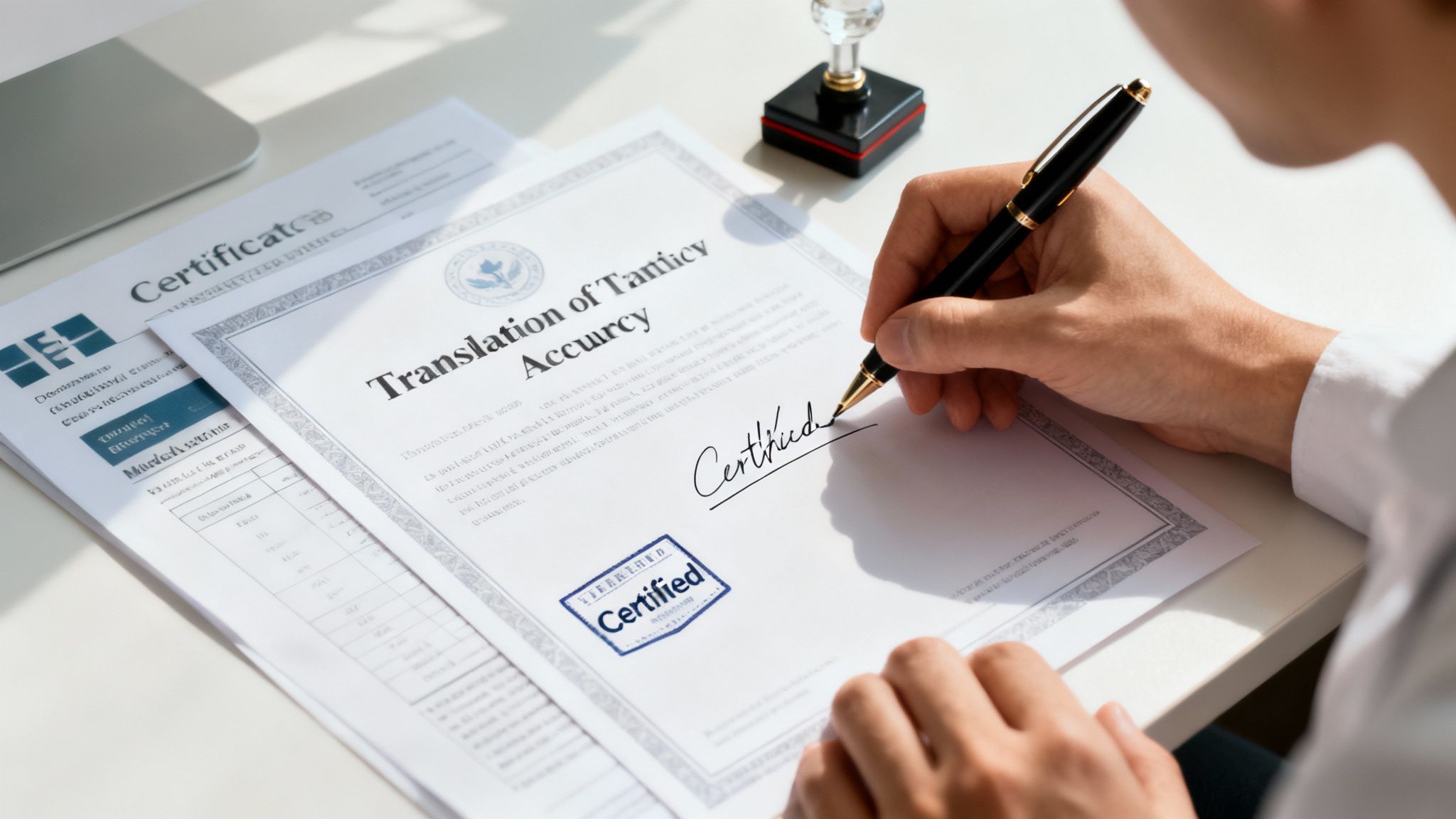
That signed certificate is what organizations look for as undeniable proof that the translation is authentic and can be trusted.
Certified vs. Notarized vs. Sworn Translations
When you start looking for official translations, you'll run into a few different terms. Here’s a simple breakdown to help you understand what you need.
- Certified Translation: This is the standard for most official purposes in the United States, especially for USCIS. It's a high-quality translation that comes with a signed statement from the provider vouching for its accuracy.
- Notarized Translation: This adds an extra layer of verification. A Notary Public (an official who witnesses signatures) watches the translator sign the certificate and then adds their own seal, or notary stamp. The notary isn't checking the translation; they are simply confirming the identity of the person who signed it. Some legal or academic institutions may require this.
- Sworn Translation: This is common in many countries outside the U.S. A "sworn translator" is someone officially approved by their government (like a court) to produce legally binding translations. Their work is automatically considered official in that country.
For the vast majority of cases in the U.S., including immigration and medical claims, a certified translation is exactly what you need. It’s always smart to double-check the specific requirements of the institution you're submitting documents to.
Why Certification Is a Must-Have for Medical Records
When dealing with something as critical as your medical history, certification is your guarantee of precision and accountability. It proves that a qualified linguist who understands complex medical terminology handled your private information correctly.
This professional assurance is vital when you submit documents for:
- Immigration Medical Exams (USCIS): To accurately show vaccination records or explain pre-existing conditions.
- Seeking Medical Care Abroad: To give your new doctor a crystal-clear picture of your health history.
- Filing Insurance Claims: To provide unambiguous proof of medical treatments received in another country.
Knowing the difference between translation types ensures you get exactly what you need without a hitch. You can learn more about the specific certifications and standards in the translation of medical documents to ensure your paperwork is always compliant.
Getting Medical Translations Right for USCIS
When you're dealing with U.S. Citizenship and Immigration Services (USCIS), there’s no room for error. They have strict rules for translated documents, and a single mistake with your medical records can trigger a Request for Evidence (RFE)—a major roadblock that can delay your immigration case for months. Getting it perfect the first time is essential.
For example, Maria was applying for her Green Card and submitted a translation of her son's medical records. The translator missed a small stamp on the original document. USCIS issued an RFE for an "incomplete translation," delaying her entire case by four months until she could provide a new, fully compliant version.
The All-Important Certification Statement
Every translated medical document you submit to USCIS must be backed by a formal certification. This isn't just a quick note; it's a signed declaration from the translator or translation company that includes three specific things:
- A statement of accuracy: A clear sentence confirming the translation is a true and correct version of the source document.
- The translator’s details: Their full name, signature, and contact information.
- The date: The exact date the certification was signed.
One rule catches many people by surprise: you cannot translate your own documents for USCIS, even if you are fluent in both languages. USCIS requires an impartial third party to avoid any conflict of interest. This also means you can't ask a family member to do it.
Keeping Your Private Information Safe
Your medical records are deeply personal. It's crucial that your data is handled securely. Any reputable translation service must be HIPAA-compliant. The Health Insurance Portability and Accountability Act (HIPAA) is a U.S. federal law that sets the standard for protecting sensitive patient information. This means the service you choose must use secure, encrypted systems for file transfers and require translators to sign strict non-disclosure agreements (NDAs). For a deeper dive, review this detailed guide on USCIS translation requirements.
As healthcare evolves, translation trends for 2026 show a mix of AI for speed and human experts for the final precision needed to meet standards like HIPAA and ISO 17100. While 73% of businesses use AI in some capacity, only 19% trust it for sensitive, regulated work like medical communications. This highlights why human-certified services remain essential for guaranteeing accuracy and confidentiality. You can learn more about these healthcare translation trends on Suma Latam.
How To Get Your Medical Documents Translated: A Step-by-Step Guide
Getting your medical records translated doesn't have to be complicated. Here’s a simple, step-by-step process to get you from a stack of papers to a submission-ready translation.
Step 1: Gather and Prepare Your Documents
First, collect every medical document you need translated, such as vaccination records, lab results, or hospital discharge papers. Don't forget any pages with official stamps, signatures, or notes in the margins. Then, create clear digital copies. A scanner is best, but a well-lit photo from your smartphone can also work. The quality of the translation depends on how legible your original document is.
Step 2: Choose a Reputable Translation Provider
Next, find a professional translation service that specializes in medical document translation and guarantees USCIS acceptance. A good provider will be upfront about their pricing, often a flat rate per page, and should have a proven track record. Check their pricing and turnaround options to get a clear idea of what to expect. Remember, it must be an impartial, professional third party.
Step 3: Upload Securely and Get a Quote
Upload your digital files to the provider’s secure online portal. A trustworthy service will use an encrypted platform to protect your sensitive health information and maintain HIPAA compliance. After uploading, you should receive an instant quote based on the number of pages, so you know the exact cost before you commit.
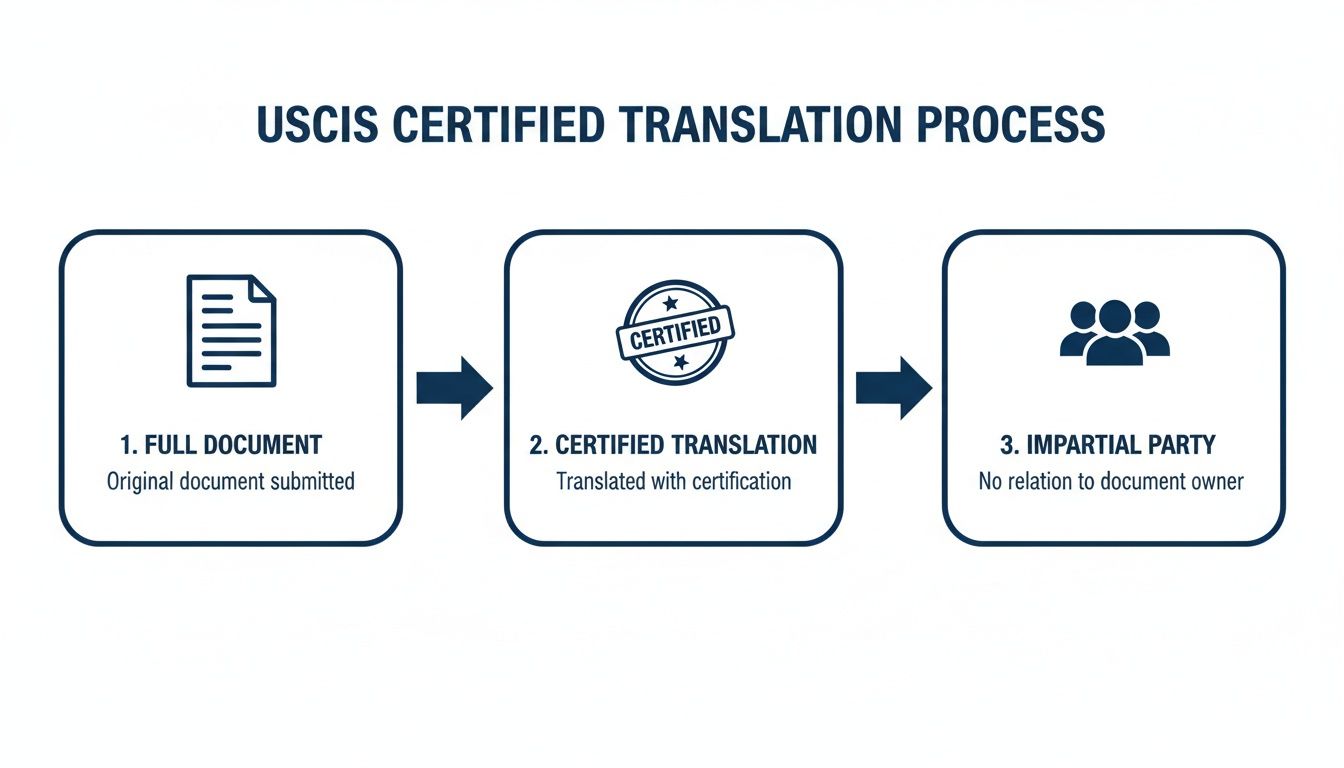
This simple process ensures your translation is complete, certified, and handled by an impartial professional.
Step 4: Review and Submit Your Translation
Once you approve the quote, an expert linguist gets to work. You'll soon receive the final certified translation by email, which will include the signed Certificate of Translation Accuracy. Before submitting, do a quick final check to confirm that all names, dates, and locations match the original. Then, submit both the certified translation and a copy of the original document to the requesting authority.
Decoding Costs, Turnaround Times, and Data Security
When you need a medical document translation, three practical questions immediately come to mind: How much will it cost? How quickly can I get it? And is my private information safe?
Unpacking Pricing and Turnaround Times
For official documents, pricing should be transparent. A clear, per-page rate is the most straightforward approach, avoiding the confusion of hourly billing or hidden fees. Turnaround time depends on the document's complexity. Standard documents like vaccination records can often be translated and certified within 24 hours. A dense, multi-page hospital report will naturally take longer.
Your goal is to find the right balance of speed, cost, and quality. Rushing a complex medical translation can lead to mistakes, so partnering with a service that sets realistic deadlines is always the safer choice.
The need for these services is growing. The interpreting and translation market is expected to reach USD 17.2 billion by 2029. This boom underscores how critical reliable, HIPAA-compliant translation workflows are, especially since automated tools still can't match the accuracy of a human expert.
Choosing the Right Service Level
Not all translation services are the same. Here’s a quick comparison to help you choose wisely.
Translation Service Level Comparison
| Feature | Free Machine Translation (e.g., Google Translate) | Freelance Translator | Professional Agency (e.g., TranslateDay) |
|---|---|---|---|
| Accuracy | Highly variable; prone to errors in medical terms. | Can be high, but quality is unverified. | High, with multi-step quality checks. |
| Certification | Not available. Cannot be used for official purposes. | May offer, but often not widely accepted. | Guaranteed acceptance for legal & official use. |
| HIPAA Compliance | No. Data is not secure or confidential. | Unlikely; no formal security protocols. | Yes. Strict data protection and NDAs. |
| Turnaround Time | Instant, but not reliable for accuracy. | Varies widely; no guaranteed delivery. | Fast and reliable, often within 24 hours. |
| Cost | Free. | Lower cost, but you get what you pay for. | Competitive per-page pricing. |
| Best For | Getting the general gist of non-sensitive text. | Informal, low-stakes translation projects. | Official use: immigration, legal, insurance, etc. |
While free tools are tempting, they are completely unsuitable for official medical documents where precision and privacy are paramount. A professional agency provides the accountability you need.
Your Data Security Is Non-Negotiable
Your medical records contain highly private information. That's why HIPAA compliance is a strict legal requirement. A trustworthy translation service must have strong security measures, including:
- Encrypted File Transfers: Protecting your documents from the moment you upload them.
- Strict NDAs: Legally binding all linguists to confidentiality.
- Secure Platforms: Shielding your information from potential threats.
The standards for protecting medical data are rigorous. For example, learning about HIPAA compliance in healthcare faxing shows the level of care required. When you explore our medical records translation services, you'll see we prioritize protecting your information with that same diligence.
Common Mistakes That Invalidate Your Translation
An avoidable mistake on a medical translation can lead to months of delays or an outright rejection. Knowing these common pitfalls is the best way to ensure a smooth process.
The most frequent mistake? Asking a friend or family member to do the translation. While it might seem like a way to save money, official bodies like USCIS see this as a conflict of interest and will reject the document. They require an impartial, professional third party.
Using Uncertified or Automated Tools
Another surefire way to get your documents rejected is by using free online tools like Google Translate. These tools cannot grasp the nuances of complex medical terminology and, most importantly, cannot provide the Certificate of Translation Accuracy that every official institution demands.
Incomplete Translations and Missing Certifications
An official translation must be a complete copy of the original. This means everything—stamps, seals, signatures, and handwritten notes—must be translated. A common error is translating only the main text, which USCIS will flag as an incomplete document. Equally problematic is forgetting to include the signed certification statement, which gives the translation its legal standing.
When USCIS issues a Request for Evidence (RFE), it’s often due to one of these mistakes. An RFE stops the clock on your case and can add months to your wait time.
The only way to avoid these issues is to work with a professional service that specializes in certified translation. They know the rules and deliver compliant documents from the start. You can learn more about our process and typical turnaround times, or explore our specific medical records translation services for complex cases.
Your Final Questions About Medical Document Translation
Here are answers to a few more common questions to ensure you have all the information you need.
Do I Have to Mail My Original Medical Records for Translation?
No, you should never mail your original documents. A professional translation service works with high-quality digital copies (scans or clear photos). This keeps your originals safe, speeds up the process, and gives the translator a perfectly clear file to work with.
Is a Certified Medical Translation Valid Forever?
Yes. A certified translation is a permanent, official record of the original document at the time of translation. As long as the source document remains unchanged, the certified translation that accompanies it has no expiration date and can be reused for different applications.
What if I Find a Mistake in My Translated Document?
Reputable translation services have a quality assurance process to prevent errors. However, on the rare occasion that something slips through, a trustworthy provider will stand by their work. If you spot an error, they should offer revisions free of charge to ensure the document is 100% correct.
At TranslateDay, we make getting an accurate, secure, and compliant medical translation simple. Our expert linguists are ready to handle your sensitive documents with the precision and confidentiality they demand.
Get an instant quote and you can have your certified translation back in as little as 24 hours.


