
When you need to submit documents for immigration, academic applications, or legal matters, a transcript translation service is often a critical step. Simply put, this service converts your official academic records from one language into another, but it does so in a very specific way. The final document includes a certified translation, which is a formal statement guaranteeing its accuracy. This certification is what makes the translation official and acceptable to authorities like U.S. Citizenship and Immigration Services (USCIS), universities, and courts.
This guide will walk you through everything you need to know, using real-world examples to explain the process, clarify requirements, and help you avoid common mistakes. Whether you're applying for a Green Card, enrolling in a U.S. university, or preparing legal paperwork, getting your translation right the first time is essential.
Why Your Future Depends on an Accurate Transcript Translation
Let's look at a common scenario. Imagine Maria, an engineer from Brazil, is applying for a U.S. visa. Her academic transcript, detailing years of hard work, is in Portuguese. A quick translation from an online tool or a bilingual friend won't be accepted by USCIS.
Maria needs a professional transcript translation service that provides a certified translation. This means the translated document must be an exact, word-for-word copy of the original, accompanied by a signed statement from the translation provider. This statement, or "Certificate of Accuracy," confirms the translation is complete and accurate and that the translator is competent in both languages. Without this formal certification, Maria's application could be delayed by a Request for Evidence (RFE) or even rejected, jeopardizing her immigration plans. It’s not just about changing words; it's about meeting strict legal standards.
The Growing Need for Official Translations
Before we dive deeper, it's important to understand the fundamental difference between transcription and translation. Transcription converts audio into text, while translation converts text from one language to another. For official documents, we are focused exclusively on translation.
The demand for these services is rising. As of 2025, the global translation market is valued at over USD 956.81 billion and is expected to reach USD 1.18 trillion by 2035. This growth reflects how many people, like Maria, are pursuing international opportunities and require their official documents, such as academic transcripts and civil certificates, to be professionally translated.
More Than Just Grades on a Page
Your academic transcript tells the official story of your educational journey. A professional translation ensures every detail is preserved accurately.
- Course Titles: A course like "Cálculo Integral" from a Spanish transcript is translated precisely as "Integral Calculus," preventing any confusion.
- Grading Systems: A translator's role is to convey the meaning of your grades. A "10" in Mexico is not the same as an "A" in the U.S. A professional service will often include a note to explain these differences for evaluation bodies.
- Official Marks and Seals: Every stamp, signature, and seal on the original document is noted in the translation. This is crucial for proving the document's authenticity.
A professional transcript translation service makes your academic history understandable and acceptable to official institutions. For anyone submitting foreign records for immigration, education, or professional licensing in the U.S., using an expert in official document translation is the first and most important step.
Understanding Certified Versus Notarized Translations
When dealing with official documents like academic transcripts, you will often encounter the terms "certified translation" and "notarized translation." They sound similar but serve very different purposes. Confusing them is a common and costly mistake that can lead to rejected applications for university admission or immigration.
Understanding the difference is key to a smooth application process.
What Is a Certified Translation?
A certified translation is a translated document accompanied by a signed statement from the translator or translation company. This statement, often called a "Certificate of Translation Accuracy," attests that the translation is a complete and accurate representation of the original document.
Think of it this way: the certification is a professional guarantee of quality. It tells the receiving institution—like USCIS (the U.S. government agency handling immigration) or a university admissions office—that a qualified professional stands behind the work. This is the standard requirement for most official purposes in the United States because the focus is on the accuracy of the content.
What Is a Notarized Translation Then?
A notarized translation adds an extra layer of verification, but it's focused on identity, not accuracy. When a translation is notarized, a Notary Public—an official authorized by the government—witnesses the translator signing the Certificate of Accuracy.
The notary's job is not to check the translation itself. They don't verify if the Spanish was translated correctly into English. Their only role is to confirm the identity of the person signing the document. The notary stamp verifies the signature, not the translation's quality. While some legal situations or foreign institutions might require notarization, it is not a standard requirement for USCIS in 2025 or 2026.
For more details, you can explore our guide on the differences between certified and notarized translation.
This decision tree can help you determine what you need.
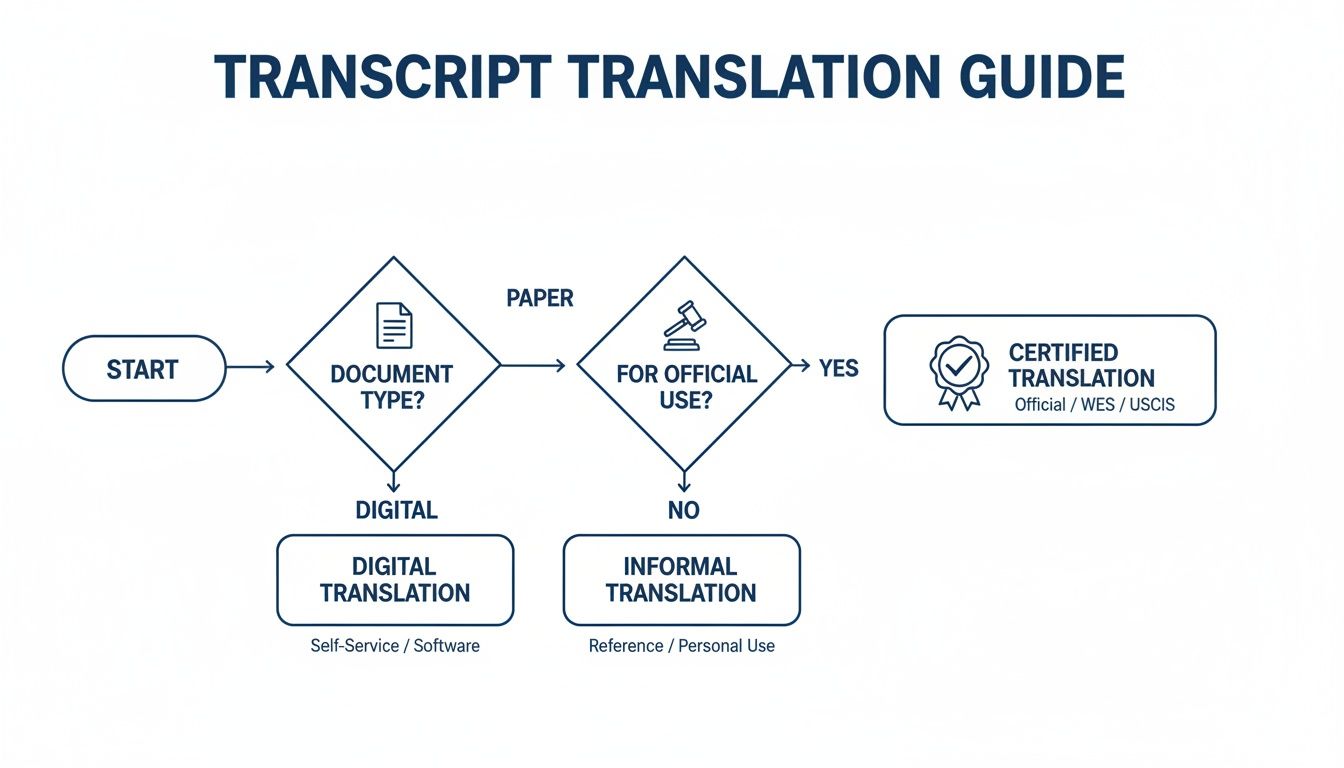
For any official submission in the U.S., such as immigration or university applications, a certified translation is the correct choice.
Certified Translation vs Notarized Translation At a Glance
This table breaks down the key differences to help you choose the right service for your needs.
| Feature | Certified Translation | Notarized Translation |
|---|---|---|
| Purpose | Guarantees the accuracy and completeness of the translation. | Verifies the identity of the person signing the document. |
| Validator | The translator or translation company. | A government-authorized Notary Public. |
| Common Use | USCIS, university admissions, credential evaluations (WES), etc. | Some legal documents, international contracts, or wills (rare for U.S. immigration). |
In short, certification is about the quality of the translation, while notarization is about the identity of the signer.
The Real-World Impact of Choosing Correctly
Let’s consider a practical example. Alejandro is applying to a master's program in the U.S. from Colombia. He gets his Spanish academic transcript translated and notarized, thinking the official stamp makes it more valid. He does not, however, get it certified.
The university rejects his application. Why? Because the notarization only proved who signed the document, not that the translation was accurate. This simple mistake forces him to delay his education by a full year.
The takeaway is clear: Certification vouches for the quality and accuracy of the translation, which is what U.S. institutions care about. Notarization only verifies the signer's identity.
To avoid Alejandro's situation, always check the specific requirements of the institution you're applying to. For any submission to USCIS or a U.S. university, a certified translation is the non-negotiable standard. Your safest path is to work with a professional transcript translation service that provides a clear Certificate of Translation Accuracy.
Translating Your Academic Transcripts Step-by-Step
Getting your official documents translated can feel overwhelming, but it's a manageable process when broken down into clear steps. This guide provides an actionable plan to ensure your academic records are translated correctly and meet the strict standards required by institutions like USCIS.
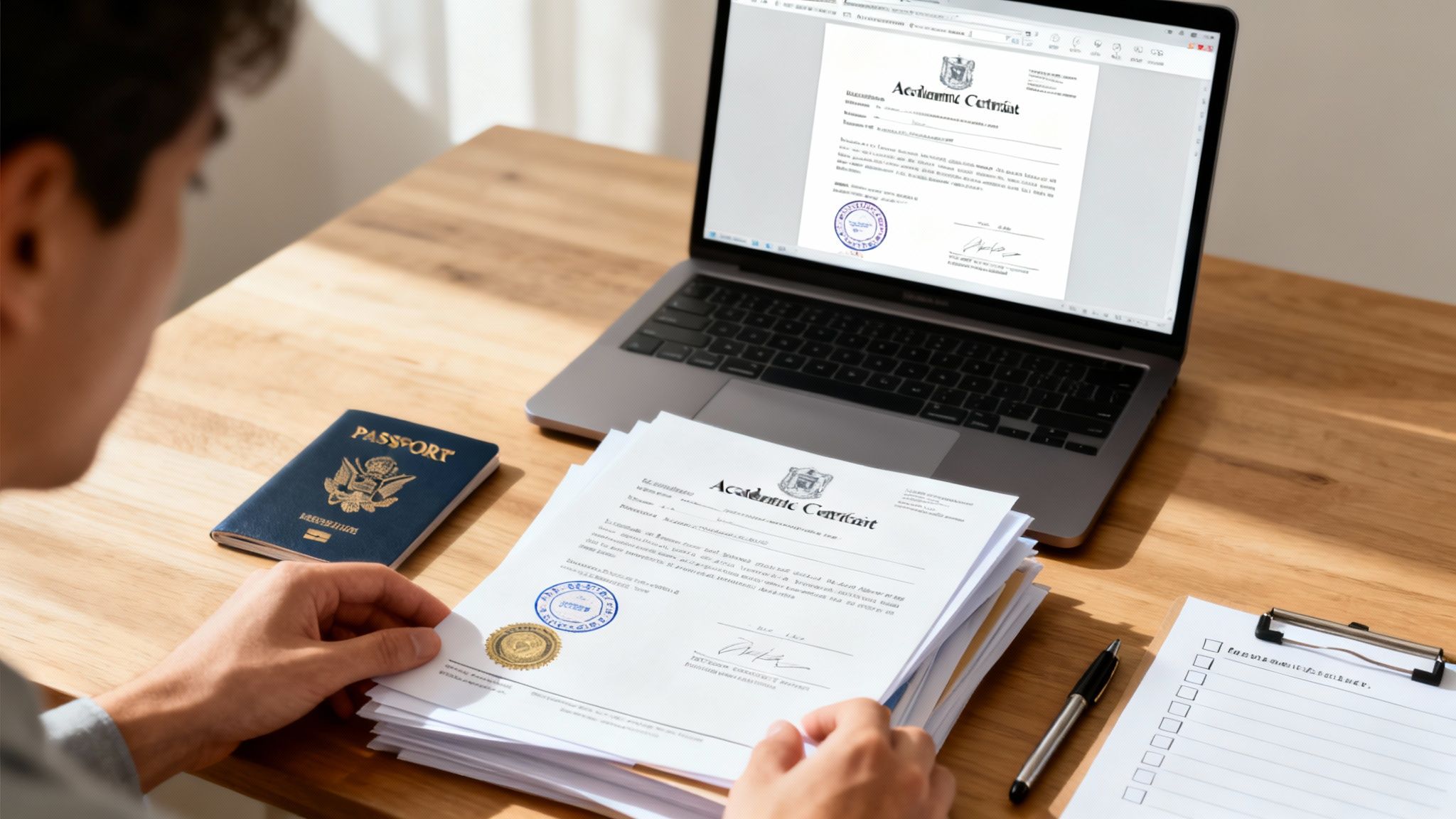
Step 1: Gather Your Complete Official Transcripts
First, you must collect every page of your official academic transcripts. This is the foundation of the process, and incomplete documents will cause delays. Ensure you have the full record exactly as it was issued by your school.
Document Checklist:
- Every Single Page: Include both the front and back of each page. The back often contains a grading key or other essential information that must be translated.
- All Seals and Stamps: Official seals, signatures, and embossed marks are proof of authenticity. Make sure they are clear and legible in the copies you provide.
- Accompanying Documents: If your transcript came with a diploma, certificate, or a separate legend explaining the grading system, include those as well.
Submitting incomplete records is a major red flag for officials and almost always results in a request for more information, delaying your application.
Step 2: Choose a Specialized Translation Provider
Not all translation services are created equal. You need a provider that specializes in certified translations for academic documents. A general translation agency may not understand the specific terminology, grading systems, or formatting rules required by USCIS or credential evaluators.
Look for a service that offers a USCIS acceptance guarantee. This is your assurance that they understand the legal requirements and are confident their work will be accepted. Choosing the right partner is the most important decision in this process. You can see what a specialized provider offers on our certified translation service page.
The demand for specialized translation is significant, particularly in the U.S., which holds 39.41% of the global language services market. This market is driven by students and professionals like you who need certified translations for immigration and academic purposes. You can read more about these global translation trends on redokun.com.
Step 3: Submit Clear Copies and All the Details
Once you have chosen a provider, you will need to submit your documents. The good news is that you do not have to mail your original, irreplaceable papers. High-quality digital copies are all that's needed.
Submission Checklist:
- High-Resolution Scans or Photos: Use a scanner to create clear PDF files. If using a phone, ensure there is bright, even lighting with no shadows, and that every word is sharp.
- Correct Name Spellings: Provide the full, correct English spelling of every name on the transcript. This must match your passport or other official ID exactly to avoid discrepancies.
- Your Contact Information: Double-check your email and phone number so the translator can reach you with any questions.
Pro Tip: Before uploading, review your files to ensure no part of the page is cut off. The translation must be a complete mirror of the original, and missing sections can invalidate it.
Step 4: Review and Approve the Final Translation
A professional transcript translation service will provide a draft for your review before finalizing it. Do not skip this step. This is your opportunity to perform a final quality check.
Compare the translation side-by-side with your original transcript. Carefully check critical details like names, dates, course titles, and grades. Even without speaking the target language, you can spot a misspelled name or an incorrect number.
If everything looks perfect, approve the draft. If you find an error, notify the company immediately. A reputable service will make corrections promptly before issuing the final certified document.
Critical Mistakes to Avoid with Your Transcript Translation
A small error on your translated transcript can lead to significant problems, including application delays, requests for evidence from USCIS, or even outright rejection. Fortunately, these common pitfalls are easy to avoid once you know what to look for.
Mistake 1: Using a Friend or Family Member
While it may seem like a way to save money, asking a bilingual friend or family member to translate official documents is a critical error. USCIS policy strictly prohibits translations from anyone with a personal connection to the applicant, as they are considered inherently biased.
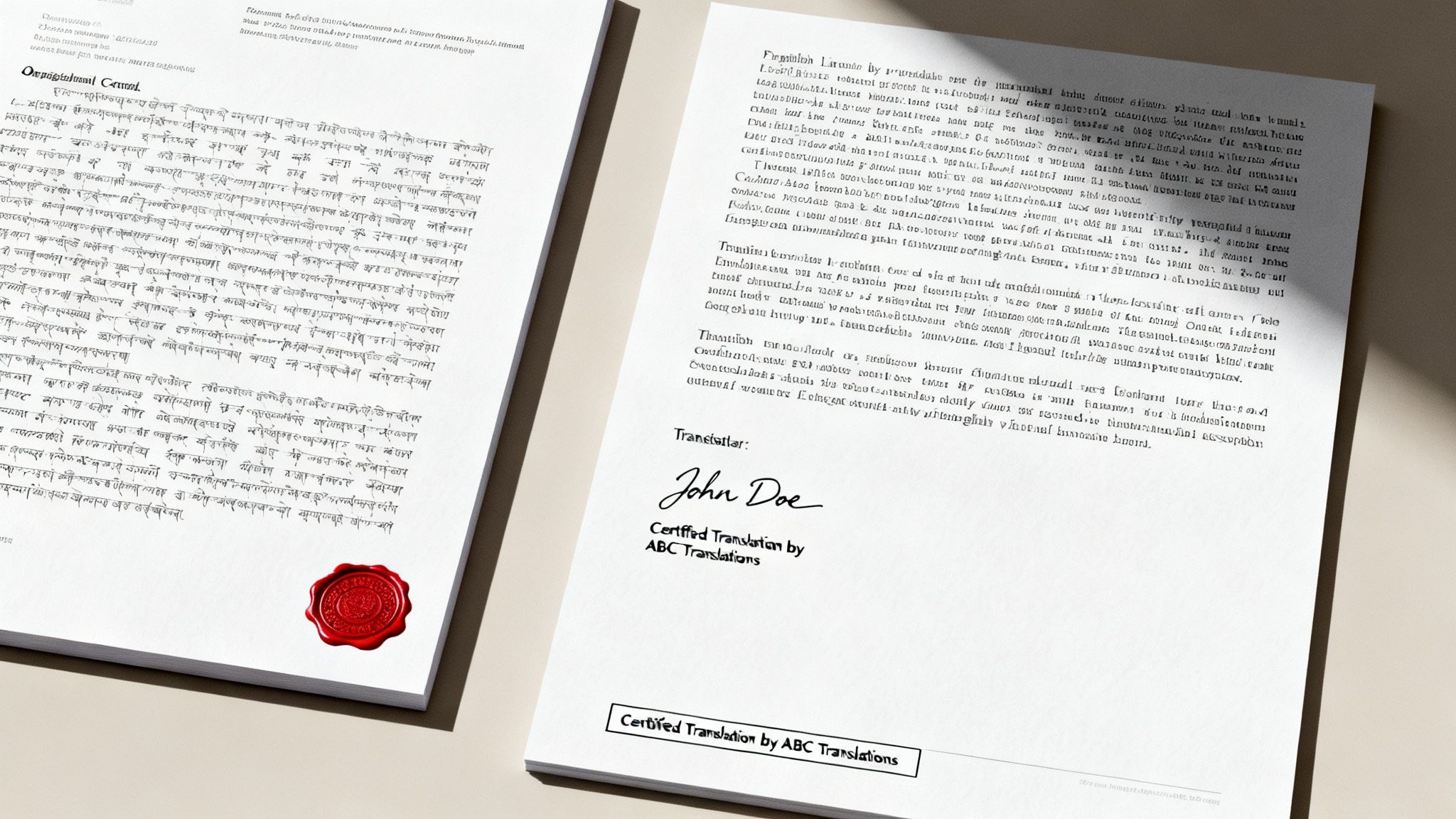
Official bodies require a translation from an impartial, professional third party. A certified translation includes a formal statement from the translator or agency, confirming their qualifications and the accuracy of the work. This creates the objective, trustworthy record that authorities demand.
Mistake 2: Submitting a Summary Instead of a Full Translation
Some people try to save time by translating only what they consider the important parts of a document, such as final grades or the degree conferred. This is a major mistake. USCIS, universities, and credential evaluators require a complete and literal word-for-word translation of the entire document.
This includes:
- Every course name and grade.
- All notes, keys, and legends (often found on the back of the transcript).
- Every official seal, stamp, and signature.
The translation must be a perfect mirror of the original. Anything less is considered incomplete and will be rejected.
Mistake 3: Inconsistent Name Spellings
This subtle error is surprisingly common. For example, if your name is "José Luis Pérez-García" on your transcript but "Jose L. Perez" on your passport, an immigration officer may see this as a discrepancy.
Even minor differences in spelling between your translated documents and your official ID can trigger a Request for Evidence (RFE), causing significant delays.
Pro Tip: Always provide your translator with a copy of your passport or government-issued ID. This ensures they use the correct, official English spelling of your name across all documents, eliminating any chance of confusion.
Mistake 4: Choosing a Service Without a USCIS Acceptance Guarantee
Many translation services are available online, but not all are equipped to handle certified translations for USCIS. Choosing a provider that does not offer a 100% USCIS acceptance guarantee is a risky gamble.
This guarantee is more than a marketing slogan; it signifies that the provider understands the strict legal requirements and stands behind their work. It means they know the correct formatting, include the necessary certification statement, and produce a document designed to pass official review. Without this assurance, you risk paying for a translation that is ultimately useless. You can see how a transparent, guaranteed service works by reviewing our detailed pricing and turnaround times.
A Cautionary Tale: A Three-Month Delay Over a Simple Error
Consider the case of a software developer applying for an H-1B visa. He hired a freelance translator who misspelled the name of his university. This small typo created a discrepancy that USCIS could not ignore.
The result was a three-month delay while he scrambled to obtain a corrected, properly certified translation. This single, preventable mistake nearly cost him his job offer. When you need help with immigration paperwork, it is always best to use specialized USCIS translation services.
How to Choose a Reliable Transcript Translation Service
With countless options online, selecting a trustworthy transcript translation service is crucial. The quality of their work directly impacts your immigration case, university application, or professional license. Here is a practical checklist to help you choose a provider that will get it right the first time.
Look for a USCIS Acceptance Guarantee
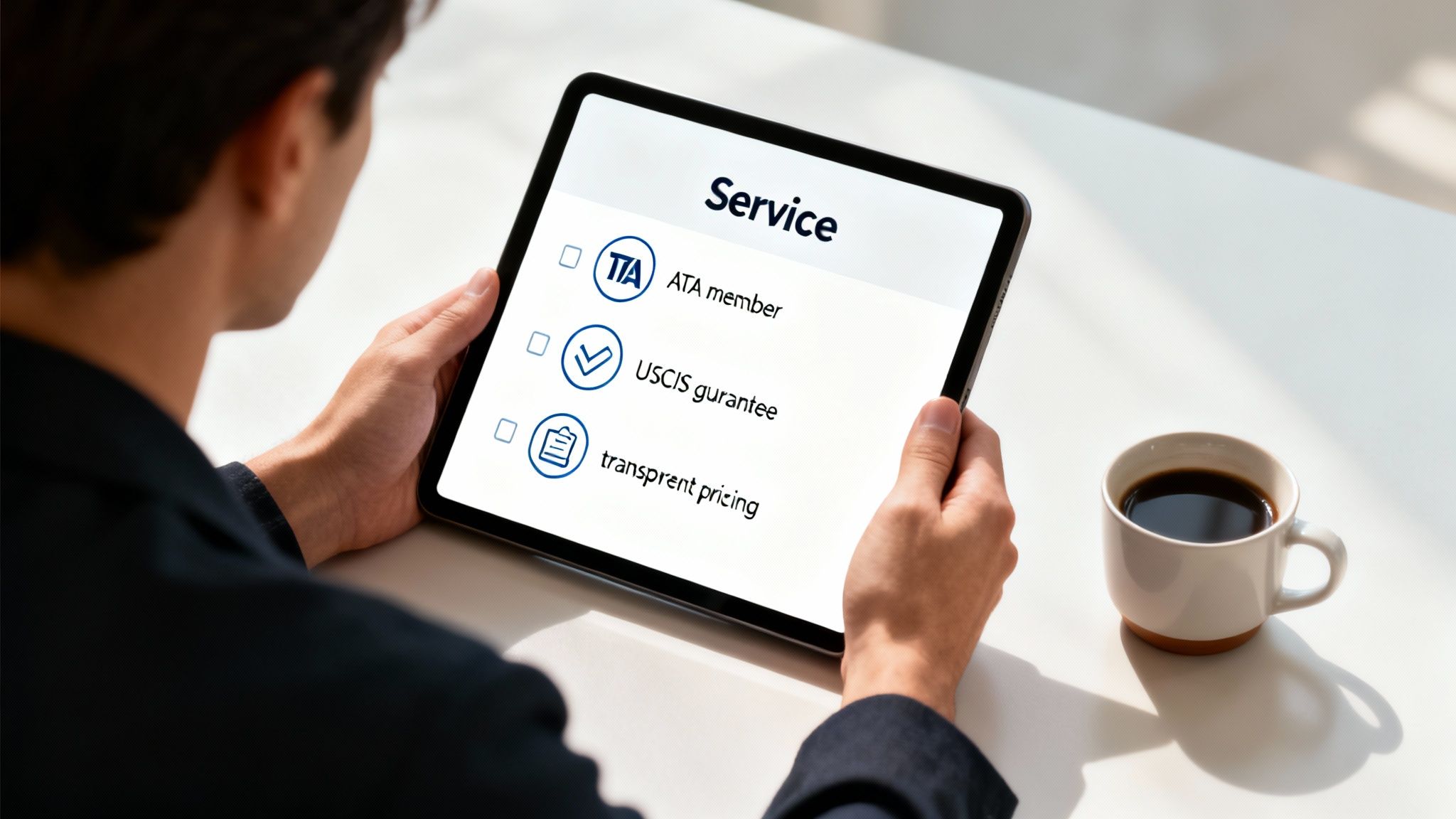
For immigration purposes, this is the most important factor. Always look for a 100% USCIS acceptance guarantee. This is your safety net. A service offering this guarantee demonstrates deep knowledge of USCIS regulations for certified translations.
This guarantee holds them accountable. If USCIS issues a Request for Evidence (RFE) due to a translation error, a reputable company will correct it immediately at no extra cost. Without that promise, you risk paying for a document that gets rejected, causing delays and forcing you to start over.
Verify Professional Credentials and Reputation
A credible service will be transparent about its qualifications. Look for affiliations with professional organizations like the American Translators Association (ATA). While not a USCIS requirement, ATA membership indicates a commitment to professional standards and ethics.
Next, check online reviews. See what past customers say about accuracy, speed, and customer support. A provider with a strong, positive reputation is a much safer choice.
Insist on Transparent Pricing and Turnaround Times
Hidden fees and vague deadlines are red flags. A reliable service will provide clear, upfront pricing. The most straightforward model is a flat rate per page (typically defined as up to 250 words), which allows you to calculate your cost without surprises.
Clear turnaround times are equally important. A 24-hour turnaround for a standard 1-3 page document is a common industry standard. If you have an urgent deadline, confirm they offer expedited services with a guaranteed delivery time.
Prioritize Data Security and Confidentiality
Your academic transcripts contain sensitive personal information. Choose a service that takes data security seriously. Ensure their website uses secure encryption (look for "https://" in the URL) and that they have a clear privacy policy explaining how they protect your documents.
For example, companies providing HIPAA-compliant transcription services follow strict data protection protocols. While your transcript is not a medical record, you should expect the same level of security. Your files should be managed in a secure environment from upload to delivery.
The demand for document translation is projected to grow at a 9% compound annual rate between 2025 and 2032, driven by global migration and the need for multilingual academic records. This growth makes it even more important to select a provider that balances quality with efficiency.
Evaluate the Quality and Process
Finally, a good provider should offer a simple and transparent process. You should have the opportunity to review the translation before it is finalized and certified. This critical step allows you to be the final quality check—you can confirm that names, dates, and course titles are all correct. If you are unsure what to look for, our guide on translation quality assessment can provide helpful tips.
By following this checklist, you can confidently choose a reliable partner who will deliver an accurate, compliant, and secure translation.
Your Top Questions About Transcript Translation Answered
When preparing official documents, many questions can arise. If you need a transcript translation service, you likely want clear, direct answers to move forward with confidence. Here are the answers to the most common questions.
How Much Will My Transcript Translation Cost?
Pricing is a primary concern for many. While some companies charge by the word, this can be unpredictable with dense academic documents. A more transparent and budget-friendly model is a flat, per-page rate.
For instance, a common pricing structure is a set fee for every 250 words, which generally corresponds to one page. This simplicity means the price you see is the price you pay, with no hidden fees. It allows you to plan your budget for university or immigration applications without guesswork.
This predictable structure ensures your cost is clear, whether your transcript contains technical engineering courses or broad liberal arts subjects.
How Long Will the Translation Take?
Time is often a critical factor, especially with deadlines from universities or USCIS. A professional transcript translation service can typically work very quickly.
For standard documents of one to three pages, a 24-hour turnaround is a reliable industry standard. This means you can often receive your certified translation the next day.
If you are facing an urgent deadline, ask about expedited services. A good provider will have a clear process for rush jobs, ensuring you can meet even the tightest deadlines without sacrificing quality.
Do I Need to Send My Original Transcript?
The answer is a definite no. For security reasons, you should never mail your original documents. They are valuable and could be lost or damaged in transit.
Modern translation services use a fully digital workflow. They only require high-quality digital copies of your documents, which you can upload securely from your computer or phone.
You keep your original documents with you at all times. By providing a clear scan or a high-resolution photo, you can start the translation process immediately while keeping your papers safe.
For the best digital copies, follow these tips:
- Use a Scanner: A flatbed scanner will produce a crisp, clear PDF.
- Ensure Good Lighting: If using a phone, place the document on a flat surface in a well-lit area to avoid shadows. Every word, stamp, and seal must be legible.
- Include Both Sides: Remember to scan or photograph both sides of every page, as important information like grading keys is often on the back.
Will USCIS Actually Accept This Translation?
When your immigration status is on the line, this is the most important question. A reputable and experienced transcript translation service should answer with an unequivocal "yes," backed by a 100% USCIS acceptance guarantee.
This guarantee is your assurance that the company understands the specific requirements set by United States Citizenship and Immigration Services. They know how to format the document, what the certification statement must include, and how to present everything for a smooth review process.
By offering a guarantee, the provider takes on the responsibility for compliance, giving you peace of mind. Choosing a service that guarantees its work eliminates the risk of rejection due to a translation error.
Ready to have your documents translated by certified professionals? At TranslateDay, we deliver accurate, USCIS-compliant translations quickly and securely.
Get an instant quote and start your translation in minutes.


