
Navigating immigration, academic applications, or medical care in a new country often requires one crucial step: translating your personal documents. Medical records translation is the professional service that converts a patient's health information—like doctor's notes, lab results, diagnoses, and treatment histories—from one language into another. This isn't just about changing words; it's about ensuring that doctors, immigration officials, or insurance companies get a clear and accurate picture of your health, no matter where the documents came from.
A simple mistake, like a mistranslated allergy or a misunderstood diagnosis, can have life-altering consequences. For official purposes, precision isn’t just a goal; it’s a strict requirement. This guide will walk you through everything you need to know to get it right.

Why Accurate Medical Translation is Non-Negotiable
Imagine you're applying for a Green Card, and the U.S. government needs to see your vaccination history. Or picture yourself seeking specialized medical care abroad, and your new doctor needs to understand your entire cancer treatment history. In both scenarios, medical records translation acts as the essential bridge, telling your medical story accurately in a new language. This is critical in any situation where clear communication directly impacts a person’s health, legal status, or financial well-being.
Take the real-world example of a family moving to the United States. To complete their application, they must submit vaccination records to U.S. Citizenship and Immigration Services (USCIS), the government agency handling immigration. Without a certified translation, those vital documents are just unreadable pages, which could halt or even jeopardize their entire immigration case.
Similarly, a patient traveling for a clinical trial needs their complete medical history translated with absolute precision. A tiny error in translating a lab result or a tumor’s specific characteristics could lead to a flawed and dangerous treatment plan.
The High Stakes of Getting It Right
The risks involved leave zero room for error. A small mistake can quickly escalate into a major problem:
- Patient Safety: A mistranslated allergy to penicillin could be fatal. An incorrect dosage conversion for a medication can lead to a dangerous underdose or overdose.
- Legal and Immigration Compliance: Official bodies like USCIS have strict standards. An inaccurate or improperly certified translation will be rejected, causing frustrating and costly delays in your immigration or legal case.
- Continuity of Care: When you see a new doctor, they rely on your past medical records to make the best decisions for your future health. Flawless translation ensures that critical context isn't lost between providers.
The difference between a professional translation and a poor one isn’t just about words; it’s about people's lives. In one well-known case, a patient was left quadriplegic after the Spanish word 'intoxicado' (which means poisoned or feeling ill from something ingested) was misinterpreted as 'intoxicated' (drunk), resulting in a tragic misdiagnosis and treatment error.
A Growing Need in a Connected World
As more people move across borders for work, family, or safety, the demand for these services is skyrocketing. The global market for medical translation services is expected to continue its strong growth into 2026 and beyond, driven by international patient care and large-scale clinical trials.
Modern medical records are often created using sophisticated technology, and understanding how tools like voice recognition software for healthcare are used gives you an idea of how these complex documents come to be in the first place. This growth highlights just how many people rely on accurate translations for immigration, insurance claims, and global medical consultations.
Key Scenarios Requiring Medical Records Translation
To put it into perspective, here are some of the most common real-world situations where accurate medical record translation is an absolute must.
| Scenario | Primary Reason | Common Documents |
|---|---|---|
| Immigration (USCIS) | Meeting legal requirements for visas, Green Cards, or citizenship. | Vaccination records, medical examination forms (I-693), proof of medical conditions. |
| Seeking Medical Care Abroad | Ensuring continuity of care and accurate treatment by a new medical team. | Full patient history, physician's notes, lab results, imaging reports (MRI, X-ray). |
| Insurance Claims | Proving medical necessity for treatments received overseas or for travel insurance. | Hospital bills, treatment summaries, receipts, prescription details. |
| Clinical Trials | Enrolling international participants and consolidating global research data. | Informed consent forms, patient-reported outcomes, adverse event reports. |
| Legal Proceedings | Providing medical evidence for personal injury lawsuits or disability claims. | Medical expert reports, diagnostic test results, rehabilitation notes. |
Ultimately, professional translation isn't a luxury. It's a fundamental necessity for protecting patient safety, meeting legal obligations, and achieving the best possible outcomes in your medical and personal journey.
Understanding Certified Translation for Medical Records
Have you ever been asked for a "certified translation" of a medical document by an official body like USCIS or a hospital? It might sound technical, but the concept is simple. They need more than just a word-for-word translation; they need a formal guarantee of accuracy.
A certified translation is a translated document that includes a signed statement from the translator or translation agency. This statement, often called a "Certificate of Accuracy," is a formal declaration confirming that the translation is a complete and precise rendering of the original document.
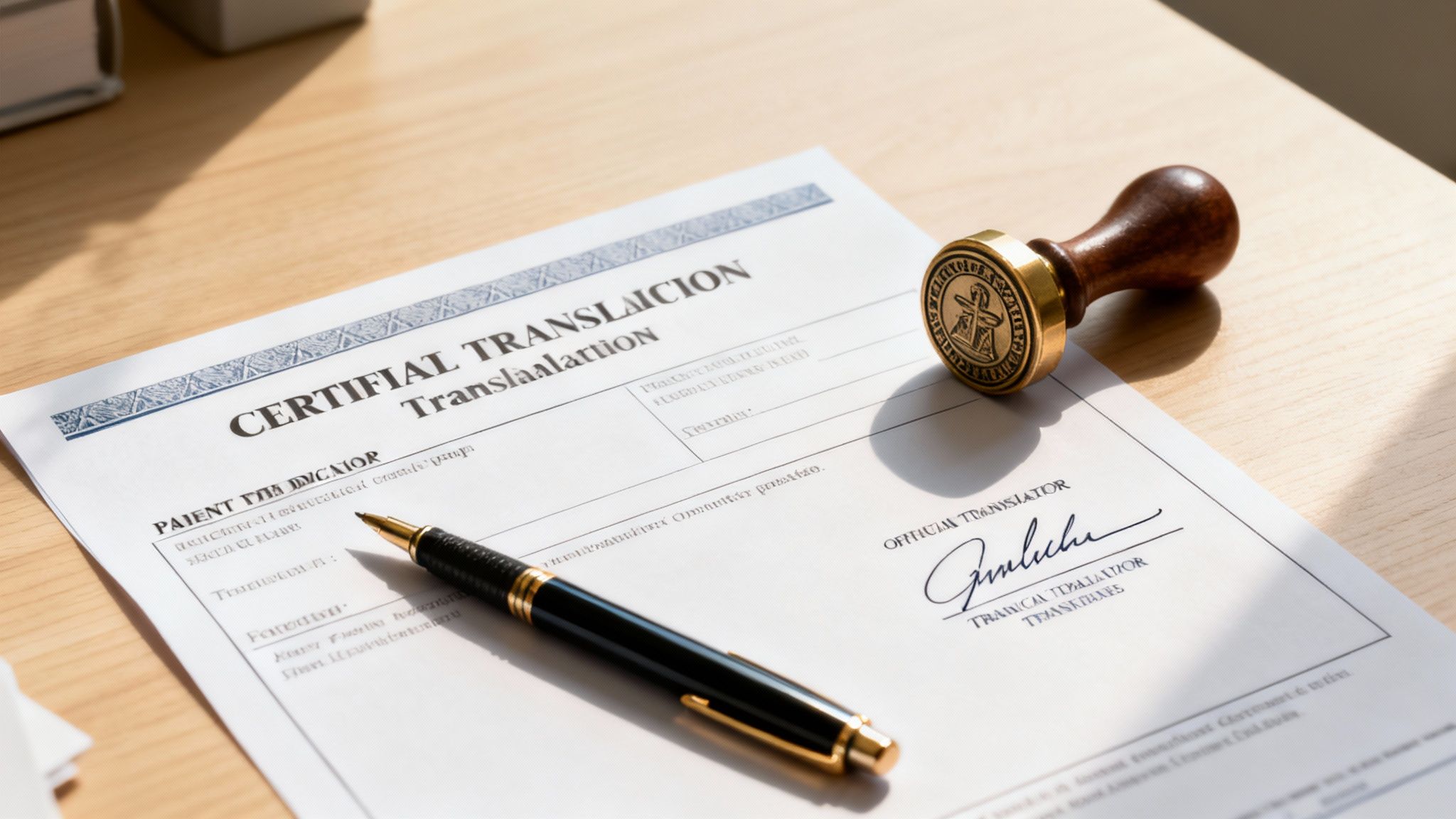
Think of it as the translator taking a professional oath. They are putting their name and reputation on the line, attesting that their work is true and correct. This formal accountability is why institutions trust certified translations for high-stakes matters like immigration applications or legal cases.
Why Your Bilingual Friend Cannot Certify a Translation
It’s a common question: "My cousin is fluent, can't she just translate my records?" While it seems like an easy shortcut, this approach is almost certain to be rejected by official organizations like USCIS, universities, or courts.
These institutions require an impartial, professional third party to certify the translation. A translation from a friend or family member, no matter how skilled, is considered biased and lacks the formal guarantee of accuracy. The purpose of certification is to prevent fraud, conflicts of interest, and the honest mistakes that an amateur might easily make with complex medical or legal terminology.
For example, when applying for a Green Card, you must submit translated medical exam results. USCIS will not accept a translation done by you or a relative. They require a formal medical records translation from a professional service that includes that critical signed certification.
Certified vs. Notarized Translation: What Is the Difference?
People often confuse "certified" and "notarized," but they mean two very different things in the world of official translations. Understanding the distinction is crucial to avoid having your documents rejected.
- Certified Translation: This is all about the quality and accuracy of the translation. The translator or agency signs a certificate attesting that the work is complete and correct.
- Notarized Translation: This has nothing to do with quality. A notary stamp simply verifies the identity of the person who signed the certificate. A Notary Public watches the translator sign the document and then adds their own stamp and signature to confirm it was really them.
In short, certification vouches for the translation’s accuracy, while notarization vouches for the translator’s identity.
For most USCIS and medical purposes, a certified translation is all you need. However, some legal or academic institutions might request notarization as an extra layer of security. The golden rule is to always double-check the specific requirements of the organization you're submitting documents to. You can learn more about these important distinctions and see examples of certified and notarized translation.
Ultimately, the certification statement is what transforms a simple translation into an official document that authorities will accept. It’s the seal of approval ensuring your crucial medical history is communicated accurately.
Protecting Your Privacy with HIPAA Compliant Translation
Your medical history contains some of your most private information. When you need these records translated, keeping them confidential is just as important as getting the words right. That’s where the Health Insurance Portability and Accountability Act (HIPAA) comes in.
Think of HIPAA as the strict, legally-binding rulebook for protecting patient health information in the United States. A translation service that is HIPAA compliant has implemented tough security protocols to handle, store, and share medical data safely, giving you peace of mind that your private records are secure.

The Risks of Non-Compliant Translation
Imagine you need to translate lab results to submit an insurance claim for treatment you received overseas. If you send them to a service that doesn't follow HIPAA guidelines, you're gambling with your personal data. Your information could end up on an unsecured server, be sent through unencrypted email, or be handled by translators who haven't signed confidentiality agreements.
The stakes are incredibly high. The healthcare sector is a prime target for cybercriminals, and a data breach can expose you to fraud and identity theft. For the millions of people in the U.S. with limited English proficiency, a data security failure is another major barrier to receiving safe, effective care.
What to Look for in a Secure Translation Provider
When choosing a translation provider for your health information, prioritizing privacy is non-negotiable. A secure, HIPAA-compliant service demonstrates its commitment to safety through its entire process.
Here’s a practical checklist to help you vet providers and ensure your confidential information is protected:
- Secure File Upload Portal: They must offer an encrypted portal for sending and receiving documents. Never use a service that asks you to email sensitive records directly.
- Data Encryption: Your data should be scrambled (encrypted) at all times—both when it's being transferred and when it's stored. This makes it unreadable to unauthorized parties.
- Confidentiality Agreements: Every linguist, project manager, and staff member with potential access to your files must be bound by a strict non-disclosure agreement (NDA).
- Transparent Privacy Policy: Look for a clear, easy-to-read privacy policy on their website that explains exactly how they handle and protect your information.
A HIPAA-compliant workflow isn't just a marketing term; it's a fundamental promise to protect your most sensitive data with the same level of security you'd expect from your own doctor's office or hospital.
Understanding the details of secure data handling, such as HIPAA compliance in healthcare faxing, is also important for maintaining confidentiality. By insisting on these security measures, you can move forward with your translation needs, knowing your privacy is fully protected.
What Kinds of Medical Documents Usually Need Translation?
When you need a medical records translation, it’s typically for something important and often time-sensitive. The good news is you don't have to translate every single paper in your medical file. Knowing which documents are most commonly requested can save you time, money, and stress.
The records people need translated range from a simple vaccination card for an immigration application to a complex pathology report for cancer treatment. Each document tells a vital piece of your health story. Getting that story translated perfectly is essential so that the person reading it—whether it’s a new doctor, an immigration officer, or an insurance agent—can make the right decision.
Patient History and Physician’s Notes
Your patient history is like your health biography. It covers past illnesses, surgeries, chronic conditions, and family medical history. Physician's notes are the doctor's observations and plans from each appointment.
- Real-World Example: For any new doctor, this is the starting point. A precisely translated history ensures they don't miss a critical detail, like a past allergy to a certain medication, which could completely change their approach to your care in 2026.
Laboratory and Pathology Reports
These documents contain the hard data about your health. Lab reports provide the numbers from blood work and other tests. Pathology reports offer a microscopic analysis of tissue samples, which is critical in fields like oncology.
The language here is highly technical. A single mistake in translating a lab value, a unit of measurement, or the name of a specific cell can lead to a wrong medical conclusion. For instance, if a pathology report incorrectly translates a tumor as benign when it’s actually malignant, the consequences could be devastating.
Surgical Reports and Hospital Discharge Summaries
A surgical report is a detailed account of an operation. A hospital discharge summary recaps your entire hospital stay, summarizing your diagnosis, the treatment you received, and instructions for at-home care.
- Real-World Example: These documents are essential proof for follow-up care or insurance claims. A man recovering from heart surgery in his home country needed his surgical report translated to prove the procedure was medically necessary for his U.S. insurance company to cover the follow-up physical therapy.
Vaccination and Immunization Records
This simple list of vaccinations is a non-negotiable requirement for many official processes, especially U.S. immigration. If you're applying for a U.S. visa, Green Card, or citizenship, you must provide a translated and certified record of your immunizations.
USCIS needs this to confirm that applicants meet public health standards. Submitting a clear, professionally translated vaccination record is a simple way to avoid a Request for Evidence (RFE), an official query that can put your immigration case on hold for months. For a full list of documents we handle, check out our guide to the types of specialized translation.
Documents for Clinical Trials and Insurance
The need for medical translation is growing rapidly, particularly within life sciences. The market continues to expand, partly due to the millions of global clinical trials that demand perfect translations of documents like informed consent forms. You can learn more about these market trends and how they are shaping global healthcare.
For insurance claims, documents like hospital bills and prescription receipts must be translated accurately to ensure reimbursement. An unclear description of a medical procedure is one of the fastest ways to get a claim denied.
Before you submit your documents, a quick check can make the process smoother. Use this checklist to review your files.
Medical Document Translation Checklist
| Document Type | Key Information to Check | Common Use Case |
|---|---|---|
| Patient History | Ensure all dates, diagnoses, and allergies are clearly legible and complete. | Continuing medical care in a new country |
| Lab/Pathology Report | Verify that all numerical values, units of measurement, and specimen IDs are visible. | Second opinions or specialized treatment |
| Hospital Discharge Summary | Check for the primary diagnosis, procedures performed, and follow-up care instructions. | Insurance claims and follow-up appointments |
| Vaccination Record | Confirm that the names of all vaccines and the dates they were administered are present. | Immigration (USCIS) and school enrollment |
| Surgical Report | Make sure the surgeon's name, procedure details, and post-op findings are included. | Legal cases or complex insurance verification |
Taking a few minutes to review your documents with this checklist ensures your translator has everything needed to deliver a precise and compliant translation.
A Step-by-Step Guide to Getting Your Medical Records Translated
So, you need your medical records translated for an official purpose. The process might seem complex, but it's quite straightforward when broken down. Let’s walk through it together, from preparing your documents to receiving a flawless certified translation ready for submission.
Step 1: Prepare Your Documents
The quality of the final translation depends heavily on the quality of the original documents you provide. A little preparation now can prevent major headaches later.
First, gather every page of the required medical record. If this is for a USCIS application, double-check their requirements—they often need the full document, not just a summary. Missing pages are a common cause of delays.
Next, create high-quality digital copies. A flatbed scanner is ideal for producing clear PDFs or high-resolution JPEGs. Avoid taking photos with your phone in poor lighting; shadows and blurry text can make parts of the document unreadable. Every word, stamp, and signature must be perfectly clear for the translator.
Step 2: Choose a Reputable Translation Service
This is your most important decision. You need a partner who guarantees accuracy and meets strict legal and privacy standards. Avoid generic online tools or non-specialist freelancers, as their work is often rejected by official bodies and may put your confidential data at risk.
Look for these key signs of a trustworthy provider:
- USCIS Acceptance Guarantee: For immigration purposes, this is non-negotiable. The service must guarantee its certified translations will be accepted by U.S. Citizenship and Immigration Services.
- HIPAA Compliance: Your medical history is private. A HIPAA-compliant provider uses secure servers and encrypted file transfers to protect your information.
- Expert Medical Translators: The translators should have proven experience with medical terminology. A general translator may struggle with the specific language in a pathology report or surgical summary.
Step 3: Get a Clear Quote and Understand the Pricing
A trustworthy service is always transparent about its costs. Most professional agencies charge either per page or per word. A per-page model is often simpler, as you know the exact total cost upfront with no surprises.
Always get a clear, itemized quote before committing. The price should include the complete certified translation, the certification statement, and standard digital delivery. The best services offer instant online quotes. To see how industry standards are set, review a clear breakdown of translation pricing.
The translation process handles a variety of critical documents, each requiring careful attention.
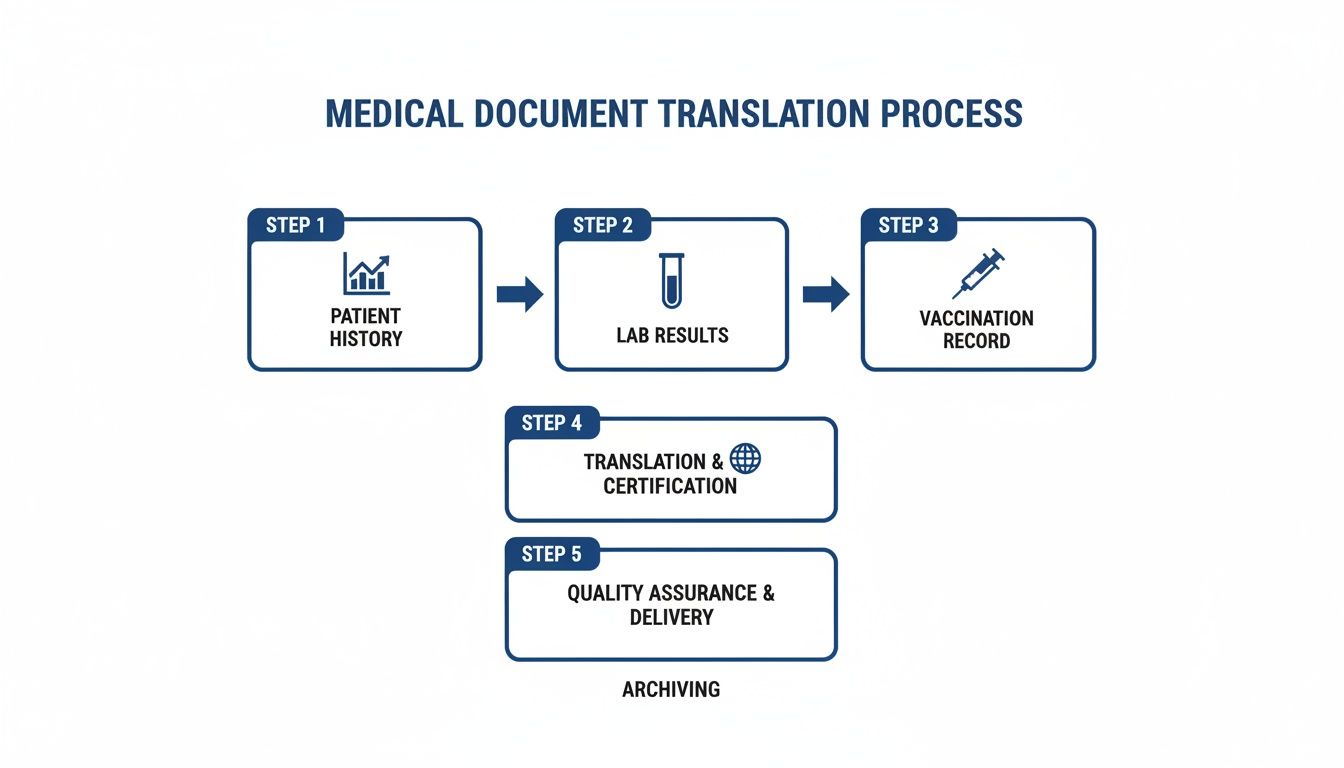
As you can see, documents like patient histories, lab results, and vaccination records are foundational, which is why meticulous handling from start to finish is so important.
Step 4: Place Your Order and Let the Experts Work
Once you've selected a provider and approved the quote, placing the order is simple. You’ll upload your scanned documents through their secure online portal and complete the payment.
Behind the scenes, a carefully managed process begins. Your project is assigned to a professional translator who is a native speaker of the target language and has expertise in the medical field.
The specialist meticulously translates your document, paying close attention to every technical term, dosage, and diagnosis to ensure the final text is both linguistically correct and medically precise.
Step 5: Quality Assurance and Certification
A professional translation is never finished after the first draft. It then moves to a rigorous quality assurance (QA) check. A second qualified linguist reviews the translated document against the original, checking for any errors, omissions, or formatting issues.
This two-step verification process guarantees the accuracy required for high-stakes documents. Only after passing this QA review does the agency prepare the Certificate of Accuracy—the formal signed statement attesting that the translation is a complete and correct reflection of the original.
Step 6: Receive and Review Your Final Translation
How long does it take? For standard documents of 1-3 pages, many top services offer a 24-hour turnaround. You’ll receive the final certified translation as a digital PDF via email or a secure download link.
When it arrives, take a moment to review it. Double-check that all personal information, like names and dates, is spelled correctly. At that point, your document is ready to be submitted to USCIS, an insurance company, a hospital, or any other organization that requires it.
Got Questions About Medical Translation? We've Got Answers.
Diving into medical records translation can feel overwhelming, especially when you're on a deadline. This section provides clear, straightforward answers to the most common questions we hear, helping you move forward with confidence.
How Much Does Certified Medical Records Translation Cost?
Pricing should be transparent and easy to understand. The most common model is a flat rate per page, where a page is typically defined as up to 250 words.
This approach offers several benefits:
- No Hidden Fees: The price you see is the price you pay. It includes the translation, the official Certificate of Accuracy, and digital delivery.
- Simple Budgeting: You know the final cost just by counting your pages, which removes the guesswork of per-word pricing.
- Fast and Easy: You can get an instant quote online by simply uploading your files.
For example, a three-page vaccination record for a USCIS application will have one clear, fixed price. No surprises, no stress. You can see how this simple, per-page model works on our translation pricing page.
How Long Does It Take to Translate My Medical Documents?
Time is often a critical factor, especially with immigration deadlines or upcoming doctor's appointments. Professional translation services are designed for speed without sacrificing accuracy.
For most standard documents of one to three pages—like lab results, vaccination records, or doctor's notes—a 24-hour turnaround is a realistic expectation. This speed helps keep your plans on track.
For more extensive records, like a full patient history or a lengthy surgical report, the timeline will be slightly longer. A quality agency will always provide a clear delivery estimate with your quote. If you're in a real time crunch, most services offer an expedited or "rush" option to meet the tightest deadlines.
Will USCIS Accept My Translated Medical Records?
For anyone navigating the U.S. immigration process, this is a critical question. The answer is yes—as long as the translation meets their strict requirements. U.S. Citizenship and Immigration Services (USCIS) is very particular about documentation.
To ensure your translated medical record is accepted, it must be a certified translation. This means it must be accompanied by a signed statement from the translator or translation company vouching for its accuracy and completeness.
A professional service specializing in certified translations for USCIS provides this certification automatically. They stake their reputation on meeting USCIS standards, which significantly lowers your risk of receiving a Request for Evidence (RFE) that could delay your case by months.
Using a bilingual friend or a generic online tool is not an option for official submissions. For USCIS, the certification is just as important as the translation itself.
Is Your Medical Translation Process HIPAA Compliant?
Your medical information is private, and protecting it is non-negotiable. The Health Insurance Portability and Accountability Act (HIPAA) sets the U.S. standard for protecting patient health data, and any translation process you use must be compliant.
A truly HIPAA-compliant workflow includes multiple layers of security:
- Secure File Transfers: You should only upload or download your documents through a secure portal using 256-bit SSL encryption—the same level of security used by banks.
- Confidentiality Agreements: Every linguist and staff member who may see your documents is legally bound by a strict non-disclosure agreement (NDA).
- Secure Data Storage: Your files are stored on secure, access-controlled servers, never on personal devices or unsecured cloud drives.
When you choose a HIPAA-compliant provider, you can be confident that your sensitive health data is handled with the same care and security you expect from your own doctor's office.
At TranslateDay, we understand that translating your medical records is a critical step in your journey, with no room for error. We deliver fast, secure, and fully certified translations guaranteed to be accepted by USCIS and other official institutions.
Ready to take the next step? Get an instant quote and have your professionally translated documents back in as little as 24 hours.


