
Navigating the world of international documents can feel complex, but it usually comes down to two key steps: getting an apostille and a certified translation. Think of the apostille as a universal passport for your official document—it proves to another country that it’s authentic. The certified translation then acts as the official interpreter, ensuring everyone understands exactly what your document says. This guide will walk you through the process for immigration, academic, and legal needs.
Understanding Apostille and Translation: A Simple Explanation
When you need to use an official document—like a birth certificate, marriage license, or university transcript—in a foreign country, you can’t just hand over the original. That country’s government has no way of knowing if it's real. They need proof that your document is a legitimate, legally valid record.
This is where a translation with apostille becomes essential. It’s a two-step validation process that most countries require before they’ll accept foreign documents for legal, academic, or immigration matters.
Let's use a simple analogy. Imagine your official document is a special key made in your home country.
-
The Apostille: This is an official, globally recognized tag attached to your key. This tag doesn't explain what the key opens. Instead, it confirms that the person who first certified the key (like a county clerk or a notary public who issued the original document) was a legitimate official. It’s all about verifying the signature and seal on the document.
-
The Certified Translation: Now, what if the instructions for using that key are in a language the foreign country doesn't understand? A certified translation provides a precise, word-for-word interpretation of those instructions. It's a document, signed by a professional translator or agency, stating that the translation is accurate and complete, making the key's purpose clear to everyone.
Key Takeaway: An apostille authenticates the origin of a document (the signature and seal), while a certified translation clarifies its content. You almost always need both to open doors abroad.
Real-World Example: Moving to Spain
Maria and her family are applying for residency in Spain in 2026. The Spanish consulate needs their official U.S. marriage certificate to process the application.
First, they must get an apostille for their marriage certificate from the Secretary of State where they were married. This step proves to the Spanish government that the certificate is a genuine, U.S.-issued document.
Next, because the original document is in English, they need a certified translation of both the marriage certificate and the apostille page into Spanish. A professional translator will create a new document in Spanish that mirrors the original, along with a signed statement of accuracy. If they submit one without the other, their application will be rejected, causing serious delays.
This dual requirement is standard for countries that are part of the Hague Convention. However, U.S. agencies like the United States Citizenship and Immigration Services (USCIS) have their own rules for documents submitted within the United States. Understanding these differences, including the distinction between certified and notarized documents, is the first step to a smooth process.
The Correct Order: Get the Apostille Before the Translation
When preparing documents for another country, getting the apostille and translation sequence right isn't just a suggestion—it's mandatory. Getting this backward is one of the most common and costly mistakes, and it almost always leads to rejection by foreign officials.
The rule is simple and absolute: you must get an apostille for your original document first, before it is translated.
Think of it like getting a blueprint for a house approved by the city. You get the original plans stamped and signed before you give copies to your builder. The official stamp validates the source. An apostille works the same way; it’s an official certification that verifies the signature and seal on your original public document, such as a county clerk’s signature on a birth certificate. The apostille is validating that signature, not the translation that comes later.
If you translate the document first, you end up with two disconnected pieces of paper. The apostille is attached to your original, but the receiving agency has no proof that the translation is a faithful rendering of that now-validated document. It breaks the chain of authenticity, and they will not accept it.
Why the Sequence Matters
The legal validity of your submission depends on this workflow. The apostille acts as an official handshake between governments, confirming that the signature on your document is legitimate. Translating the document before this critical verification step makes the entire package invalid.
Let’s look at a common scenario. Imagine a U.S. student applying to a university in Italy for the 2026 academic year. They need to submit their American diploma, which is a type of academic transcript.
-
The Wrong Way (Common Mistake): The student, eager to get things done, immediately has their diploma translated into Italian. They then send the original English diploma to the Secretary of State to be apostilled. The Italian university receives an Italian translation and an apostilled English diploma. These are two separate documents in their eyes, and because the apostille doesn't certify the translation, the application is rejected.
-
The Right Way: The student first sends their original U.S. diploma to the correct Secretary of State and gets the apostille certificate attached. Now, they have a complete, officially authenticated document package (the diploma + the apostille). They submit this entire package for a professional certified translation. The final submission to the Italian university is a certified translation of both the diploma and its apostille. This is the only way it will be accepted.
This flowchart illustrates the correct three-step process for validating your documents from start to finish.
As you can see, the apostille is the bridge between your original document and the final translation. It has to be in place before you move on.
Here’s a quick checklist to help you avoid common pitfalls. Following this process will save you from the headache and expense of a rejected application.
Checklist: Apostille and Translation Workflow
| Step | Action Required | Why It's Important | Common Mistake to Avoid |
|---|---|---|---|
| 1. Obtain Original | Get the original or a certified copy of your public document (e.g., birth certificate, diploma). A certified copy is a fresh copy issued by the official record-keeper. | Only officially issued documents can be apostilled. Photocopies are not valid. | Using a plain photocopy instead of a certified copy issued by the relevant authority (like a county clerk). |
| 2. Secure Apostille | Send the original/certified copy to the designated authority (e.g., Secretary of State) for the apostille. | The apostille authenticates the signature/seal on the original document, creating a legally valid package. | Getting the document translated before getting the apostille. This is the most frequent error. |
| 3. Translate Package | Provide the entire apostilled document (original + apostille page) for certified translation. | The translation must include everything—the original document and the apostille—to maintain the chain of authenticity. | Only translating the original document and leaving out the apostille certificate page. |
By following these steps, you ensure that foreign officials see exactly what they need to: a clear, unbroken line of authentication. For more details, you can review our transparent pricing and turnaround times for these multi-page projects.
Navigating Global Rules: Hague Convention vs. Non-Member Countries
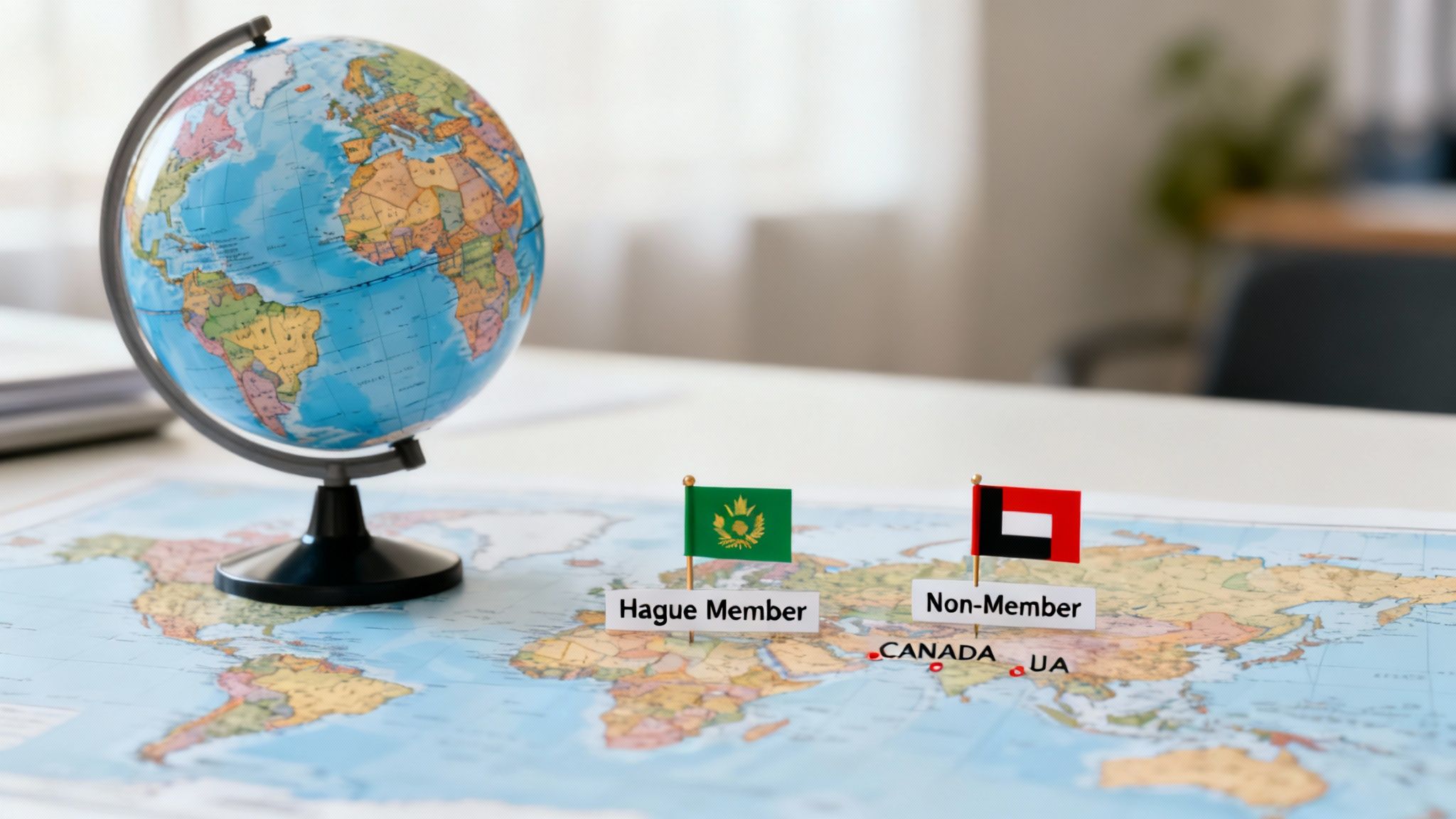
Getting a document officially recognized in another country isn't a one-size-fits-all process. The exact steps you need to follow depend entirely on where you're sending it. The world is divided into two groups: countries that are part of the Hague Apostille Convention and those that aren't. Knowing which group your destination country belongs to is the secret to a hassle-free process.
In 1961, a group of countries created the Hague Apostille Convention, a treaty designed to simplify the authentication of documents for international use. With over 124 countries now participating, it has become a cornerstone of global document exchange. It replaces the old, complicated process of "consular legalization" with a single, standardized certificate: the apostille.
This treaty has fueled growth in the official document translation market, which was valued at USD 5.2 billion in 2024 and is projected to reach USD 9.1 billion by 2033. You can learn more in the full market research report.
The Simple Path: Hague Convention Countries
If you are sending documents to a country that has signed the Hague Convention, your path is straightforward. Think of it as the express lane for document validation. All you need is a single apostille from the correct authority in your home country to prove your document is authentic.
This group includes the United States, the United Kingdom, Mexico, Japan, Germany, and Australia. If you have a U.S.-issued document and need to use it in one of these countries, the process is simple: get the original apostilled first, then have the entire package translated.
Key Insight: For Hague member countries, an apostille is the final seal of approval. Once it's attached, the receiving country is obligated to accept the document's authenticity without needing further proof.
This map from the official Hague Conference website shows how many countries have adopted this simpler system. The areas in blue are where a single apostille is all you will need.
The Complex Route: Non-Member Countries
What if your destination country isn't a Hague member? This is where you'll need to prepare for a more involved journey. For nations like Canada, the United Arab Emirates (UAE), Vietnam, or Kuwait, a simple apostille won't be enough.
You must go through a multi-step process known as consular legalization or authentication. It takes longer, costs more, and involves a chain of verifications.
- Step 1: State-Level Certification. Your document is first authenticated by the Secretary of State where it was issued.
- Step 2: Federal Authentication. It then goes to the U.S. Department of State in Washington, D.C., for another verification.
- Step 3: Embassy Legalization. Finally, you submit the document to the destination country's embassy or consulate for their official stamp.
Each step adds its own fees and delays, which is why checking your destination country's status should always be your first move.
Real-World Comparison: Hague vs. Non-Hague
Let’s see how this affects two professionals moving abroad in 2026.
Scenario 1: Maria Moves to Germany (Hague Member)
Maria needs her U.S. university diploma validated for a German work visa.
- Action 1: She gets her diploma apostilled by her state's Secretary of State, which takes about two weeks.
- Action 2: She sends the apostilled diploma for a certified translation for academic purposes.
- Total Time: The process takes about 2-3 weeks and is clear and direct.
Scenario 2: David Moves to Vietnam (Non-Hague Member)
David needs his U.S. birth certificate validated for a long-term residency visa in Vietnam.
- Action 1: He gets his birth certificate authenticated at the state level.
- Action 2: He then mails it to the U.S. Department of State for federal authentication, a step that can take several weeks.
- Action 3: Next, he submits the federally authenticated document to the Vietnamese Embassy for final legalization.
- Action 4: Only after all that can he get the complete package translated.
- Total Time: Easily 6-8 weeks or more, with much higher costs from multiple government and shipping fees.
The difference is significant. By identifying the correct process for your destination from the start, you can set a realistic timeline and budget, keeping your international plans on track.
The Big Exception: What USCIS Really Wants for Your Foreign Documents
Navigating the paperwork for a U.S. Citizenship and Immigration Services (USCIS) application can be overwhelming, especially with documents from another country. Here is a crucial piece of information that simplifies the process: USCIS does not require an apostille for foreign documents.
This is a common point of confusion. An apostille is used to prove a document's authenticity to a foreign government. Since USCIS is part of the U.S. government, you are submitting your documents for domestic review. That international verification is not needed.
So, what does USCIS require? It’s simple. They need to understand every word on your documents. Their one non-negotiable rule is that you must provide a complete and accurate certified translation for any document not in English.
Real-World Example: A Green Card Application
Even though USCIS doesn't ask for apostilles, you might still encounter them during your immigration journey. The key is to understand who is asking for the document and why.
Let's imagine a U.S. citizen is marrying a Colombian citizen and plans to file for a spousal Green Card in 2026.
-
The Wedding in Colombia: Before they can marry, the Colombian government might require the U.S. citizen to provide a U.S. birth certificate to prove they are single. This document will need an apostille for the Colombian officials, not for the U.S.
-
Coming Home: After the wedding, the couple receives their official Colombian marriage certificate. This civil certificate is in Spanish and is critical evidence for their Green Card application.
-
The USCIS Application: When they prepare the I-130 petition for USCIS, they will need certified translations of all non-English documents. This means translating the Colombian marriage certificate and the foreign spouse's birth certificate. They do not need to get an apostille for these Colombian documents to submit them to USCIS.
Key Takeaway: The need for an apostille depends on who you are giving the document to. If it's for a foreign government, you probably need one. If it's for USCIS, you just need a certified translation.
Checklist for Your USCIS Submission
To ensure your application is processed without delays, focus on getting the translations right. For each foreign-language document, your package should include these three items:
- A clear, readable copy of the original document (e.g., your birth certificate from Mexico).
- A full, word-for-word English translation of that document.
- A signed statement from the translator or translation company confirming that the translation is accurate and complete, and that the translator is competent to translate.
This is exactly what an immigration officer needs. While adding an unnecessary apostille won't get your case rejected, it will cost you time and money that are better spent ensuring your translations are perfect. To learn more, check the complete USCIS translation requirements.
How to Get an Apostille for Your U.S. Documents
Getting an apostille in the United States is a logical process, but there’s one critical detail that trips many people up: knowing where to send your documents. The U.S. has two separate paths for apostilles, and picking the right one depends on who issued your document.
Sending it to the wrong office is a common mistake that guarantees rejection, wasting time and money on shipping and fees. It's like trying to renew your state driver's license at a federal post office—they simply don't have the authority to help you.
The Two Paths to an Apostille in the USA
The entire process depends on whether your document is state-issued or federally-issued. This single fact determines which government office can legally authenticate it.
-
For State-Issued Documents: These include birth certificates, marriage licenses, university diplomas, and documents notarized by a local public official (a notary public). These records are created by state, county, or city officials. To get one apostilled, you must go through the Secretary of State (or an equivalent office) in the state where the document was issued.
-
For Federally-Issued Documents: These are documents that come from a U.S. federal agency, like the FBI, IRS, or federal courts. For these, the only place to get an apostille is the U.S. Department of State in Washington, D.C. A state office has no authority over a federal document.
Key Insight: It all comes down to the signature. The government body that can verify the signature on your document is the one that issues the apostille. The California Secretary of State can confirm a California county clerk's signature, but only the U.S. Department of State can verify the signature of an FBI official.
A Practical Example: Maria’s Dual Apostille Journey
Let's walk through a real-world scenario. Maria, a U.S. citizen, is preparing her paperwork to move to Italy for a job in 2026. The Italian consulate needs two apostilled documents: her California birth certificate and a recent IRS tax return summary.
This means she must navigate both apostille processes simultaneously.
-
Document 1: The California Birth Certificate (State-Issued)
- Where to Send: Maria needs to send her original, certified birth certificate directly to the California Secretary of State's office in Sacramento.
- The Process: She will visit their website, download the apostille request form, and mail it with her birth certificate and the state's fee.
- Result: The California Secretary of State verifies the signature of the county official who signed her certificate and attaches the apostille.
-
Document 2: The IRS Tax Document (Federally-Issued)
- Where to Send: For her IRS document, she must send it to the U.S. Department of State's Office of Authentications.
- The Process: This requires a different form, a separate fee, and a different mailing address in Virginia.
- Result: The U.S. Department of State authenticates the document and attaches a federal apostille.
By understanding this key difference, Maria gets both documents apostilled correctly on the first try. The same logic applies to all kinds of documents, including complex situations like recognizing a foreign adoption order, which requires careful handling of paperwork by the correct government bodies.
Using Third-Party Services for Speed and Convenience
What if you are in a rush, living overseas, or simply want to avoid government bureaucracy? This is where third-party apostille services are useful. These companies specialize in managing the entire process for you.
You provide them with your document, and they handle everything—the correct forms, payment, and submission to the proper government office. While there is a service fee, the peace of mind and time saved can be well worth it, especially when facing a tight deadline. They can often get it done faster and eliminate the risk of mistakes, ensuring your translation with apostille project stays on track.
What to Do After Your Document Has an Apostille

You’ve successfully navigated the bureaucracy and have the apostille attached to your document. That's a huge step, but there's one final piece: getting a certified translation. This is what makes your authenticated document understandable and acceptable to the foreign entity. The good news is that this part is often the simplest.
With your apostilled document in hand, take a clear scan or high-quality photo of every single page. This includes the original document (like your birth certificate) and the apostille certificate now attached to it. The entire package must be translated as one unit to be considered valid.
How the Translation Process Works
Once you have your scans, you upload them to a secure translation platform. A professional translator specializing in official documents gets to work. They meticulously translate every word on both the original document and the apostille itself, including text within seals, stamps, and signatures.
You will receive a comprehensive certified translation package. This includes the translated documents along with a signed "Certificate of Accuracy," a formal statement from the translator or agency vouching that the translation is a complete and true representation of the original. This is the format that foreign governments, courts, and universities expect.
Our Promise: We treat every translation with apostille with the care it deserves. Most documents are turned around within 24 hours, and we follow strict guidelines to ensure your paperwork is handled by true professionals.
The need for this two-step process—apostille first, then translation—was highlighted when China joined the Apostille Convention in late 2023. This change dramatically reduced document processing times by about 90% for anyone conducting business with China. But even with this streamlined system, there's a critical rule: all apostilled documents must be presented with a certified translation into Simplified Chinese, showing how essential professional translation remains.
Do I Need to Get the Translation Notarized, Too?
This is a common question. For most situations, a standard certified translation is sufficient. However, some specific legal or institutional requirements might call for an extra layer of validation through notarization.
A notarized translation means a notary public watches the translator sign the accuracy statement. The notary public is not checking the translation; they are only confirming the identity of the person who signed it by verifying their ID and adding a notary stamp.
- When might you need it? It's most common in high-stakes legal cases, some real estate transactions, or for certain universities with their own strict protocols.
- How do you know for sure? The only way to know is to ask. Always double-check the precise requirements with the organization requesting your documents. If they use the term "notarized translation," then it's a step you cannot skip.
Getting these final details right ensures your documents are accepted without issues. By understanding how to get a certified translation that properly includes both the source document and its apostille, you can be confident your paperwork is fully compliant for 2026 and beyond.
Common Questions About Apostille Translation
Even with a clear roadmap, specific questions may arise. Here are answers to some of the most common ones we hear from clients navigating the apostille and certified translation process.
How Much Does an Apostille Translation Cost?
It is helpful to think of the total cost in two parts.
First, there is the government fee for the apostille itself. This is a fixed cost set by the issuing agency, like a U.S. Secretary of State's office. Typically, you can expect to pay between $5 and $20 per document, not including shipping fees.
Second, there is the cost for the certified translation service. Remember that once the apostille is attached, you have a two-part document: the original document plus the apostille certificate. You’ll need to budget for both the government fee and the translation fee to get an accurate estimate of your total cost.
Can I Get an Apostille for a Photocopy?
No, you cannot get an apostille for a standard photocopy. An apostille can only be applied to an original document or an officially certified copy issued by the legal custodian of that record.
For example, if you need an apostille for your birth certificate, you cannot just use a copy machine. You must order a new, certified copy directly from the County Clerk or the relevant vital records office. Only that fresh, official copy is eligible for authentication.
How Long Does the Entire Process Take?
Planning and patience are key, as the timeline can vary significantly.
The apostille is almost always the longest part of the process. Depending on the government office and its current workload, obtaining the apostille can take anywhere from a few business days to several weeks. Always check the agency’s website for the most up-to-date processing times for 2026.
The certified translation, on the other hand, is much faster. Most single documents, even with the attached apostille, can be translated and certified within 24 hours. To be safe, it's a good idea to budget at least two to four weeks for the entire process, from ordering your certified copy to receiving the final translation.
At TranslateDay, we specialize in making that final step as smooth as possible. Once you have the apostille in hand, we deliver fast, accurate, and USCIS-accepted certified translations to complete your official paperwork. Get an instant quote and you can have your translated documents ready in as little as 24 hours.


