When you're facing a tight deadline for something as life-changing as a Green Card application or a university admission, one small mistake on a translated document can bring everything to a halt. This is why professional translation services for legal documents are not just helpful—they are essential. This isn't a task for a bilingual friend; it requires a certified expert who understands the precise language of the law and the strict rules that official bodies like U.S. Citizenship and Immigration Services (USCIS) demand.
Why Flawless Legal Document Translation is a Non-Negotiable
Imagine this scenario: Maria has spent months gathering documents to bring her husband to the U.S. She submits the application to USCIS, feeling relieved. Weeks later, a rejection notice arrives. The reason? The translation of their marriage certificate, a key piece of evidence, was not properly certified. This isn't a rare horror story; it happens frequently and highlights the high stakes of legal and immigration paperwork.
Government bodies, court systems, and universities have incredibly high standards. They need absolute certainty that the translated document is a perfect, mirror image of the original. Even a minor error—a swapped date, a misspelled name, or a mistranslated legal term—can jeopardize your entire case, leading to delays, rejections, and immense stress.
The Gold Standard: Certified Translation
This is where certified translation comes in. Think of it as the official seal of approval for any document you submit, whether it's for immigration, a court case, or a university application.
So, what is it? A certified translation is more than just the translated text. It includes a signed statement from the translator or translation agency, formally declaring that the translation is complete and accurate. This statement, often called a "Certificate of Translation Accuracy," is proof that a qualified professional handled the job.
For an agency like USCIS—the U.S. government body that handles immigration matters—this certification is the formal assurance they need to trust the document. It shows the translation was done by a professional who understands the seriousness of the task, a critical part of their review process.
The Real-World Consequences of a Bad Translation
A poorly translated document can have serious, real-world consequences. Let’s look at a few examples:
- Immigration: A mistranslated birth certificate could create confusion about family relationships, casting doubt on a visa application and leading to stressful interviews or an outright denial.
- Academic Applications: An academic transcript—your official record of courses and grades—with translation errors could misrepresent your achievements, potentially costing you a spot at your dream university.
- Legal Cases: In court, an inaccurate translation of a business contract or witness statement could completely undermine your legal argument, leading to devastating financial or personal outcomes.
These scenarios make it clear: precision isn't just about getting the words right; it's about protecting your rights and your future. For anyone navigating these complex processes, professional translation is the first and most critical step. You can discover more about why accuracy is so important and how it directly impacts your application.
Decoding Certified, Notarized, and Sworn Translations
When dealing with official paperwork, you'll hear terms like "certified," "notarized," and "sworn" translation. They might sound similar, but they represent different levels of formal verification. Understanding the difference is crucial for ensuring your legal documents are accepted without a hitch.
Let's break it down simply. A certified translation is a professional's guarantee of accuracy. A notarized translation adds an extra layer of identity verification. A sworn translation is the most legally powerful, performed by a translator who is officially recognized by a court.
The Foundation: Certified Translation
A certified translation is the standard requirement for most official needs in the United States, including all USCIS applications. It consists of two parts: the translated document itself and a signed statement from the translator or translation company.
This statement, the "Certificate of Translation Accuracy," is a formal declaration that the translation is a complete and accurate reflection of the original document. It’s a professional promise that creates a clear trail of accountability, which is why agencies like USCIS trust it. You can learn more in our detailed guide on what makes a translation certified.
Adding a Layer: Notarized Translation
A notarized translation takes the certification process one step further. In this case, a Notary Public—an official authorized to witness signatures—watches the translator sign the Certificate of Translation Accuracy. The notary then applies their official stamp and signature.
It’s important to understand what the notary’s stamp (the notary stamp) means.
The notary's stamp does not check the quality of the translation. Instead, it verifies the identity of the person who signed the certificate. It’s an anti-fraud measure that confirms the signature is legitimate.
This is sometimes required for documents like international business contracts or certain academic records sent to specific institutions.
The Highest Level: Sworn Translation
A sworn translation is the most formal and legally binding type. This work is done by a sworn translator, an individual who has been officially appointed and authorized by their country's government or a court, like a Ministry of Foreign Affairs.
These translators have taken a legal oath, making them personally and legally responsible for their work's accuracy. A sworn translation carries the translator's official stamp and signature, giving it the same legal weight as the original document. This is common in many European, South American, and Asian countries for court cases, real estate deals, and other official matters.
The demand for these services is growing rapidly. The global market for legal document translation services was valued at around USD 5.2 billion in 2023 and is projected to reach USD 9.3 billion by 2032. This shows how vital this service is in our interconnected world. You can find more details in this report on the growing legal translation market on dataintelo.com.
Comparing Official Translation Types
Here’s a simple checklist to help you choose the right translation for your legal, immigration, or academic needs.
| Translation Type | What It Guarantees | Who Performs It | Best For |
|---|---|---|---|
| Certified | Accuracy and completeness of the translation. | Professional translator or translation agency. | USCIS applications, U.S. university admissions, and most U.S. legal needs. |
| Notarized | The identity of the translator signing the certification. | A certified translator, with a Notary Public as a witness. | Certain academic records, international business contracts, or specific government requests. |
| Sworn | Legal validity equivalent to the original document. | A court-appointed sworn translator. | Official court proceedings, government filings, and legal matters outside the U.S. |
Matching the right type to your situation is the key to a smooth and successful process.
What Kinds of Documents Need a Certified Translation?
Life’s most important moments often involve official paperwork. Whether you’re moving to a new country, enrolling in a university, or handling a legal matter, a certified translation is often the key that unlocks the next step. It proves your documents are authentic and understandable to foreign authorities.
Here are the most common documents that require certified translation, broken down by category.
Immigration Documents for USCIS
Navigating the U.S. immigration system is a process where every detail matters. USCIS requires that any official document not written in English must be submitted with a complete, accurate, and certified translation. There is no room for error.
Here are the documents we translate most often for immigration cases:
- Birth Certificates: These are fundamental civil certificates proving your identity and family connections.
- Marriage Certificates: Essential for spousal visas and marriage-based Green Card applications.
- Divorce Decrees: Required to prove that a previous marriage has been legally ended.
- Adoption Papers: Critical for families adopting a child from another country.
- Passports and Visas: Translating past travel documents helps build a clear immigration history.
For example, a family from Mexico applying for residency needs their birth certificates translated from Spanish. A professional certified translation ensures the USCIS officer can clearly read their names, dates, and places of birth, preventing frustrating delays. If you are preparing an application, learn more about our specific services for certified translations for USCIS.
Academic Records for Education and Credentials
When applying to a university abroad or seeking a professional license, your academic history needs to be perfectly clear. Evaluation bodies and admissions offices require precise translations to accurately assess your qualifications.
These are the typical academic documents needing certification:
- Diplomas and Degrees: To prove you completed your studies.
- Academic Transcripts: This is your official record of courses and grades, vital for admissions and credit transfers.
- Resumes or CVs: An accurately translated CV ensures your professional history is presented correctly to employers or admissions committees.
For example, a student from China applying to a U.S. university needs her high school transcript translated. The certified translation must perfectly capture course names and grading systems so the admissions board can fairly evaluate her academic background.
This diagram helps visualize the different tiers of official translation, from the foundational certified translation to more specialized types.
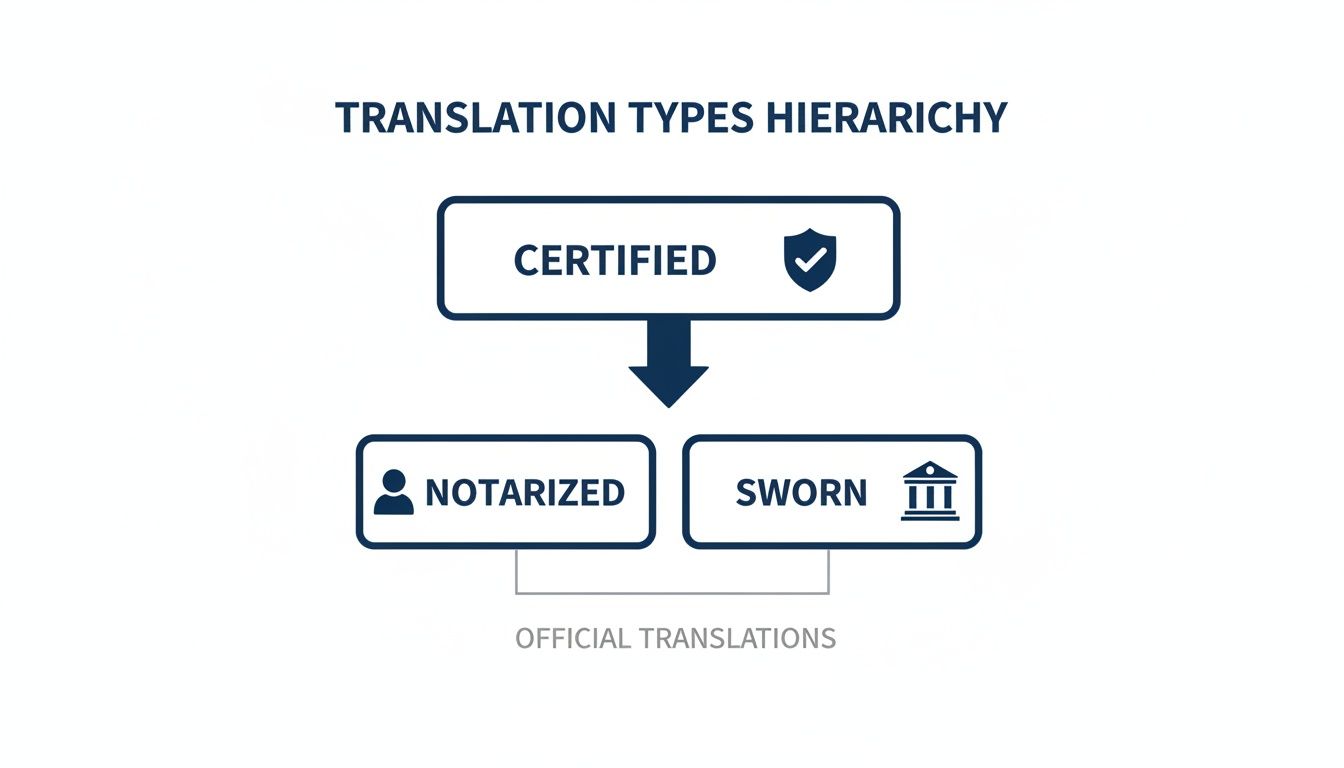
As you can see, a certified translation is the starting point. Depending on the legal system you're dealing with, you might need the extra layers of verification that come with notarized or sworn translations.
Legal and Business Papers
In the world of international business and law, a single mistranslated word can lead to costly legal disputes. Clarity and precision are mandatory.
This is a broad category, but some of the most common documents include:
- Contracts and Agreements: From employment offers to real estate deals, the terms must be identical in both languages.
- Court Orders: Legal rulings, such as custody agreements, that need to be enforced in another country.
- Patents and Trademarks: An inventor needs a meticulously translated patent to protect their intellectual property in global markets.
- Bank Statements and Financial Records: Often required for visa applications or international investments to prove financial stability.
- Wills and Testaments: Essential for ensuring inheritance matters are handled correctly across different legal systems.
Imagine an entrepreneur who invented a new medical device. To protect her invention in Japan, she needs a certified translation of her U.S. patent. The technical jargon and legal phrasing have to be translated with absolute precision, or her intellectual property rights might not hold up under Japanese law.
In all these cases, the goal is the same: the translated document must be a perfect mirror of the original. This requires deep expertise in the specific subject matter. For a clear breakdown of our pricing and turnaround times for these different document types, we keep things simple and transparent.
How to Get Your Documents Translated Step By Step
Many people assume getting a certified translation is a complicated and time-consuming process. The good news is, it's not. Modern services have made it incredibly straightforward. You can get a secure, official, and fully compliant translation delivered to your inbox, often in less than 24 hours.
Here’s a simple, step-by-step guide to the process.
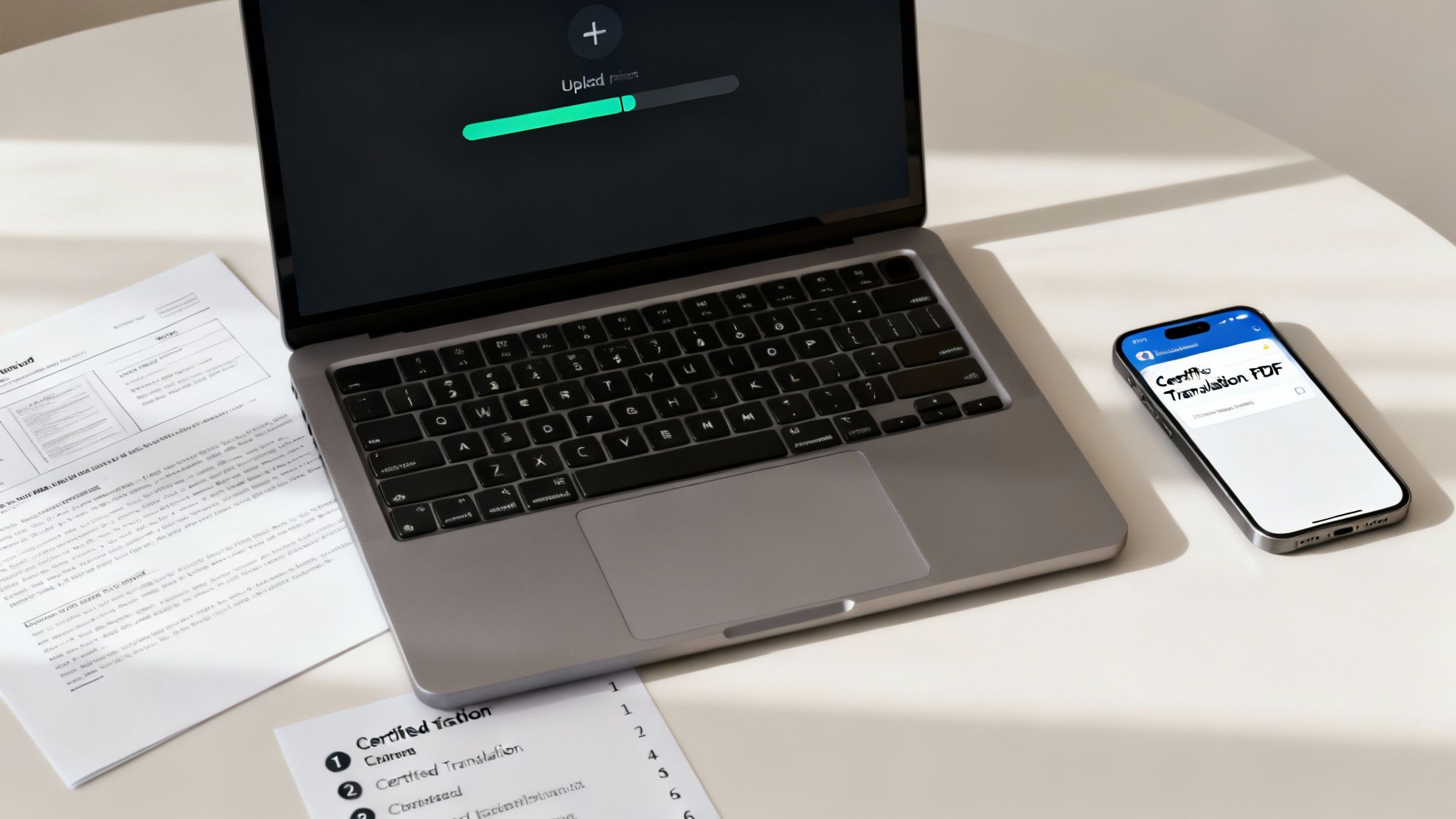
Step 1: Prepare Your Documents
First, you need a clear digital copy of your document. A high-quality scan is best, but a sharp, well-lit photo from your smartphone works perfectly well. The most important thing is that every word, stamp, and signature is easy to read. If the translator can't see it, they can't translate it.
Step 2: Get an Instant Quote
Next, upload your file to the translation service's secure online portal. Reputable companies use encryption to protect your private information. Once uploaded, you should receive an instant quote. This transparency is key—you'll know the exact cost before committing.
Step 3: Place Your Order Securely
If you're happy with the quote, place your order through their secure payment system. This signals the translation experts to begin. You’ll get a confirmation email immediately with an estimated delivery time. For common documents like birth certificates or diplomas, the turnaround is often a speedy 24 hours.
Pro Tip: If you're facing an urgent deadline, like a last-minute USCIS filing, look for an expedited service option. It may cost a little extra, but the peace of mind of meeting your deadline is often worth it.
Step 4: Human Translation and Quality Review
This is where the real work happens. A qualified human translator—fluent in both languages and an expert in legal terminology—will carefully translate your document. This is not a job for AI. Automated tools can't grasp the critical nuances and legal context required for official documents. For more complex needs, like corporate contracts, guides on English-Hebrew Document Translation for Businesses show just how specialized this work can be.
After the initial translation, a second professional linguist performs a quality assurance (QA) review. They double-check every name, date, and legal phrase to ensure 100% accuracy. This two-step, human-powered process is why certified translations are trusted by official bodies. While the legal translation market is projected to reach USD 7.46 billion in 2026, this commitment to human accuracy remains the foundation of the industry.
Step 5: Receive Your Certified Translation
Once the translation passes the QA check, it's finalized. You’ll receive a digital PDF in your email, which includes the translated document and the vital signed Certificate of Translation Accuracy. This file is ready for you to submit directly to USCIS, universities, courts, or any other institution.
From start to finish, the process is designed for security, speed, and your convenience. For an even deeper look, check out our guide on how to get a certified translation.
How to Choose the Right Translation Provider
Selecting a provider for your translation services for legal documents is the most important decision in this process. Choose well, and your application sails through. Choose poorly, and you risk costly delays and rejections.
This choice is about more than comparing prices. It’s about finding a trustworthy partner who delivers accuracy, reliability, and peace of mind. A great provider acts as your compliance expert, ensuring every word meets the demanding standards of bodies like USCIS or federal courts.
Here is a practical checklist to help you make a smart, informed decision.
Non-Negotiable Quality Standards
Before looking at the cost, ensure any potential provider meets these core quality benchmarks. This information should be easy to find on their website.
Guaranteed USCIS Acceptance: For any immigration-related document, this is a must. The provider must explicitly guarantee their certified translations meet all USCIS requirements. This is a firm commitment to compliance.
100% Human Translators: AI is useful, but not for legal documents. A professional service will only use qualified human translators who understand the nuances of legal language, cultural context, and proper formatting.
Professional Affiliations: Look for memberships in respected industry organizations like the American Translators Association (ATA). This shows the company adheres to high professional and ethical standards.
Evaluating Transparency and Security
Once you’ve confirmed their quality standards, look at how they operate. A top-tier service is open about its processes and dedicated to protecting your sensitive data.
You're handing over documents with your most personal information. Their security should be as strong as their translation skills.
A provider’s commitment to security reflects their professionalism. Look for clear statements on data encryption, secure upload portals, and strict confidentiality policies. Your personal data deserves the highest level of protection.
Similarly, pricing should be transparent. You need a clear, upfront quote with no hidden fees. A simple per-page or per-word rate helps you budget without surprises. This clarity is the hallmark of a customer-focused service. You can see an example of what this looks like by checking out our straightforward pricing and turnaround times.
Red Flags and Warning Signs to Watch For
Knowing what to look for is only half the battle; you also need to know what to avoid. When evaluating providers, vet them carefully, just as you would any of the other essential platforms for legal professionals. The legal translation field is a massive part of the global market, estimated at US$12.7 billion in 2024, and that size means quality can vary dramatically. You can read more about the document translation market trends to understand the landscape.
Here are some common red flags:
- Vague Certification Process: If they can't clearly explain what their certification includes, move on.
- Lack of Customer Reviews: A history of positive, verifiable reviews is a strong sign of a reliable company.
- No Physical Address or Phone Number: Anonymity is a major warning sign. You need to know who you're dealing with.
- Unrealistically Low Prices: If a price seems too good to be true, it likely is. Cheap services often cut corners with unqualified translators or machine translation, which puts your legal case at risk.
Choosing the right provider is about finding a partner invested in your success. By using this checklist, you can confidently find a service that delivers the precision and compliance your legal matter requires.
Your Questions About Legal Translations, Answered
When you're dealing with official paperwork, questions are bound to arise. To give you peace of mind, we’ve answered the most common questions we hear from clients in simple, clear terms.
How Much Does a Certified Translation Cost?
Pricing for certified translations is usually straightforward. Most providers charge a flat fee per page, where a standard page is defined as up to 250 words. This makes budgeting for a one-page birth certificate or diploma simple and predictable.
This per-page model means you know the exact cost upfront, with no surprises. For much longer documents, like business contracts or detailed court records, pricing might switch to a per-word rate to be fair to the amount of work involved.
Here’s a typical breakdown:
- Simple Documents (1-3 pages): Expect a clear, flat rate per page for things like birth certificates, marriage licenses, and driver's licenses.
- Complex Documents (4+ pages): The cost will likely be calculated per word to accurately reflect the detailed work required.
- No Hidden Fees: A trustworthy provider will never charge extra for the certification statement or the digital PDF delivery. That should always be included.
The key is clarity. You should be able to get an instant quote just by uploading your document.
How Long Will My Translation Take?
This is a critical question, especially with a USCIS or court deadline looming. The good news is that professional online services are built for speed without sacrificing quality.
For most standard documents—like civil certificates, single-page letters, or academic diplomas—a 24-hour turnaround is the industry standard. This is possible due to an efficient process that assigns your document to a qualified translator almost immediately.
Imagine this: you realize on Tuesday that your immigration application is due Friday, and you forgot to translate your marriage certificate. With a reliable service, you could upload it Tuesday evening and have the certified, ready-to-submit translation in your inbox by Wednesday.
For larger projects, like a multi-page legal agreement or a lengthy medical history, the timeline will be longer. A good provider will give you a clear delivery estimate with your quote, so you know exactly what to expect.
Will My Translation Be Accepted by USCIS?
For anyone navigating the U.S. immigration system, this is the most important question. The answer you get should be a firm and unequivocal yes. Any professional service handling translation services for legal documents for immigration must provide a 100% USCIS acceptance guarantee.
This guarantee is a promise that the translation follows every single USCIS rule, which includes:
- A complete and accurate word-for-word translation of the original document.
- A signed "Certificate of Translation Accuracy" from the translator or agency.
- The translator's name, signature, and contact information.
- The date the translation was completed.
This certification serves as an official record that USCIS trusts, proving that a qualified professional stands behind the translation's accuracy. This is a non-negotiable requirement. For more details, you can review our specific services for certified translations for USCIS.
Is It Safe to Send My Personal Documents Online?
Uploading sensitive documents like birth certificates, passports, or bank statements online can feel unnerving. That's why data security must be a top priority for any translation service you consider. Protecting your confidentiality is a fundamental part of their job.
A reputable agency uses multiple layers of security to keep your information private and protected.
Here’s what to look for in their process:
- Secure Website and Upload Portal: Check for "https://" in the site's address. The 's' means your connection is encrypted.
- Strict Confidentiality Policies: All translators and staff should be bound by a non-disclosure agreement (NDA), making them legally responsible for keeping your information private.
- Secure Payment Gateways: Payments should be processed through trusted, encrypted platforms like Stripe or PayPal.
- Data Deletion Protocols: A secure service should have a clear policy for permanently deleting your files from their servers after the translation is completed and approved.
Your personal information deserves the same level of security you’d expect from a bank or law firm. Don't settle for less.
At TranslateDay, we make certified translations simple, secure, and fast. With our expert human translators, guaranteed USCIS acceptance, and transparent pricing, you can move forward with confidence, knowing your documents are in safe hands.
Get an instant quote and take the next step in your journey today.