
Starting your immigration journey can feel overwhelming, especially when you're dealing with official papers from your home country. One of the most important rules is that any document you give to U.S. immigration authorities (like USCIS) that isn't in English must come with a certified English translation. Getting this right from the start can be the difference between a smooth process and a long, frustrating delay.
The Essential Role of Translations in Your Immigration Journey
Imagine a family excited about applying for their Green Cards, but their application suddenly stops. The reason? Their marriage certificate from their home country wasn't translated and certified correctly. This is a common story where a single piece of paper becomes a major problem. It shows why a professional translation for immigration is not just helpful—it's absolutely necessary.
The need for perfect translation becomes obvious when you think about all the paperwork involved in processes like securing a residence visa in a new country. Each document tells a part of your story, and for your application to be successful, the U.S. Citizenship and Immigration Services (USCIS) needs to read that story perfectly in English.
Why Certified Translations Are Non-Negotiable
Let's clear up what "certified translation" really means. It's not a special document from the government. Instead, it's a perfect, word-for-word translation of your original document that a professional translator or company guarantees is accurate.
This guarantee comes as a signed letter, often called a "Certificate of Translation Accuracy." This certificate promises two things: that the translator is skilled enough to translate from the original language into English, and that the translation is a complete and exact copy of the original. This is the seal of approval that makes a USCIS officer trust your documents.
The immigration system is massive, which is why this accuracy is so important. As of March 2025, USCIS was handling a backlog of over 2.39 million I-130 petitions, the forms for family-based Green Cards. In the first half of fiscal year 2025 alone, nearly 500,000 people applied for citizenship. With millions of applications in line, even a small mistake can push your file to the back of the queue.
Setting the Foundation for a Successful Application
Investing in a professional translation service for your immigration paperwork is an investment in your future. It's one of the easiest ways to avoid a rejection because of a bad translation—a completely preventable mistake that trips up too many people.
By making sure every birth certificate, marriage license, and bank statement is perfectly translated and certified from the beginning, you're building a strong, believable case. You can explore specific USCIS translation needs in our immigration section to learn more.
What Exactly Is a Certified Translation for USCIS?
When you hear "certified translation," you might imagine a complicated, government-stamped paper. The reality is much simpler.
A certified translation for immigration is just two things put together: a complete, word-for-word English translation of your original document, plus a signed letter from the translator or translation company vouching for it.
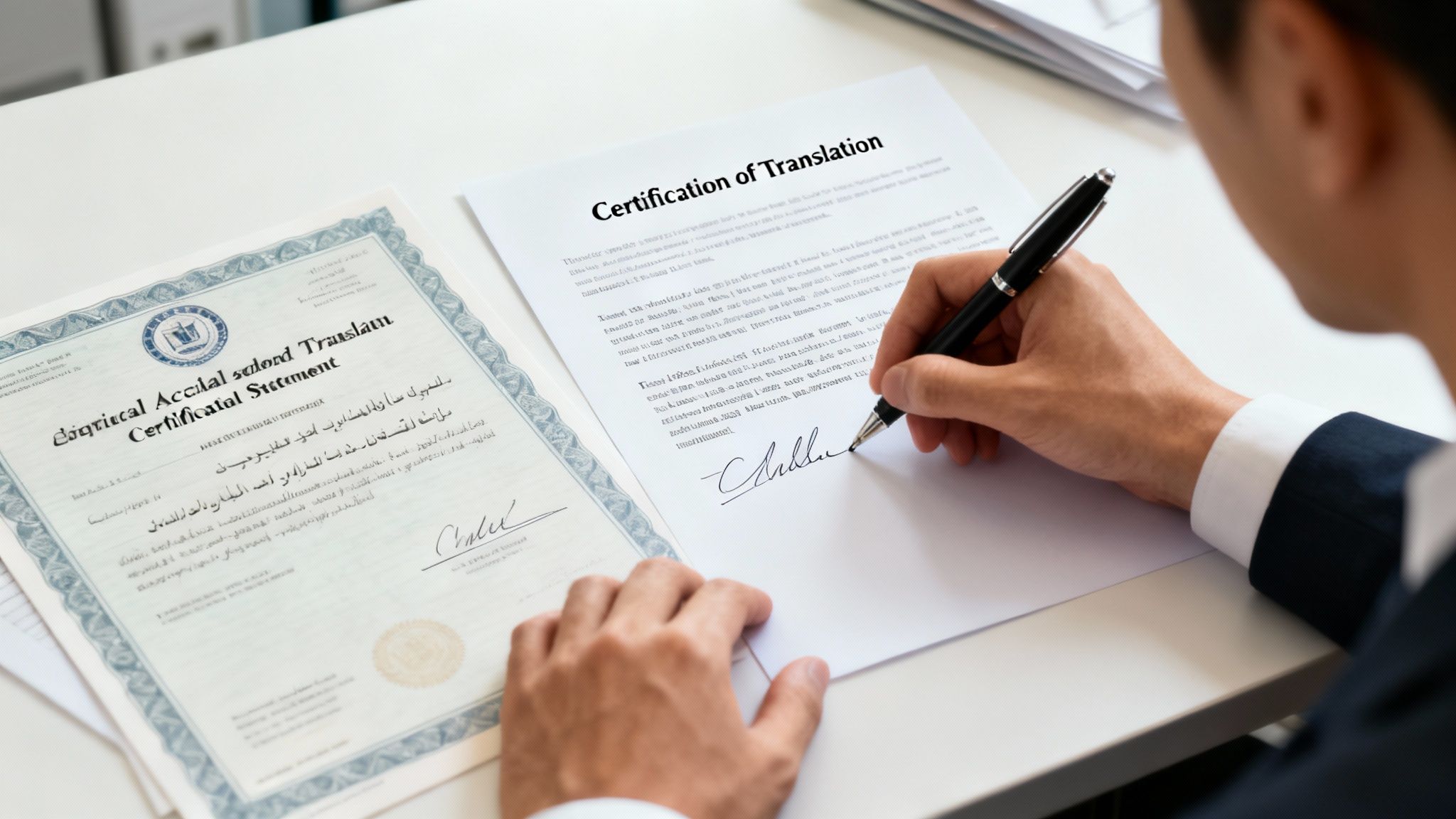
That signed letter is the key. It’s called a Certification Statement, and it's a professional promise, not a government seal. The statement simply confirms that the translation is accurate and the person who did it is fluent in both languages.
This certification is what makes your translated document official in the eyes of U.S. Citizenship and Immigration Services (USCIS), the agency handling your case.
The Anatomy of a USCIS-Compliant Certification
So, what does this certification letter need to say? It should give the immigration officer all the essential information at a glance.
To be accepted by USCIS, every certification must include these five key details:
- A statement of accuracy: A simple sentence declaring the English version is a complete and accurate translation.
- Translator's credentials: A statement confirming the translator is competent to translate from the original language into English.
- Identification of the document: It must clearly name the document, like "Birth Certificate of Jane Doe."
- Contact information: The name, signature, and contact details of the translator or company representative.
- Date: The date the certification was signed.
If any of these things are missing, USCIS might put your case on hold and send you a Request for Evidence (RFE), which always causes long delays. You can review the official USCIS translation requirements for more details.
A Real-World Example: A Student Visa Application
Let's see how this works in a real situation. Maria, a student from Brazil, has been accepted to a U.S. university. To get her student visa, she needs to submit her academic transcripts, which are the official records of her grades. Her transcripts are in Portuguese. Even if Maria speaks perfect English, she can't translate them herself.
Instead, she uses a professional service. The final package she receives includes two parts:
- The English translation of her transcripts, formatted to look just like the original.
- A separate page with the Certification Statement, signed and dated, confirming the translation is accurate and the translator is fluent in Portuguese and English.
This complete package is exactly what the U.S. consulate needs. The visa officer can now confidently review her academic history without questioning the translation.
Certified vs. Notarized Translations: A Key Distinction
One of the most confusing parts for applicants is the difference between "certified" and "notarized" translations. They sound similar, but they do different things.
A certified translation is about the quality of the translation. The translator guarantees it's accurate. A notarized translation, however, is about verifying the identity of the person who signed the certification. A Notary Public is an official who witnesses the translator signing the document and then adds their own stamp (a notary stamp) to confirm it was really them. The notary does not check the translation itself.
Certified vs Notarized Translations: What USCIS Requires
| Feature | Certified Translation | Notarized Translation |
|---|---|---|
| Primary Purpose | To confirm the accuracy of the translation. | To verify the identity of the person signing. |
| Who Signs It? | The translator or a translation company representative. | A Notary Public (in addition to the translator). |
| What It Guarantees | The translation is complete and correct. | The signature on the document is authentic. |
| USCIS Requirement | This is what USCIS requires for immigration filings. | Generally not required by USCIS. |
Key Takeaway for USCIS: For almost all immigration applications, USCIS requires a certified translation. They do not require notarization. Paying extra for a notary stamp is usually an unnecessary expense unless you've been specifically asked for one, perhaps for a separate court case.
Focus on getting a proper certified translation from a trusted service. It’s the simplest and most reliable way to meet official requirements.
Common Documents That Require Translation
When you gather your paperwork for immigration, you'll see that your life story is told through official documents. Each one—from a birth certificate to a school diploma—has a purpose. If any of these papers are not in English, you will need a professional, certified translation for them to be understood by U.S. authorities.
Think of your application as a puzzle. Each translated document is a piece that must fit perfectly to show the USCIS officer the full picture. If even one piece is missing or incorrect, it can cause confusion and lead to serious delays.
Civil and Personal Identity Documents
These are the most common documents in immigration. Civil certificates, like birth or marriage certificates, are the foundation of your identity and family relationships.
- Birth Certificates: This is the primary document to prove who you are, your age, and your parents. A certified translation of your birth certificate is essential for nearly any family-based visa, Green Card, or citizenship application.
- Marriage Certificates: This is crucial proof of a legal marriage, required for spousal visas and other family applications.
- Divorce Decrees: If you or your spouse were married before, you must provide a translated divorce decree to show all previous marriages were legally ended.
- Adoption Papers: For families adopting a child from another country, translated adoption decrees and the child's original birth certificate are mandatory.
- Death Certificates: This document is needed to prove a prior marriage ended due to a spouse's death or to establish inheritance rights.
Academic and Professional Records
These documents showcase your education and work experience. They are very important for employment-based visas (like H-1B), student visas (F-1), and any application where your skills are being evaluated. An academic transcript is the official record of your courses and grades.
- Academic Transcripts and Diplomas: These show your educational history and prove you meet the requirements for a school program or a specific job.
- Professional Licenses or Certifications: If you are in a licensed profession like medicine or engineering, a translated copy of your license is needed to get your credentials recognized in the U.S.
Legal, Financial, and Medical Paperwork
This category includes documents that support other parts of your case, such as proving you can support yourself financially, clearing up legal issues, or addressing medical requirements.
The U.S. immigration court system is under immense pressure. In the first 11 months of fiscal year 2025, judges completed over 722,000 cases, yet 3.75 million are still pending. In this high-stakes environment, evidence must be perfect. An untranslated legal document is not a small mistake—it's a critical error. You can learn more about how legal translation services shape immigration outcomes on languageconnections.com.
A Real-World Scenario: The Adoption Journey
Imagine a couple adopting a child from Colombia. They needed certified translations of the child's birth certificate to prove identity, their own marriage certificate to show they were a stable couple, and the official Colombian adoption decree to prove they were legal guardians. Additionally, the child's medical records had to be translated to meet U.S. health requirements. Each translated document was a crucial step in bringing their child home.
This example shows how different documents work together to build a strong immigration case. Making a checklist and getting every required document professionally translated is one of the smartest things you can do.
How to Get Your Documents Translated Step by Step
Feeling buried in paperwork? It's a common feeling, but getting your documents translated doesn’t have to be stressful. By following a clear process, you can get it done correctly and avoid delays. Let's walk through the steps, from gathering your documents to receiving the final certified translation.
Step 1: Gather and Scan Your Original Documents
First, you need high-quality digital copies of your original documents. You don't need to mail the physical papers—in fact, it's safer not to. A scanner or even your smartphone camera can work well.
Make sure every part of the document is clear and easy to read, including:
- All text and numbers, with nothing cut off.
- Stamps, seals, and signatures, even if they are faint.
- The entire front and back of the page if there is information on both sides.
Pro Tip: Save your files as high-resolution PDFs or JPEGs. A blurry scan can lead to translation errors, which might trigger a Request for Evidence (RFE) from USCIS.
Staying organized is key. Following good document management best practices will help you keep track of everything and avoid last-minute stress.
Step 2: Choose a Reputable Translation Service
This is the most important decision. Not all translation providers are the same. Your top priority is finding a service that specializes in certified translations for immigration and guarantees USCIS acceptance.
Here’s what to look for in a trustworthy service:
- A Public USCIS Acceptance Guarantee: They should promise their translations will be accepted by USCIS.
- Transparent Pricing: You should know the exact cost upfront. Look for a clear, flat rate per page to avoid surprises.
- Professional Affiliations: Membership in organizations like the American Translators Association (ATA) is a good sign of quality.
- Positive Customer Reviews: See what other immigration applicants have said about their experience.
Step 3: Upload Your Files and Place Your Order
Once you've chosen a service, the next step is simple. Most services have a secure website where you can upload your scanned documents. You'll select the original and target languages (e.g., Spanish to English) and tell them how many pages you have. This online process makes getting translations fast and convenient.
Step 4: Review and Receive Your Certified Translation
For standard documents of 1-3 pages, many professional services can complete the translation within 24 hours. When it's ready, you'll typically receive an email with two attachments:
- The Translated Document: A word-for-word translation, formatted to look like the original.
- The Certificate of Translation Accuracy: A signed statement on company letterhead confirming the translation is accurate.
This two-part package is exactly what USCIS needs. Print both documents, attach them to your application, and keep digital copies for your records.
This chart breaks down the most common document types.
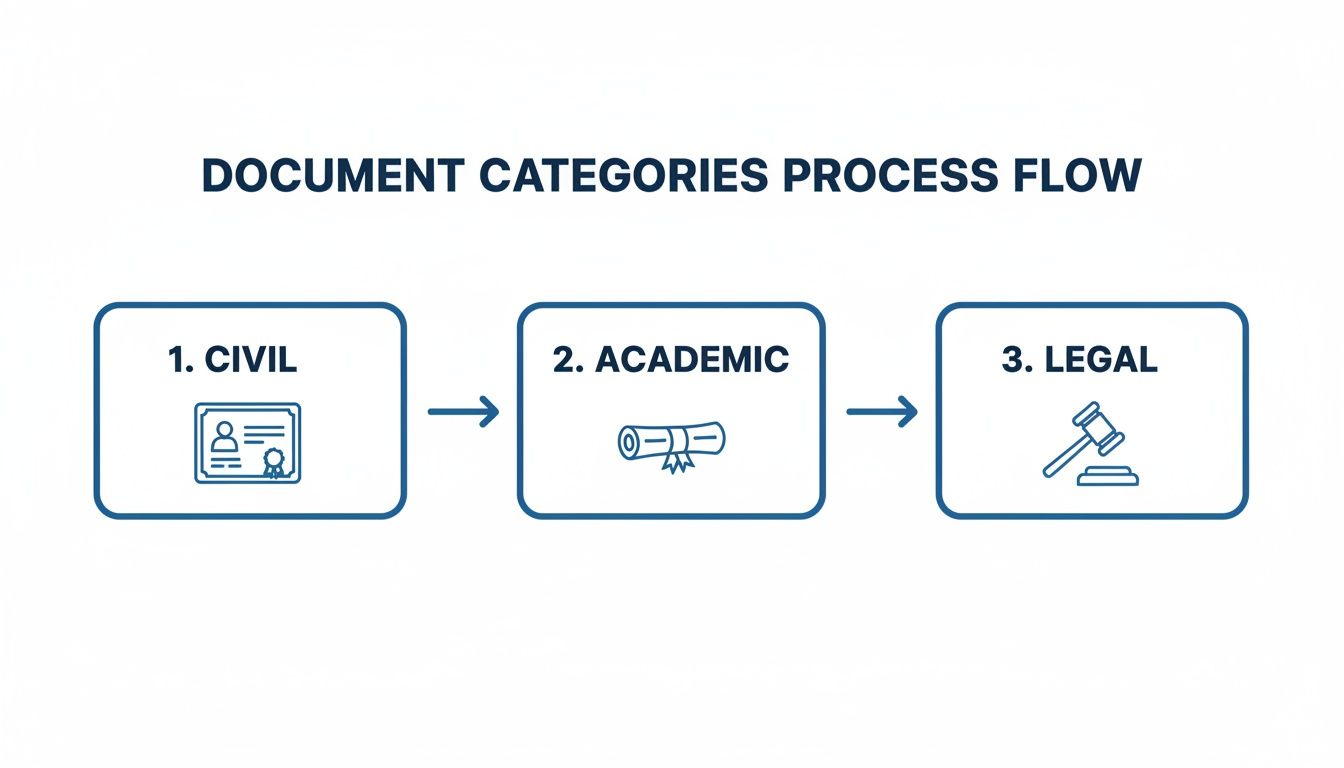
As the visual shows, your paperwork usually falls into one of three buckets—civil, academic, or legal—and each one helps build a complete picture for immigration officials.
A Real-World Example: A Tech Professional on a Deadline
Let's see this in action. A software developer was trying to meet a tight H-1B visa deadline. Days before the cutoff, he realized his university diploma and academic transcripts from India needed to be translated.
Under pressure, he found an online service guaranteeing a 24-hour turnaround. He scanned and uploaded his documents on a Friday evening. By Saturday afternoon, the complete, USCIS-compliant translation package was in his inbox. This allowed him to submit his application on time, saving his job offer. His story shows how a professional, efficient service can be a lifesaver when you're against the clock.
Common Mistakes That Can Derail Your Application
A small mistake on a translated document can cause a huge problem for your immigration case. It can lead to long delays, a Request for Evidence (RFE) from USCIS, or even a rejection. The process is already complicated; you don't need a preventable error holding you back.
Let's review the most common mistakes so you can avoid them.
Translating Documents Yourself
This is the biggest mistake people make. Even if you are fluent in English and your native language, you cannot translate your own documents for a USCIS application. USCIS considers this a conflict of interest because you are not an impartial person in your own case.
An official translation for immigration must be objective. The certification statement is a professional's guarantee that the translation is accurate and unbiased—something you, as the applicant, cannot provide for your own file.
Using a Friend or Family Member
Just like doing it yourself, asking a friend or family member is not allowed. They may want to help, but USCIS does not consider them a neutral source.
For example, your cousin, who speaks fluent English, translates your birth certificate. They accidentally swap the day and month to match the U.S. date format. USCIS sees this inconsistency, sends an RFE, and your case is delayed for months. This is why you need a professional.
"USCIS requires an impartial, third-party translation to ensure objectivity. Self-translations, or those done by relatives, are considered a conflict of interest and are not accepted."
Hiring a professional service ensures accuracy and meets all USCIS rules.
Submitting a Summary Instead of a Full Translation
Immigration officers need to see everything. Submitting a summary or a partial translation will get your document rejected.
The rule is simple: every word, stamp, and seal from the original document must be translated. Nothing can be left out. If something is hard to read, the translator must note it (e.g., "[Signature]", "[Seal]", or "[Illegible]"). This shows the translation is a complete and faithful copy. You can get a better sense of what this requires by reviewing our detailed translation process information.
Ignoring Formatting and Layout
A good translation should look as much like the original document as possible. This helps the USCIS officer compare the two documents side-by-side to verify information quickly.
A translation that is just a block of text is confusing and slows the review process. Professional services, like our certified translation service, take care to match the original's structure. This attention to detail shows professionalism and makes the officer's job easier.
Checklist to Avoid Common Translation Errors
Use this checklist before you submit your translated documents to make sure you have met all USCIS requirements.
| Checklist Item | Why It Matters | Status (Yes/No) |
|---|---|---|
| Translation done by an impartial third party? | USCIS prohibits self-translations or translations by friends/family due to conflict of interest. | |
| Is a signed Certificate of Translation included? | This statement from the translator confirms the accuracy and completeness of the work. | |
| Is the translation a complete, word-for-word copy? | Summaries or partial translations are not accepted. Every stamp and seal must be noted. | |
| Does the formatting mirror the original document? | A similar layout makes it easier for the USCIS officer to review and verify the information. | |
| Are all key details (names, dates, places) correct? | A simple typo can lead to a Request for Evidence (RFE) and significant delays. | |
| Is a copy of the original source document included? | USCIS requires both the original document and the certified translation for comparison. |
Taking a few minutes to check these points can save you months of stress.
How Long Does It Take and What Does It Cost? A Look at Translation Timelines and Pricing
When you have an immigration deadline, two questions are always on your mind: "How fast can I get this?" and "How much will it cost?" Understanding the time and price for your translation for immigration is key to a smooth process.
The good news is that for most standard, single-page documents—like a birth certificate, marriage license, or diploma—many professional services offer a 24-hour turnaround. This speed can be a lifesaver when you're on a tight schedule.
What Determines the Turnaround Time?
The time it takes to get your translation back depends on a few factors:
- Length: A three-page bank statement is much quicker to translate than a 20-page legal contract.
- Complexity: A standard birth certificate is simple. A technical medical report or a complex legal document requires a translator with special expertise, which can take more time.
- Language Pair: Translating common languages like Spanish to English is generally faster. Translating from a less common language might take an extra day or two.
I remember an asylum seeker who had an urgent court deadline. They had a stack of witness statements in a specific dialect that needed to be translated and certified in just 48 hours. Finding a service that could guarantee that fast turnaround was the only way they met the court's deadline. This shows how critical a reliable turnaround time can be.
Breaking Down the Cost of Translation
Pricing for translation is usually based on a per-word or per-page rate. For immigration documents, a flat-rate per-page pricing model is often the clearest and most affordable option. It eliminates guesswork, so you don't face unexpected fees for formatting or the certification itself. We built our transparent pricing structure around this simple idea.
The translation industry is closely linked to immigration trends. It reached a $75 billion valuation in 2025 and continues to grow. Legal and medical translations, which are essential for USCIS applications, now make up nearly a quarter of that revenue because there is no room for error. With U.S. agencies handling over 1.2 million Green Card applications annually, you can see why fast, dependable services are so important. You can read more about these translation industry trends on brightlinestranslation.com.
Ultimately, when you pay for a certified translation service, you're paying for accuracy, USCIS compliance, and peace of mind. It’s a smart investment to ensure your documents are accepted without issue.
A Few Common Questions About Immigration Translations
Navigating immigration paperwork always brings up questions. Let's answer some of the most common ones about getting documents translated for your application.
Do I Need to Mail My Original Documents?
No, you do not. In fact, you should keep your original documents in a safe place. Reputable online translation services work with high-quality digital copies.
A clear scan or a well-lit photo from your phone is all they need. This protects your important papers from getting lost in the mail and allows the translators to start working right away.
What If My Original Document Has a Typo?
This is a great question. A certified translator's job is to create an exact, word-for-word copy of the original document—including any mistakes, like typos.
They cannot change the original. If you find an error on your birth certificate or another official record, you should contact the office that issued it and request a corrected version before you have it translated.
I'm Fluent—Can I Just Translate the Documents Myself?
Even if you are perfectly fluent, USCIS does not allow you to translate your own documents. The same rule applies to translations from family members or friends.
Immigration officials require a translation from an impartial third party. This eliminates any conflict of interest and gives them confidence that the translation is an unbiased, accurate copy of the original.
How Do I Know If a Translation Service Is Legitimate?
Choosing the right service is very important. Here are four things to look for to ensure a company is trustworthy and meets USCIS standards:
- A Clear USCIS Acceptance Guarantee: They should state clearly that their certified translations are accepted by USCIS.
- Professional Affiliations: Membership in groups like the American Translators Association (ATA) shows a commitment to professional standards.
- Straightforward Pricing: You should get a clear, upfront price. A flat rate per page is usually a good sign.
- Real Customer Reviews: See what other people going through the immigration process have said. Honest feedback is a great way to judge a company's reliability.
At TranslateDay, we deliver fast, accurate translations that are guaranteed to be accepted by USCIS. Our professionals understand exactly what's needed for your application to go smoothly. Get an instant quote and take the next confident step in your immigration journey.


