
When preparing your immigration case for U.S. Citizenship and Immigration Services (USCIS), one rule is absolute: any document not in English must be submitted with a complete, certified English translation. This isn't just a suggestion; it's a strict requirement. You can't simply run your birth certificate through an online tool or ask a bilingual family member to help. You need a formal, signed statement from a competent translator who vouches for the translation's completeness and accuracy. Anything less is a direct path to a Request for Evidence (RFE), which can stall your case for months.
Why a Certified Translation Is Non-Negotiable for USCIS
Imagine this scenario: After months of gathering documents and carefully filling out forms, you finally submit your Green Card application, feeling a huge sense of relief. Weeks later, a dreaded RFE arrives in the mail, derailing your timeline—all because the translation of your marriage certificate didn't meet USCIS standards.
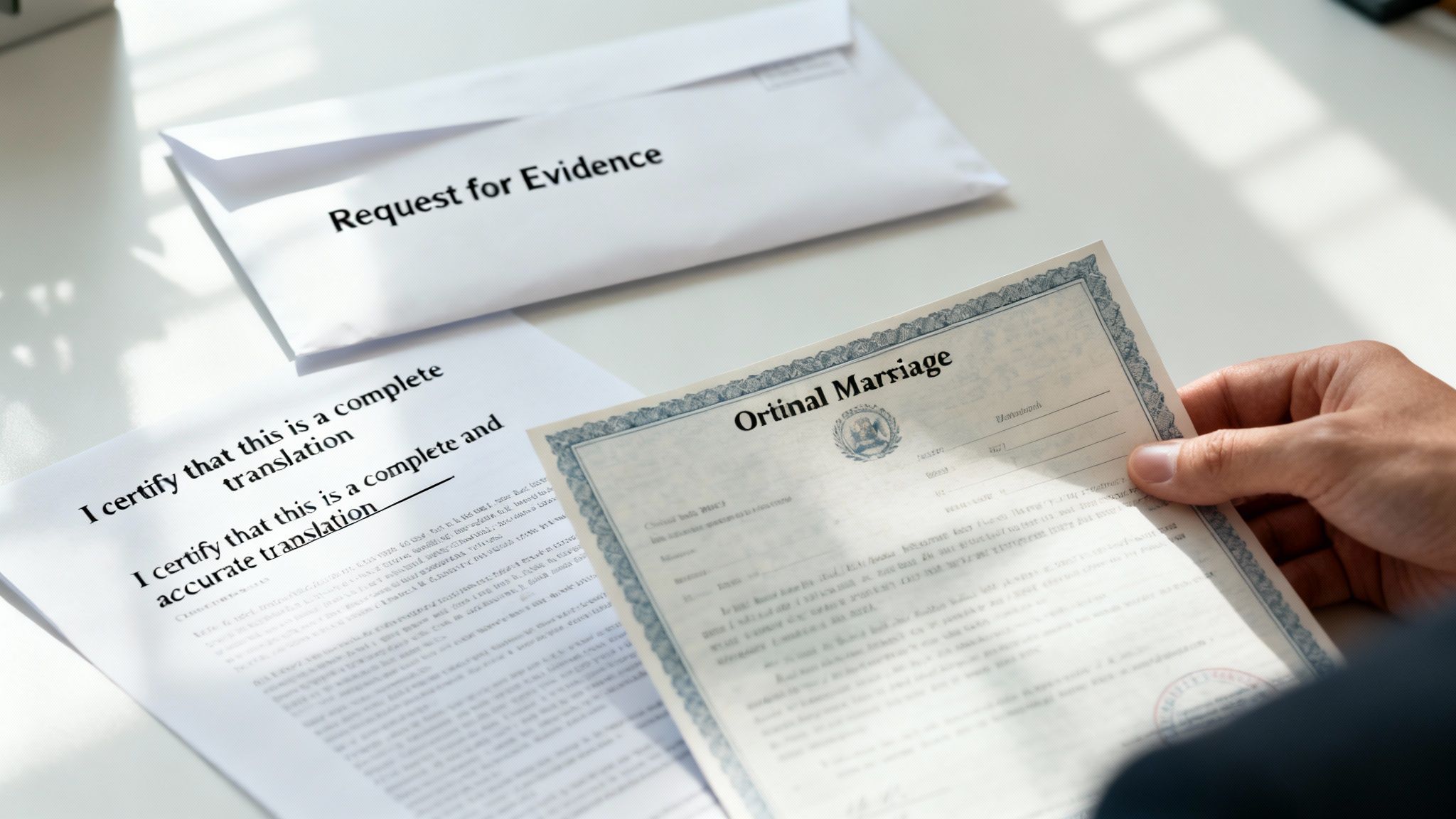
This is a common reality for many applicants. USCIS, the government agency handling immigration, has a legal process to follow. When they ask for a certified translation, it's because they need concrete proof of two key things:
- Competence: The person who translated the document is fluent in both English and the original language.
- Accuracy: The English text is a true, complete, and word-for-word reflection of the original document.
The Impact of Today's Massive Backlogs
The U.S. immigration system is under immense pressure. With a backlog of pending cases reaching nearly 11.3 million in early 2024, USCIS officers are overwhelmed with paperwork. They don’t have the time or resources to second-guess a questionable translation or try to decipher a foreign-language certificate.
Any document that doesn't meet their clear-cut standards gets flagged. It’s the fastest way to receive an RFE, which can easily add months of frustrating delays to your case.
A professional, certified translation acts as your best defense against preventable delays. It signals to the reviewing officer that your documents are clear, reliable, and ready for a smooth review—something they desperately need in today's high-volume environment.
It's About More Than Just the Words
A common mistake is assuming that as long as the text is translated correctly, you're good to go. That's only half the battle. USCIS expects the translation to mirror the original document's format and layout as closely as possible.
Why? The officer needs to look at the original and the translation side-by-side and easily match up names, dates, and official markings. This includes the placement of stamps, seals, signatures, and even handwritten notes. For example, a birth certificate from Mexico often has official stamps in specific spots. A proper translation will indicate their presence and location with a simple note in brackets, like [Official Seal of the Civil Registry] or [Illegible Signature]. Leaving these details out makes the document seem incomplete and can raise red flags.
USCIS Translation Requirements at a Glance
This table breaks down the core requirements for any translated document you submit, making it easy to see what you need.
| Requirement | What It Means in Simple Terms | Why It's Critical for USCIS |
|---|---|---|
| Complete Translation | Every single word from the original must be translated. This includes text on stamps, seals, and notes in the margins. | Ensures the officer has the full context and no crucial information (like expiration dates or legal clauses) is missing. |
| Certification by Translator | A separate statement signed by the translator declaring the translation is accurate and that they are competent to translate. | This is the official proof USCIS needs to trust the translation without verifying it themselves, saving them valuable time. |
| No Notarization Needed | USCIS does not require the translator's certification statement to be notarized by a Notary Public. | Simplifies the process and saves you an extra step and expense. The translator's signature is what provides the legal weight. |
| Original Copy Included | You must submit a photocopy of the original foreign-language document along with the certified English translation. | Allows the USCIS officer to compare the translation directly against the source document to verify names, dates, and other key details. |
Getting these four things right is the foundation of a successful submission. For a more detailed breakdown, you can always check the official USCIS translation requirements. Following these rules is non-negotiable if you want your application to move forward smoothly.
Which Immigration Documents Require Translation
When putting together your USCIS application, it’s easy to get lost in the details. One of the most critical rules is about your documents. USCIS has a very clear policy: any official document you submit that isn't in English must come with a complete, certified English translation.
This rule is absolute. It applies to everything, from a one-page police clearance report to a handwritten note on the side of a marriage license. These are often called civil certificates—official records issued by a government authority, such as birth, marriage, or death certificates. Everything must be translated and certified, or you risk delays.
Common Documents by Application Type
While every case is unique, a core group of documents appears in most applications. Let's walk through the usual suspects for some of the most common scenarios.
For Green Card and Adjustment of Status Applications (I-485)
Let's say Maria is applying for a Green Card after marrying a U.S. citizen. To approve her case, USCIS needs proof of her identity, evidence that her relationship is genuine, and confirmation she is legally eligible to immigrate. She will likely need translations for:
- Birth Certificate: This is the primary proof of identity and family ties. A proper birth certificate translation is one of the first things to get in order.
- Marriage Certificate: The official document proving her legal partnership. If she was married overseas, the foreign certificate needs a certified translation.
- Divorce Decrees or Death Certificates: If Maria or her spouse were married before, they must submit translated copies of any documents proving those previous marriages were legally ended.
- Police Clearance Certificates: Depending on her history, she may need official records from every country she’s lived in, proving she doesn’t have a criminal record.
For Fiancé(e) Visas (K-1) and Citizenship (N-400)
Whether you're proving your intention to marry for a K-1 visa or documenting your entire history for naturalization, the paperwork can feel similar, but the focus shifts.
- Proof of Relationship: For K-1 visas, this could include personal letters or sworn statements from friends and family originally written in another language.
- Civil Documents: Just like with the I-485, you'll need things like birth, marriage, and divorce certificates to paint a clear picture of your life story and identity.
A Quick Reality Check: The need for accurate translations is massive. USCIS granted lawful permanent residence to nearly 1.2 million people in 2023. With median processing times for I-130 petitions now averaging 14.5 months in 2025, a simple mistake in your paperwork can push your timeline back even further. You can find more USCIS processing statistics on thelanguagedoctors.org.
Why USCIS Only Requires Certified Translations, Not Notarized
Here’s a point that trips up many applicants: the difference between a certified translation and a notarized translation. A certified translation is what USCIS requires. It's a translated document accompanied by a signed statement from the translator or translation company. This statement, often called a "Certificate of Translation Accuracy," affirms two things: the translation is complete and accurate, and the translator is fluent in both languages.
A notarized translation adds an extra step that is unnecessary for USCIS. In this case, a Notary Public watches the translator sign the certificate and then adds their official seal or notary stamp. This doesn't verify the quality of the translation; it only verifies the identity of the person who signed the certification. Since USCIS doesn’t require it, paying extra for notarization for your immigration application is a waste of money.
What Goes Into a Proper USCIS Certification Letter?
The certification letter is the most critical piece of your translated document package. It’s a formal statement that gives your translation legal standing in your immigration case. USCIS officers are trained to look at this letter first, scanning for key phrases that prove it meets their standards. Think of it as the translator's professional oath—they are putting their name on the line, declaring that the English version is a complete and accurate mirror of the original.
Let's look at the official guidance straight from the source. The USCIS Policy Manual is crystal clear on what they expect.
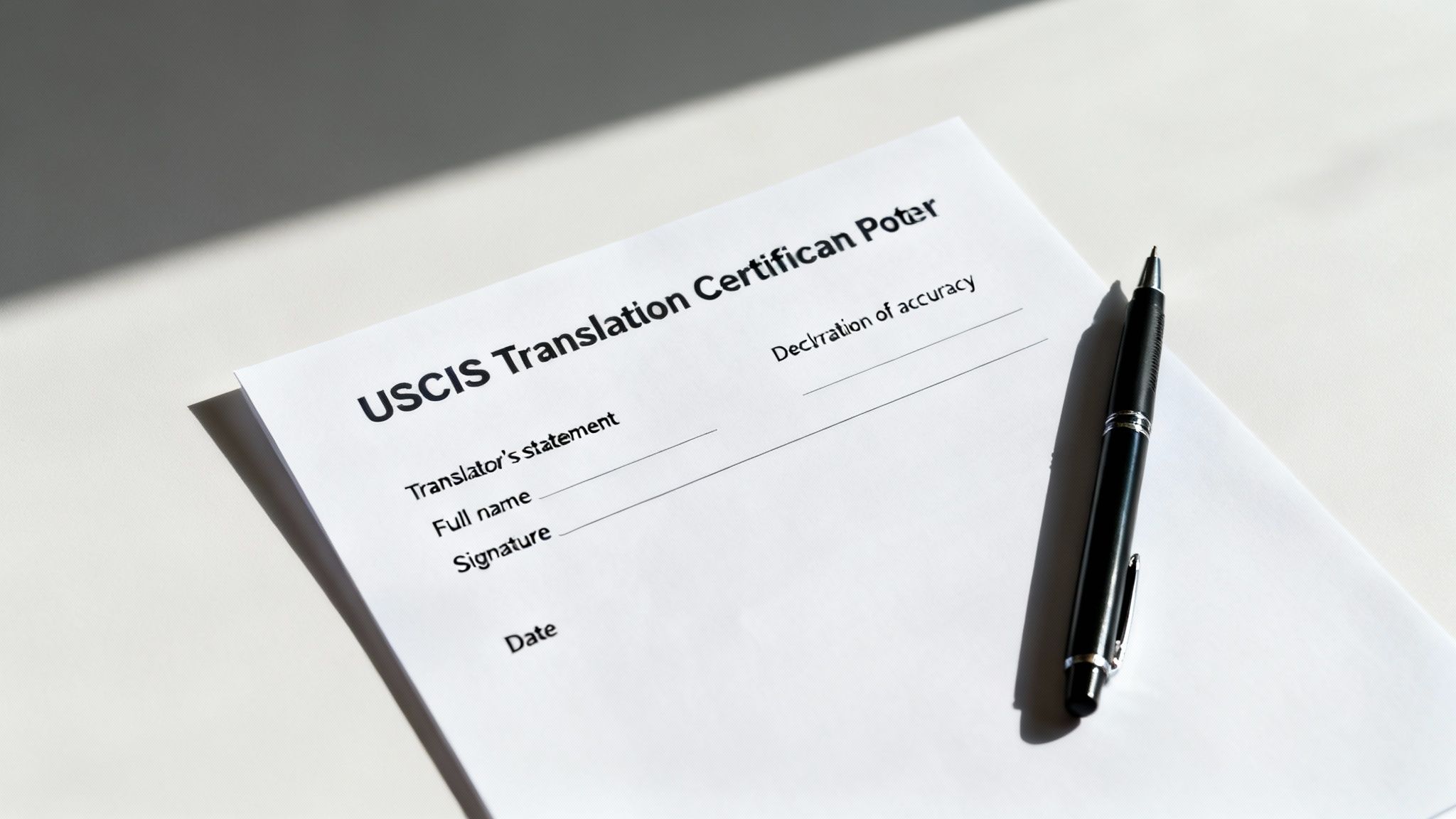
The screenshot shows the core requirement: a certification from the translator confirming two things: they are competent, and the translation is accurate. It's important to note what isn't mentioned—there's no requirement for notarization or for the translator to have specific professional credentials. The entire focus is on that signed statement.
The Four Must-Have Elements of a Certification Letter
To ensure your certification letter is compliant, it needs four essential components. An application can be delayed for missing just one of these, so it pays to get it right the first time.
- A Statement of Competence: The letter must clearly state that the translator is competent to translate from the original language into English.
- A Statement of Accuracy: The translator must affirm the translation is "complete and accurate." These specific words are crucial, as USCIS officers are trained to look for them.
- The Translator's Information: The letter must provide the translator’s full name, signature, and current address for accountability.
- The Date: The date the translator signed the certification must be clearly listed.
A Sample USCIS-Compliant Certification Letter
Here’s a straightforward, effective template. Any professional translation service will provide something very similar.
Certificate of Translation Accuracy
I, [Translator's Full Name], hereby certify that I am fluent in English and [Source Language], and that the foregoing document is a true, complete, and accurate translation of the attached document, titled [Original Document Title].
Signature: _________________________
Printed Name: [Translator's Full Name]
Address: [Translator's Full Street Address]
Email: [Translator's Email Address]
Date: [Month, Day, 2026]
This format is clean, direct, and gives the reviewing officer everything they need at a glance.
A Word of Warning: You Can't Certify Your Own Translation
I often get this question: "I'm fluent in both languages. Can I just translate and certify my own birth certificate?" The answer is a hard no. USCIS considers this a conflict of interest. As the applicant, you cannot act as the impartial third party verifying your own documents. This is why you must use a professional service or a competent, unrelated third-party translator. For a deeper dive, our guide on certified and notarized translations can help clarify these distinctions.
Common Translation Mistakes That Get Your Application Rejected
Navigating the USCIS translation process can feel like a minefield. The best way to sidestep delays is to know what trips people up before you start. Many applicants try to save time and money, but some shortcuts are almost guaranteed to backfire and can make an immigration officer question your entire application.
Relying on Friends, Family, or Unofficial Translators
This is the most common mistake. It’s tempting to ask a bilingual friend for help, but USCIS sees them as biased. Even with the best intentions, they lack the professional training to handle the specific requirements of a legal translation. For example, a cousin might skip over a section they think is irrelevant or mistranslate a legal term, creating major confusion for the USCIS officer.
A professional translation isn’t just about swapping words. It's about meticulously preserving the legal integrity and precise meaning of the source document.
Using Machine Translation Tools
Yes, tools like Google Translate are impressive in 2026, but they have no place in your official USCIS submission. These platforms are built for casual conversation, not the rigid formatting and specific terminology found in legal documents like court records or academic transcripts (official records of a student's courses and grades).
Submitting a machine-generated translation is a fast-track to rejection. Legal translation studies show that 17% contain grammar errors and 14% have vocabulary errors—exactly the kind of mistakes that get a file flagged. Some legal experts estimate that such errors can add over $15,000 to a case's cost, and machine translations often lead to automatic rejection in immigration court. You can find more details on court-compliant translation standards at Leaders-in-Law.com.
Submitting Partial or Summary Translations
Imagine you have a ten-page legal document, and most of it seems like boilerplate. It might seem reasonable to translate only the key pages. This is a critical error. The USCIS policy is strict: you must provide a complete, word-for-word translation of the entire document.
- The Mistake: Translating only what you think are the "important" parts.
- The Fix: Every single word must be translated. This includes all text in stamps, seals, and even handwritten notes. Anything that can't be translated, like a signature, should be noted in brackets (e.g.,
[Signature]or[Official Seal]).
The officer has no idea what you’ve left out and must assume the document is incomplete, forcing them to issue an RFE.
Forgetting to Include Both Documents
Even a perfect translation will cause problems if you don't submit it correctly. For every translated document, your package needs two things:
- A clean photocopy of the original document in the foreign language.
- The certified English translation, which must include the signed Certificate of Translation Accuracy.
Forgetting the original is a surprisingly frequent oversight. The officer needs to compare the translation against the source to confirm it’s accurate. Without both, your evidence can't be verified. To avoid these preventable delays, consider our straightforward, compliant certified translation services.
Request a certified translation today and get your application right from the start.
Getting Your Certified Translation Without the Hassle
Once you know the common mistakes, the next step is finding a reliable way to get your documents translated. The good news is that securing a USCIS-compliant certified translation in 2026 is easier than ever. You can get everything done online in just a few minutes, allowing you to focus on the rest of your application with confidence.
A Simple Path to a USCIS-Guaranteed Translation
The process is designed to be efficient and stress-free, turning a major hurdle into a simple checklist item.
- Prep Your Documents: Scan or take clear, well-lit photos of your documents. High-quality PDFs or JPGs are fine. Just make sure you capture the entire page, including all corners and stamps.
- Get an Instant Quote: A reputable service will offer transparent pricing upfront. You upload your files, and the system calculates the cost. No surprises. You can see how our translation pricing works for a clear example.
- Securely Upload and Order: Happy with the quote? You can securely upload your files and place your order. Professional companies use encrypted platforms to protect your sensitive information.
- Receive Your Certified Translation: For most standard documents (like a birth certificate, usually 1-3 pages), the turnaround is incredibly fast—often within 24 hours. You’ll get a digital PDF of the certified translation, complete with the required certification, ready to print and include in your USCIS package.
Key Features That Give You Peace of Mind
When choosing a translation service, a few things are non-negotiable. These guarantees protect your application from delays.
- USCIS Acceptance Guarantee: This is the most important promise a service can make. It means they stand behind their work and guarantee USCIS will accept their translations. If there's an issue, they'll fix it immediately at no extra cost.
- Professional Human Translators: Your important documents should be handled by experienced human linguists, never by automated software. This is crucial for accuracy and understanding the nuances of legal terminology.
- ATA Membership: Look for a service that's a member of a professional organization like the American Translators Association (ATA). It’s a strong signal of their commitment to high professional standards.
- Strict Confidentiality: You're handing over personal documents. The service must use secure systems and have clear privacy protocols to protect your data.
This flowchart reinforces why relying on Google Translate, asking a family member, or submitting a summary are some of the fastest ways to get a Request for Evidence (RFE).
Why a Professional Service Is Your Safest Bet
Let's quickly compare your options. While it's tempting to save money by asking a friend or hiring a freelancer, the stakes with immigration paperwork are too high.
Comparing Translation Options for USCIS
| Feature | Professional Service | Freelance Translator | Friend or Family Member |
|---|---|---|---|
| USCIS Acceptance Guarantee | Yes, 100% Guaranteed | Maybe, depends on experience | No Guarantee |
| Proper Certification Statement | Included, every time | You must request and verify it | Unlikely to be formatted correctly |
| Speed and Turnaround | Typically within 24 hours | Varies widely, can take days | Unpredictable, depends on their schedule |
| Confidentiality | Secure, encrypted platform | Varies, can be risky | High risk of privacy issues |
| Experience with USCIS | Specialized expertise | Hit or miss | Little to no formal experience |
| Cost | Affordable, transparent pricing | Can be expensive or cheap, quality varies | Free (but could cost you in delays) |
This comparison makes it clear: a specialized service is built to handle the unique pressures of immigration filings.
When you choose a professional service specializing in USCIS translations, you're not just buying a document. You're investing in a guarantee—an assurance that a critical component of your immigration case is handled correctly and in full compliance with federal requirements.
Think about a real-world scenario. A client, David, was applying for his Green Card. He first asked a family friend to translate his divorce decree. The friend, with good intentions, summarized a few legal clauses they thought were just repetitive. USCIS immediately sent an RFE for an incomplete translation, delaying his case by a stressful four months. Once he came to us for a word-for-word certified translation, his application was approved shortly after resubmission.
This story perfectly illustrates why expertise in translating documents for USCIS is so vital. It’s about much more than just knowing two languages; it’s about understanding the legal process inside and out.
Ready to get your documents translated the right way?
Get an instant quote for your certified translation.
Got Questions About USCIS Translations? We've Got Answers.
Even after you've gathered all your paperwork, the specifics of translating documents for USCIS can be tricky. It's normal to have a few last-minute questions. Let's clear up some of the most common points of confusion so you can submit your application with complete confidence.
Can I Just Translate My Own Documents?
This is a big one. You might be completely bilingual, but USCIS policy is very clear: don't do it. As the applicant, you're an involved party, which creates a conflict of interest. The purpose of the certification is to have a neutral third party vouch for the translation's accuracy. If you sign it yourself, an officer will question its impartiality. Always use a professional service or another qualified person who has no personal stake in your case.
So, Do the Translations Need to Be Notarized?
Absolutely not. This is a widespread myth that costs applicants unnecessary money. USCIS does not require notarization. A notary's stamp only confirms the identity of the person signing the document—it says nothing about their translation skills. All USCIS needs is a certified translation, which hinges on the translator’s signed statement of accuracy.
Key Takeaway: The translator's signed certification is what USCIS cares about, not a notary's stamp. Save your money for something else.
What's the Difference Between a Certified and a Sworn Translation?
These terms are easy to mix up, but the difference comes down to legal jurisdiction.
- A Certified Translation is the U.S. standard. It's a document accompanied by a signed letter from the translator stating they are competent and the work is accurate.
- A Sworn Translation is a more formal process common in other countries, like in Europe or South America. A sworn translator is officially authorized by their government (like a court or ministry) to produce legally binding translations.
For all U.S. immigration purposes, you only need a U.S.-style certified translation.
What Happens If I Get an RFE Because of a Translation Problem?
Getting a Request for Evidence (RFE) is a major headache. It means your case is paused because an officer found an issue with one of your translations—perhaps the certification was missing, a section wasn't translated, or there were clear inaccuracies. An RFE comes with a strict deadline to fix the problem. You'll have to get a completely new, compliant certified translation and resubmit it, which can add months of stressful delays. The best way to avoid this is to work with a professional service that understands the requirements and guarantees their work will be accepted, like our USCIS-certified translation services.
At TranslateDay, we take the guesswork out of the process. We deliver fast, accurate translations guaranteed to meet USCIS standards, so your application keeps moving forward without a hitch.
Get an instant quote and you can have your documents ready in as little as 24 hours.


