
When you're dealing with U.S. immigration, translating documents for the United States Citizenship and Immigration Services (USCIS) isn't just about swapping words. It's a formal process that requires a certified translation. This means you need a complete, word-for-word English version of your original document, accompanied by a signed statement from a professional translator who vouches for their competence and the translation's accuracy. Getting this right is crucial for a smooth and stress-free application process.
Understanding USCIS Certified Translation Requirements
Navigating the U.S. immigration system can feel like solving a complex puzzle. Each piece, including every document you submit, must fit perfectly. One of the most critical pieces is the proper translation of any document not originally in English. A small mistake here isn't just a minor typo—it can trigger a dreaded Request for Evidence (RFE), a formal request for more information from USCIS that can easily delay your case by months and add unnecessary stress.
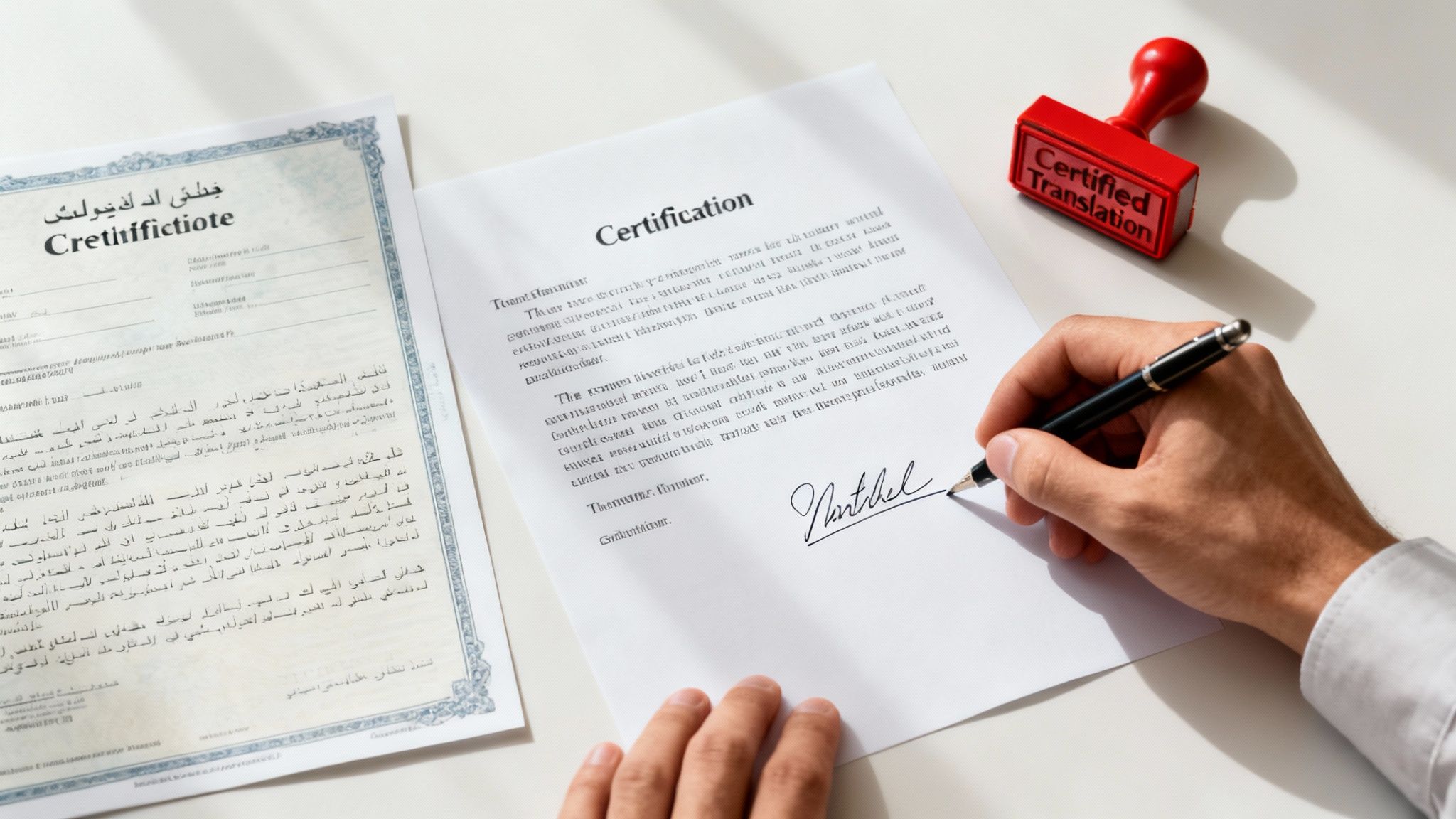
What Makes a Translation "Certified" for USCIS?
Let's clear up a common misconception: a "certified translation" doesn't need a special government seal or a fancy stamp from a court. It's all about accountability.
For USCIS, a certified translation is simply an English translation that includes a signed letter, or "certificate," from the translator or translation company. This letter is their formal statement guaranteeing the translation is complete and accurate.
This Certificate of Translation Accuracy is non-negotiable and must include a few key things:
- A statement confirming the translator is competent to translate from the original language (e.g., Spanish, Mandarin, Arabic) into English.
- A declaration that the English translation is a complete and accurate version of the original document.
- The translator's full name, their signature, and the date.
Think of it as the translator's professional oath. They are formally stating, "I am qualified to do this, and I guarantee this translation is a true and correct reflection of the original." This is also why you can’t translate your own documents for your case—USCIS considers it a conflict of interest, even if you're fluent in both languages.
A Quick Checklist for Your USCIS Translations
To make things easier, here’s a quick-reference checklist. Before you submit your application, run your translated documents through these points to ensure they tick all the boxes.
USCIS Translation Requirements Checklist
| Requirement | What It Means | Why It Is Critical |
|---|---|---|
| Full English Translation | Every single word from the original document must be translated, including all stamps, seals, and notes in the margins. | USCIS needs a complete picture. Missing even small details can raise questions about the document's authenticity and lead to an RFE. |
| Certificate of Accuracy | A separate, signed statement from the translator or translation company must be included. | This is the official proof that a competent professional stands behind the work, making the translation a valid piece of evidence for your case. |
| Translator's Competence | The certificate must affirm the translator is proficient in both the source language and English. | This assures USCIS the translation is not a guess, but an accurate rendering by someone who understands the nuances of both languages fluently. |
| Identification & Signature | The certificate must clearly state the translator's full name, signature, and the date of certification. | This makes the translator accountable for their work and provides a point of contact if USCIS has any questions about the translation. |
| No Self-Translation | You cannot translate your own birth certificate or any other document for your own immigration application. | USCIS sees this as a conflict of interest. The translation must come from a neutral and objective third party to be considered unbiased. |
Making sure your submission meets every one of these criteria is your best defense against easily avoidable delays in your immigration process.
A Real-World Example: Maria's Green Card Application
Let's look at a common scenario. Maria was applying for a Green Card for her mother from Mexico. Her mother’s birth certificate, a key civil certificate, was written in Spanish and covered in official stamps and handwritten notes from the local registry.
Maria wisely hired a professional translation service. They provided a complete translation that didn't just cover the main text but also translated every other element on the page, including descriptions like "[Official Seal of the Civil Registry]" and accurate translations of all the handwritten notes.
Because every detail was accounted for, the USCIS officer reviewing the case could easily verify the document's authenticity. Imagine if Maria had asked a friend who might have skipped those "unimportant" notes. Her application could have been flagged as incomplete, almost certainly leading to a time-consuming RFE.
The rules are strict for a reason: any document in a foreign language must be submitted with a complete English translation and the signed certification. You can learn more by checking the official rules for USCIS translation, but the bottom line is that cutting corners is a surefire way to hit bureaucratic hurdles.
Which Documents Need to be Translated for USCIS?
One of the first challenges in preparing your USCIS application is identifying which documents need a certified English translation. The core rule is simple: any supporting document you submit that is not in English must be accompanied by a complete, certified English translation.
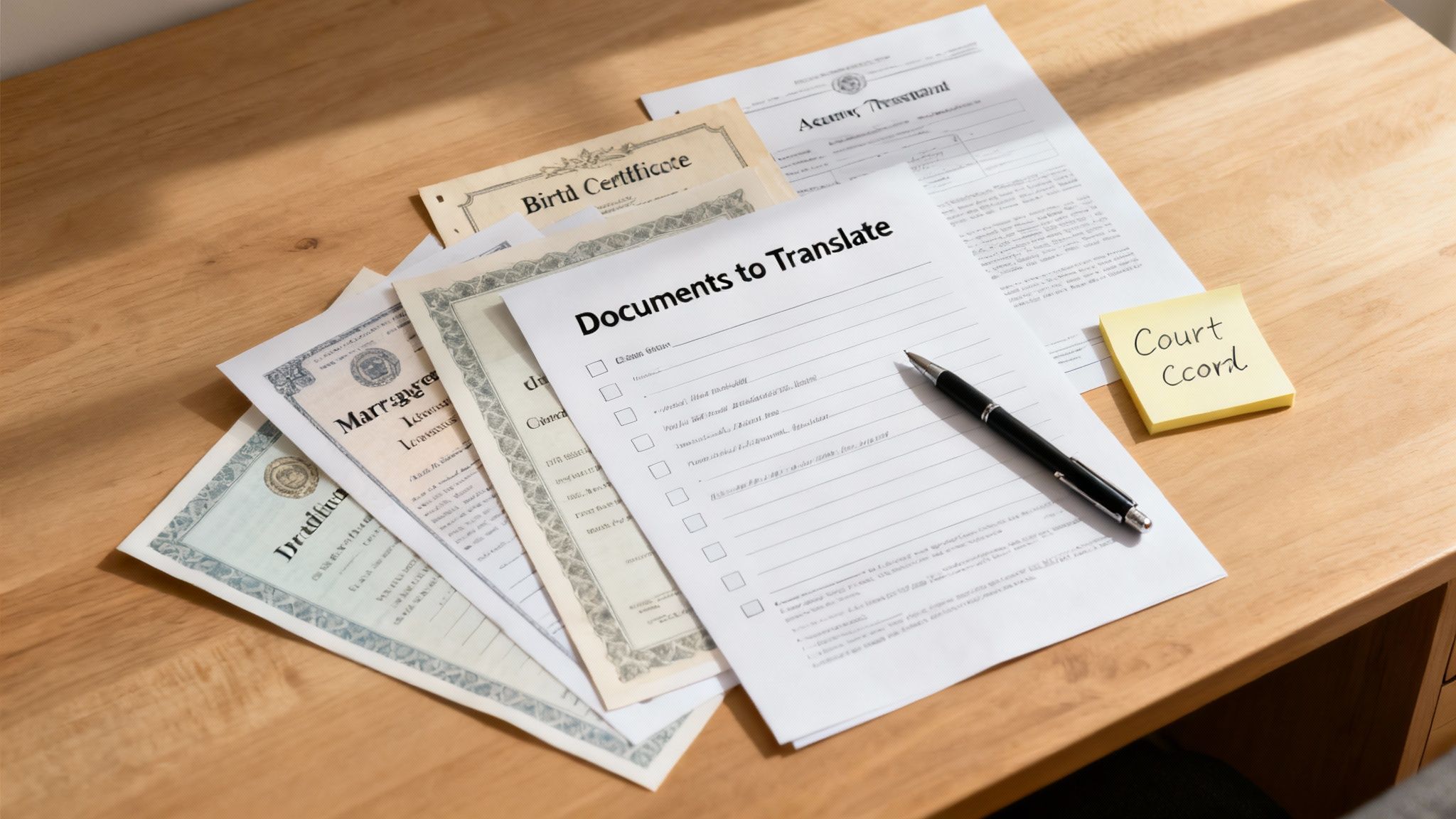
Think of it this way: your application tells the story of your eligibility. Each document is a piece of evidence supporting that story. If the immigration officer can't read a piece of evidence, it doesn't count. The certified translation acts as the official key that unlocks that document for them.
Common Documents That Always Need Translation
While every case is unique, most applications will include documents from a few standard categories. I always advise clients to create a checklist to ensure nothing gets missed.
-
Civil Certificates (Vital Records): These are foundational documents that prove your identity, family relationships, and major life events.
- Birth Certificates (This is the most common document we translate for immigration.)
- Marriage Certificates
- Divorce Decrees
- Death Certificates (if applicable, for a deceased spouse or parent)
- Adoption Decrees
-
Academic and Professional Documents: If you're applying for an employment-based visa or proving educational qualifications, these are essential.
- University Diplomas
- Academic Transcripts (These are detailed records of your courses and grades.)
- Professional Licenses and Certifications
-
Legal and Financial Paperwork: These documents provide a fuller picture of your background, financial stability, or legal history.
- Police Clearance Certificates from every country you've lived in
- Court Records or Legal Judgments
- Bank Statements (often required to prove financial support)
- National ID Cards or pages from a non-English passport
A Real-Life Example: The Overlooked Academic Transcript
I once worked with an engineer from Colombia, let's call him Juan, applying for an H-1B work visa. He knew his diploma needed translation, so he had that done right away. What he didn't realize was that his multi-page academic transcript was just as critical.
He assumed the diploma alone was enough proof of his degree. But USCIS needed to see his course-by-course breakdown to confirm his education met the specific "specialty occupation" requirements. We caught this during our review and had to rush the transcript translation to meet his filing deadline. Had he filed without it, he would have almost certainly received an RFE, putting his case on hold for months and jeopardizing his job offer.
Expert Tip: Before you begin, lay out all your original documents. Create a simple two-column checklist: "Document Name" on the left, and "Needs Translation (Y/N)" on the right. This simple exercise is the best way to ensure nothing slips through the cracks.
The goal is to be thorough. For instance, the list of required documents for a spouse visa can be quite extensive, highlighting just how many pieces of paper might be involved. You want to leave zero ambiguity for the USCIS officer reviewing your file.
Choosing a Reliable Service for Translating Documents for USCIS
Selecting the right person or agency for translating documents for USCIS is a critical step. This isn't just about finding the best price—it’s about protecting your application from delays or rejection. A single bad translation can set you back months.
You generally have two options: a freelance translator or a professional translation agency. While a talented freelancer can do a great job, agencies often provide an extra layer of security, such as built-in quality control and a solid guarantee of USCIS acceptance.
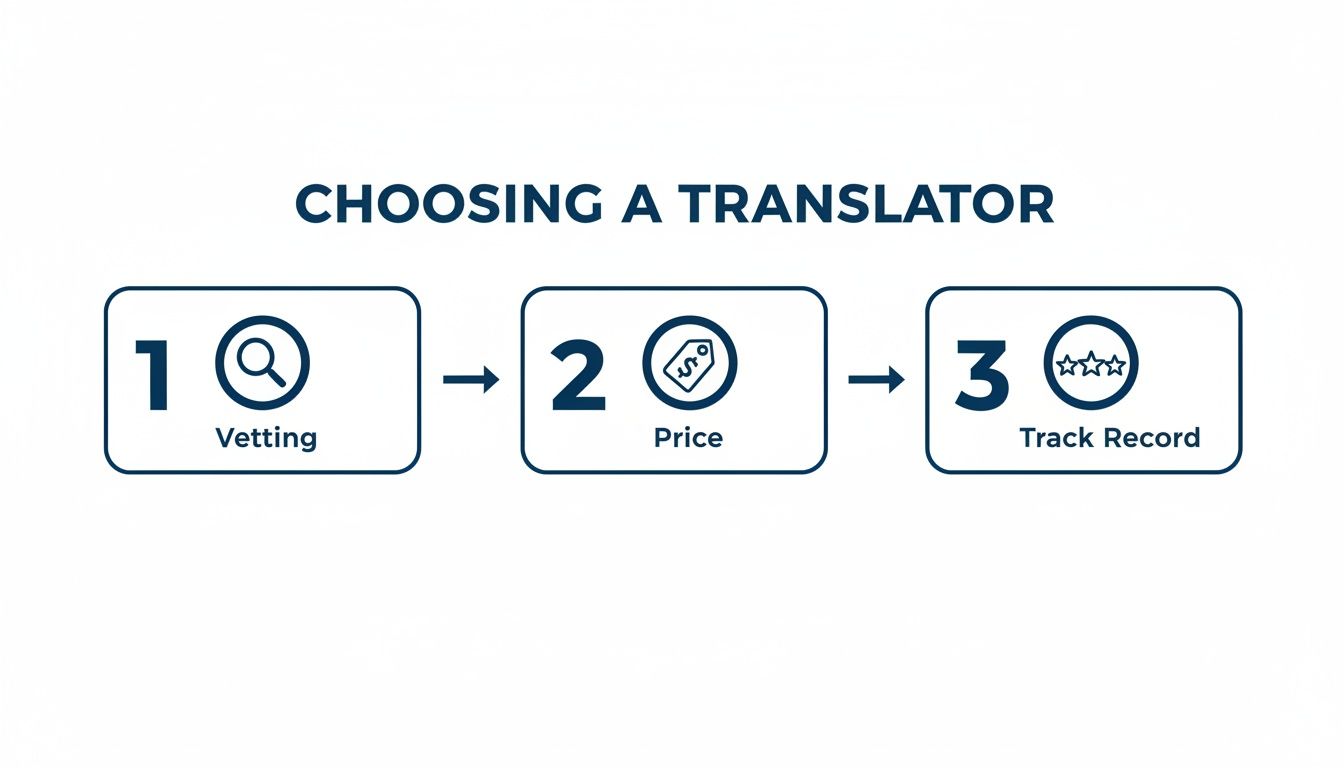
How to Vet a Translation Provider
So, how do you spot a reliable service? Look for clear signs of expertise and trustworthiness.
- Proven Track Record: A trustworthy provider will have a history of successful USCIS submissions. Look for testimonials or case studies that specifically mention immigration paperwork.
- Professional Affiliations: Membership in a professional group like the American Translators Association (ATA) is a great sign that they adhere to high industry standards.
- Clear Guarantees: The service should explicitly state that they guarantee acceptance by USCIS.
With USCIS backlogs projected to remain significant into 2026, there is no room for error. A flawed translation is one of the most common and avoidable reasons for an RFE. You can learn more about how translation errors impact USCIS application outcomes to understand the risks.
Key Questions to Ask Before You Hire
Before committing to a service, ask these questions to gauge their professionalism:
- Do you guarantee USCIS acceptance? A confident, experienced service will always stand behind its work.
- What is included in your certification statement? Ensure their certificate contains all the elements USCIS requires: the translator's qualification, a statement of accuracy, and their full name and signature.
- What is your quality assurance process? A second linguist should ideally review every translation to catch any potential errors.
- What are your turnaround times? Ask about both standard and urgent translation options so you can plan for your deadlines.
A professional translation service is more than just a vendor; they're your compliance partner. Their job isn't just to change words from one language to another—it's to deliver a document package that will pass USCIS review without a hitch.
Ultimately, you are paying for peace of mind. Investing in a top-notch service ensures your documents are accurate, properly certified, and formatted to meet the strict standards of immigration officials. While some legal documents may need extra steps, you can learn more about when you might need certified and notarized translation services for other situations. For USCIS, a solid certification is what truly matters.
The Translation Process: From Original Document to Certified Copy
Once you’ve identified the documents needing translation and selected a provider, the next step is getting the work done correctly. This process is straightforward when you know what to expect and how to prepare.
Before sending anything to your translator, your first job is to provide a perfect copy of the original document. I can't stress this enough: use a high-quality scanner. A blurry phone picture taken in a dim room is a recipe for disaster. The translator might misread a critical name, date, or place, which could cause a major problem with your application. Always provide clear, high-resolution scans of every single page.
The All-Important Certificate of Translation Accuracy
The single most critical part of the deliverable is the Certificate of Translation Accuracy. This is the signed statement where the translator takes formal responsibility for the work.
While USCIS doesn't mandate a specific template, a valid certification must contain these key elements. Here is a solid example:
I, [Translator's Full Name], hereby certify that I am fluent in English and [Source Language] and that the foregoing is a complete and accurate translation of the attached document, [Title of Original Document], to the best of my knowledge and ability.
Signature: _________________________
Printed Name: [Translator's Full Name]
Address: [Translator's Full Address]
Date: [MM/DD/YYYY]
This simple text block does everything needed: it identifies the translator, confirms their competence in both languages, vouches for the translation's accuracy, and provides USCIS with their contact details.
Certified vs. Notarized: The Critical Difference for USCIS
One of the most common points of confusion is the difference between a certified and a notarized translation. They sound similar, but for USCIS, they are worlds apart. Understanding this difference will save you time and money.
- A certified translation, as we've discussed, is a translation that includes a signed statement of accuracy from the translator. This is what USCIS requires.
- A notarized translation means a Notary Public has witnessed the translator signing their certification. A notary stamp only verifies the identity of the signer; it does not verify the quality or accuracy of the translation itself.
The table below breaks it down clearly.
Certified vs. Notarized Translation: What USCIS Requires
| Feature | Certified Translation | Notarized Translation |
|---|---|---|
| What It Is | A translator or company signs a statement attesting to the translation's accuracy and completeness. | A Notary Public witnesses the translator signing the certification and adds a notary stamp. |
| Who Vouching | The translator or translation service provider vouches for the translation's accuracy. | The notary only verifies the signer's identity, not the quality of the work. |
| USCIS Requirement | This is the standard requirement. USCIS needs to know a competent person stands behind the translation. | Almost never required. This is an unnecessary extra step for nearly all immigration filings. |
| Purpose | To prove the translation is a faithful rendering of the original document. | To prove the person signing the document is who they say they are. |
The bottom line is simple: USCIS requires a certified translation. Notarization is an extra step that is generally not needed for immigration purposes. Save yourself the fee and hassle. Stick with a proper certification, which is exactly what you get when you use a professional service. You can see how this focus on essentials is reflected in our straightforward pricing and turnaround times.
Final Review and Assembling Your Application Package
You've received your translations. This is a huge step, but don't rush to the finish line just yet. Taking a few minutes for a meticulous final review is your best defense against a Request for Evidence (RFE). A tiny oversight can derail your timeline, so this quality check is non-negotiable.
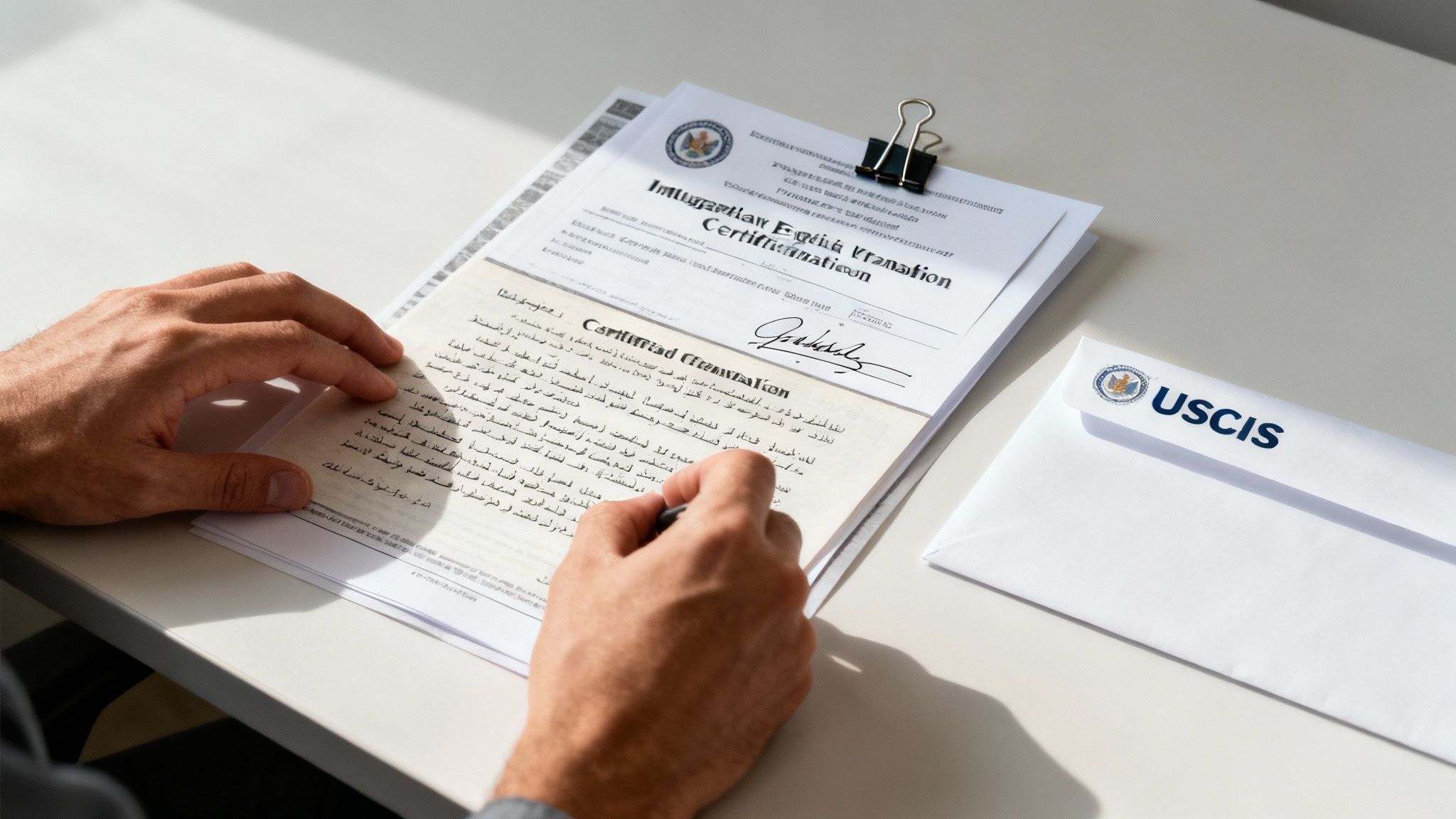
Think of yourself as the final inspector. Lay the original document and its translation side-by-side. It’s time to go over them with a fine-toothed comb.
Your Final Review Checklist
Before you assemble your package, run through this critical checklist:
- Check Names, Dates, and Places: Are all names spelled exactly as they are on the original? Have all dates been correctly written in the U.S. standard (MM/DD/YYYY)? Verify every city, region, and address. One wrong letter can cause confusion.
- Confirm Completeness: Has every single word been translated? Look closely at the original. Don't forget official stamps, seals, or any handwritten notes in the margins. These elements are part of the document and must be accounted for, often with a note like
[Illegible signature]or[Official seal of the Ministry of Interior]. - Verify the Certification: Is the Certificate of Translation Accuracy present and correctly filled out? Check for the translator's signature, full name, and date.
A Word of Caution from Experience: You don't get to decide what's "important" on a document. USCIS requires a complete, word-for-word translation. I’ve seen applicants get RFEs for leaving out what they thought was just boilerplate text. When USCIS says everything, they mean everything.
How to Assemble Your Documents for Submission
Once you're confident the translation is flawless, it's time to assemble your package. The golden rule is simple: the certified translation always stays with the original document. They are a pair.
If you are submitting a paper application, you will include a photocopy of the foreign-language document, and right behind it, you will place its certified English translation. Staple just those two pages (or the full set, if it's a multi-page document) together. This simple act keeps things organized and makes the reviewer's job much easier.
For online submissions, you'll merge the scanned copy of the original document and its translation into a single PDF file. Make the original the first page(s) and the translation the last page(s). USCIS often has file size limits, so it's a good idea to know some strategies for compressing PDF files without losing quality. This ensures your submission uploads smoothly.
This final review and assembly step shows you're diligent and serious about your case, setting it up for a successful review. For more information, please visit our main certified translation service page.
Common Questions About USCIS Translations
Even with a checklist, a few questions often pop up. Here are answers to some of the most common ones to help you finalize your application with confidence.
Can I translate my own documents for USCIS?
No. It doesn't matter if you're a professional interpreter or perfectly bilingual—USCIS will not accept a translation you’ve done yourself. They require an impartial third party to vouch for the translation's accuracy, eliminating any potential conflict of interest. A professional service provides that crucial, neutral expert sign-off.
What is the difference between a Certified and Sworn translation?
A certified translation is the standard for U.S. immigration and relies on a translator's signed statement of accuracy. A sworn translation is a more formal process used in many other countries, where a translator who is officially appointed by a court or government body ("sworn in") provides the translation. For USCIS, you only need a certified translation, not a sworn one.
What if my name is spelled differently across documents?
This is surprisingly common, especially when names are transliterated from other alphabets. The key is that the translator must translate the name exactly as it appears on each document. It is not their job to "fix" or standardize spellings. You should address the discrepancy yourself by including a short, simple letter of explanation with your application, clarifying that different spellings (like "Müller," "Mueller," or "Muller") all refer to you.
Expert Tip: Never ask a translator to alter names or dates to match other documents. A certified translation must be a faithful mirror of the original, including any inconsistencies. The responsibility for explaining those discrepancies lies with you.
How long does a certified translation take?
Turnaround time depends on the document's complexity and the service provider. For standard, one-to-three-page documents like birth or marriage certificates, many professional services can deliver in as little as 24 hours. For longer documents, such as legal contracts or academic transcripts, expect it to take a few business days. If you are on a tight deadline, always ask about urgent or expedited options before you order.
At TranslateDay, our entire process is built to deliver fast, accurate, and USCIS-guaranteed certified translations. We provide a 24-hour turnaround for most standard documents, giving you complete peace of mind. Get an instant quote and let our experts handle your translation needs so you can focus on the rest of your application.


