
When you're staring at a pile of official documents for your U.S. Citizenship and Immigration Services (USCIS) application, it’s easy to feel overwhelmed. What do you do with papers that aren't in English? The answer is a certified translation. Think of this not as a simple word-for-word swap, but as a formal, precise translation that includes a signed guarantee from a professional translator or company, confirming it’s completely accurate. Getting your certified translations for USCIS done correctly is fundamental to a smooth and successful immigration journey.
Why Certified Translations Are Non-Negotiable For U.S. Immigration
Navigating the U.S. immigration system is all about proving who you are—your identity, relationships, and qualifications—using official papers from your home country. USCIS, the government agency handling immigration, needs to understand every single detail on those documents to make a fair decision. A certified translation acts as a trusted bridge, making sure nothing gets lost in translation and that your file meets their strict legal standards.
Imagine you're applying for a Green Card after marrying a U.S. citizen. Your marriage certificate from another country has a small, handwritten note from the issuing clerk in the margin. An amateur or machine translation might ignore it or get it wrong. A professional certified translation, on the other hand, will carefully translate every word, stamp, and note. This detailed approach is what prevents an officer from questioning your documents and delaying your case.
The High Cost Of A Bad Translation
A small mistake or an uncertified document can trigger a Request for Evidence (RFE). This is a formal notice from USCIS asking for more information, and it can stall your application for months. It adds a huge amount of stress and uncertainty to an already long process.
This isn't just a bureaucratic formality—it has real consequences. In fiscal year 2023, USCIS granted lawful permanent residence to nearly 1.2 million people. In the first half of FY2025 alone, applicants filed over 545,000 new I-485 (Green Card) applications. Think about how many of those cases relied on perfectly translated birth certificates, marriage licenses, and financial records. A botched translation can easily turn a standard 7-8 month processing time into a year-long ordeal.
A certified translation is your insurance policy against preventable delays. It tells the reviewing officer that the information they are reading is a complete and faithful representation of the original, removing any doubt or ambiguity from your file.
Common Immigration Documents Requiring Certified Translation
Here’s a quick-reference table of common documents—often called civil certificates—that almost always require a certified translation for any official purpose, including immigration.
| Document Type | Common Use Case | Why It's Critical |
|---|---|---|
| Birth Certificates | Proof of identity, age, and parentage for family-based petitions (I-130). | Establishes fundamental identity and relationships. |
| Marriage Certificates | Proving a valid marital relationship for spousal visas (K-1, CR-1) and Green Cards. | The cornerstone document for marriage-based applications. |
| Divorce Decrees | Proving a previous marriage was legally terminated before a new one began. | Prevents accusations of bigamy and confirms eligibility to remarry. |
| Police Clearance Certificates | Required for background checks to establish good moral character. | A critical part of the security and admissibility screening. |
| Academic Diplomas & Transcripts | For employment-based visas (H-1B, EB-2) to prove educational qualifications. An academic transcript is a record of your courses and grades. | Verifies you meet the minimum educational requirements for the job. |
| Financial Statements | Proving financial support for sponsorship applications (I-864). | Demonstrates the sponsor can financially support the applicant. |
| Adoption Documents | For international adoption cases to prove legal parent-child relationships. | Confirms the legal validity of the adoption process. |
| Passports & National ID Cards | Basic identity verification. | Key identification documents that must be fully understood. |
This isn't an exhaustive list, but it covers the essentials for most applications. If a document is important to your case and it's not in English, you should plan on getting it translated.
Building A Foundation Of Trust
Ultimately, submitting a proper certified translation builds trust. It signals to USCIS that you're taking the process seriously and have provided clear, verifiable information. It shows professionalism and respect for the legal requirements.
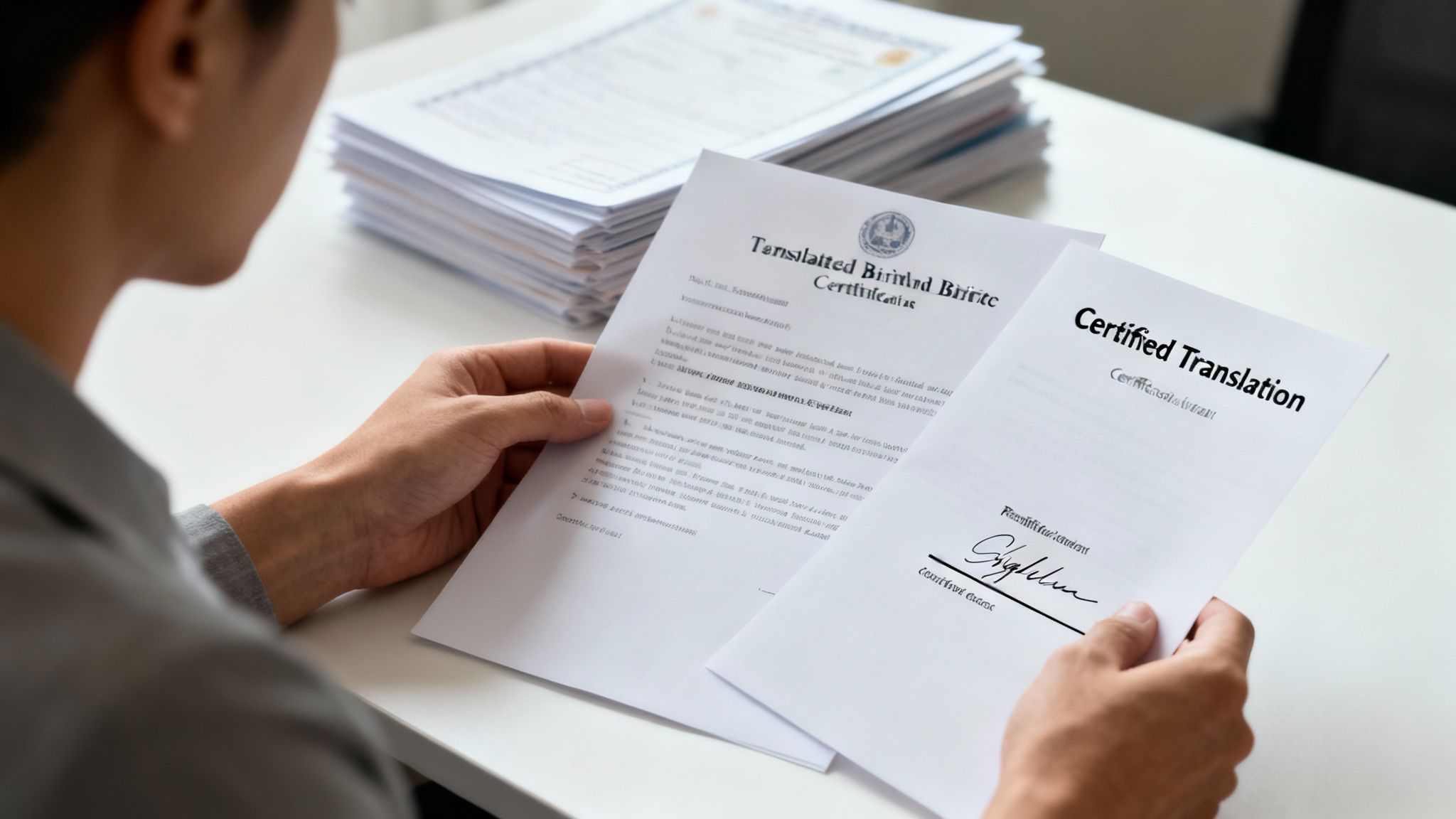
Whether it’s a one-page birth certificate or a complex legal contract, the certification provides an essential layer of validation. It's also worth knowing the nuances between different types of official translations. For instance, a notary stamp verifies the identity of the person signing a document, but a certification guarantees the translation's quality. You can learn more about the differences between certified and notarized translation services to see what your specific situation calls for.
By investing in a proper translation, you're not just ticking a box—you're laying the groundwork for a strong, credible, and successful immigration application.
Understanding Official USCIS Translation Requirements
Navigating the rules from U.S. Citizenship and Immigration Services (USCIS) can feel complicated, but their guidelines for document translations are quite clear. Let's break down exactly what immigration officers look for.
The main rule is simple: if any document you submit isn't in English, you must also provide a complete, certified English translation. USCIS needs to be able to read and understand every piece of your evidence without any confusion.
The 3 Core Rules for a USCIS-Compliant Translation
I’ve seen countless applications, and the ones that sail through without issues always nail three key things: completeness, proper certification, and an impartial translator. Get any of these wrong, and you’re risking a Request for Evidence (RFE), which causes serious delays.
1. The Translation Must Be Complete
This is an absolute must. The English translation has to be a perfect, word-for-word mirror of the original. That means every single thing on the page gets translated—stamps, seals, signatures, and even those little handwritten notes in the margins.
I've seen people get RFEs just for missing a single, seemingly insignificant stamp. To USCIS, an incomplete translation is a red flag.
2. It Must Come with a Certification Letter
This is what makes a translation a "certified translation." It’s not about an official government license for the translator. Instead, it’s a formal statement—a letter—from the person or company who did the work, guaranteeing that the translation is accurate and complete.
3. The Translator Can't Be You (Or a Relative)
Even if you're perfectly bilingual, you cannot translate your own documents for a USCIS application. The same goes for your spouse, parent, or any other involved party.
USCIS demands an impartial third party to handle the translation. This prevents any potential conflict of interest and ensures the translation is objective.
What Goes into a Certification Statement?
The certification letter doesn't need to be long, but it must include a few key pieces of information to be valid. Think of it as the translator's professional promise.
A proper certification from your translator or agency must include:
- A statement confirming the translator is fluent in both English and the source language.
- A declaration that the translation is complete and accurate to the best of their ability.
- The translator's full name and signature.
- The translator's contact information (like an address or phone number).
- The date the certification was signed.
Here’s a real-world example of what that looks like. It's usually a simple, straightforward statement.
Sample Certificate of Translation Accuracy
I, [Translator’s Full Name], certify that I am fluent in English and [Original Language] and that I am competent to translate documents from [Original Language] to English. I further certify that the attached document is a complete and accurate translation of the original [Document Name].
Signature: _________________________
Name: [Translator’s Full Name]
Address: [Translator's Address]
Date: [Date]
That’s it. This simple statement gives the USCIS officer the assurance they need. Any professional translation service will provide this automatically.
Certified vs. Notarized Translations: A Common Point of Confusion
Here’s a question I get all the time: "Do my translations need to be notarized?" For USCIS, the answer is a clear and simple no.
This is a common mix-up. Here's the difference in simple terms:
- A certified translation is about accuracy. The translator is guaranteeing the quality of their work.
- A notarized translation is about identity. A notary public just confirms that the person signing the certification is who they say they are. The notary doesn't check the translation at all. A notary stamp is the official seal they use.
While you might need notarization for documents sent to courts or some universities, it’s an unnecessary step for your USCIS package. For a deeper dive, our complete guide on official USCIS translation requirements covers every detail to help you get it right the first time.
How to Get Your Immigration Documents Translated Online
Forget hunting down local agencies or dealing with slow, paper-based systems. Today, you can get a fully compliant, certified translation for your immigration documents entirely online—often within 24 hours. This simple process ensures your documents are ready for USCIS and puts you in control.
Let’s walk through the steps to get it done right.
First Things First: Prepping Your Documents
Before uploading anything, check the quality of your original documents. A blurry photo or a bad scan can make it impossible for a translator to read every detail. This can lead to an inaccurate translation and a dreaded Request for Evidence (RFE).
To avoid issues, you need clear, high-quality digital copies. This includes documents like your birth certificate, marriage license, or university transcripts.
- A scanner is your best friend. If you have one, use it for a crisp, high-resolution image.
- Your phone can work in a pinch. If using your smartphone, place the document on a flat surface with good light. Avoid shadows and hold your phone parallel to the paper to prevent distortion.
- Do a quick quality check. Before you upload, zoom in. Can you easily read every word, stamp, and seal? If you can't, neither can the translator.
Once you’re happy with the quality, save the files as a PDF or JPG.
Finding an Online Translation Service You Can Trust
A quick search will show you countless options. How do you pick the right one? You need a service that is reliable and understands USCIS rules inside and out. A professional agency isn't just selling a translation—they're selling peace of mind.
Here are the green flags to look for:
- USCIS Acceptance Guarantee: This is a must. The service should promise that USCIS will accept their certified translations. It shows they stand behind their work.
- Clear, Upfront Pricing: Look for a clear per-page rate (often based on a word count like 250 words). This lets you know the exact cost upfront, with no surprise fees. We cover this in more detail in our guide to translation pricing and turnaround times.
- Professional Affiliations: Credentials matter. Look for memberships in organizations like the American Translators Association (ATA). This indicates a commitment to high industry standards.
- A Proper Certification Statement: The service should automatically include a signed Certificate of Translation Accuracy with every order. This isn't an optional add-on; it's a core requirement.
Focusing on these points will help you find a partner you can rely on for your certified translations for USCIS.
What to Expect From the Online Process
After you've picked a service, the process is incredibly simple. You'll upload your scanned documents through a secure portal on their website. From there, just select the source and target languages (e.g., Spanish to English), confirm the page count, and fill out your contact info.
For most standard documents of 1-3 pages, you can expect a 24-hour turnaround. You’ll typically get an email with the translated document and the signed certification letter.
This flowchart breaks down the core principles USCIS cares about.
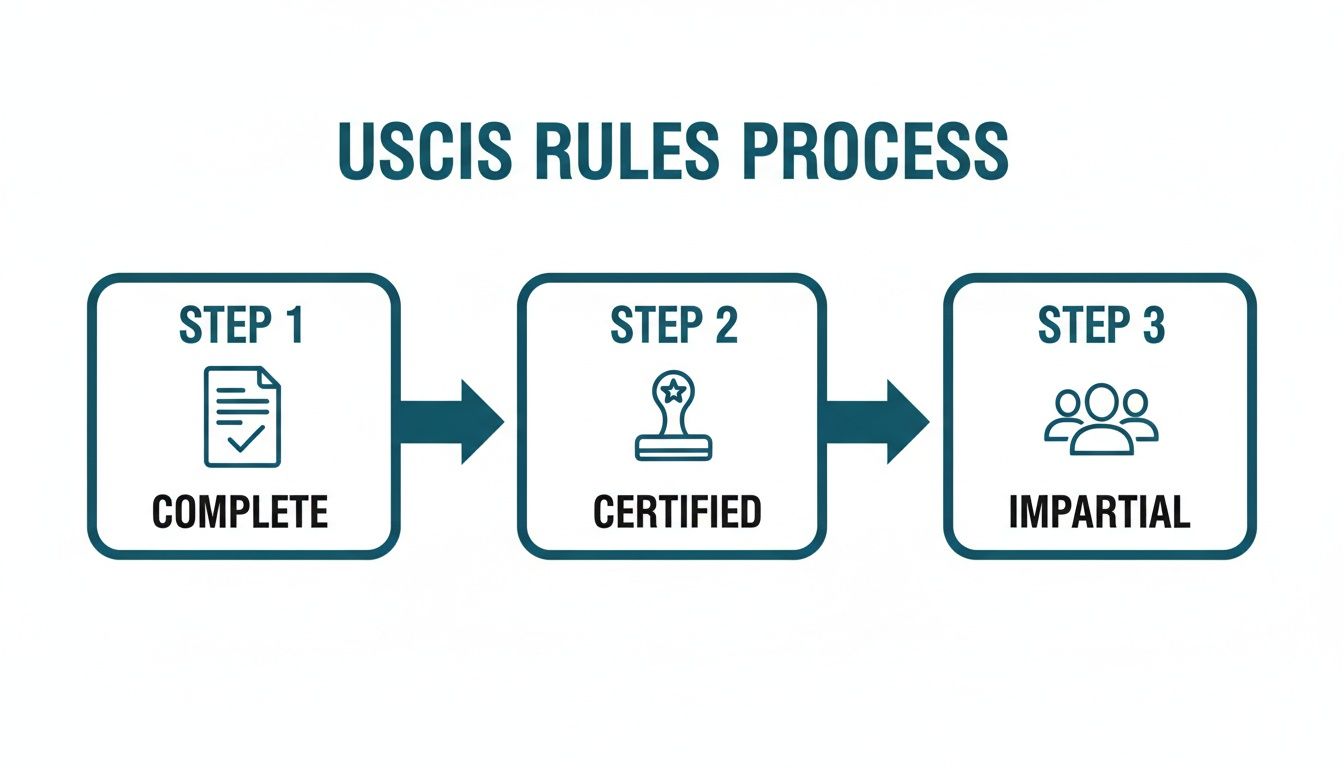
As you can see, every translation has to be complete, properly certified, and done by someone who isn't you or a family member.
Pro Tip: When you get the translation back, give it a quick review. Even if you don't speak the language, check that all names, dates, and places are spelled correctly. A good service will fix minor typos for you right away.
The digital files you receive are ready for your application. Just print both the translated document and the certification letter, and include them with a photocopy of the original. This professional presentation makes it easy for the immigration officer to verify everything, which is especially important when you’re submitting critical civil documents for immigration.
Common Mistakes That Can Derail Your Application
A simple mistake on a translated document can cause major headaches, leading to frustrating delays or even a Request for Evidence (RFE) from USCIS. I've seen it happen time and again. Understanding these common pitfalls is the best way to ensure your application avoids them.
Let's walk through some real-world scenarios where tiny oversights created big problems.
The Incomplete Translation Trap
One of the most frequent errors is an incomplete translation. An immigration officer needs to see a perfect, word-for-word mirror of the original document. This means everything—every stamp, seal, signature, and even those little handwritten notes in the margins—must be translated.
For example, imagine a student submits their university transcript for a visa. The translator ignores the tiny footnotes at the bottom and doesn't describe the registrar's official seal. To USCIS, this document is incomplete and will almost certainly be sent back, causing an urgent deadline scramble.
The Fix: Before you submit, place the original and the translation side-by-side. Make sure every single element is there. A professional translator will use notations like "[Illegible signature]" or "[Official University Seal]" to describe non-textual parts, ensuring nothing is missed.
The Well-Meaning (But Unqualified) Friend
It’s tempting to save money by asking a bilingual friend or family member for help. While their intentions are good, this is a classic mistake. USCIS is very clear: they want an impartial third party to do the work to avoid any conflicts of interest.
More importantly, your friend probably doesn't know how to draft a formal Certificate of Translation Accuracy. Without that signed statement, your translation holds no official weight and the officer will have to reject it.
For a deeper dive into this and other common issues, check out our detailed guide on the top translation mistakes to avoid.
Overlooking the Formatting Details
Formatting might seem like a minor point, but it's critical for the person reviewing your file. A properly translated document should mimic the original's layout as closely as possible. This makes it easy for an officer to compare the two documents and verify names, dates, and other key details at a glance.
For instance, consider a bank statement needed for a sponsorship case. If the translation is just a big block of text—no columns, no tables—it's a nightmare to decipher. The officer can't easily match the numbers and may question the document's authenticity.
A professional service that specializes in translating documents for immigration understands this. They know that preserving the visual format is a core part of delivering an accurate and compliant translation. Steering clear of these common blunders will dramatically improve your chances of a smooth process.
What to Expect for Translation Costs and Turnaround Times
When you're dealing with an immigration case, two questions always come up: "How much will this cost?" and "How fast can I get it back?" You're already juggling deadlines and a budget, so you need straight answers.
Breaking Down the Turnaround Times
How long it takes to get your certified translation back depends on the document's size. For the most common, single-page documents, the process is surprisingly quick.
- Standard Docs (1-3 Pages): Things like a birth certificate, marriage license, or a national ID card can usually be translated and certified in under 24 hours. This is where reputable online services excel.
- Longer Documents (4+ Pages): If you have something more involved, like university transcripts, lengthy financial statements, or detailed legal contracts, allow for more time. A good rule of thumb is to add one business day for every three to four pages.
Did you just get a Request for Evidence (RFE) with a tight deadline? Don't panic. Many professional translation services offer rush options. You'll pay a bit more, but they'll prioritize your project, often getting it done in half the standard time. It’s a valuable safety net when you're in a time crunch.
How Translation Pricing Works
A trustworthy translation partner will be upfront about their pricing. You should be wary of any service that makes you upload documents just to get a complicated quote. The best model is a simple, flat rate.
Look for a clear, per-page price. A "page" is generally defined as up to 250 words. This makes it easy to calculate your total cost before you commit. For example, a one-page birth certificate plus a two-page divorce decree simply counts as three pages.
This per-page pricing model removes the uncertainty. You know exactly what you’ll pay before you upload, which is a huge relief when managing all the other expenses of an immigration application.
The need for this kind of reliable service is growing. As more people navigate complex visa requirements, the global market for immigration document translation is expanding. This niche is part of a massive global translation market valued at $27.78 billion in 2025, and it’s expected to grow even more by 2026. This trend shows how critical high-quality, certified translations have become. You can find more details on the immigration translation service market growth.
Knowing these details helps you plan your timeline and budget with confidence, removing two major stressors from the immigration process.
Common Questions About Immigration Translations
Even when you think you have everything organized, a few questions always seem to pop up before you submit your immigration package. Let's clear up some of the most common points of confusion.
Can I Translate My Own Documents If I'm Fluent?
It’s a logical question, but the answer from U.S. Citizenship and Immigration Services (USCIS) is a firm no. Even if you are a professional translator, you are not allowed to translate documents for your own application.
This rule exists to prevent any conflict of interest. USCIS requires an objective, third-party professional to guarantee the translation's accuracy, ensuring the information hasn't been biased in any way.
What’s the Difference Between a Sworn and a Certified Translation?
This one trips up a lot of people, mostly because the terms change depending on the country.
- A certified translation is the standard in the United States. It's a high-quality translation that comes with a signed statement from the translator, vouching for its accuracy. This is what USCIS requires.
- A sworn translation is a more formal process used in many European and Latin American countries. It requires a translator who has been officially appointed by a court or government authority.
For any USCIS application, you only need a certified translation. Don't spend extra time or money looking for a sworn translator—it's not necessary for U.S. immigration.
Do I Need to Mail My Original Documents to the Translation Agency?
Definitely not. In fact, you should never mail your original, irreplaceable documents. Modern translation services work with high-quality digital files.
All you need to do is provide clear scans or high-resolution photos of your documents, whether it’s a birth certificate translation or a medical report. It’s faster, safer, and your originals stay exactly where they belong: with you.
Where Does Notarization Fit into All This?
A notary public's job is to verify the identity of the person signing a document. In this case, they would be verifying the translator's identity, not the quality of their work. That's why USCIS does not require notarization for translations.
The notary's stamp says nothing about the translation's accuracy. While some other institutions, like certain universities, might ask for it, it's an unnecessary step for your USCIS package. Your focus should be entirely on getting that proper certification letter.
The key takeaway is simple: USCIS cares about the accuracy of the translation (proven by certification), not the identity of the person who signed for it (verified by a notary).
The reason for this intense focus on accuracy becomes clear when you look at the system's massive workload. Immigration courts are dealing with incredible backlogs; a tiny error can set your case back months. In the first 11 months of FY2025 alone, the Executive Office for Immigration Review (EOIR) completed over 722,000 cases, but the average wait time is still around 636 days. An RFE due to a bad translation is one of the most common—and avoidable—reasons for delay. You can learn more about how legal translations impact immigration cases.
Getting these details right from the start is one of the best things you can do to help your application move smoothly through the system.
At TranslateDay, we specialize in fast, accurate, and USCIS-guaranteed certified translations. Our expert linguists are ready to handle your immigration, academic, and legal documents with the precision they require.
Get an instant quote and have your certified translation ready in 24 hours.


