
When you need to translate documents for immigration, the first and most important step is understanding what officials actually require. It isn't as simple as just getting a translation; you need what's called a certified translation. This is a complete, word-for-word translation of your original document that includes a signed statement from the translator or translation company. This statement confirms the translation's accuracy and the translator's competence. For U.S. Citizenship and Immigration Services (USCIS)—the government agency that handles immigration cases—this certification is non-negotiable.
Your First Hurdle: What USCIS Really Wants
Starting your immigration journey can feel like facing a mountain of paperwork. If any of your key documents—like a birth certificate, marriage license, or an academic transcript (your school records)—aren't in English, you'll need to submit a translation alongside the original. But here's the catch: you can't just ask a bilingual friend to do it for you.
USCIS has very specific rules, and not following them to the letter can cause serious delays or even get your application flat-out rejected.
The absolute core requirement is a certified translation. This isn't just about swapping words from one language to another; it’s about providing an official, trustworthy translation that a government agency can accept without question. The most critical piece of this is the "Certificate of Translation Accuracy."
The All-Important Certification Letter
This letter, sometimes called a certification statement, is mandatory for every single translated document you submit. It's the translator's formal, signed declaration that the English version is a true and accurate mirror of the original text. Without it, USCIS will flag your document as incomplete.
A proper certification statement must include:
- A statement confirming the translation is complete and accurate.
- The translator's confirmation that they are competent to translate from the source language into English.
- The translator’s full name, signature, and the date of signing.
- Contact information for the translator or translation company.
Think of it as a professional guarantee. When an immigration officer sees this letter, it gives them confidence that a qualified, impartial expert handled the document, which builds trust in your entire application. For a deeper dive into what this involves, you can explore our complete guide on certified translation services.
To make it crystal clear, here’s a quick summary of the non-negotiable USCIS rules for any translated document you submit.
USCIS Translation Requirements At A Glance
| Requirement | What It Means For You | Why It Is Critical |
|---|---|---|
| Complete Translation | The entire document must be translated, including seals, stamps, and signatures. You can't pick and choose parts. | USCIS needs a full and transparent record. Missing information, even if it seems minor, can lead to a Request for Evidence (RFE). |
| Translator Certification | A separate letter must attest to the translation's accuracy and the translator's competence. | This is your proof that the translation is professional and reliable, not just a casual effort by a non-expert. |
| Impartial Translator | You cannot translate your own documents, nor can a close family member. You need an unbiased third party. | USCIS considers translations from applicants or family members to be a conflict of interest, which immediately undermines credibility. |
| Originals & Translations | You must submit a clear copy of the original non-English document alongside its certified English translation. | The officer needs to compare the original and the translation to verify consistency. Submitting only one or the other will get your application flagged. |
Getting these four things right is the foundation of a successful submission. Don't let a simple paperwork mistake derail your immigration case.
A Real-World Example: The Rodriguez Family's Green Card Application
Think about the Rodriguez family, who were applying for a Green Card. Their application file included birth certificates from Colombia and a marriage certificate from Mexico. They knew they needed translations but were fuzzy on the specifics.
Initially, Mr. Rodriguez considered asking his brother, who is fluent in both languages, to handle the translations to save a little money. Thankfully, a quick search revealed that USCIS does not permit translations by the applicant or their family members due to potential bias. This one piece of information saved them from an automatic Request for Evidence (RFE), which would have stalled their case for months.
They opted for a professional service that provided certified translations for all their civil documents (official records like birth and marriage certificates). They submitted clear photocopies of their original Spanish-language certificates along with the certified English translations. Each translation came with a signed certification letter, ticking every box for USCIS and allowing their application to move forward without a hitch.
Certified vs. Notarized Translation: Clarifying the Confusion
This is a common point of confusion. Many people mix up "certified" and "notarized" translations, but for USCIS, they serve very different purposes.
As we've covered, a certified translation speaks to the accuracy of the translation itself. A notarized translation, on the other hand, is about verifying the identity of the person who signed the certification. A notary public simply watches the translator sign the certification letter and then adds their official stamp and seal (a notary stamp). The notary has no idea if the translation is good or bad; they only confirm that the person who signed it is who they say they are.
For almost all USCIS applications, a certified translation is all you need. USCIS does not require notarization. Adding a notary stamp when it isn't required doesn't strengthen your application—it's just an unnecessary expense.
However, some other institutions, like certain universities or foreign embassies, might specifically ask for notarization. The lesson here is to always double-check the requirements for the specific agency you're dealing with. Knowing the difference can save you time and money, a topic we cover in our FAQ section. For your immigration paperwork, remember that the signed certification of accuracy is what truly matters to USCIS.
Figuring Out Which Documents Need a Certified Translation
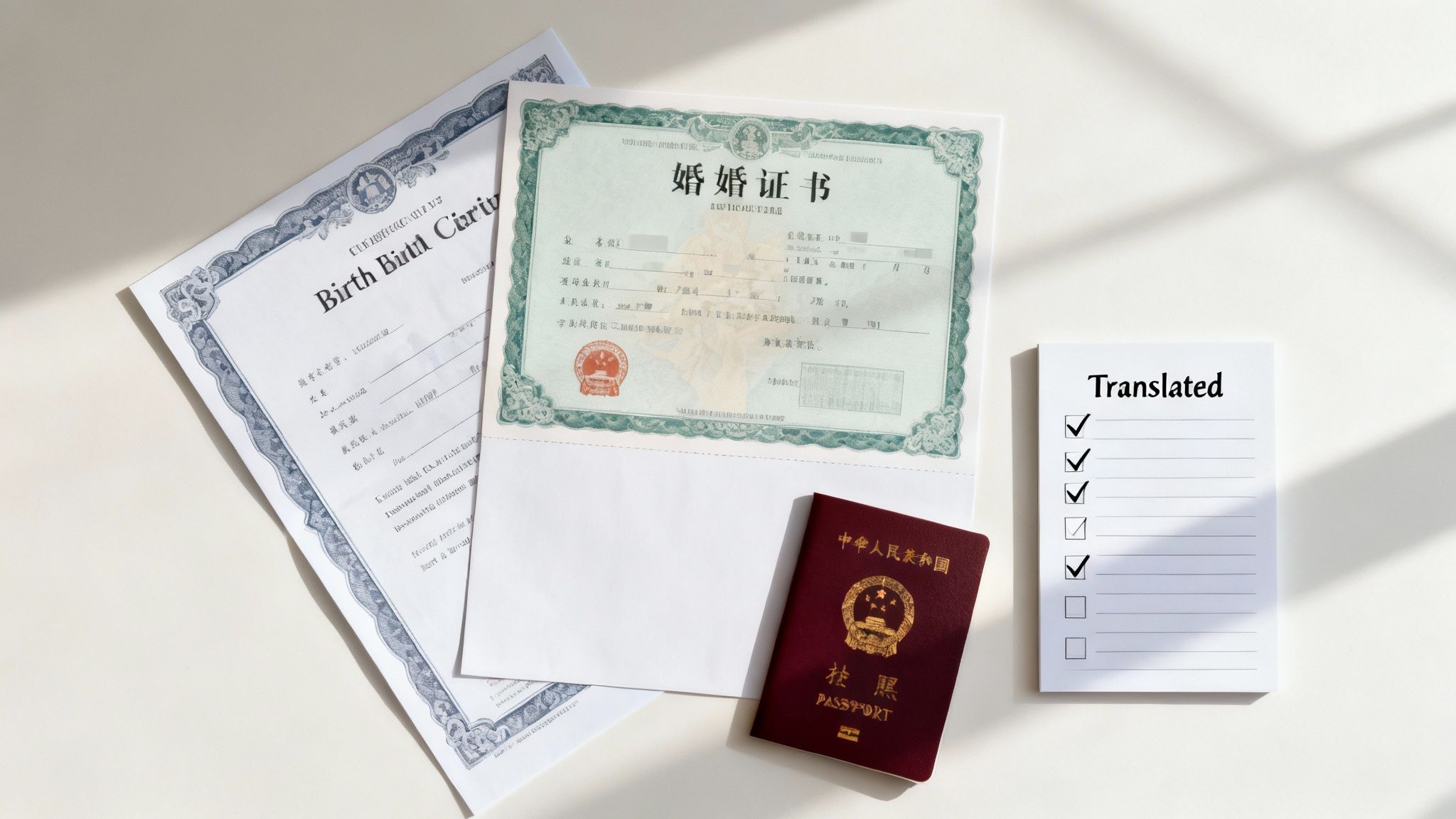
One of the first questions people ask when starting their immigration journey is, "Which of my documents actually need to be translated?" It’s a great question, because getting this wrong can be a costly mistake. A missing translation can trigger a dreaded Request for Evidence (RFE) from USCIS, putting your case on hold for months.
The rule of thumb is pretty simple: if a document is not in English, you must provide a complete and certified English translation alongside it.
It’s easy to think that only the big-ticket items like a birth certificate need attention. But that’s a risky assumption. USCIS needs a full, uninterrupted story, and any supporting document—no matter how small it seems—is part of that narrative. One untranslated paper can leave a gap in your file, and that’s often enough to make a reviewing officer pause.
The Core Documents USCIS Always Expects
While every immigration case is unique, a few documents are standard across the board. If any of the following are in another language, you absolutely need a certified translation.
- Vital Records: These are the documents that prove who you are. We're talking about your birth certificate, marriage certificates, divorce decrees, and any adoption papers. These are often called civil certificates.
- Legal and Personal Papers: This bucket includes documents that establish your legal standing and background. Think police clearance certificates, national ID cards, and any court or criminal records.
- Academic and Professional Credentials: For employment-based visas or cases where education matters, you’ll need to translate academic transcripts (your grades and course history), diplomas, and professional licenses.
Keep in mind, this isn't an exhaustive list. Depending on your situation, you might also need to translate things like financial statements, property deeds, or military service records. The key is to meticulously review the specific requirements for your application and flag anything that isn't in English.
A Real-World Example: Why Legal Nuances Matter
Let me give you a practical example. Imagine a family adopting a child from a country where the legal decrees use very specific, culturally-rooted language. A basic, word-for-word translation might completely miss the subtle legal meaning of terms related to custody or guardianship.
A professional translator who specializes in legal translations will catch those nuances. They ensure the English translation accurately captures the legal weight and original intent of the adoption decree. This isn't just about getting the words right; it's about preserving the legal validity. A poor translation could cause USCIS to question the entire adoption, creating a massive, heartbreaking roadblock.
This is why it's so important to understand the different levels of verification. It's always a good idea to learn more about the distinction between certified and notarized translation to see what your specific case requires.
Why Accuracy Is More Critical Than Ever
The need for high-quality translations in the U.S. immigration system isn't just something we talk about—the data backs it up.
As far back as 2018, about 90% of all immigration court hearings required interpretation in a language other than English. That number has only gone up. The Executive Office for Immigration Review (EOIR) is handling a massive caseload, with over 40 different languages regularly showing up in their system.
This data paints a clear picture: immigration officers are navigating a sea of multilingual documents every single day. When you submit a clear, accurate, and properly certified translation, you're not just following the rules—you're making their job easier. That goes a long way toward helping your application get processed smoothly and without delay.
The best way to start is by creating a simple checklist. Go through your application requirements line by line, pull out all the supporting documents, and if one isn't in English, put it on your "to translate" list. It’s a methodical approach that helps you build a strong, RFE-proof case right from the very beginning.
How To Find A Translation Service You Can Trust
Choosing the right partner to translate documents for immigration is easily one of the most critical decisions you'll make during your application. This isn't just about changing words from one language to another; it's about handing over a crucial piece of your future to someone who gets what’s at stake. A single mistake or a botched certification can bring your entire case to a halt, costing you time, money, and a whole lot of stress.
Think of it like this: you wouldn't pick a surgeon for a major operation just because they were the cheapest. You'd want expertise, a solid track record, and a professional you can trust. The same exact logic applies here. The gap between a low-cost freelancer and a professional agency that guarantees USCIS acceptance can mean the difference between getting approved and getting denied.
What To Look For In A Provider
Once you start looking, you’ll find everything from individual freelancers to huge agencies. Knowing how to vet them is key. A great starting point is looking for professional credentials, like membership in the American Translators Association (ATA). ATA members have to follow a strict code of ethics, which gives you a solid layer of confidence in their work.
But even more important is direct experience with USCIS. A translator might be a wizard with literary texts but have zero clue how to correctly format a birth certificate or write a certification letter that USCIS will actually accept. You need a specialist who deals with immigration paperwork day in and day out.
Real-World Scenario: A student applying for an F-1 visa had his financial statements translated by a general service. They converted the currency figures but completely ignored the bank's official seals and the fine print in the footnotes. USCIS immediately sent a Request for Evidence (RFE), flagging the document as incomplete. The student had to scramble to get a second, fully compliant translation from a specialized agency, which delayed his visa by weeks and caused a mountain of anxiety.
A Checklist for Vetting Translation Services
Before you hand over your documents (and your money), ask these direct questions. Their answers will tell you everything you need to know.
- "Do you guarantee acceptance by USCIS?" This is non-negotiable. An experienced service will offer this guarantee without hesitation because their process is built to meet USCIS standards.
- "Is the certification included in the price?" Watch out for hidden fees. A signed Certificate of Translation Accuracy should always be part of the standard package. To see what straightforward costs look like, check out our translation pricing information.
- "What's your process for ensuring accuracy?" A good service will have a native speaker do the translation, then have a second expert review it to catch any potential errors.
- "How do you protect my personal information?" You're sharing sensitive documents. The provider must have a secure, encrypted online portal for uploads. Never send personal documents over a standard, unsecured email.
- "What’s the turnaround time?" Professional services can typically turn around a standard document, like a birth certificate translation, within 24-48 hours. This is a lifesaver when you're up against a tight deadline.
The Advantage of a Dedicated Online Service
For immigration applicants juggling a million things, a dedicated online translation service is a game-changer. You can upload your documents from anywhere, anytime, without having to find and travel to a physical office. That convenience is priceless when time is short.
An established online provider will have a workflow specifically designed for immigration and USCIS document translations. This specialization means they are always on top of the latest USCIS requirements, giving you one less thing to worry about. By taking the time to pick a trustworthy and experienced partner, you can turn your translated documents into a major asset for your case, not a potential roadblock.
How Your Document Becomes a USCIS-Ready Translation
Getting your documents ready for an immigration application can feel overwhelming, but the translation process itself is actually quite straightforward. It’s not some mysterious black box. Let’s walk through how a simple document, like a birth certificate, goes from its original language to a certified translation that USCIS will accept.
First, Get Your Document Ready for Translation
It all starts with a good, clean copy of your original document. You don’t need professional equipment for this; your phone's camera will do the job perfectly if you follow a few simple rules.
Think of it this way: the translator can only translate what they can see.
- Light is your best friend. Lay the document on a dark, flat surface near a window. Natural light is best because it avoids the weird shadows and glare you get from overhead lights.
- No creases or curls. Make sure the paper is completely flat. A curled corner or a deep fold could hide a crucial date, stamp, or signature.
- Capture the whole thing. Get your phone directly over the document and make sure all four corners are in the picture. Don't forget any stamps, seals, or handwritten notes in the margins—they're all part of the official record.
- Do a quick quality check. Before you send it off, zoom in on the picture. Can you read every single word and number clearly? If it’s even a little blurry to you, it will be unreadable for the translator.
Taking a moment to get a crisp, clear image is the foundation for an accurate translation. It eliminates any guesswork and ensures the final version is a perfect mirror of the original, which is exactly what USCIS demands.
The Online Ordering Process
With your clear digital copy in hand, ordering from a professional service is simple. You’ll use a secure portal to upload your file—a word of advice, never email sensitive documents. It's just not secure enough.
You'll then specify what you need, like translating from Spanish to English, and confirm the number of pages. This is also your chance to flag any urgent deadlines. Good translation services will offer expedited options for an extra fee, which can be a lifesaver when you're on a tight schedule.
Behind the Scenes: Translation and Quality Control
This is where the real expertise comes in. Once you've placed your order, your document goes to a professional translator who is a native speaker of the target language. They don't just run it through a program; they meticulously recreate the document’s layout, tone, and context.
A professional translator will never guess. If a stamp is faded or handwriting is impossible to read, they won't make something up. Instead, they will note it in the translation (e.g., "[illegible text]"). This honesty is crucial for maintaining the integrity of your application and is a sign of a true professional.
But it doesn’t stop there. After the first translation is done, a second expert reviews everything. They compare the translation to your original document, hunting for any typos, omissions, or errors. This two-step verification is the gold standard for reliable translation and is absolutely essential for creating a flawless document ready for USCIS.
The need for these services is huge and growing. The immigration document translation market is expected to expand significantly through 2031. The wider translation industry was valued at USD 27.78 billion in 2025 and is projected to reach USD 34.24 billion by 2029. This growth is driven by the more than 27 million U.S. residents with limited English proficiency who depend on these services.
This infographic shows how seriously agencies take the vetting process for the experts who handle these critical documents.
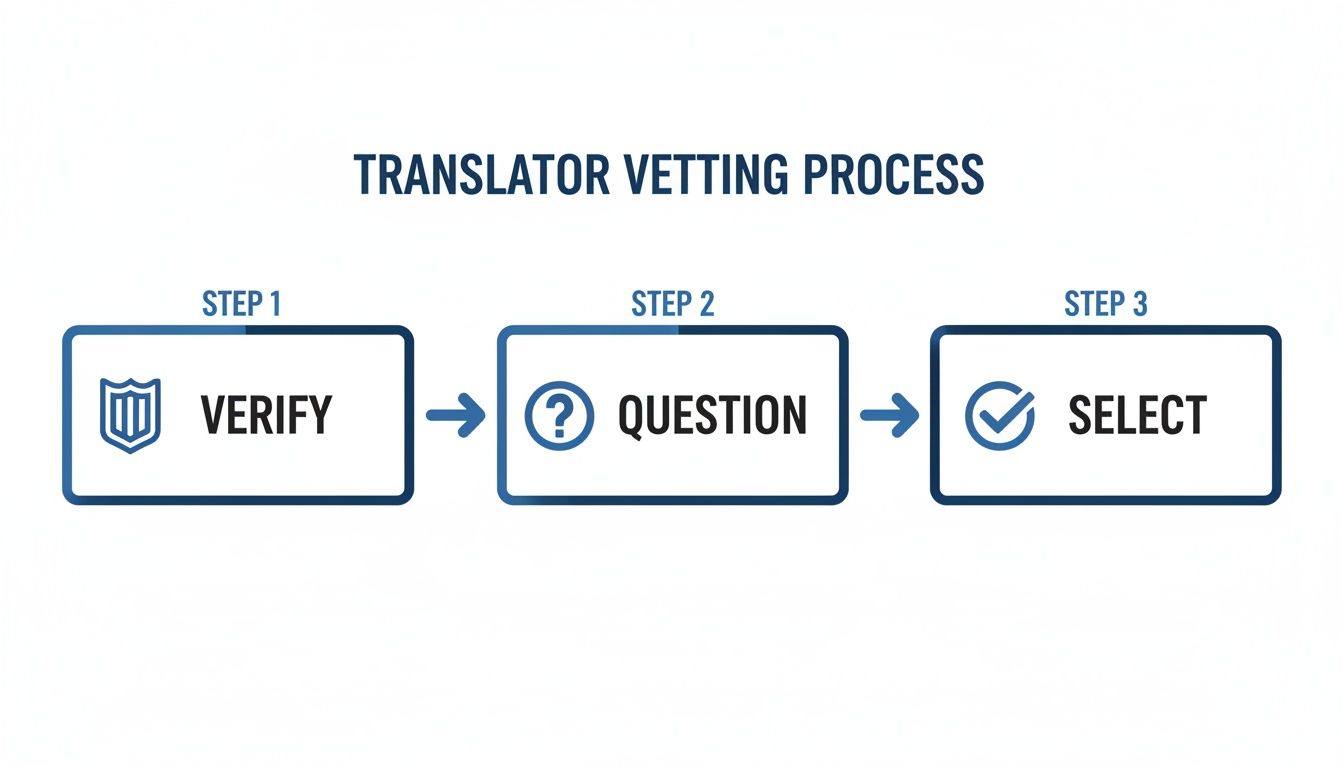
This kind of structured vetting makes sure that your file is handled by someone who truly understands the high stakes and specific requirements of immigration paperwork.
Receiving Your Final Certified Translation
The last piece of the puzzle is the Certificate of Translation Accuracy. This is the official, signed statement we talked about earlier that vouches for the translation’s accuracy and the translator’s ability.
You'll get a final package as a digital PDF, which will include everything you need to submit:
- The clear copy of the original document you sent.
- The complete, properly formatted English translation.
- The signed Certificate of Translation Accuracy.
This complete bundle is what you’ll upload with your USCIS application. For most standard documents—think one to three pages—you can typically expect the entire process to take about 24 hours. Of course, if you have something more complex, like a long legal file, it will take more time, but a good provider will give you a clear timeline from the start. To get a better sense of exactly what officials are looking for, you can learn more about the specific USCIS translation requirements in our guide.
Costly Translation Mistakes That Can Derail Your Application
Even a tiny error in your translated documents can trigger a Request for Evidence (RFE), cause major delays, or even get your immigration application denied outright. The stakes are incredibly high. USCIS officers are trained to spot inconsistencies, so it pays to know what they're looking for.
Think of this as your guide to what not to do. It’ll help you review your final documents with a critical eye and catch issues before they become problems.
One of the most common—and damaging—mistakes we see is submitting a summary instead of a full, word-for-word translation. An applicant might think, "The officer only needs to see the important parts," but that's not how USCIS operates. They see a summary as an incomplete document, plain and simple. Every stamp, seal, signature, and footnote has to be translated to create a complete and trustworthy record.
Why a Friend or Family Member Is Not an Option
Another frequent pitfall is asking a bilingual friend or relative to do the translation. It might seem like an easy way to save a few dollars, but USCIS strictly prohibits this. They view it as a clear conflict of interest because a family member can’t be a truly impartial, neutral party in your case.
It doesn’t matter if your cousin is a professional linguist. Their involvement immediately undermines the credibility of the translation in the eyes of an immigration officer. This isn't about fluency; it’s about following the rules. Submitting a translation from someone who isn’t a neutral third party is a huge red flag that can stop your application in its tracks.
The Missing Certification Catastrophe
Perhaps the single biggest error is submitting a translation without the proper certification statement. A perfectly translated document is essentially worthless to USCIS if it isn't accompanied by a signed letter from the translator or translation company.
This letter is the official guarantee, attesting to the translation's accuracy and the translator's competence. It's not just a formality. Without it, your translation is just an unofficial piece of paper, and your application will be considered incomplete. We've seen cases get stuck for months because of this simple, avoidable mistake. To dig deeper into what can go wrong, check out our guide on common document translation mistakes.
Real-World Scenario: An applicant for a marriage-based Green Card submitted a beautifully translated birth certificate. But the translator, a family friend, forgot to include a certification letter. USCIS issued an RFE, and the applicant had to scramble to find a professional service, get a new certified translation, and resubmit everything. That one mistake added a three-month delay to their case.
Small Details with Big Consequences
Accuracy goes way beyond just the words themselves. Seemingly minor details can have massive implications if they’re handled incorrectly.
- Incorrect Date Formatting: Never "fix" the date format. If the original document says 12/05/1985 (representing May 12th in many countries), the translation must also say 12/05/1985. Changing it to the U.S. standard of 05/12/1985 is technically altering the document and can create serious discrepancies. The translation must mirror the original exactly.
- Currency Conversion Errors: When translating a bank statement or financial document, you should never convert the currency. If the original shows ¥1,000,000, the translation should also show ¥1,000,000, not its equivalent in US dollars. Converting the amount is a major error that alters the source document.
- Missing Official Marks: It's easy to overlook a faint stamp, an official seal, or a handwritten note in the margin of a birth certificate. But these marks are often crucial for verifying a document's authenticity, and leaving them out can render the translation incomplete.
The need for this level of precision is only growing. With more people moving internationally and immigration systems going digital, the demand for certified translation services is higher than ever. By 2026, this demand is expected to see continued growth not just in the U.S. but also across the European Union, where multilingual documentation is often a legal requirement. You can discover more about this growing need for country-specific compliance at Nimdzi.com.
Your Top Immigration Translation Questions, Answered
When you're getting close to submitting your immigration packet, a few key questions always seem to pop up. Let's get them answered so you can file with total confidence. Here's what people ask us all the time, based on our years of experience with USCIS cases.
Does USCIS Require Translated Documents To Be Notarized?
This is a big one, and the answer is simple: No, USCIS does not require notarization.
What they do require is a certified translation. This is a formal statement signed by the translator or a representative of the translation company. The statement swears that the translation is accurate and complete and that the translator is fluent enough in both languages to do the job right.
While some other places, like universities or maybe a foreign consulate, might ask for a notary, it’s an unnecessary step for U.S. immigration. Stick to the USCIS requirements—the certification letter is what they care about. Adding a notary seal won't earn you bonus points.
Can I Translate My Own Birth Certificate For A Green Card Application?
Even if you’re a professional interpreter, you can't translate your own documents for a USCIS application. The reason is simple: USCIS sees it as a conflict of interest. You can't be a neutral, unbiased party in your own immigration case.
This rule extends to family members, too. Your cousin who teaches Spanish can't do it, either. The translation has to come from a neutral third party who can professionally certify that it's a true and accurate translation. Using a professional service for your USCIS certified translation is the only way to guarantee you meet this requirement without a hitch.
Should I Submit Original Documents Or Photocopies To USCIS?
Unless you are specifically told to bring an original document to an interview, you should only submit photocopies with your application packet. Never, ever mail your original birth certificate or passport.
Here’s exactly what you need to send for each translated document:
- A high-quality, legible photocopy of the original document (in the foreign language).
- The full, typed English translation.
- The signed Certificate of Translation Accuracy from the translator or company.
Sending originals is a huge risk. They can get lost in the mail or within the USCIS system, and you might never see them again.
How Much Does It Cost To Translate Immigration Documents?
Pricing can be all over the map, but a good, reliable service will be transparent. Look for a simple, per-page rate. It makes it easy to figure out your total cost without any surprise fees later on. A standard, competitive rate is often around $23 per page for a page with up to 250 words.
If you see a price that seems too good to be true, it probably is. Super-low rates can be a red flag for a service that might be cutting corners, which could lead to an inaccurate translation or a certification that USCIS rejects. Always make sure the price includes the signed Certificate of Translation. You can see an example of a clear cost structure on our translation pricing page.
For even more deep dives into the nuances of immigration translation, industry resources are a great place to turn. You can find more information by checking out Parakeet AI's blog for further insights.
At TranslateDay, our entire process is built to deliver USCIS-accepted certified translations, fast. With our expert translators and acceptance guarantee, you can check this major item off your list and focus on the rest of your application.
Get an instant quote and have your certified translation ready in 24 hours.


