
Navigating immigration paperwork or university applications can feel like walking through a minefield. A simple mistake on a translated document can bring the entire process to a halt. When you're submitting your academic records, a basic translation won't do. You need a certified translation—an official, professional translation that includes a signed guarantee of its accuracy, which is exactly what authorities like USCIS and universities demand.
Why a Perfect Transcript Translation is Not Negotiable
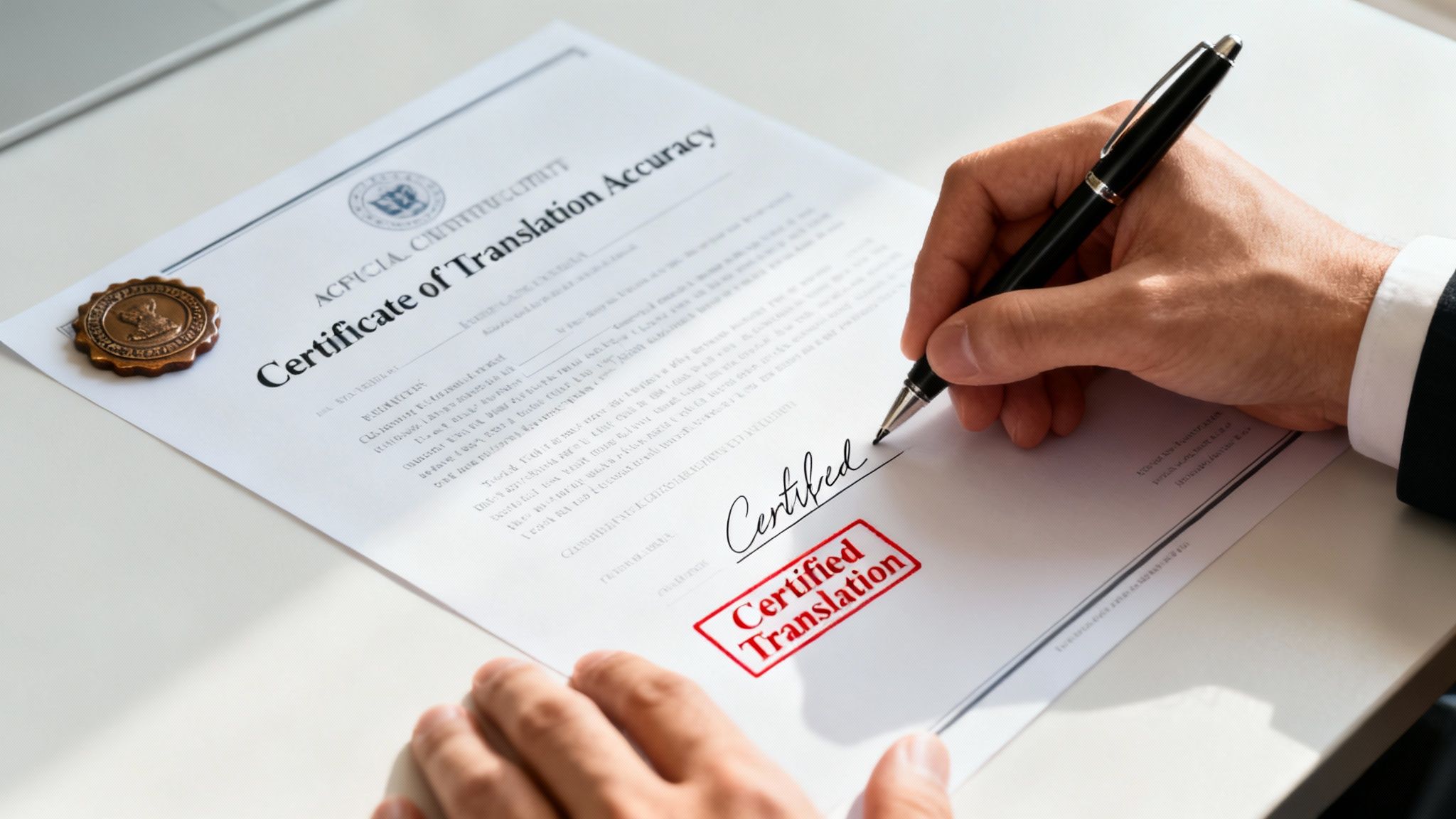
Whether you're an international student aiming for a top U.S. college or a professional applying for a Green Card, the accuracy of your translated documents is critical. Official bodies like U.S. Citizenship and Immigration Services (USCIS)—the U.S. government agency that handles immigration—and university admissions offices have no room for error. They must be completely certain that the documents you submit are a perfect reflection of your academic history.
Think of a certified translation as a sworn promise. It's not just about changing words from one language to another; it’s about carefully preserving every detail of the original document. This includes grades, course titles, official stamps, and signatures. This guarantee comes in a signed document called a "Certificate of Translation Accuracy," which accompanies your translated transcript and serves as proof of its authenticity.
The High Stakes of an Inaccurate Translation
A sloppy or incorrect translation can create serious problems right away. For instance, an admissions officer might struggle to understand your academic qualifications, pushing your application to the bottom of the pile. Even worse, a USCIS officer could flag your immigration case for review, leading to frustrating delays or even a flat-out rejection.
Imagine Maria, an aspiring engineer from Colombia, who is applying for her master's degree. She submits a translation of her academic transcript done by a well-meaning but uncertified friend. The university can't verify her course equivalencies because the terminology is unclear, and they put her application on hold. She has to rush to find professional transcripts translation services to get a certified version, almost missing the enrollment deadline for the 2026 academic year. These situations are not just hypothetical; they happen every day.
The need for precise translation is part of a massive global trend. The translation services market was valued at an enormous USD 27.78 billion in 2025 and continues to grow, fueled by the ambitions of international students and immigrants. This growth shows just how many people rely on these services for their future. You can read the full research on the translation services market to see the data for yourself.
A certified translation acts as your official, word-for-word promise to authorities. It confirms that every detail, from course codes to registrar signatures, has been accurately and completely rendered in the new language, eliminating any doubt or ambiguity.
Who Needs Certified Transcript Translations and Why
Certified translations are required for many official processes. While the context may vary, the core need for accuracy and official validation is always the same. It's the only way for institutions to trust the documents they're reviewing.
This table shows who typically needs certified transcript translations and why the official certification is essential.
| Who You Are | What You Need It For | Why Certification Is Crucial |
|---|---|---|
| International Student | University or college admissions | To verify academic history and ensure course equivalency. |
| Immigration Applicant | USCIS visa, Green Card, or citizenship | To prove educational qualifications and meet strict legal standards. |
| Professional | Job applications or professional licensing | To validate foreign credentials and work experience for employers. |
| Medical Professional | Licensing or residency programs | To confirm medical school performance and qualifications with precision. |
Ultimately, investing in a professional certified translation service is about securing your peace of mind. It ensures your documents meet the strict standards of official organizations, helping your application proceed smoothly.
Certified vs. Standard Translation: What’s the Difference?
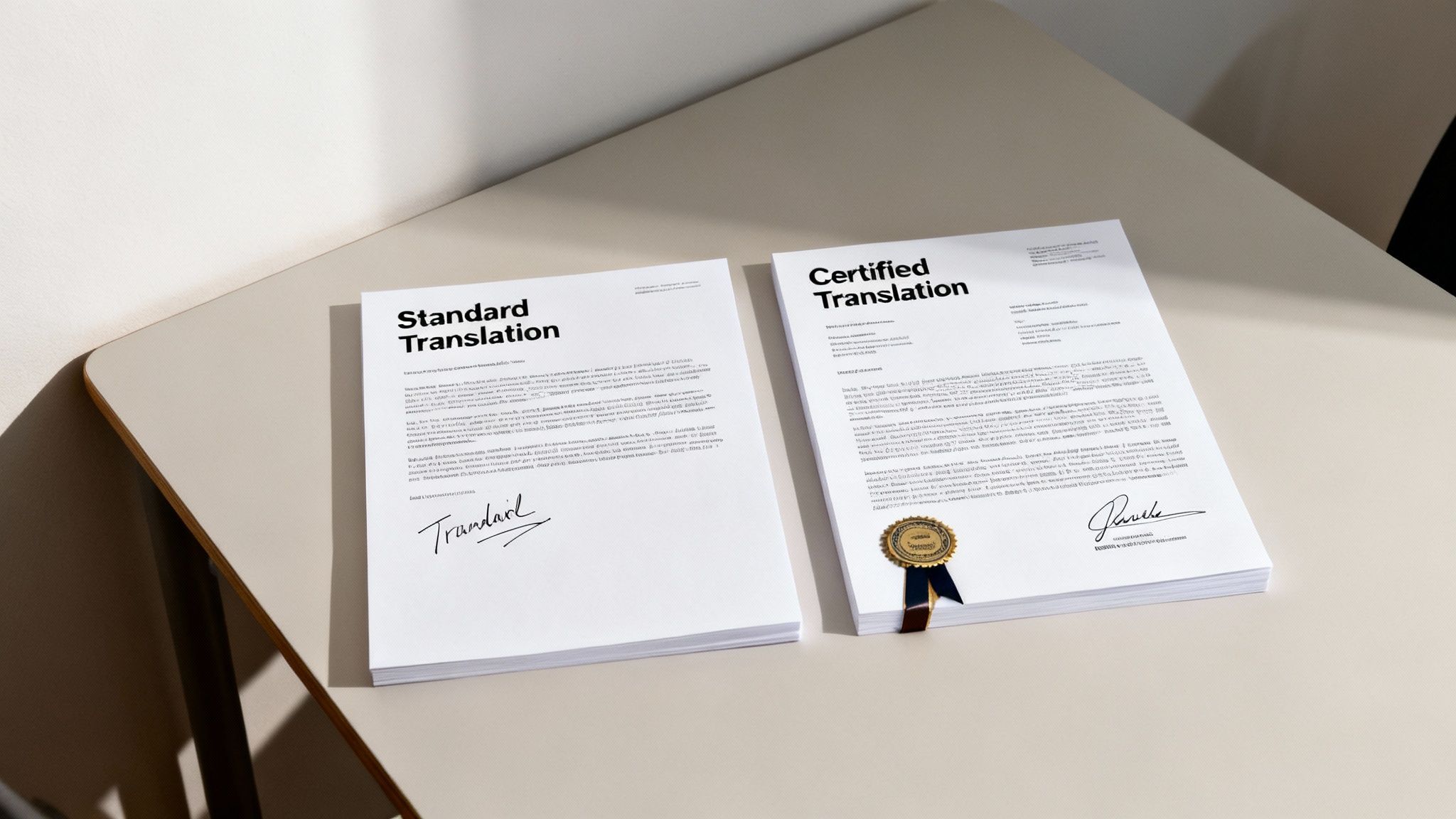
When you need a document translated, it's easy to assume all translations are the same. But for official purposes like a university application or an immigration file, the difference between a standard translation and a certified translation is enormous. Understanding this difference is the first step toward a successful application.
A standard translation is informal. It’s like telling a friend the main points of an article you read. It's useful for understanding a website or a casual email, but it has no official legal weight.
A certified translation, on the other hand, is a formal document that comes with a signed guarantee of its accuracy and completeness. This guarantee is called a Certificate of Translation Accuracy, and it's what makes the translation official. This is the only type of translation that institutions like USCIS or university admissions offices will accept for important records like your academic transcript.
The Three Parts of a Certified Translation
A proper certified translation isn't just one paper. It's a complete package of three documents that prove the translation is legitimate. When you hire professional transcripts translation services, this is what you should always get:
- A copy of your original document: This shows the exact source material the translator used.
- The translated document: This is the English version of your transcript, formatted to mirror the layout of the original.
- A Certificate of Translation Accuracy: This is the most important part. It’s a formal statement signed by the translator or translation company, confirming that the translation is a true and accurate version of the original text.
This signed certificate is what gives the translation its official power. Without it, your translation is just words on a page with no legal standing.
Real-World Example: Let's say you're applying for U.S. citizenship. You submit a birth certificate from your home country. USCIS won't just accept a simple English version of it. They need the certified translation package: a copy of the original birth certificate, the English translation, and the signed Certificate of Translation Accuracy to prove it's a faithful translation.
Notarized and Sworn Translations: What’s the Difference?
You might also hear the terms "notarized" or "sworn" translation, which can be confusing. They sound similar but serve different purposes.
A notarized translation adds one more step. A Notary Public (an official authorized to witness signatures) watches the translator sign the Certificate of Accuracy and then adds their own seal and signature. The notary isn't checking the quality of the translation; they are only verifying the identity of the person who signed the certificate. USCIS doesn't typically require notarization for most documents, but some specific institutions might. You can learn more about certified and notarized translation to see if you need it.
A sworn translation is a more specialized requirement, common in many European countries. In this system, a translator is officially appointed and "sworn in" before a court, giving their translations a special legal status. This is almost never required for applications within the United States.
For U.S. immigration and academic purposes, the certified translation is what you need. It provides the official assurance required to keep your application moving forward.
Meeting USCIS and Academic Requirements
Figuring out the rules for official bodies like U.S. Citizenship and Immigration Services (USCIS) or American universities can be daunting. The good news is that their requirements for translated documents are quite clear. Once you understand what they need, preparing your application becomes much easier.
USCIS Requirements for Certified Translations
For any immigration-related matter, USCIS has a strict rule: any document not in English must be submitted with a complete, word-for-word English translation. The translation must also come with a signed statement from the translator certifying its accuracy and their competence to translate.
This certification statement is the most critical part for USCIS. While there's no official template, every valid certification must include three key elements:
- A statement of the translator's competence: The translator must confirm they are fluent in both English and the original language.
- An attestation of accuracy: The statement must declare that the translation is a complete and accurate version of the original document.
- The translator’s details: It must include the translator's full name, signature, and the date.
If any of these elements are missing, USCIS will likely issue a Request for Evidence (RFE), which can delay your case for weeks or even months. To avoid this, it's wise to review the complete USCIS requirements for translated documents. For something as important as immigration, using specialized USCIS document translation services is the safest way to ensure compliance.
How Academic Institution Requirements Differ
Universities and credential evaluation services like World Education Services (WES) also require certified translations, but they look at them with a focus on clarity and consistency. Admissions officers need to fully understand your academic background without any ambiguity.
This means your translated transcript must be a perfect mirror of the original. Everything—from course titles and grades to the registrar's stamps and seals—must be translated and formatted to match the original layout. This allows officials to easily compare the two documents and accurately evaluate your education.
A common mistake is submitting a translation that summarizes course descriptions or simplifies academic terms. This creates confusion and can lead to your credentials being undervalued, potentially hurting your chances of admission or receiving transfer credits.
A Practical Checklist for Document Preparation
The demand for precise, official translations is growing rapidly. In the transcripts translation services market, the judicial and legal segment is projected to account for over 25.5% of the market share by 2035, driven by the increasing volume of cross-border legal and immigration cases.
To ensure your documents meet these high standards, follow this simple checklist:
- Create High-Quality Scans: Use a flatbed scanner to create clear, high-resolution PDFs or JPGs. Make sure the entire page, including borders and stamps, is visible.
- Never Send Originals (Unless Instructed): Always submit copies of your original documents along with the certified translation. Official bodies rarely ask for originals, and you risk losing them permanently if you mail them.
- Verify All Information: Before submitting, triple-check that your name, birthdate, and other key details are spelled correctly and are consistent across all your documents. A small typo can cause a major delay.
Your Step-by-Step Translation Process
Getting official documents translated online should be a simple and secure experience. You can get everything you need from home in just a few clicks, without confusing forms or in-person appointments. The process is designed for speed and accuracy, giving you peace of mind when deadlines are near.
Let's walk through the typical four-step journey to get your foreign-language transcript translated and certified for USCIS or a university.
This straightforward workflow is all it takes to prepare your documents for submission.
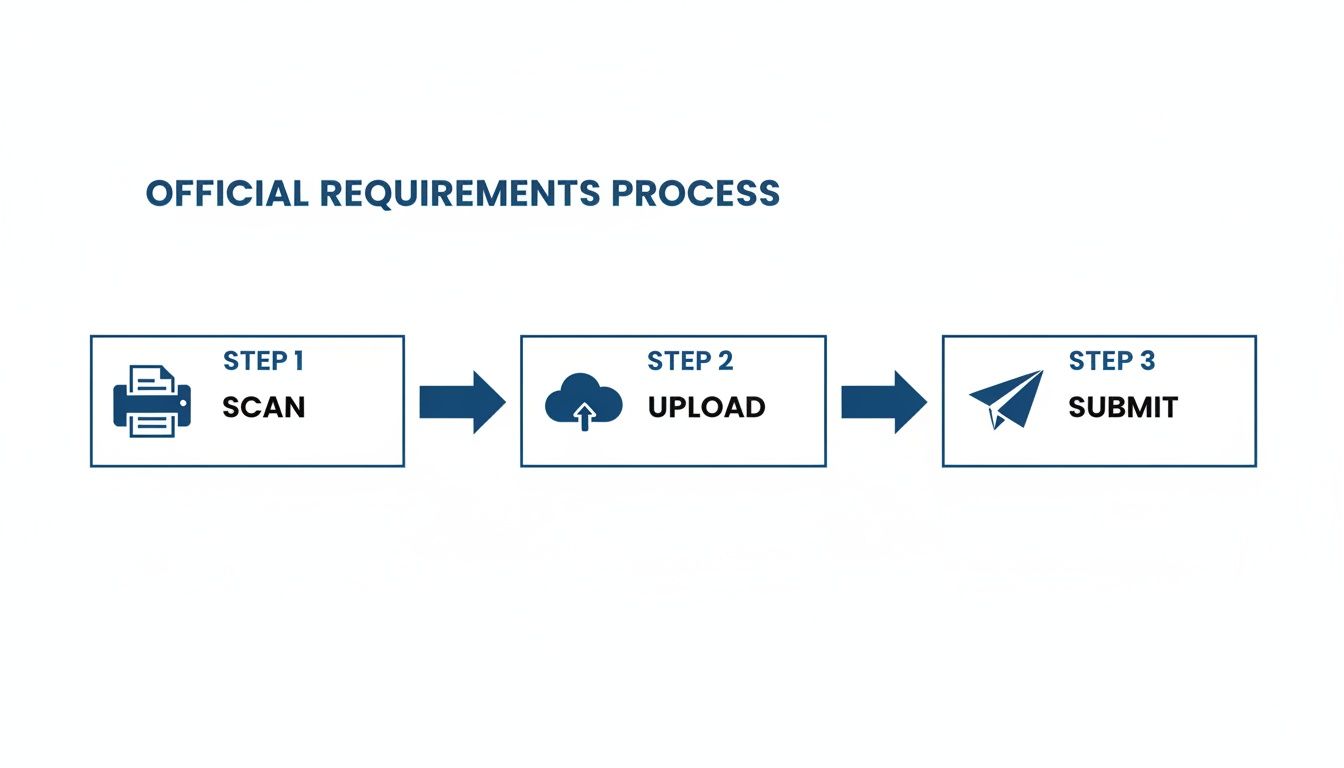
As you can see, modern transcripts translation services have simplified the entire submission process into a few core actions you can complete from anywhere.
Step 1: Document Submission and Quote
The first step is to upload your documents. You don't need a professional scanner—a clear photo from your phone often works well. Reputable agencies accept common file formats like PDF, DOCX, and JPG for documents such as an academic transcript, diploma, or a marriage certificate.
Once your files are uploaded, you should receive an instant quote. A transparent, per-page pricing model means there are no hidden fees. Knowing the exact cost upfront helps you manage your application budget effectively.
For example, a student from Mexico with a three-page academic record can upload the document and immediately see the total cost for a certified translation, allowing them to proceed with confidence.
Step 2: Professional Human Translation
This is where the real work begins. Once you approve the quote, your documents are assigned to a professional human translator. Automated tools like AI simply cannot handle the specific terminology and nuances of official records. The translator will be a native speaker of the source language and fluent in English, ensuring every detail is captured perfectly.
They will meticulously recreate your document, focusing on:
- Formatting: The translated version will visually match the original, making it easy for officials to compare the two.
- Terminology: Course titles and academic terms will be translated precisely to convey their correct meaning.
- Completeness: Every stamp, seal, signature, and handwritten note will be accounted for in the final translation.
Step 3: Quality Control and Certification
Before the translation is sent to you, it undergoes a quality assurance check. A second linguist reviews the entire document for any errors in grammar, spelling, or accuracy. This two-step verification process ensures a flawless final product that meets the high standards of USCIS and universities.
Once perfected, the agency prepares the Certificate of Translation Accuracy. This is the signed statement that confirms the translation's completeness and correctness—it's what makes the translation "certified." To learn more, you can review our guide on the translation and certification process.
Step 4: Secure Delivery
After the translation is complete and certified, the final documents are sent to you. For most standard orders of one to three pages, you will receive a digital PDF copy via email within 24 hours. This PDF is ready to be printed and included with your application. If you need a physical copy with an original "wet ink" signature, most services can mail one for a small fee. Your sensitive personal data is kept safe throughout the process using secure, encrypted systems.
Here’s a quick overview of the online transcript translation workflow:
Online Transcript Translation Workflow
| Step | What You Do | What the Agency Does | Expected Time |
|---|---|---|---|
| 1. Upload & Order | Scan or photograph your document and upload it. Fill out the order form. | The system analyzes your document and provides an instant price quote. | 5-10 minutes |
| 2. Translation | Confirm the order and make the payment. | A professional human translator converts your document into English, matching the original format. | 12-24 hours |
| 3. Quality Review | Relax while we work. | A second linguist proofreads the translation for accuracy and completeness. | Included in the 24-hour window |
| 4. Certification & Delivery | Check your email. | The agency generates the Certificate of Accuracy and delivers it to you digitally. | Within 24 hours of ordering |
This workflow is designed for maximum efficiency, ensuring you receive your documents without unnecessary delays. Ready to begin? Get an instant quote for your certified transcript translation today.
Common Mistakes That Can Derail Your Application
A single error in your translated transcript can cause a major delay or even a rejection from USCIS or a university. You’ve worked too hard to let a preventable mistake jeopardize your application.
One of the most frequent mistakes is asking a bilingual friend or family member to do the translation. While their intentions may be good, this raises immediate red flags for officials. They are not professionally certified and cannot be held accountable for their work, which is unacceptable for official purposes. Always use a professional certified translation service.
Another common error is submitting a summarized translation instead of a complete, word-for-word version. Officials need to see everything—every course name, grade, and note. Summaries omit crucial details, leading to confusion and often a dreaded Request for Evidence.
Why Automated Tools Are Not an Option
It can be tempting to use free online tools like Google Translate. However, these tools cannot provide the legal certification required for official documents. They also struggle with the specific academic and legal context, resulting in translations that are almost certain to be rejected.
The demand for professional document translation is surging for a reason. Driven by rising global migration and international student applications, the market is projected to grow at a CAGR of 9% from 2025 to 2032. North America alone accounts for 39.41% of the global share, largely because of students from the Asia-Pacific region needing diploma and transcript translations. This trend underscores just how critical professional services have become. You can find more details on these market trends in this report.
Finally, a surprisingly common oversight is failing to translate everything on the page, including seals, stamps, signatures, and handwritten notes. Omitting these elements creates gaps in the record that officials cannot verify. Ensure your translator annotates every mark exactly as it appears.
Tips to Avoid Common Pitfalls
- Inspect Every Page: Before submitting a document for translation, check that every page is clear and complete.
- Verify Translator Credentials: The translator’s certificate is your proof. It must state their fluency in both languages and include their signature and the date.
- Follow Formatting Guidelines: A good translation will mirror the original layout, making it easy for officials to cross-reference the two documents.
Another trap is submitting poor-quality scans. Blurry or cropped images can hide important information, which is a recipe for rejection. Use a proper flatbed scanner or a high-resolution camera with good lighting.
Experts warn that missing details like a registrar seal or instructor initials can trigger a Request for Evidence and derail your timeline.
Common Problems and Solutions
- Wrong Document Version: Make sure you're using the official transcript issued by your institution, not an unofficial copy from a student portal.
- Missing Translator Statement: Double-check that the translator’s certificate is attached and clearly states their qualifications, signature, and the date. This is not optional.
For a deeper dive into preventing these kinds of issues, check out our guide on Translation Mistakes and How to Fix Them.
By avoiding these common mistakes, you can keep your application moving forward smoothly. An accurate, certified transcript translation is your key to a successful review process.
How to Choose the Right Translation Service
With so many online options, finding the right partner for your transcripts translation services can feel overwhelming. This decision affects your academic future or immigration status, so it’s about more than just translating words—it’s about ensuring accuracy, official recognition, and peace of mind.
This guide will help you focus on a few key criteria to confidently choose a provider who will get the job done right the first time.
Non-Negotiable Guarantees
First, look for an explicit USCIS acceptance guarantee. Any reputable agency handling immigration documents will stand behind their work and promise their certified translations will be accepted by USCIS. If this promise isn't clearly visible on their website, consider it a red flag.
Next, confirm they use professional human translators. Automated tools cannot handle the nuances of academic transcripts or the precision required for official documents. A reliable service will always use skilled linguists who can ensure every detail is translated perfectly.
Think of a professional translation service as your partner in the application process. They understand that a single mistake can derail your plans and stake their reputation on delivering flawless, compliant documents every time.
Transparency and Trustworthiness
Clear, upfront pricing is essential. The best services have a simple per-page or per-word model with no hidden fees. You should be able to upload your transcript and get an instant, exact quote before committing. For a clear example, you can review our transparent pricing and turnaround information.
Customer reviews also provide valuable insight. Look for feedback from people in similar situations—other students applying to U.S. universities or individuals navigating the immigration process. Consistently positive reviews are a strong indicator of a reliable service.
Finally, check the company’s commitment to data security. You are uploading documents with sensitive personal information. A trustworthy provider will use secure, encrypted platforms to protect your data from start to finish.
A Checklist for Choosing Your Provider
To simplify your decision, use this checklist when evaluating potential translation services:
- USCIS Acceptance Guarantee: Is it clearly stated and unconditional?
- Human Translators: Do they confirm they use professional human linguists, not just software?
- Transparent Pricing: Can you get an instant, fixed quote with no surprise charges?
- Strong Customer Reviews: Do they have positive feedback from clients with similar needs?
- Fast Turnaround Times: Can they deliver within your deadline, ideally in 24-48 hours?
- Data Security: Does the website mention using secure and encrypted systems?
Choosing the right partner for your academic transcript translation is a critical step. By following this guide, you can find a service that delivers the accurate and reliable translations you need to succeed.
Ready to work with a team that checks every box? Get an instant quote and receive your certified translation in as little as 24 hours.
Your Transcript Translation Questions, Answered
When you're dealing with official applications and tight deadlines, you're bound to have questions about getting your transcripts translated. Here are answers to some of the most common ones.
Do I Need to Mail You My Original Transcripts?
Absolutely not, and we strongly advise against it! Never mail your irreplaceable, original documents. A professional translator only needs a high-quality digital copy.
Simply send us a clear scan or a sharp photograph of your transcript. We will work from that digital copy to create a precise, certified translation, and you can keep your original documents safely with you.
What's the Real Difference Between Certified and Notarized Translations?
This is a common point of confusion. Let’s break it down simply.
A certified translation includes a formal statement, or "Certificate of Accuracy," signed by the translator or translation agency. This statement confirms that the translation is a complete and accurate version of the original document. This is what USCIS and nearly all U.S. universities require.
A notarized translation adds an extra layer of verification. A Notary Public witnesses the translator signing the certificate and adds their own official seal. The notary isn’t checking the translation itself; they are only verifying the identity of the person who signed it.
For the vast majority of U.S. immigration and academic applications, a certified translation is all you need. Notarization is rarely required for transcripts and often adds unnecessary cost and time, unless an institution specifically requests it.
If you do need both, we offer dedicated certified and notarized translation services.
How Do You Calculate the Price for Translating a Transcript?
We believe in clear, upfront pricing. Our model is simple: we charge a flat rate per page, with a standard page defined as up to 250 words.
This approach ensures you know the exact cost before you place your order. Just upload your document, and our system will provide an instant quote, making it easy to budget for your application expenses. You can see a full breakdown on our pricing and turnaround page.
What Will the Translated Transcript Look Like?
Your translated document will be formatted to look as much like the original as possible. We carefully replicate the layout, including the placement of text, official seals, stamps, and signatures.
This "mirror-image" formatting is crucial. It allows admissions officers and USCIS officials to easily compare the translation to your original copy, which helps speed up their review process and prevent any potential issues.
Feeling more confident? The team at TranslateDay is ready to deliver the fast, accurate, and USCIS-accepted certified translations you need to move forward.


