
When you need to submit important documents for official purposes—like for an immigration application, a university admission, or a legal case—a basic translation won't be accepted. You need a specialized online certified translation service. This service provides a legally valid translation of your documents, complete with a signed statement guaranteeing its accuracy.
This isn't just about switching words from one language to another. It's a formal process designed to ensure that official bodies like USCIS (United States Citizenship and Immigration Services), universities, and courts accept your paperwork without hesitation. For any situation where precision and official acceptance are non-negotiable, a certified translation is the only path forward.
What Exactly Is a Certified Translation?
So, what makes a translation "certified"? Think of it as an official seal of approval on your translated document. It’s a formal promise that the translation is a complete and accurate reflection of the original, making it suitable for official use.
A certified translation always includes two key parts:
- The Flawlessly Translated Document: A professional human translator meticulously replicates every word, phrase, and detail from your original document into the target language. They even work to maintain the original formatting as closely as possible.
- The Certificate of Translation Accuracy: This is the crucial element. It's a formal statement, usually on a separate page, signed by the translator or a representative of the translation company. This certificate is their professional pledge, confirming the accuracy and completeness of the translation.
The Power of the Certification Statement
The Certificate of Accuracy is what gives the translation its legal authority. It is a signed declaration stating that the translator is fluent in both languages and that, to the best of their professional knowledge, the translation is a true and faithful version of the original.
This simple document removes any doubt about the translation’s quality and integrity.
For example, imagine you are applying for a U.S. visa, and your birth certificate is in Spanish. You can't just ask a bilingual friend to translate it or use a free online tool. USCIS will reject it immediately. Why? They have no way of knowing if the translation is accurate or if the person who translated it was qualified. This common mistake could trigger a Request for Evidence (RFE), delaying your application for weeks or even months.
A professional online certified translation service is designed to prevent this exact problem. It provides the official documentation required by these strict institutions, helping your application proceed smoothly. You aren't just paying for translated words; you're investing in a guarantee of acceptance.
Why Official Bodies Demand Certification
Government agencies, courts, and universities can't afford to take risks with important documents. They need absolute certainty that the paperwork they review is trustworthy. A certified translation provides that trust by making the translator or agency formally accountable for their work. It's proof that a qualified professional stands behind every word.
This is why certification is mandatory for:
- Immigration Paperwork: Documents for USCIS, such as birth certificates, marriage licenses, and passports, must be certified.
- Academic Applications: High schools, colleges, and universities almost always require certified translations of academic transcripts and diplomas.
- Legal Proceedings: Courts rely on certified translations of evidence, contracts, and other legal documents to ensure fairness and accuracy.
To help you identify a proper certified translation, here’s a breakdown of its essential components.
Key Features of a Certified Translation
This table breaks down the essential components of a certified translation, helping you quickly understand what makes it official and trustworthy.
| Component | What It Is | Why It Matters for You |
|---|---|---|
| Complete Translation | An exact, word-for-word translation of the entire source document. | Ensures no information is missing, which could cause rejection. |
| Certificate of Accuracy | A signed statement from the translator or agency. | This is the legal guarantee that the translation is accurate and complete. |
| Translator's Credentials | Information about the translator's qualifications or the agency's credentials (e.g., ATA membership). | Proves the work was done by a qualified professional. |
| Contact Information | The name, address, and signature of the translator or a company representative. | Allows the requesting institution to verify the translation's source. |
| Date of Translation | The date the translation was completed and certified. | Provides a clear record of when the document was prepared. |
Each of these elements works together to create a document that official bodies can rely on.
While AI tools are getting better at quick translations, there’s a massive difference between a machine-generated text and a legally recognized document. For anyone understanding the role of official translations, it's clear that for official submissions, a certified human translation is still the only reliable option.
To dive deeper, you can learn more about the specifics of certified and notarized translation and how these services are structured to meet strict official standards. Ultimately, this process ensures your documents aren't just translated, but are legally valid and ready for submission.
How the Online Translation Process Works
You might think getting an important document officially translated is a complicated, time-consuming process. It used to be. But with a modern online certified translation service, the entire process is surprisingly simple and fast.
Everything is designed to be secure and straightforward, breaking down what seems like a major task into three easy steps. Let's walk through how you go from holding a document in one language to having a fully certified translation ready for official submission.
Step 1: Securely Upload Your Documents
It all begins with submitting your document. A professional service provides a secure, encrypted online portal for you to upload your files. You don't need a high-tech scanner—a clear photo from your phone or a standard PDF or Word file is perfect.
Imagine you have a tight USCIS deadline and need your birth certificate translated urgently. You can simply snap a clear picture of it, upload it from your phone in minutes, and the process is started. Reputable services use strong encryption, so your sensitive details, like passport numbers or medical information, are kept completely private from the moment you upload.
This quick infographic shows just how simple the journey is from start to finish.
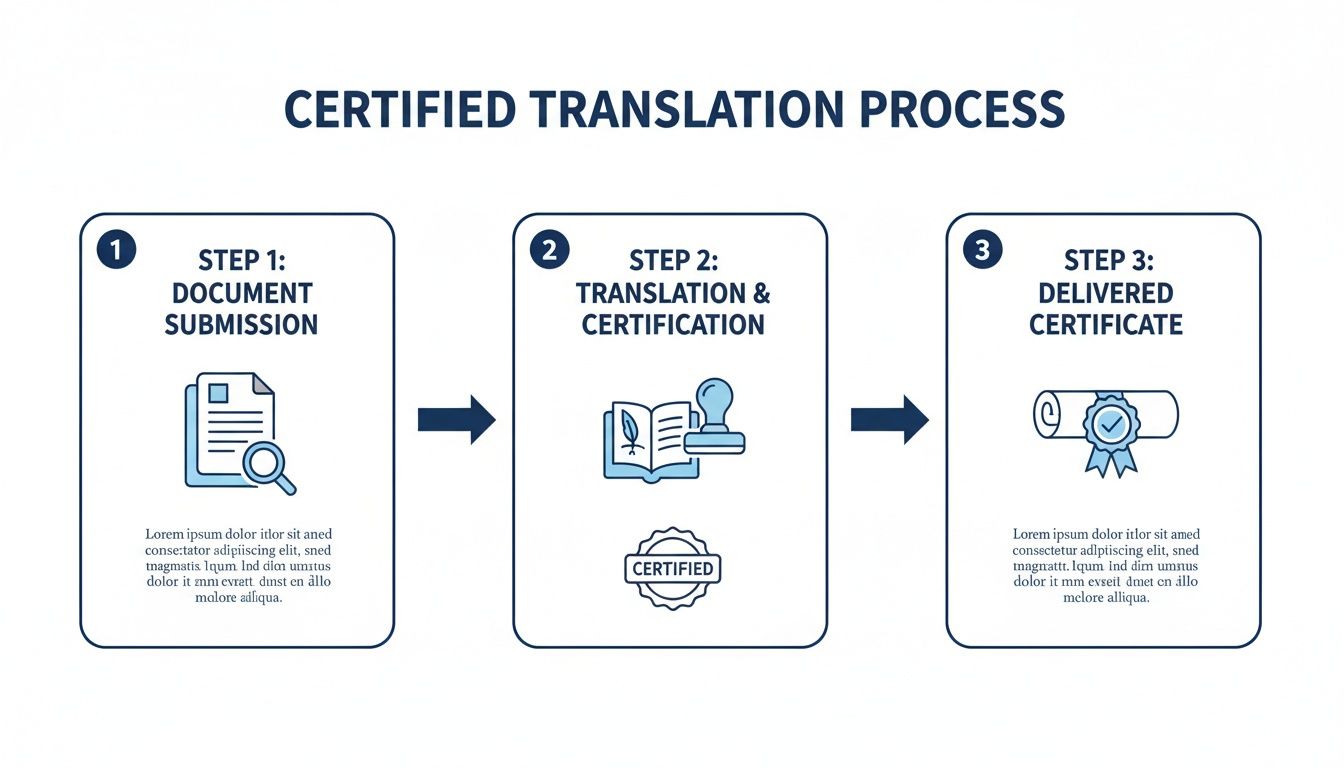
As you can see, the workflow is built for speed and clarity, moving your request from your hands to a professional translator and back again without any fuss.
Step 2: A Professional Human Translator Gets to Work
This is where the real work happens. Once your document is received, it is assigned to a qualified human translator—not a machine. While automated tools have improved, they cannot handle the nuance, specific formatting, and legal weight required for official documents. A human expert ensures every detail is correct.
These are not just people who speak two languages; they are professionals, often members of organizations like the American Translators Association (ATA), who specialize in specific fields like legal, medical, or academic translation. They understand the precise terminology for legal contracts, medical reports, and academic transcripts, so nothing is lost in translation.
Real-World Scenario: Maria is applying for a Master's program in the U.S. and needs her academic transcripts from Spain translated into English. She uploads the PDF, and a translator experienced in academic documents takes over. The translator ensures that course names, grading systems, and university-specific terms are accurately converted to their U.S. equivalents, so the admissions office has a clear and accurate record of her achievements.
Step 3: Receive Your Certified Translation
The final step is receiving the finished product. For most standard documents (1-3 pages), you can expect the certified translation to be delivered to your email within 24 hours. You will receive a digital PDF of the translated document, which includes the signed Certificate of Translation Accuracy.
This digital copy is sufficient for most submissions to agencies like USCIS or universities. If you need a physical "hard copy," most services can mail one to you. This fast delivery means you can confidently meet your deadlines without worrying about acceptance. You can learn more by checking out our guide on translation turnaround times.
With a top-tier online certified translation service, what once felt like a bureaucratic nightmare becomes a simple, stress-free task.
Meeting Official USCIS Requirements
When you are dealing with United States Citizenship and Immigration Services (USCIS)—the agency responsible for Green Cards, visas, and citizenship—there is no room for error. USCIS has strict, non-negotiable rules for any document not originally in English. Getting this part right is critical for a smooth application.
The good news is that the rules are straightforward. USCIS doesn't require complex or expensive notarizations. They require two things: a complete English translation of your original document and a signed certification from the translator or translation company.
What USCIS Actually Looks for in a Certified Translation
For your translated document to be accepted by USCIS, it must be accompanied by a formal statement from the translator. This is the "Certificate of Accuracy," and it must formally confirm two key points:
- Translator Competence: The certificate must state that the person who performed the translation is fluent in both English and the original language and is competent to translate.
- Translation Accuracy: It must also declare that the translation is a complete and accurate rendition of the original document.
That's it. USCIS does not require the translator to have a specific state license or federal certification. The focus is entirely on the signed attestation of competence and accuracy from a qualified, impartial third party.
A Real-World Immigration Story
Consider the Garcia family, who are applying for their Green Cards. They have gathered their essential documents from their home country: birth certificates for their children and their own marriage certificate. They know these documents must be submitted in English.
Mr. Garcia initially considers asking his bilingual cousin to translate them to save money. However, he learns that USCIS regulations are clear: the translator must be impartial. A family member is not considered an objective third party. Submitting a translation from a relative could easily trigger a Request for Evidence (RFE), delaying their entire case by months.
Instead, they choose an online certified translation service. In less than 24 hours, they receive professional English translations of all three documents, each accompanied by a signed Certificate of Accuracy. This certificate proves to the USCIS officer that the translations are reliable, complete, and prepared by a competent professional, allowing their application to move forward without any translation-related issues.
Why Professional Certification Matters Beyond USCIS
The standards used by USCIS are the gold standard for most official bodies across the United States. Whether it's a university, a medical board, or a courtroom, they all need to trust the documents they review.
- Academic Institutions: When you apply to a university, the admissions office needs a certified translation of your academic transcript and diploma to fairly evaluate your qualifications.
- Medical Boards: A doctor from another country seeking licensure in the U.S. must provide certified translations of their medical credentials and records.
- Legal Courts: In legal proceedings, courts require certified translations of evidence, contracts, and witness statements to ensure the process is fair and based on accurate information.
In every one of these situations, the goal is the same: to remove any doubt about the document's authenticity and accuracy. A professional certification provides that assurance, making your documents instantly credible.
This need for trustworthy documentation is only growing. The global demand for accurate legal translations for immigration, notarization, and court cases is on the rise. Certified translation has become so vital that the judicial translation market alone is expected to capture over 25.5% of the market share by 2035. That number really highlights just how critical official acceptance is in our connected world. If you're interested in the data, you can read the full research on the translation service market.
Navigating these requirements can feel overwhelming, but a professional service is built to handle it for you. By using a service that understands exactly what’s needed, you can provide documents that meet the highest standards. For a detailed breakdown, check out our guide on what makes a translation meet official USCIS standards.
What Kinds of Documents Need a Certified Translation?
You have an official document—a birth certificate, a diploma, a legal contract—and you need to submit it to an authority like a court, a university, or a government agency. The question is: does it need a certified translation? More often than not, the answer is yes.
Anytime you are dealing with official matters, you cannot simply submit a translation done by a friend or an app. You need a document that carries legal weight. That’s where a professional online certified translation service becomes essential, ready to handle the specific, high-stakes paperwork that keeps your life moving forward.
Think of a certified translation as a bridge. It connects your original document to its new official context, ensuring every detail is carried over accurately. This isn't just about swapping words; it's about preventing the small misunderstandings that can lead to significant and costly delays.
Immigration and Civil Documents
This is the most common reason people seek certified translations. When navigating the complexities of immigration—applying for a visa, Green Card, or citizenship—agencies like USCIS have zero tolerance for ambiguity. They require certified English translations for all your vital records, also known as civil certificates.
- Birth Certificates: The foundational proof of your identity and family relationships.
- Marriage Certificates: Essential for spousal visas or proving your marital status.
- Divorce Decrees: Needed to show you are legally single and free to remarry.
- Passports and Visas: Used to establish a clear record of your identity and travel history.
- Adoption Papers: Critical for international adoptions and family-based immigration petitions.
For example, a couple from Brazil applying for U.S. residency will need to submit certified translations of their marriage certificate and their children's birth certificates. This allows the USCIS officer to instantly verify their family unit without language barriers, helping to keep the application process smooth. You can dive deeper into specific immigration and USCIS translations requirements here.
Academic and Professional Credentials
Planning to study abroad or get your professional license recognized in a new country? Your academic and career history must be perfectly clear to the people reviewing it.
- Academic Transcripts: These documents detail your courses and grades. A certified translation ensures the admissions team can properly evaluate your academic background.
- Diplomas and Degrees: This is your proof of graduation and qualifications.
- Resumes or CVs: Often required for job applications or when seeking professional credentialing.
Let’s say a student from France is applying to a master's program in the United States. She will need certified translations of her bachelor's diploma and all her university transcripts. This is non-negotiable; it's the only way the admissions committee can fairly assess her qualifications against their own standards.
Legal and Financial Documents
When it comes to legal matters or financial transactions, there is no room for error. A misplaced comma or a poorly translated term can change the entire meaning of a contract or court order.
- Contracts and Affidavits: For business agreements or sworn legal statements.
- Bank Statements: Frequently required for visa applications to prove financial stability.
- Court Orders: This includes judgments, subpoenas, and other official rulings.
- Wills and Testaments: Guarantees that final wishes and inheritance instructions are understood and followed precisely.
This is exactly why so many legal professionals turn to a trusted online certified translation service for this kind of critical work.
Medical Records
Accurate medical information can be a matter of life and death. For patients moving between countries, certified translations are crucial for ensuring a smooth continuation of care. They're also vital for handling insurance claims and any related legal matters.
The need for high-quality healthcare translation has exploded. Back in 2020, the demand jumped by a staggering 49%, largely driven by the urgent need to share COVID-19 information across different languages. Today, that need remains high for everything from patient histories and vaccination records to complex insurance filings. You can discover more insights about these translation statistics.
A Quick Note on Notarization: You might also hear the term "notarized translation." It's easy to get confused, but they serve different purposes. Certification is about the accuracy of the translation. A notary stamp is about verifying the identity of the person who signed the certification. For most official bodies, including USCIS, certification alone is all you need. Some institutions, however, might ask for that extra layer of validation. Always double-check the specific rules of the organization you’re submitting to. Our FAQ on notarization breaks this down even further.
No matter what kind of document you have, getting a certified translation is the key to making sure it's officially recognized and accepted.
How to Choose the Right Translation Provider
Choosing an online certified translation service is more than just finding someone to change words from one language to another. It's about finding a partner you can trust with your future. One small mistake on a translated birth certificate for a Green Card application or a transcript for university admission can lead to frustrating delays or even rejection. This checklist will help you make a smart, confident choice.
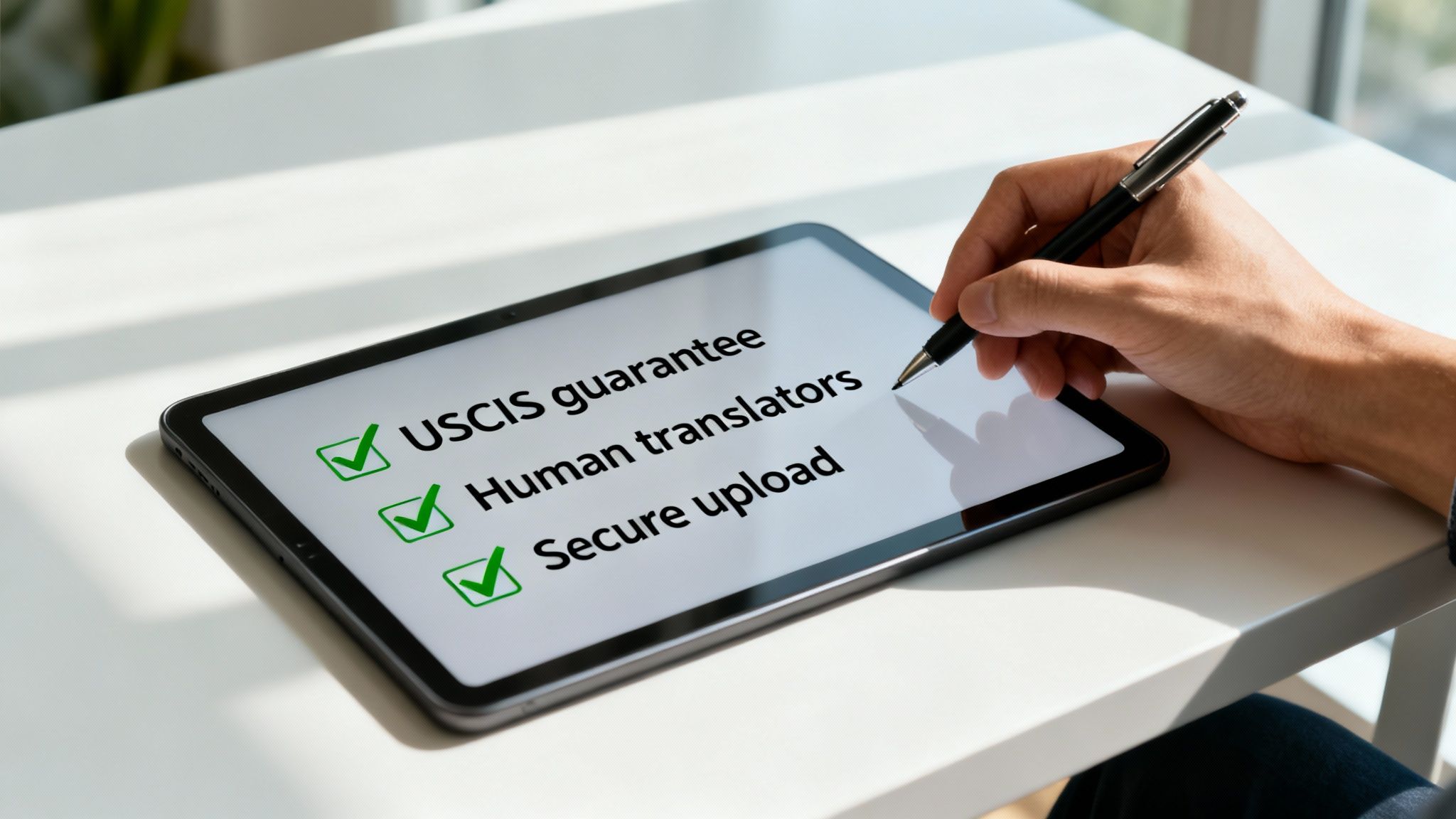
When your critical documents are on the line, you need a provider that delivers on its promises. A great service combines speed, accuracy, and reliability, ensuring your paperwork meets the strict standards of official bodies like USCIS.
Non-Negotiable Factors for Your Checklist
As you compare services, a few factors should be absolute deal-breakers. These are the elements that separate true professionals from risky shortcuts, giving you peace of mind.
Make sure to check these boxes first:
- 100% USCIS Acceptance Guarantee: This is the single most important promise a provider can make. A service that backs its work with a full acceptance guarantee for USCIS filings is confident in its quality. It also means they will fix any issues if you receive a Request for Evidence (RFE).
- Professional Human Translators: AI has its place, but it cannot capture the nuance and precision needed for official documents. Ensure the service uses qualified, professional human translators, especially those with experience in the legal, medical, or academic fields.
- Transparent Pricing: Avoid any service with a vague or confusing pricing model. Look for a clear, per-page or per-word rate with no hidden fees. A trustworthy company will provide an instant quote upfront, so you know exactly what you’re paying. For a clear example, you can see our straightforward translation pricing structure.
These three pillars are the foundation of any reliable translation service. If any of them are missing, you’re taking an unnecessary gamble.
A provider’s willingness to guarantee their work, especially for an institution as strict as USCIS, is the clearest indicator of their professionalism and commitment to accuracy. It transforms their service from a simple transaction into a partnership.
Evaluating Speed, Security, and Reputation
Once you’ve covered the basics, the best services stand out in three other key areas: how fast they work, how they protect your data, and what their customers say about them.
First, let's talk about turnaround expectations. For many people, deadlines are non-negotiable. A dependable online certified translation service should offer a standard turnaround of 24 hours for documents that are 1-3 pages long. That speed is a lifesaver when you're facing an urgent deadline for USCIS or a university application.
Next is security. You are about to upload documents containing sensitive personal information—passport numbers, birth dates, and financial details. The provider must use end-to-end encryption for all uploads and have a clear, strict privacy policy. Your data deserves the same level of protection you'd expect from a bank.
Finally, check their reputation by reading customer reviews. Don't just rely on the testimonials on their website. Look for reviews on independent, third-party platforms to get an unbiased picture of their reliability and customer service. Consistent positive feedback is a strong sign they live up to their claims. To see how we put these principles into practice, you can explore how we handle legal and civil documents.
Red Flags to Watch Out For
Knowing what to look for is only half the battle; knowing what to avoid is just as important. Here are a few common mistakes and red flags that should make you think twice:
- Vague Certification Statements: If a company can't clearly explain what their "certification" includes, walk away.
- No Physical Address or Phone Number: A legitimate business provides verifiable contact information. A lack of it is a major red flag.
- Prices That Seem Too Good to Be True: Rock-bottom prices often mean machine-only translation or work from an unqualified translator, both of which can lead to instant rejection.
- No Mention of an Acceptance Guarantee: If a service isn't willing to stand behind their work, why should you trust them with your important documents?
The demand for professional translation is booming, with the industry projected to hit USD 75.7 billion by 2026. This growth means new companies are appearing, making it even more critical to choose an established, reputable provider like a trusted online certified translation service. For a closer look at this trend, you can learn more about the language services market findings.
By keeping this checklist in mind, you can confidently choose a provider that will treat your documents with the professional care they deserve.
Answering Your Top Questions
Navigating official paperwork can feel overwhelming, but it doesn't have to be. Here are answers to the most common questions we receive about using an online certified translation service, designed to give you clarity and confidence.
How Much Will My Translation Cost?
It’s normal to worry about hidden fees, especially when you're on a budget. Reputable online services offer pricing clarity with an upfront model.
Most professionals charge a simple, flat rate per page, where a "page" is typically defined as up to 250 words. This means you know the total cost before you commit. For instance, a one-page birth certificate and a two-page transcript would be billed as exactly three pages. No guesswork, no surprises.
This transparent approach makes it easier to budget for your USCIS application or university submission.
How Quickly Can I Get My Documents Back?
Deadlines are stressful. Whether it’s for an immigration filing or a legal proceeding, time is often critical. This is where an online service excels.
For most standard documents—typically 1-3 pages—a 24-hour turnaround is the industry standard. You can upload your file today and have the finished, certified translation in your email by tomorrow. For urgent situations, many services offer rush options for a small extra fee, giving you peace of mind that you won’t miss a critical deadline.
Is a Notarized Translation Different from a Certified One?
Yes, and this is a crucial distinction. They may sound similar, but they serve two completely different functions.
-
A Certified Translation is about accuracy. It includes a signed statement from the translator or company guaranteeing that the translation is a true and complete version of the original. For 99% of situations, including all standard USCIS applications, this is what you need. A sworn translation is a similar concept used in some other countries, where the translator is officially sworn before a court.
-
A Notarized Translation is about identity verification. A Notary Public witnesses the translator signing the accuracy certificate and adds an official stamp and signature. This process does not verify the quality of the translation itself; it only confirms the identity of the person who signed the certificate.
Key Takeaway: Always double-check the specific requirements of the organization you are submitting to. USCIS does not require notarization, but some specific courts or foreign institutions might. Don't pay for notarization unless you are explicitly told you need it.
Want to explore this topic in more detail? You can find a complete breakdown on the TranslateDay Frequently Asked Questions page.
Can I Just Translate My Own Documents for USCIS?
It’s a tempting idea, especially if you are fluent in both languages. However, for USCIS, the answer is a firm no.
USCIS requires a neutral, third-party certification to ensure there is no bias or conflict of interest. The certificate must be signed by a competent translator who is not the applicant or a close relative. Using a professional service makes your submission credible and helps you avoid a dreaded Request for Evidence (RFE), which could delay your case for months.
A great online certified translation service knows that providing quick, clear answers is just as crucial as the translation itself. Many now use tools like an AI chatbot for customer support to offer instant, 24/7 help for questions just like these. After all, great communication is part of the package.
Ready to move forward with your documents, free of stress? At TranslateDay, we deliver fast, accurate, and USCIS-guaranteed certified translations.


