
Navigating the U.S. immigration process can be complex, and for important documents like your marriage certificate, there's no room for error. If your certificate is in a language other than English, you'll need a specific type of translation to meet the strict standards of U.S. Citizenship and Immigration Services (USCIS).
So, what is a marriage certificate translation for USCIS? It's a complete and accurate English version of your original document, prepared by a qualified translator. Crucially, it must include a signed "Certificate of Translation Accuracy," where the translator confirms their fluency and vouches for the translation's correctness. For anyone applying for a Green Card, visa, or citizenship, this is an essential step you cannot skip.
Why USCIS Requires a Certified Translation for Your Marriage Certificate
Let's imagine a real-world situation. Maria and David are applying for a marriage-based Green Card. They were married in Mexico, so their marriage certificate is in Spanish. To submit their application, they must follow a critical rule from USCIS, the U.S. government agency that handles immigration: any official document not in English must come with a full, certified English translation.
A certified translation is more than just changing words from one language to another. It's an official document that includes a signed statement from the translator, confirming they are fluent in both languages and that the English version is a true and exact copy of the original. This certification is the proof USCIS needs to trust that your document is authentic and accurate.
The High Stakes of an Incorrect Translation
A small mistake on a translated document can have big consequences. An incorrect, incomplete, or uncertified translation is a common reason USCIS issues a Request for Evidence (RFE). An RFE pauses your application, demands more paperwork, and can easily add months to your wait time.
For example, a couple I worked with faced a six-month delay because their initial translation of a marriage certificate from Brazil missed the official stamps on the back. It was a simple oversight, but it caused significant stress and uncertainty. In the worst-case scenario, a flawed translation could lead to an outright denial of your application, forcing you to start the entire expensive and time-consuming process over.
To understand the scale, USCIS processed nearly 11 million applications in 2023. Immigration officers need documents that are clear and easy to verify. Since a marriage certificate is a foundational civil document for many family-based cases, a flawless translation is essential to keep your application moving forward.
USCIS needs absolute clarity. The translation must be a mirror image of your original marriage certificate. That means every word, stamp, seal, and even handwritten scribble has to be translated. There is no room for summary or interpretation.
Understanding the Core Requirements
USCIS rules exist to create a fair and consistent standard for everyone. By requiring all foreign documents to be in English, officers can review cases efficiently.
Here’s a simple checklist of what USCIS requires for your translated marriage certificate.
USCIS Certified Translation Requirements: A Checklist
| Requirement | What It Means for You | Why It's Critical |
|---|---|---|
| Complete Translation | Every single word on the original document (front and back) must be translated. This includes stamps, seals, and signatures. | Ensures the officer has the full context and that no vital information is missing. |
| Translator's Certification | A signed statement from the translator attesting to the accuracy and completeness of the translation. | This is the official proof that the translation is reliable and was done by a professional. |
| Translator Competence | The certification must state that the translator is fluent in both the foreign language and English. | Verifies the translation wasn't done by an amateur or a machine, which can introduce critical errors. |
| Original Document Copy | You must submit a clear copy of the original non-English marriage certificate along with the translation. | Allows the USCIS officer to compare the translation with the source document for consistency. |
Getting these details right helps the USCIS officer process your case without delays. While you focus on the translation, remember you might also need professional legal document printing services for other parts of your application package. For a deeper dive into the official rules, you can review the complete USCIS translation requirements.
What a Perfect USCIS Certified Translation Includes
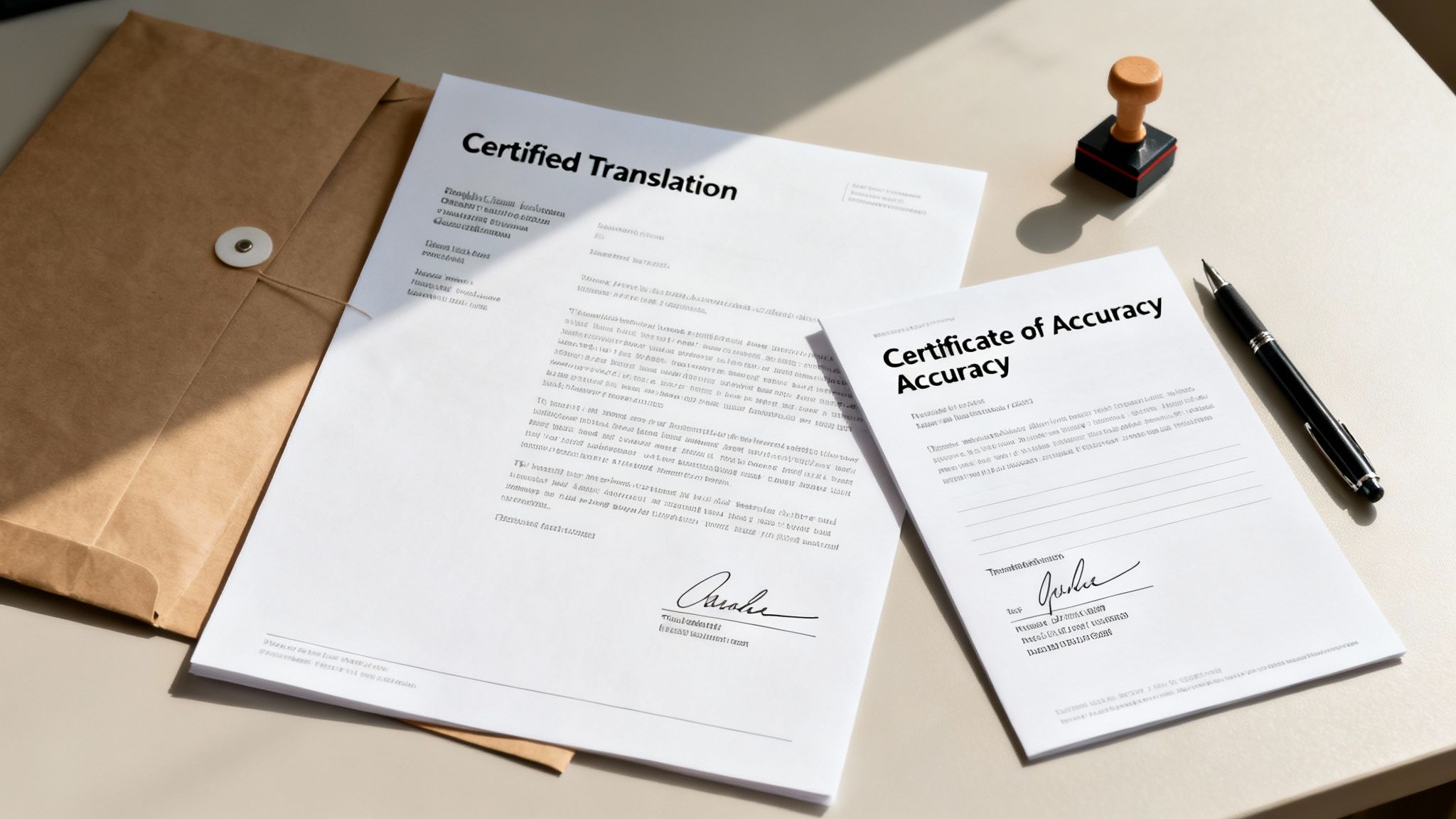
Let’s get practical. What does a USCIS-approved translation actually look like? The final document you submit should be a perfect mirror of your original marriage certificate. It must reflect everything—every printed word, official stamp, decorative seal, and even small handwritten notes.
Nothing can be left out.
A solid marriage certificate translation for USCIS is more than a simple word swap. It's a complete, official package designed to be instantly understandable and trustworthy to an immigration officer. This is crucial for avoiding a Request for Evidence (RFE), which can stall your case.
The Anatomy of a Flawless Translation
When you receive your translated document, do a quick check to ensure it has these key components:
- A True Word-for-Word Match: The translation must be literal and complete. USCIS does not accept summaries or paraphrased versions.
- Mirrored Formatting: The layout of the translation should mimic the original as closely as possible. This helps the reviewing officer easily compare the two documents side-by-side.
- Translation of All Elements: This is where many people make mistakes. Every mark on the page needs to be translated or described, including:
- Stamps and seals: These should be described, such as "[Seal of the Civil Registry of Bogota]."
- Signatures: Indicated simply as "[Signature]."
- Handwritten notes or illegible text: Noted as "[Illegible text]" so the officer knows it wasn't ignored.
To get the best results, start with a crystal-clear scan of your original document. It's worth understanding how Optical Character Recognition (OCR) works, as this technology helps convert an image of your certificate into text for the translator. A blurry scan can lead to errors.
The Certification Statement: The Heart of Compliance
The most important part of the package is the certification statement, sometimes called a Certificate of Translation Accuracy. This is a separate declaration, usually on the translation company's official letterhead, that accompanies the translated document.
This statement is where the translator or company representative formally swears that the translation is accurate and complete.
This signed certification is the legal proof USCIS needs. It’s what tells them the translation is legitimate and was done by someone who knows what they're doing. Without it, your translation is just words on a page with no official standing.
A compliant certification statement must include:
- A statement that the translator is fluent in both English and the original language.
- A declaration that the translation is complete and accurate.
- The translator's full name.
- The translator's signature.
- The date of the signature.
- Contact information for the translator or their company.
Here’s a simple example of the language you’d find in a certification:
"I, [Translator's Full Name], certify that I am fluent in English and [Source Language], and that this is a true and accurate translation of the attached marriage certificate."
The Notarization Myth: Do You Need a Notary Stamp?
One of the biggest points of confusion is about notarization. Let me be clear: USCIS does not require your translations to be notarized.
A notary stamp only verifies the identity of the person who signed the document—in this case, the translator. A notary cannot check the accuracy of the translation itself. That’s the job of the signed certification. While you might need notarization for other documents, like an academic transcript for a university, it's an unnecessary step and expense for your immigration application. You can learn more about the difference in this guide on certified and notarized translation.
Focus on getting the certification statement right. It’s the key to a successful submission.
Common Mistakes That Can Derail Your Application
I've seen it happen many times. An applicant believes they have everything in order, only to have their USCIS case stalled by a simple, preventable mistake with their translated documents. Knowing these common traps ahead of time is the best way to avoid frustrating delays.
For instance, a couple applying for citizenship asked a bilingual friend to translate their marriage certificate to save money. Weeks later, they received a Request for Evidence (RFE). The reason? The translation lacked a proper certification from an impartial party. That one shortcut added months of stress to their immigration journey.
Another common error is providing a summary instead of a full, word-for-word translation. USCIS officers need an exact mirror of the original, not the general idea. Skipping over stamps, seals, or small handwritten notes is a fast track to an RFE.
The Dangers of Uncertified Translations
One of the biggest red flags for USCIS is a translation without a proper certification. This often happens when people rely on a friend, a family member, or even themselves. Even if you are fluent in both languages, USCIS rules require a certification from an objective third party.
You absolutely cannot certify your own translation. This is a major conflict of interest and will cause your document to be rejected. The formal certification from a professional is what gives your translated marriage certificate official weight.
In the eyes of USCIS, a translation without a proper certification is just an unofficial piece of paper. The signature and attestation are what transform it into valid evidence for your case.
Incomplete or Summarized Content
When USCIS says they require a "complete" translation, they mean it. Every single mark on the original document must be translated or noted.
Common omissions include:
- Stamps and Seals: Official emblems must be described (e.g., "[Seal of the Civil Registry of Madrid]").
- Handwritten Notes: Any notes in the margins must be translated. If they are unreadable, the translator should mark them as "[Illegible text]."
- The Back of the Document: People often forget to check the reverse side. Any information there is part of the official document and must be included.
Submitting an incomplete translation can look like you are trying to hide something, leading to extra scrutiny and delays.
Forgetting to Include the Original Document
Your certified English translation works together with your original marriage certificate; it does not replace it. You must always submit a clean, readable photocopy of the original foreign-language document alongside its certified translation.
This allows the USCIS officer to place them side-by-side and cross-reference names, dates, and other key details. Forgetting this simple step is an administrative error that will bring your application to a halt. To avoid this and other common issues, it’s wise to review the most frequent translation mistakes that can put an application at risk.
Choosing a Service Without a USCIS Acceptance Guarantee
Not all translation services are created equal. A general translation company might not understand the specific rules for immigration paperwork. Their work could be linguistically perfect but fail on formatting and certification requirements, causing USCIS to reject it.
To keep your application safe, always choose a translation service that offers an explicit USCIS acceptance guarantee. This is your assurance that the company knows the rules inside and out and stands behind its work. It's your peace of mind that you're working with specialists who understand what’s at stake.
How to Choose the Right Translation Service
Choosing a service to handle your marriage certificate translation for a USCIS application is a critical decision. This single document is a cornerstone of your case, and the translation must be perfect. The right service makes the process smooth, while the wrong one can lead to delays and RFEs.
So, how do you find a service you can trust?
The Non-Negotiable: A USCIS Acceptance Guarantee
First, the single most important thing to look for is an explicit USCIS acceptance guarantee. This is a promise that the provider knows the specific requirements of immigration paperwork and will stand behind their work. If a service doesn’t prominently feature this guarantee, it's a major red flag.
Look for Signs of Professionalism
Once you've confirmed the guarantee, dig a little deeper. True professionals leave a trail of credibility.
Membership in a professional organization like the American Translators Association (ATA) is a strong indicator of quality. It means the service follows a recognized code of ethics and holds its translators to high standards.
You also want a service that specializes in legal and immigration documents. Translating a marriage certificate requires an understanding of legal terminology and the precise formatting USCIS demands. A specialist will catch nuances that a generalist might miss.
Practical Factors That Matter
With quality checks handled, let's talk about the practical side of things.
- Turnaround Time: Immigration involves tight deadlines. A reliable service should offer a standard turnaround of 24 hours for a 1-3 page document. They should also have rush options for urgent translations.
- Pricing Clarity: You should know the cost upfront. Look for clear, per-page pricing. A trustworthy company will provide an instant quote, not make you wait for an email.
- Data Security: You are uploading a personal document. Ensure the service uses a secure, encrypted platform and is transparent about its confidentiality policies.
This flowchart shows why translations are often rejected. It’s almost always for the same handful of preventable reasons.
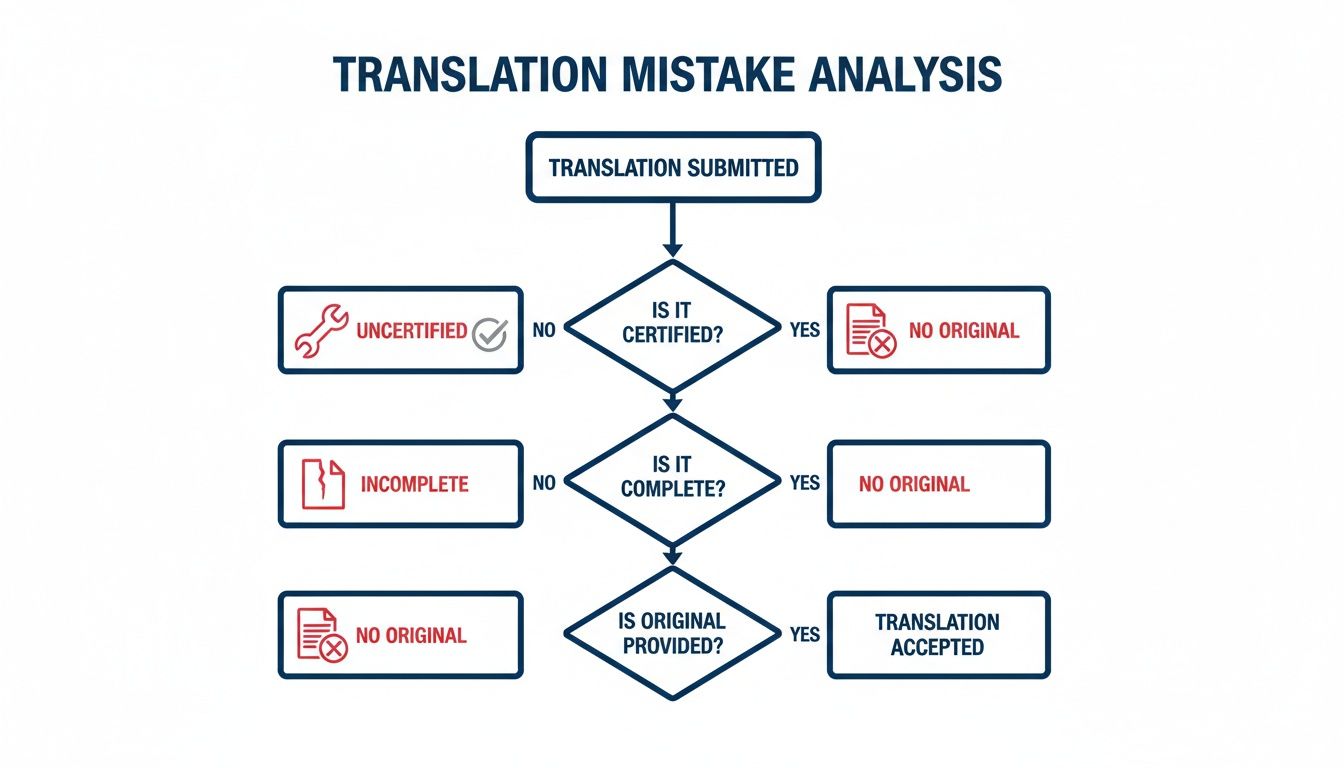
As you can see, a missing certification, an incomplete translation, or failing to include a copy of the original are the top culprits. A professional service helps you avoid all three.
Comparing Translation Service Providers for USCIS
Here's a quick comparison to help you choose the best service for your immigration documents.
| Feature | Professional Service | General Freelancer | DIY Translation (Friend/Family) |
|---|---|---|---|
| USCIS Acceptance | Guaranteed | Risky; depends on experience | Almost always rejected |
| Certification Statement | Included, properly formatted | Might be incorrect or missing | Not valid for USCIS |
| Turnaround Time | Fast and reliable (e.g., 24 hours) | Variable and unpredictable | Unpredictable |
| Accuracy | High, with quality checks | Varies; no oversight | High risk of errors |
| Cost | Transparent and upfront | Can be lower, but with risks | "Free," but can cost you dearly in delays |
Ultimately, your marriage certificate is too important to leave to chance.
Investing in a professional, specialized certified translation service isn't just another expense—it's an essential step toward a successful outcome.
To learn more, check out our guides on the certified translation process for USCIS and our straightforward pricing structure.
Getting Your Certified Translation Online
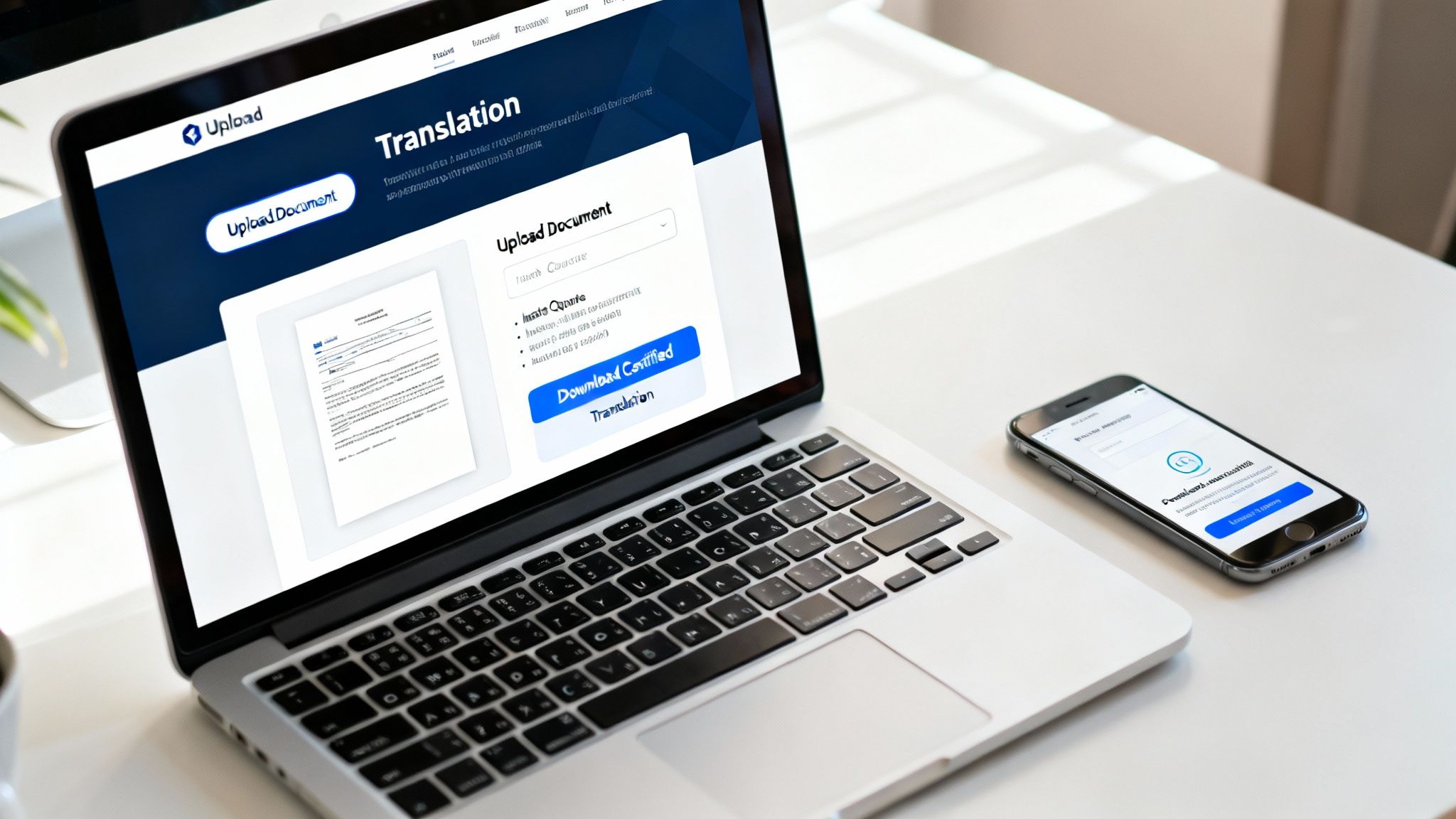
You know the rules and what to avoid. So, how do you get this done? Getting a marriage certificate translation for USCIS should be simple. The process can be handled quickly and securely online, allowing you to check one more item off your list and focus on your application with confidence.
The Modern Online Process
The process starts with your original marriage certificate. You don't need fancy equipment; a clear photo from your phone is usually sufficient. The key is legibility—make sure every word, stamp, and seal is sharp and readable. A blurry photo will only cause delays.
Once you have a good digital copy (like a PDF or high-quality image), the steps are straightforward:
- Upload Your Document: Use a secure online portal to upload your file.
- Get an Instant Quote: The cost should appear immediately based on the page count. Reputable services offer clear, per-page pricing.
- Confirm and Pay: Pay securely online to start the process.
- Translation Begins: Your document is assigned to a professional translator who specializes in civil documents for immigration.
The biggest advantage here is getting both speed and quality. A professional service can turn around a complete, certified translation of a 1-3 page document like a marriage certificate in just 24 hours.
What You Receive in Your Digital Package
When the translation is complete, you will receive a digital package ready for USCIS. This package should contain two key PDF files:
- The Certified English Translation: The word-for-word translation of your marriage certificate, formatted to mirror the original document's layout.
- The Certificate of Accuracy: The signed certification statement on company letterhead, guaranteeing the translation is complete and accurate.
This two-part bundle is exactly what USCIS officials look for. You can print these PDFs for a paper application or upload them directly for online filing. This modern approach gives you transparency and control. For a deeper dive, review our guide to the certified translation process for USCIS.
If you’re ready, you can get an instant quote for your document. This turns a complicated task into a simple, manageable step, letting you move forward with your application confidently.
Still Have Questions About Marriage Certificate Translations?
We've covered the core requirements, but when dealing with a USCIS application, questions are bound to arise. Here are answers to the most common questions I hear from people going through this process.
Does USCIS Really Need the Translation to Be Notarized?
This is a common myth. The answer is no, USCIS does not require notarization for translations.
A notary's seal only verifies the identity of the person who signed the document; it says nothing about the quality of the translation. What USCIS cares about is the certification statement—the signed letter from the translator vouching for the work's accuracy. The certification is what matters, not a notary stamp.
I'm Fluent in Both Languages. Can I Just Translate It Myself?
Even if you are a perfect bilingual speaker, you cannot translate your own marriage certificate for a USCIS application. USCIS considers this a conflict of interest because you are a party to the case.
The translation must come from an impartial third party. This is non-negotiable. Using a professional service eliminates any question of bias and shows the reviewing officer that you have followed the rules.
What Do We Do About All the Stamps, Seals, and Scribbles on the Original?
A proper, USCIS-accepted translation must be a complete mirror of the original document. This means everything on the page is accounted for.
A professional translator will handle this by:
- Describing any stamps and seals in English (e.g., "[Seal of the Civil Registry of Manila]").
- Noting where signatures appear with a simple "[Signature]".
- Translating any handwritten notes. If something is unreadable, they will mark it as "[Illegible text]".
This ensures the USCIS officer can easily see that the original and the translation match perfectly.
How Fast Can I Get This Done? I'm on a Deadline.
Application deadlines can be stressful. The good news is that for standard civil documents like a one-page marriage certificate, most reputable services offer a very fast turnaround. A 24-hour turnaround is standard in the industry for such documents.
This means you can get a fully compliant, USCIS-ready document almost immediately, keeping your application on track.
Ensuring your marriage certificate translation for USCIS is perfect is a critical step toward submitting your application with confidence. At TranslateDay, we specialize in these requirements, delivering fast, accurate, and USCIS-guaranteed certified translations every day.


