
When you need to submit official documents in a new country, a legal document translation service is your most important partner. This isn't about simply swapping words from one language to another; it's a careful process of converting your official papers, like a birth certificate or academic transcript, so they are accepted by demanding authorities like USCIS, courts, and universities. A professional translation gives your documents a legal passport, ensuring they are officially recognized wherever you need them.
Navigating immigration paperwork, university applications, or court filings is stressful enough. If your vital documents are not in English, a simple translation from a friend or an online tool won't work. A single mistake in a name, date, or legal term can lead to serious problems like application rejections, long delays, or even legal trouble. This is why a professional service that provides a certified translation—a translation with an official guarantee of accuracy—is essential for peace of mind.
What is Legal Document Translation?
Imagine you're applying for a Green Card, and you submit a birth certificate from your home country. U.S. Citizenship and Immigration Services (USCIS), the government agency handling immigration, needs to be 100% sure that the English version is a perfect match of the original. They can't just take your word for it. This is where a professional legal document translation service comes in. These services provide the precision and official backing required to ensure every single detail is perfect and legally valid.
The Power of a Certified Translation
So, what makes a professional translation official? The key is the certification. A certified translation isn't just the translated text; it's a package that includes a formal statement from the translator or translation company. This statement is often called a "Certificate of Translation Accuracy."
This signed certificate is a formal promise, confirming that the translation is:
- Accurate: It is a true and faithful mirror of the original document.
- Complete: Absolutely nothing has been left out, including text from stamps or seals.
- Professional: A qualified translator, fluent in both languages, performed the work.
Let’s look at a real-world example. Maria was applying for her U.S. Green Card and needed to submit her marriage certificate from Mexico. She used a professional service to get a certified translation service. The service provided the English version plus the all-important signed certificate. Because of this, USCIS accepted her document without any issues. If she had used a simple, uncertified translation, she likely would have received a Request for Evidence (RFE), delaying her case for months.
To make it even clearer, let's break down what makes a certified translation trustworthy.
Certified Translation at a Glance
| Component | What It Is | Why It's Critical |
|---|---|---|
| Complete Translation | An exact, word-for-word translation of the entire original document. | Authorities like USCIS require a full translation of all text, including stamps and seals, to ensure no information is missed. |
| Certificate of Accuracy | A separate statement signed by the translator or agency representative. | This is the official guarantee that the translation is accurate and complete, making it legally valid for submission. |
| Translator's Credentials | Information about the translator or agency, including name and contact details. | It establishes the qualifications and accountability of the person or company vouching for the translation. |
| Date and Signature | The signature of the responsible party and the date the certification was issued. | This authenticates the document and provides a clear timeline, confirming its validity at the time of submission. |
This table shows why each piece is non-negotiable. Missing any of these elements can lead to an immediate rejection of your documents. A certified translation acts as a formal bridge between two legal systems, providing the necessary assurance that the translated document carries the same weight and meaning as the original.
Why and When You Need Certified Legal Translations
A simple translation might be fine for an informal email, but when you're dealing with official bodies, the rules are different. Government agencies, courts, and universities need ironclad proof that the documents you're submitting are accurate and complete. This is precisely where a certified translation comes in. It’s a formal declaration that gives your documents the official weight they need to be taken seriously.
Let’s take another practical scenario. You’re applying for a U.S. student visa and your high school diploma is in Mandarin. The university admissions office can't just rely on a translation you did yourself. They need a certified translation to formally verify your academic achievements. Submitting anything less will almost certainly cause delays and could even lead to your application being rejected.
The need for this kind of precision is only growing. The legal translation service market in North America was valued at USD 2.45 billion in 2024 and is projected to reach USD 3.75 billion by 2035. This growth reflects the complex legal frameworks and steady flow of immigration and international business where accurate translations of passports, contracts, and medical records are an absolute must.
This simple decision guide boils it down: if your document is for any kind of official use, you need a certified translation.
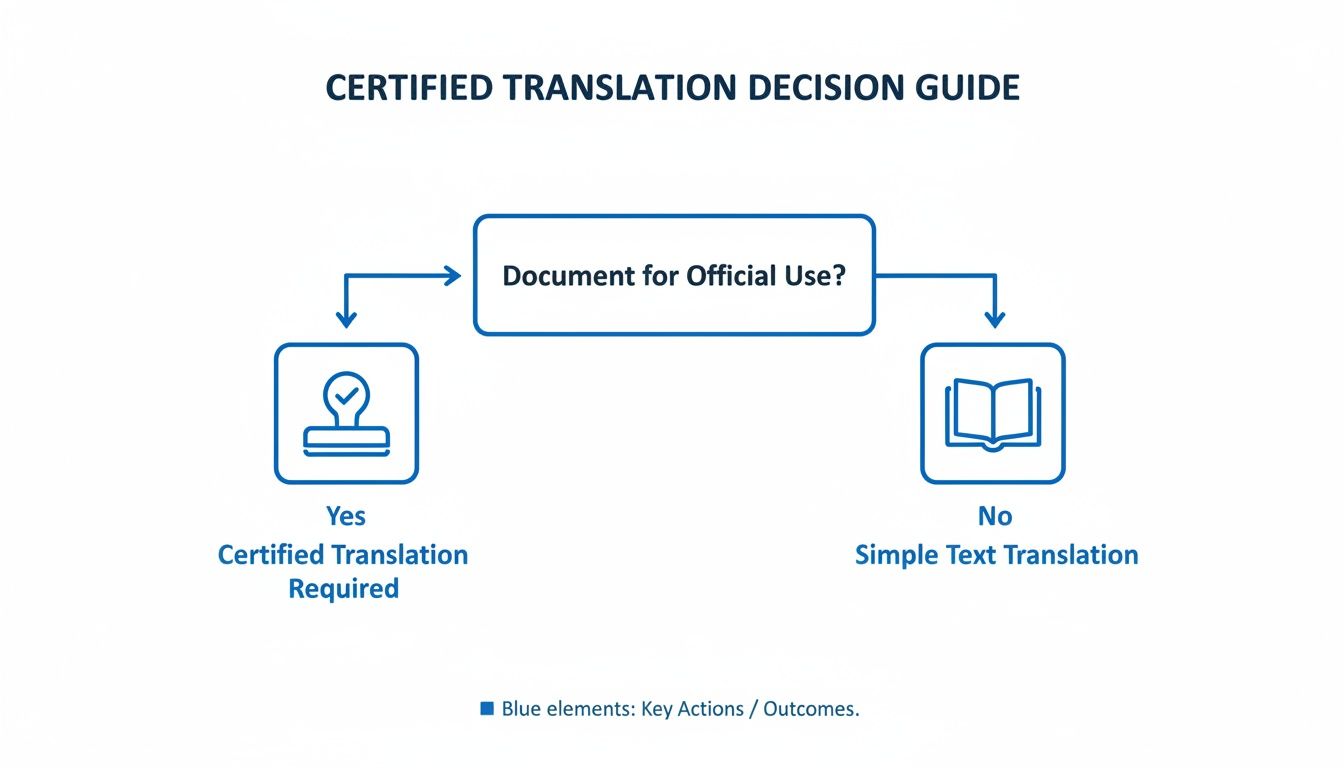
As the flowchart shows, the intended purpose of your document is the single most important factor in deciding what kind of translation you need.
Immigration and USCIS Requirements
If you're navigating the U.S. immigration system, certified translations are a must. USCIS is incredibly strict about its standards. Every document you submit—from civil certificates (official documents like birth and marriage licenses) to police background checks—is a piece of evidence building your case. For any document not in English, USCIS requires a complete, certified English translation.
Here’s a real-world example: A family is applying for asylum, and their supporting documents include newspaper articles and official reports from their home country in Arabic. To build a strong case, their lawyer must submit certified English translations of these documents so the immigration officer can understand and verify the evidence. This is why a professional legal document translation service is a non-negotiable part of any immigration application. We offer specialized certified translations for USCIS to meet these exact needs.
Academic and Professional Applications
This isn't just about immigration. Imagine you're a talented engineer from Germany applying to a Master's program at a U.S. university. The admissions board must evaluate your academic history, but your academic transcript (a detailed record of your courses and grades) and diploma are in German. They need a certified translation to ensure your qualifications are understood correctly and can be fairly compared to U.S. standards. A sloppy translation could misrepresent your achievements and cost you your spot.
Legal and Medical Proceedings
In courtrooms and hospitals, accuracy can be life-changing. For legal cases, any evidence in another language—a business contract, a text message chain, or a witness statement—must be submitted with a certified translation to be admissible in court. The court has to trust that the translation is a faithful, unbiased version of the original.
Similarly, if you need to share your medical history from another country with a U.S. doctor for treatment or an insurance claim, a certified translation is essential. A mistranslation of a diagnosis, medication, or a critical allergy could lead to dangerous medical errors. The certification provides a layer of accountability, proving a qualified professional handled your sensitive information.
What Makes a Translation “Official” and Certified?
When you hand a translated document to an official body like USCIS, how do they know it’s legitimate? A proper legal document translation service provides more than just the translated text. They deliver a complete package with specific elements that signal its authenticity. The certification is a formal, sworn statement from the translator or company that vouches for the translation's quality.
The Anatomy of a Certification Page
Every professionally certified translation includes a signed statement, usually called a "Certificate of Translation Accuracy." This is the core of its official status. While wording may vary, it must clearly state that the translation is complete and accurate to the best of the translator's professional ability.
This declaration tells the receiving authority that a qualified person has carefully translated the original document. Here’s what you should always find on the certification page:
- A formal statement confirming the translation's accuracy and completeness.
- The full name and contact details of the translator or translation agency.
- The signature of the translator or a company representative.
- The date the certification was signed.
This information creates a paper trail, allowing officials to verify the source if needed.
Do I Need Notarization or a "Sworn" Translation?
You'll often hear terms like "notarization" or "sworn translation," which can be confusing. Let's simplify them:
-
Notary Stamp: A notary stamp is a seal from a Notary Public, an official who witnesses signatures. For U.S. immigration, USCIS does not require notarization on your translated documents. A standard certification is sufficient. A notary only verifies the identity of the person signing the certificate; they do not check the translation's accuracy. Some other institutions, like foreign universities, might ask for it, so always check their specific rules.
-
Sworn Translation: This is a requirement in many countries outside the U.S., particularly in Europe and Latin America. A sworn translation is performed by a translator who is officially appointed or registered with a government body or court in that country. For any legal or immigration purpose here in the U.S., a certified translation is the standard you need.
What Kinds of Documents Need a Certified Translation?
Most people think of immigration when they hear "certified translation," but a professional legal document translation service handles a wide variety of official paperwork. The need arises in many situations, from enrolling a child in school to navigating international business deals.
The demand for this precise work is massive. In fact, the legal slice of the translation industry is valued at a staggering USD 12.7 billion in 2024. That number reflects just how critical it is to get contracts, court filings, and personal certificates right, especially as our world becomes more interconnected. You can see more data on the translation market's growth over at factmr.com.
Let's look at the common types of documents that require certified translation.
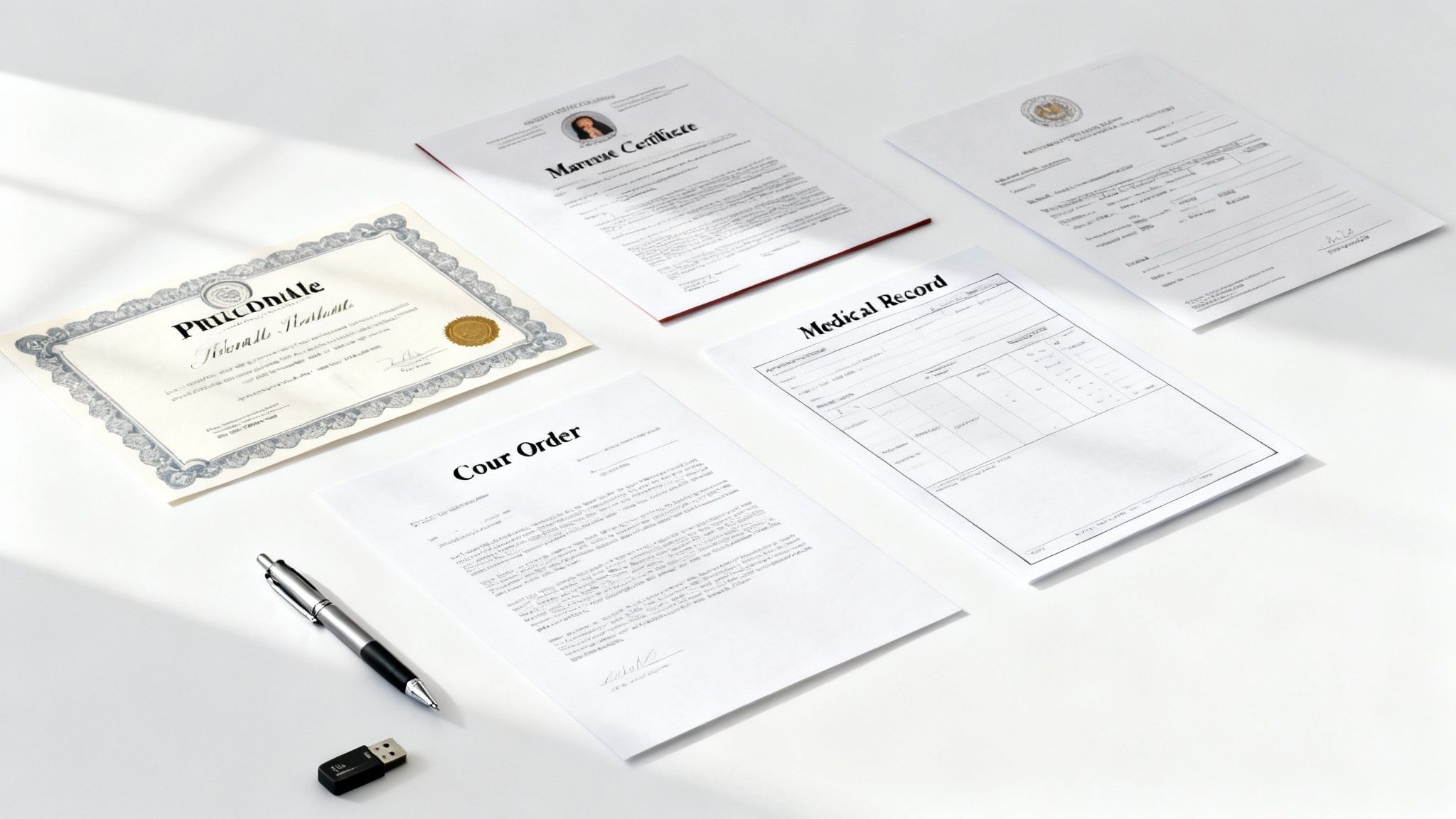
Common Document Checklist
Here’s a practical checklist of documents that almost always require certified translation for official use:
1. Immigration and Civil Documents (for USCIS, visas, etc.)
- Birth Certificates: To prove your identity and age.
- Marriage Certificates: Essential for spouse-based visas and green cards.
- Divorce Decrees: To prove you are legally single and free to remarry.
- Passports and Visas: Foreign language stamps or visas may need translation.
- Adoption Papers: To legally establish parentage in international adoptions.
- Police Clearance Certificates: For background checks.
2. Academic and Professional Credentials (for universities, licensing boards)
- Academic Transcripts: To show grades and coursework for admission.
- Diplomas and Degrees: Official proof of completing your studies.
- Professional Licenses: For getting licensed in fields like medicine or law.
- Resumes or CVs: To ensure your work history is clear to employers.
3. Legal and Business Documents (for courts, contracts, finance)
- Contracts and Agreements: To ensure all parties understand their obligations.
- Court Orders and Judgments: To present a legal decision from another country.
- Bank Statements: Often required for visa applications to prove financial stability. You can learn more about our transparent pricing for these documents.
- Wills and Testaments: For international inheritance matters.
4. Medical Documents (for doctors, insurance, legal claims)
- Patient Records and Medical Histories: So a new doctor can understand your health background.
- Immunization Records: Often required for school enrollment or immigration.
- Insurance Claims: To get reimbursed for medical care received abroad.
- Medical Reports: As evidence in personal injury or disability cases.
A mistake on any of these can cause significant delays or rejection. Having flawless translations is the foundation of a successful application or case.
How to Choose the Right Translation Provider
Choosing a legal document translation service is a critical decision that can impact the outcome of your immigration case, university application, or court proceeding. It’s about more than just finding someone who speaks the language; you need a specialist you can trust to deliver a document that will be accepted without question. A poor translation can lead to rejections, delays, and unnecessary stress. Here’s a checklist to help you find a reliable partner.
Your Essential Vetting Checklist
When evaluating a potential provider, use this checklist to ensure they meet professional standards.
-
Guaranteed USCIS Acceptance: For immigration purposes, this is non-negotiable. The provider must explicitly state that their certified translations are guaranteed to be accepted by USCIS. If this guarantee isn't clearly visible on their website, it's a red flag.
-
Human Translators: Ensure the service uses professional human translators, not just automated software. While AI can be a tool, a human expert is essential for the accuracy and nuance required for legal documents.
-
Transparent and Simple Pricing: Look for clear, upfront pricing, typically a flat rate per page (e.g., $23 per page). You should know the exact cost from the start, with no hidden fees for certification or proofreading.
-
Clear Turnaround Times: Deadlines are crucial. A reliable service will offer a firm delivery window, such as a 24-hour turnaround for standard documents of 1-3 pages, and provide rush options for urgent needs.
-
Robust Confidentiality: Your documents contain sensitive personal information. The provider must use a secure system for uploads and payments and have a strict confidentiality policy. An online certified translation service that prioritizes your privacy is a must.
-
Positive Customer Reviews: Look for reviews on independent sites like Trustpilot. Real customer feedback provides insight into the provider's reliability and quality of service.
Common Mistakes to Avoid
- Choosing the Cheapest Option Blindly: While cost is a factor, an unusually low price may indicate a lack of quality control or reliance on machine translation. A rejected document will cost you far more in time and stress.
- Using a Bilingual Friend or Family Member: Even if they are fluent, they are not a professional translator and cannot provide the required certification. Authorities like USCIS will not accept such translations.
- Ignoring Confidentiality: Never send sensitive documents over unsecured email. Only use providers with a secure, encrypted upload portal.
Choosing a translation provider is an investment in your future. The right partner delivers more than a document; they provide peace of mind.
Your Step-by-Step Guide to Getting a Certified Translation
Getting an official translation for your legal documents used to be complicated, but modern online services have made the process fast and straightforward. You can now handle everything from your computer or phone in just a few simple steps. Here’s what you can expect.
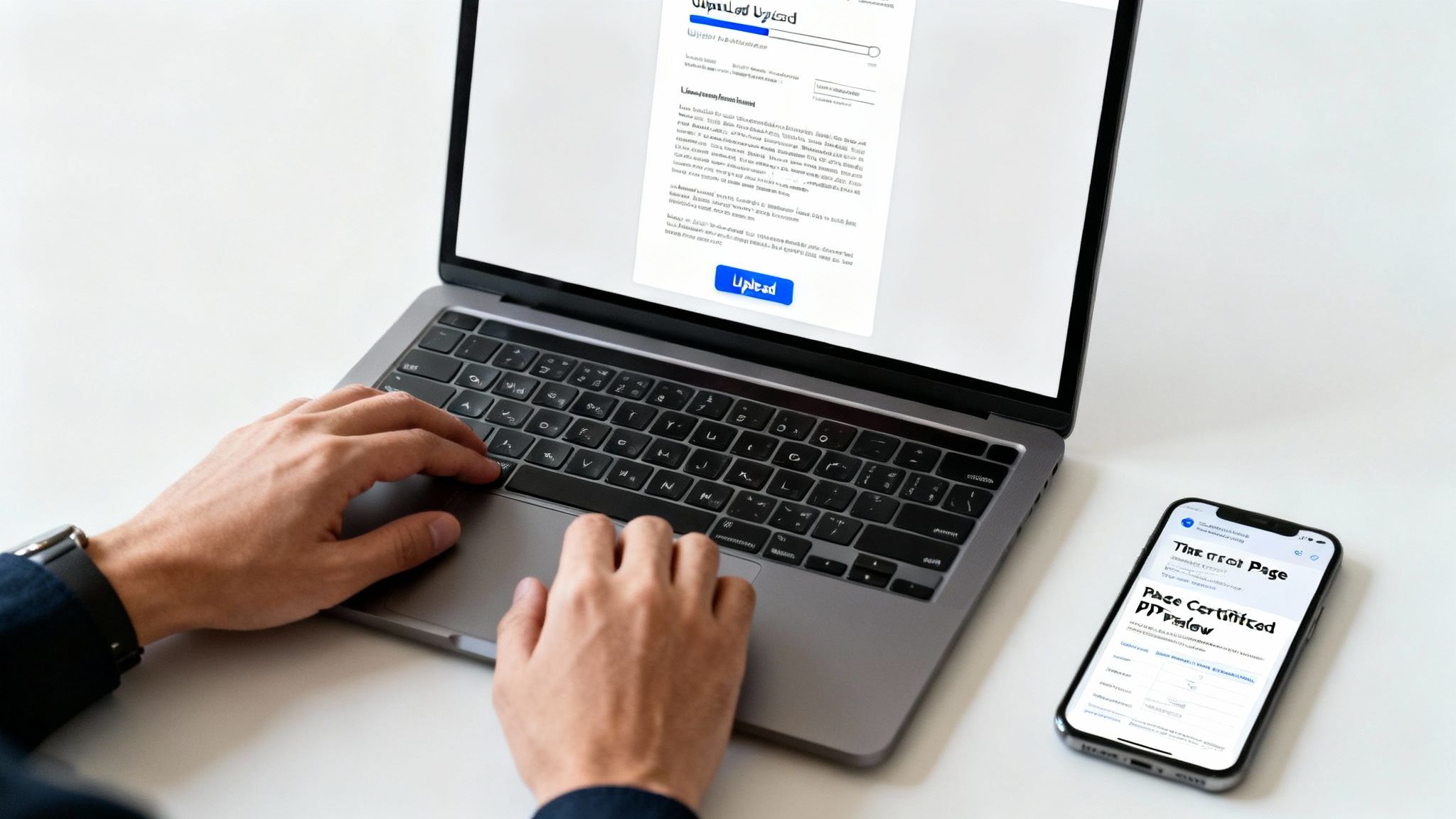
Step 1: Prepare Your Documents
You'll need a clear digital copy of your document. A high-quality photo from your smartphone is usually sufficient.
Actionable Tip: Place your document on a flat, well-lit surface. Make sure the entire page is visible, the text is sharp, and there are no shadows or glare.
Step 2: Get an Instant Quote
Go to the provider’s website. Reputable services offer an instant quote based on a simple pricing model, like a flat rate per page (up to 250 words). This ensures you know the exact cost upfront. Check our transparent pricing to see how this works.
Step 3: Upload Your Files Securely
Use the provider's secure online portal to upload your files. They typically accept common formats like PDF, JPG, and PNG. A professional legal document translation service will use encryption to protect your data, ensuring your sensitive information is handled with the confidentiality of a law firm.
Step 4: Translation by a Professional
Once you place your order, your document is assigned to a qualified human translator. They will meticulously translate everything—including names, dates, stamps, and seals—to ensure the final version is a perfect mirror of the original. For standard documents of 1-3 pages, this process is often completed within 24 hours.
Step 5: Receive and Review Your Translation
You will receive your certified translation as a digital PDF via email. This file includes both the formatted translation and the signed Certificate of Translation Accuracy.
Validation Step: Quickly review the translation to double-check that all names and dates are correct. Once you confirm everything is accurate, your document is ready for submission.
Your Top Questions About Legal Document Translation, Answered
When dealing with official paperwork, it's natural to have questions. Here are clear answers to some of the most common ones.
Does USCIS Need My Translated Documents to Be Notarized?
No. As of 2025, official USCIS guidelines state that translated documents must be certified, but they do not need to be notarized. The certification is a signed letter from the translator or translation company guaranteeing the translation's accuracy. A notary only verifies the signer's identity, not the translation itself. Always double-check the specific requirements of the organization you are submitting to, as some institutions outside of USCIS may have different rules.
What’s the Difference Between a Certified and a Sworn Translation?
This comes down to different legal systems:
-
Certified Translation: This is the standard in the United States. A translator or agency attaches a signed "Certificate of Translation Accuracy." This is exactly what you need for U.S. immigration, academic, and legal purposes.
-
Sworn Translation: This is a requirement in many other countries, especially in Europe and Latin America. A sworn translation is done by a translator who has been officially authorized by a court or government body in their country.
For any U.S. purpose, a certified translation is what you need.
How Fast Can I Get My Documents Translated?
Turnaround time depends on the document's length.
- Standard Turnaround: For most single-page documents like birth certificates or marriage licenses (typically 1-3 pages or up to 750 words), a 24-hour turnaround is standard.
- Longer Documents: Complex legal contracts or lengthy academic transcripts will take more time. Most reputable services offer rush options if you have an urgent deadline.
Always confirm the expected delivery time when you get your quote. You can learn more by checking our page on translation turnaround times.
Ready to get your documents translated accurately and quickly? TranslateDay provides fast, USCIS-guaranteed certified translations you can trust.


