
Getting a translation certificate is a straightforward but crucial step for anyone dealing with official paperwork. In simple terms, you give your original document (like a birth certificate) to a professional translation service. They return it with a perfect translation and a special signed statement called a Certificate of Translation Accuracy. This certificate is the key—it proves the translation is complete and correct, making it official for bodies like U.S. Citizenship and Immigration Services (USCIS).
What Is a Translation Certificate and Why Do You Need One?
When you’re navigating important life events like applying for a Green Card, enrolling in a U.S. university, or handling legal matters, you'll often hear the term "certified translation." The translation certificate is the document that makes it certified.
Think of it as a formal guarantee. It’s a signed statement from the translator or translation company attached to the translated document. Its main job is to declare that the translation is a complete and accurate copy of the original. This isn't a diploma for the translator; it's a quality seal for your document, telling officials they can trust the information.
Why Certification is a Must-Have for Official Documents
Let’s imagine Maria is applying for U.S. citizenship. Her birth certificate is in Spanish. To submit it to USCIS (the U.S. government agency handling immigration), she can't just send the original. She needs an English translation accompanied by a translation certificate. This certificate gives USCIS the confidence that her document is authentic and has been translated accurately, word-for-word.
Failing to provide a proper certified translation is one of the most common reasons for delays and rejections. For 2025, USCIS is projected to handle millions of petitions, many requiring translation. An improperly translated or uncertified document can cause your case to be delayed by months and may lead to extra fees for resubmission.
A translation certificate builds a bridge of trust between your foreign-language document and the official reviewing it. It confirms that nothing was lost—or added—in translation, preventing misunderstandings that could derail your application.
The Anatomy of a Valid Translation Certificate
For a translation certificate to be accepted, it must contain several key pieces of information. If any of these are missing, you risk having your entire submission rejected.
Here’s a simple checklist of what every valid certificate must include:
| Component | Simple Explanation | Why It's Essential |
|---|---|---|
| Statement of Accuracy | A sentence where the translator promises the translation is complete and true. | This is the heart of the certificate—the professional guarantee of quality. |
| Translator's Details | The name, signature, and contact info of the translator or company. | This proves a qualified professional did the work and is accountable for it. |
| Date of Translation | The date the certificate was signed. | This creates a clear timeline for your official records. |
| Document Identification | A clear mention of the document (e.g., "Spanish to English translation of a Mexican Birth Certificate"). | This links the certificate directly to the specific document, avoiding confusion. |
Always double-check your certificate for these four elements before submitting your paperwork. This simple step can save you from major headaches.
Who Is Qualified to Certify a Translation?
A common point of confusion is who can actually provide a certified translation. Official bodies like USCIS state that the translator must be "competent" in both languages, but this vague guideline often leads people to make critical mistakes.
The single most important rule is this: the person certifying the translation must be an impartial third party.
It happens all the time—someone asks a bilingual friend or family member to translate a document to save money. This is a huge mistake. Even if they are a native speaker, official bodies see this as a conflict of interest and will likely reject the translation. The same applies to translating documents yourself. Any personal connection to the applicant makes the translation untrustworthy in the eyes of officials.
The core principle is impartiality. The person or company certifying the translation cannot benefit from the outcome of your application. This is why a professional, independent translation service is always required.
This is where professional translation services are essential. They use experienced linguists who are not only fluent but also understand the specific formatting and legal phrases required for official documents like civil certificates (e.g., marriage certificates, death certificates) or academic transcripts. Using a professional service ensures the certification is credible and meets all official requirements.
Translator Certification vs. a Notary Stamp: A Critical Difference
Many people mistakenly believe that a notary's stamp is what makes a translation official. This is a common myth that can cause serious delays. It's vital to understand the difference between a certified translation and a notarized translation.
A Certified Translation is all about accuracy. The translator signs a certificate stating they are competent in both languages and the translation is a true reflection of the original. For USCIS and most U.S. institutions, this is the most important requirement.
A Notarized Translation is about identity verification. A Notary Public doesn't check the translation's quality. Their only job is to witness the translator signing the certificate and then stamp it to confirm the signer's identity.
For nearly all official U.S. submissions, including every USCIS application, the translator's certification is what matters. While some specific institutions, like a foreign embassy or certain universities, might request notarization as an extra security step, it is not a standard requirement for U.S. immigration. You can learn more in our detailed guide on certified and notarized translations.
The takeaway? Your priority should always be getting a proper certification statement from a qualified, professional translator.
Your Step-by-Step Guide to Getting a Translation Certificate
Let's walk through a real-world example to make the process crystal clear.
Imagine Kenji is from Japan and has been accepted into a U.S. university. The university requires a certified English translation of his academic transcript, which is in Japanese. Without it, his application cannot be processed. This is a very common scenario for international students.
Step 1: Prepare Your Document
First, you need a clear, high-quality digital copy of your original document. A blurry phone picture or a scan with missing edges will likely be rejected by the translation service or cause errors in the translation. Use a flatbed scanner or a good scanning app on your phone to create a clean PDF or JPG file.
Step 2: Submit to a Professional Service
Once your file is ready, the process with a reputable service is simple:
- Upload the document to their secure online platform.
- Select the original language (Japanese) and the target language (English).
- The service will provide an instant, upfront quote, usually based on the number of pages.
This initial step should only take a few minutes.
Step 3: The Translation and Certification Process
After you approve the quote, an expert translator who is fluent in both Japanese and English gets to work. They will create a precise, word-for-word translation, ensuring that every course name, grade, and official note is perfectly translated.
Next, a second linguist reviews the translation for quality assurance. This step is crucial for catching any small errors and ensuring the final document is flawless.
Finally, the Certificate of Translation Accuracy is created and signed. This certificate is permanently attached to your translated transcript, forming a single, official document.
This graphic clearly shows who is qualified for this process.
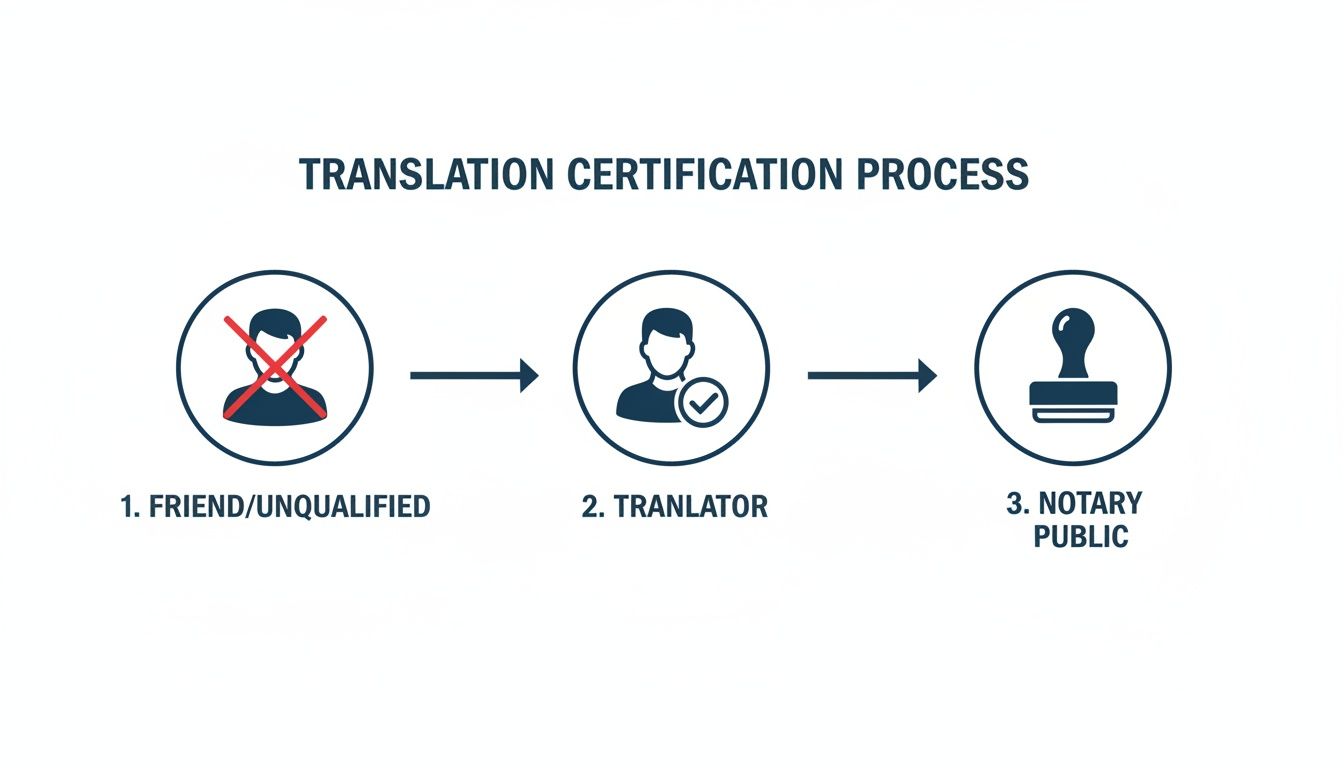
As you can see, using a friend is not an option. You need a professional. The notary is a separate, optional step that is often not required.
When the process is complete, you receive the final package: your translated document with its attached certificate, ready for submission. It's always a good idea to check the university’s specific submission rules. For more details on the strict standards for official bodies, you can review our guide on USCIS translation requirements.
Common Mistakes to Avoid with Your Certified Translation
Knowing what not to do is just as important as following the right steps. A small mistake can lead to frustrating delays or even rejection of your application. Here are the most common pitfalls to avoid.
Mistake 1: Using Machine Translation (Like Google Translate)
This is the biggest and most damaging mistake. While free online tools are great for informal translations, they are never acceptable for official documents. They cannot provide the required Certificate of Translation Accuracy and often fail to capture the precise legal or technical language in documents like medical reports or court orders. An automated translation will be rejected immediately.
Mistake 2: Submitting a Summary Instead of a Full Translation
Official bodies, especially USCIS, require a complete, word-for-word translation of the entire document. This includes all text, stamps, seals, and even handwritten notes. For example, if a stamp appears on the original, the translation must include a note like [Official Seal] in the corresponding location. Leaving out any part of the document makes the translation incomplete and invalid.
Everything on the original page must be accounted for in the translation. If there’s a signature, the translator should note its presence with
[Signature]. Omitting these details is a common reason for rejection.
Mistake 3: Not Checking the Institution's Specific Rules
Never assume all organizations have the same requirements. The rules for a certified translation for USCIS might be different from what a university, a foreign embassy, or a state court requires. For example, some universities may require the academic transcript translation to be sent directly from the agency, while a foreign government might insist on notarization. Always check the official website of the receiving institution to confirm their exact rules before you start.
Mistake 4: Ignoring the Document's Layout
A professional translation should do more than just translate the words; it should also mirror the visual layout of the original document. This allows the official reviewer to easily compare the translation to the original and verify key information like names and dates. A poorly formatted translation looks unprofessional and can raise doubts about its authenticity.
Avoiding these common errors will significantly improve your chances of a smooth application process. For more specific examples, our guide on civil document translations offers additional insights.
Understanding Costs, Turnaround Times, and Guarantees
When you have a tight deadline for an immigration filing or a university application, you need clarity on two things: how much it will cost and how quickly you can get it.

A trustworthy translation service will always provide transparent pricing. The most common model is a flat rate per page, where a "page" is typically defined as up to 250 words. This covers most standard civil certificates like birth or marriage certificates and allows you to know the full cost upfront, with no hidden fees.
Standard vs. Urgent Turnaround
For most single-page documents, a 24-hour turnaround is the industry standard. This means you can submit your document one morning and have the complete, certified translation ready by the next.
However, sometimes you need it even faster. For example, you might receive a Request for Evidence (RFE) from USCIS with a short deadline or need an urgent translation for a court date. In these cases, look for a service that offers an expedited option to handle time-sensitive requests.
A professional translation provider will always give you a clear delivery timeline before you pay. This is crucial for managing deadlines, especially with an organization like USCIS.
The Importance of a Service Guarantee
Beyond cost and speed, a service guarantee offers invaluable peace of mind. A USCIS Acceptance Guarantee is one of the most important assurances a translation service can provide. It's a promise that their work meets all official standards and will be accepted.
Here’s a real-world scenario: You submit a certified translation, but USCIS rejects it due to a minor formatting issue. Without a guarantee, you would have to start over and pay again. With a guarantee, the agency takes full responsibility. They will fix the issue immediately at no extra cost and provide a revised, compliant translation, getting your application back on track without further delays.
This guarantee shows that the translation service is a partner in your success. When you need a translation certificate for a critical matter like an immigration case, this level of support is essential. You can review our clear translation pricing to see how simple and affordable the process can be.
Frequently Asked Questions About Translation Certificates
Here are quick answers to some of the most common questions people ask.
Do I need a notary stamp on my certified translation for USCIS?
For U.S. immigration filings, the answer is almost always no. USCIS requires a proper certification statement from the translator but does not require notarization. A notary only verifies the signer's identity, not the translation's accuracy. Save yourself the extra step and cost unless another institution specifically requests it.
Can I translate my own documents if I'm fluent in both languages?
No. For any official purpose, you must use an impartial third party. Translating your own documents is a conflict of interest and is one of the quickest ways to get your application rejected by official bodies like USCIS. Always use a professional translation agency to ensure validity.
What is the difference between a certified translation and a sworn translation?
These terms depend on the country.
- A Certified Translation is the standard in the United States. It includes a certificate of accuracy signed by the translator. This is what you need for USCIS, U.S. universities, and most legal purposes here.
- A Sworn Translation is required in many other countries, especially in Europe and South America. A sworn translator is an individual officially appointed by their government or court, and their translations have special legal status in that country.
If you are submitting documents in the U.S., you need a certified translation.
How long is a translation certificate valid?
A certificate of translation accuracy does not expire. It is a permanent record confirming that the translation was a true and accurate version of the original document on the date it was completed. As long as your original document (like a birth certificate) remains valid, the certified translation associated with it is also valid. You can often reuse it for multiple applications.
Navigating the requirements for official documents doesn't have to be complicated. Our team specializes in providing fast, accurate, and USCIS-guaranteed certified translations.
Request a certified translation today and have your documents ready for submission in as little as 24 hours.


