
So, you’ve earned a degree or completed coursework outside the United States. That’s a huge accomplishment! But how do you get a U.S. university, employer, or government agency to recognize it? This is where an evaluation of foreign transcripts comes into play. It’s a professional service that converts your international degree and grades into a format American institutions can instantly understand. For anyone planning to study, work, or immigrate to the U.S., this process is an absolutely essential first step.
What Is a Foreign Transcript Evaluation and Why You Need It
Imagine you're a brilliant engineer from India applying for a master's program in the U.S. The admissions officer looks at your academic transcript (your official record of courses and grades), but the grading system is completely different from what they know. How can they be sure your bachelor's degree is equivalent to a U.S. one? That's the exact problem a foreign transcript evaluation solves.
This isn't just a simple language translation. It’s a detailed analysis done by a specialized evaluation agency. These experts review your academic history and produce an official report that clearly states its U.S. equivalent, making your qualifications understandable to American institutions.
The Critical First Step: Certified Translation
Before an evaluator even looks at your documents, you have to clear one major hurdle: if your transcripts and diploma aren't in English, you must get a certified translation.
A certified translation is a professional, word-for-word translation that includes a signed statement from the translator or company. This statement, often called a Certificate of Accuracy, confirms that the translation is complete and accurate. Evaluation agencies and official bodies like USCIS (U.S. Citizenship and Immigration Services, the agency that handles immigration) require this as proof of authenticity. It’s a non-negotiable step for any official purpose.
Who Requires a Foreign Transcript Evaluation?
You'd be surprised how often these evaluations are needed. If you're bringing foreign credentials to the U.S., you'll almost certainly need one for:
- University and College Admissions: U.S. schools rely on these reports to gauge your academic standing, check if you're eligible for admission, and determine if any of your courses can count as transfer credits.
- Immigration Applications: When you're applying for work visas (like the H-1B) or a Green Card based on your education, USCIS will often ask for an evaluation. For example, if you're preparing a citizenship case that relies on your professional background, this report is the official proof that your degree meets U.S. standards.
- Professional Licensing: Want to work as a nurse, engineer, or accountant? State licensing boards have strict educational requirements. An evaluation is needed to confirm your foreign training meets their criteria.
For instance, a nurse educated in the Philippines can't just apply for a U.S. nursing license. They first need an evaluation to show their training is equivalent to an American nursing program. Without that report, their application hits a dead end. We cover more on this topic in our guide on how to validate your studies abroad in our detailed guide.
Ultimately, a foreign transcript evaluation acts as a bridge, connecting your educational background to the American system. It gives your qualifications the official stamp of approval you need to chase your academic and professional dreams in the United States.
Choosing Your Evaluation Type: Document-by-Document vs. Course-by-Course
So, you know you need a transcript evaluation. The next big question is, which kind? Picking the right report isn't a small detail—it can make or break your application. The decision usually comes down to two main options, and they're built for completely different situations.
Think of it this way: a Document-by-Document (D-by-D) evaluation is like a summary. It confirms the main point—that you have a legitimate degree equivalent to one from the U.S. On the other hand, a Course-by-Course (C-by-C) evaluation is the full, detailed analysis. It breaks down your entire academic history into a format U.S. institutions can deeply understand.
Picking the wrong one can cost you time and money, and you might even miss a crucial application deadline. Let’s walk through each option so you can make the right call from the start.
The General Overview: Document-by-Document Evaluation
A Document-by-Document evaluation is the quicker, more straightforward of the two. Its sole purpose is to verify that your credentials are real and to state their U.S. equivalent.
This report confirms the basics:
- The name of the institution you attended.
- The dates you were enrolled.
- The name of the degree or diploma you earned.
- The U.S. equivalent of that credential (e.g., "equivalent to a Bachelor of Science degree from a regionally accredited institution in the United States").
This type is perfect when all someone needs is a simple "yes, they have a valid degree." It's a high-level verification.
For instance, say Ana is applying for an H-1B visa. The immigration attorney for her new employer needs to prove to USCIS that her foreign degree is equivalent to a U.S. bachelor's degree. A D-by-D report does exactly that, cleanly and efficiently. It’s often the go-to for employment purposes and many USCIS immigration petitions.
The Detailed Breakdown: Course-by-Course Evaluation
The Course-by-Course evaluation is a whole different beast—it's incredibly detailed. It gives you everything a D-by-D report does, but then it dives deep into your academic records.
A Course-by-Course evaluation is the only choice when your specific grades and credits are what count. It translates your entire academic history—every single subject, grade, and credit—into the American system and calculates your U.S. Grade Point Average (GPA).
Here’s what you’ll find in this in-depth report:
- A list of every single course you took.
- The U.S. equivalent credit hours for each course.
- The U.S. equivalent grade for each one (an "85" in your country might convert to a "B+").
- A final, calculated GPA on the standard U.S. 4.0 scale.
This level of detail is non-negotiable for most academic purposes. If you’re applying to a U.S. college, trying to transfer credits, or need professional licensing for fields like engineering or nursing, you'll almost certainly be asked for a C-by-C report.
Think of Leo, who wants to get his master's in engineering in the States. The university admissions board needs to see his undergraduate courses to make sure he's covered all the prerequisites for their program. A C-by-C report is the only way they can see his qualifications and compare his GPA to other applicants. Without it, his application won't be considered complete. Getting a clear picture of the full process, including pricing and turnaround times, will help you plan your application journey.
Choosing Your Evaluation Type
To make it even clearer, here's a quick comparison to help you decide which evaluation fits your needs.
| Feature | Document-by-Document Evaluation | Course-by-Course Evaluation |
|---|---|---|
| Primary Goal | Verifies the existence and U.S. equivalency of your degree. | Provides a detailed analysis of your academic coursework. |
| Content | Institution name, dates, degree awarded, U.S. equivalency. | Includes all D-by-D info plus a course list, credits, grades, and GPA. |
| Best For | Employment, immigration (like H-1B visas), some job applications. | University admissions, transferring credits, professional licensing. |
| Cost | Generally less expensive. | More expensive due to the detailed analysis required. |
| Turnaround Time | Faster to complete. | Takes longer because of its complexity. |
Ultimately, the institution you're applying to has the final say. Always check their specific requirements before ordering an evaluation to ensure you get exactly what you need.
Your Step-by-Step Roadmap From Translation to Final Report
Figuring out how to get your foreign academic records evaluated can feel overwhelming, but it's really just a series of logical steps. If you break it down, you can confidently move from your original documents to the final report that universities, employers, and immigration officials like USCIS need.
Think of this as your roadmap. We'll walk through each stage so you don't hit any unexpected roadblocks. Just remember, everything hinges on getting a perfect certified translation—that's where the journey really begins.
Step 1: Gather Your Official Documents
First things first, you need to round up all the right paperwork. This is a crucial step, and photocopies won't cut it. Evaluation agencies are strict about requiring official academic documents.
Typically, this means you'll need:
- Academic Transcripts: Your official grade reports that list every course you took and the grade you earned.
- Degree Certificates or Diplomas: The formal document proving you graduated and were awarded your degree.
What does "official" really mean? It usually means the documents come straight from your university, often in a sealed envelope to guarantee they haven't been tampered with. Always double-check the specific rules of the evaluation agency you plan to use—some insist on having the documents sent directly from your school to their office.
Step 2: Secure a Professional Certified Translation
This is easily the most important part of the process. Evaluation agencies don't offer translation services. It's entirely up to you to provide a professional certified translation for any document that isn't already in English.
A certified translation isn't a casual favor from a bilingual friend. It must be done by a professional, impartial translator or company. The final document has to come with a signed Certificate of Accuracy, which is a formal statement attesting that the translation is complete and correct. This is a non-negotiable rule for both credential evaluators and USCIS immigration cases.
This quick flowchart can help you see how your goal—whether it's for work, a visa, or school—determines the type of evaluation you'll need and sets you on the right path.
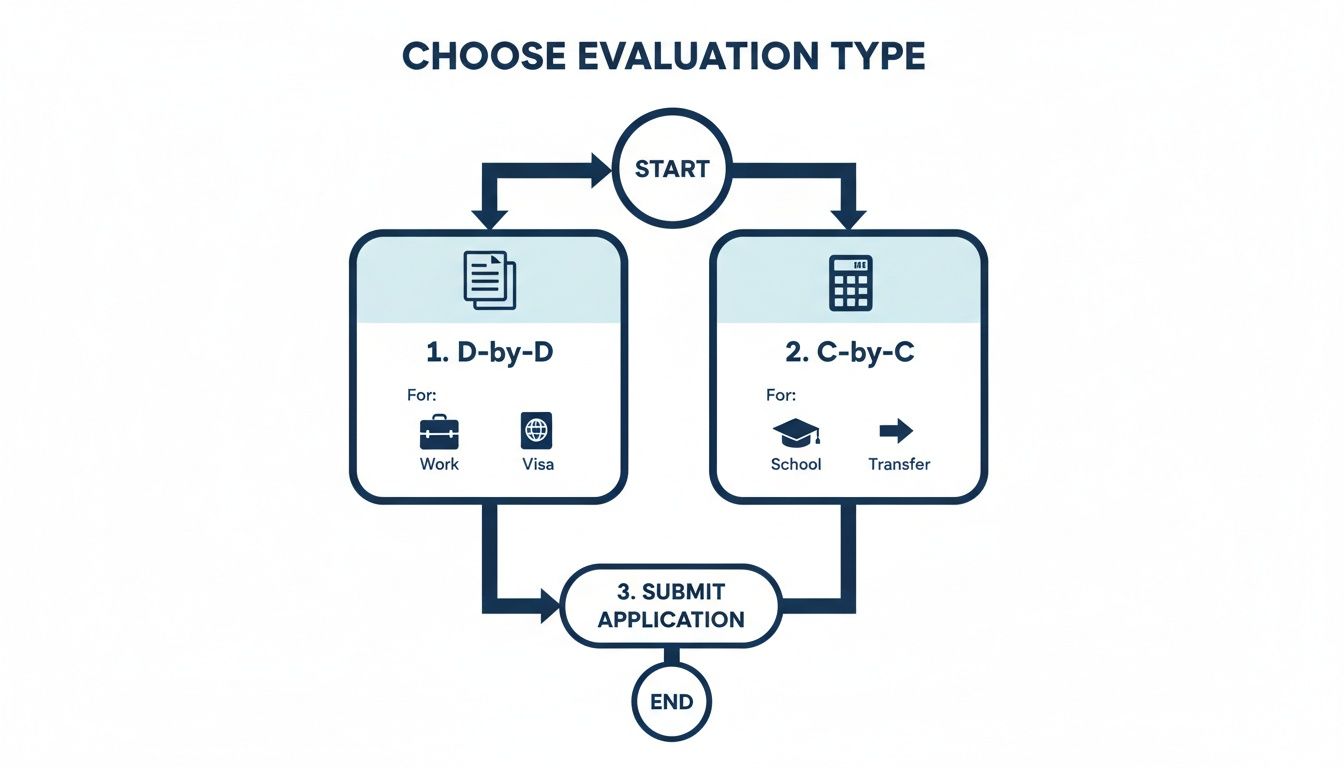
As you can see, choosing correctly between a Document-by-Document and a Course-by-Course evaluation from the very beginning saves you from wasting time and money.
Getting this right matters more than ever. The U.S. is expected to host a record number of international students in 2026, continuing recent growth trends. This boom shows just how vital accurate transcript evaluations are for admissions and visa approvals. For every one of these students, a flawless certified translation is a must-have, as even a small mistake can derail their entire academic or immigration timeline. You can read more about recent trends in international student enrollment on IIE.org.
Step 3: Choose a NACES-Approved Agency
With your certified translations in hand, the next step is to pick an evaluation agency. To make sure your report is taken seriously, you absolutely should choose a member of the National Association of Credential Evaluation Services (NACES).
NACES is the gold standard—an association of trusted, independent evaluators that all meet strict professional requirements. Institutions like universities, state licensing boards, and government agencies trust evaluations from NACES members because they know the reports are credible and meticulously prepared.
Step 4: Submit Your Complete Application
Alright, you have your official documents and your certified translations. Now you're ready to submit everything to the evaluation agency. You’ll need to send them both the original language documents and their English translations. Be sure to follow their instructions to the letter, as each agency has its own unique submission process.
Step 5: Receive and Review Your Evaluation Report
Once the agency has finished its work, you'll get your final evaluation report. Standard service usually takes about 7-15 business days, though most agencies offer rush options if you're in a hurry. This report is the key—it’s the official U.S. equivalent of your foreign education, ready to be sent off for your application. As soon as you get it, give it a thorough review to make sure everything is accurate.
Required Documents and Translation Rules You Cannot Ignore
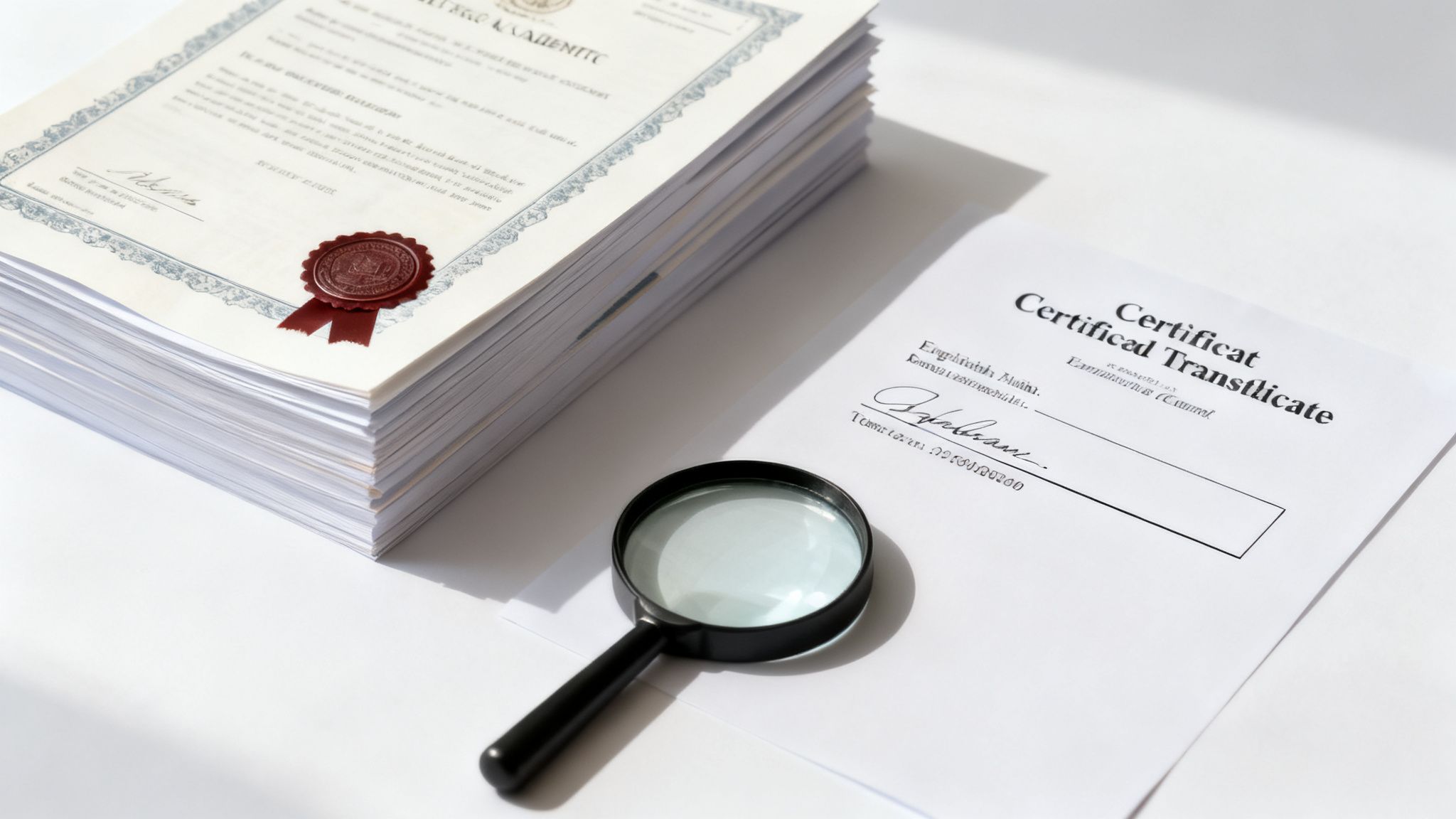
Submitting the right paperwork is half the battle when it comes to getting your foreign transcripts evaluated. Think of your documents as the ingredients for the evaluation report; if they aren't perfect, the whole process can grind to a halt. You must provide exactly what the agency asks for and follow strict translation rules to the letter.
Getting this part wrong is one of the most common reasons applications get delayed or rejected. So, let’s break down precisely what you'll need and the non-negotiable rules for getting them translated.
Your Document Checklist
First things first, you need to gather your official academic records. While the specific list might vary slightly between evaluation agencies, the core documents are almost always the same.
Here’s what you should have ready:
- Official Academic Transcripts: Your detailed grade reports (sometimes called mark sheets) that show every course you took and the grade you earned.
- Degree Certificates or Diplomas: The formal document proving you graduated and were awarded your degree.
- Proof of Name Change (if applicable): If your current name doesn't match the name on your academic records (e.g., due to marriage), you’ll need an official civil certificate like a marriage certificate to connect the dots.
The word "official" is critical here. This usually means the documents must be sent directly from your university to the evaluation agency in a sealed, stamped envelope. Always check the specific requirements of the agency you're using.
The Unbreakable Rules of Certified Translation
If your academic records aren't in English, this next step is non-negotiable. You must provide a professional certified translation for every single page.
A certified translation isn't just a translation; it's a formal document prepared by an impartial professional. It must include a signed Certificate of Accuracy, where the translator or company swears that the translation is a complete and accurate version of the original. A sworn translation is a similar concept used in other countries, but for U.S. purposes, "certified" is the standard.
This is not a job for a helpful friend or a bilingual family member. Official bodies like universities and USCIS will reject a translation from anyone with a personal connection to you, viewing it as a conflict of interest.
Imagine this real-world scenario: Maria, an architect from Brazil, was applying for a master's program in the U.S. and facing a tight deadline. To save money, she asked her cousin to translate her transcripts. The university rejected her application immediately because the translation wasn't professionally certified. That simple mistake cost her a full year, forcing her to wait for the next application cycle.
To keep your application moving, your translation must come from an unbiased, professional third party. You can find out more in our academic transcripts translation guide. When your future career or education is on the line, there’s simply no room for error.
Common Mistakes That Can Delay Your Application
When you're getting foreign transcripts evaluated, the stakes are high. One tiny misstep can throw your entire application off track, sometimes by weeks or even months. The last thing you want is to miss a crucial deadline for school, a professional license, or your immigration case because of a simple, avoidable error.
Let's walk through the most common pitfalls people run into. Knowing what to watch out for is the best way to keep your application moving smoothly.
Submitting the Wrong Type of Documents
This is probably the number one mistake. Evaluation agencies are incredibly strict about what they'll accept. A simple photocopy of your transcript or a screenshot from your student portal? That's going to get rejected instantly.
You absolutely must provide official transcripts and degree certificates. This means the documents need to come directly from your university, either in a sealed envelope or through a secure digital service.
Using an Uncertified or Improper Translation
This one is a deal-breaker. You can't translate your own documents, no matter how fluent you are. Asking a bilingual friend or family member is also out of the question.
Every official body requires a certified translation from a professional, impartial service. A proper translation is more than just the words—it comes with a signed Certificate of Accuracy, a document that attests to the translation's completeness and correctness. A notary stamp, while sometimes required for legal documents, does not make a translation certified. Certification comes from the translator's signed statement. Submitting a translation without this is a surefire way to get your application stopped in its tracks. You can learn more about our certified translation services to make sure you get this right the first time.
Choosing the Wrong Evaluation Type
We've talked about the different types of evaluations, and picking the wrong one is a classic mistake that costs both time and money. A Document-by-Document report is fine for some employment situations, but it's completely inadequate for a university application that needs a GPA and credit breakdown.
Think about it this way: a three-year bachelor's degree from a country like India often has enough coursework to be equivalent to a four-year U.S. degree. But how do you prove that? Only a Course-by-Course evaluation can do the job by detailing every subject and its credit hours. If you choose the wrong report, an admissions officer might wrongly conclude that your education doesn't measure up.
This isn't just a U.S. issue; it's a global challenge. Take Canada's Foreign Credential Recognition (FCR) Program. Recent data shows they're struggling to keep up with demand. You can read the full details about these credential recognition challenges on Canada.ca. This kind of bottleneck shows just how critical it is to get every step of the evaluation process right from the start.
Falling for Diploma Mills
A "diploma mill" is an unaccredited organization that sells degrees for a fee, with little or no real academic work involved. Evaluation agencies are experts at spotting these fakes and will flat-out refuse to evaluate their credentials.
Before you even start, double-check that your university is properly accredited by the recognized authority in your home country, like the Ministry of Education. NACES members make this verification their very first step.
Underestimating the Timeline
This might be the most frustrating mistake because it's so easy to avoid. People consistently underestimate how long this whole process takes. You can't just decide to do it a week before your deadline.
Here’s a more realistic look at the timeline you should plan for:
- Requesting official documents: This can take anywhere from a few days to several weeks.
- Certified translation: Professional services are fast, often taking 24-48 hours, but it's still a step you have to factor in. You can review our turnaround time information to plan better.
- Evaluation processing: Standard services usually take 7-15 business days, and that doesn't include shipping time.
Give yourself plenty of buffer room. By planning ahead, you can handle each stage calmly and confidently, without the stress of a ticking clock.
Understanding the Costs and Timelines Involved
Let's talk about two of the most important factors in any application process: time and money. Getting a handle on the costs and timelines for your transcript evaluation is the key to a smooth, stress-free experience. Whether you're up against a university admissions deadline or an immigration filing window, planning ahead will save you a world of headaches.
The total cost really boils down to two main components: the certified translation of your documents and the evaluation agency’s own fees.
First up is the certified translation. If your academic records aren't in English, you'll need a professional to translate them. The cost is usually calculated per page, with a standard page defined as up to 250 words. The good news is that this part is incredibly fast. Most professional services can turn around 1-3 pages in as little as 24 hours.
Breaking Down the Evaluation Fees
The second, and usually larger, cost comes directly from the evaluation agency. What you pay them depends entirely on the level of detail you need in your report. Here’s a rough guide to what you can expect to see from most NACES-approved agencies in 2026:
- Document-by-Document Evaluation: This is the more basic option that confirms your degree is equivalent to a U.S. one. The cost for this typically falls between $100 and $150.
- Course-by-Course Evaluation: If you need a full breakdown of your coursework and a calculated GPA, you'll need this report. Expect to budget between $180 and $250.
Keep in mind, there can be a few extra costs. If you're in a hurry, most agencies offer a rush service for a significant extra fee. You might also need to send official copies to several different places, and each additional copy will add a small charge.
Mapping Out a Realistic Timeline
Managing your calendar is just as critical as managing your budget. While the translation part is quick, the evaluation itself is a process that requires some patience.
A common mistake is underestimating how long this really takes. People forget to factor in everything—getting documents from their old school, the translation, the evaluation itself, and even shipping. My best advice? Start early.
Here’s a practical timeline to help you map it out:
- Document Retrieval (1-4 weeks): This can be the most unpredictable part. Getting official transcripts from a university in another country can sometimes take a while.
- Certified Translation (1-2 days): This is the easy step. Professional services are built for speed. If you want to know more about the specifics, check out our guide on how to get a translation certificate.
- Standard Evaluation Processing (7-15 business days): Once the agency has everything they need, this is their standard turnaround time to complete the analysis.
- Shipping (3-7 business days): Finally, don't forget to account for the time it takes for the physical report to get from them to you or the institution that needs it.
When you add it all up, you can see why it's a good idea to kick off this process at least one to two months before your deadline.
Frequently Asked Questions About Transcript Evaluations
It’s natural to have a few questions as you get ready to submit everything. Let's clear up some of the most common ones about getting your foreign transcripts evaluated.
Can I Translate My Own Academic Transcripts?
That’s a definite no. You might be fluent in both languages, but official bodies like USCIS, universities, and professional boards need a completely impartial translation. They view self-translations as a conflict of interest, so they'll be rejected on the spot.
What you need is a certified translation. This comes from a professional service and includes a signed statement confirming its accuracy and completeness—a guarantee you simply can't provide for your own documents.
What Is NACES and Why Does It Matter?
NACES is short for the National Association of Credential Evaluation Services. Think of it as a professional alliance of the most trusted and reputable evaluation companies in the U.S. They all agree to follow a strict code of ethics and professional standards.
Because of this, most American universities, government agencies, and licensing boards will only accept evaluations from a NACES member company. It’s their way of ensuring the report they receive is credible, consistent, and reliable.
How Long Is an Evaluation Report Valid?
Technically, the evaluation report itself doesn't expire. It’s a snapshot of your academic achievements at the time it was created.
However, the institution you're sending it to might have its own rules. Some universities or employers may ask for a report that was completed within the last few years. It’s always a good idea to double-check their specific requirements before you get started.
Don't let translation hurdles slow down your application. We provide fast, accurate, and USCIS-accepted certified translations to keep everything on track.


