
Navigating the U.S. immigration process often means dealing with a lot of paperwork. If any of your official documents—like a birth certificate or marriage license—are not in English, you'll need what's called a certified translation. So, what is it? A certified translation is a professional, word-for-word translation of your document that includes a signed statement from the translator or translation company. This statement, often called a "Certificate of Accuracy," guarantees that the translation is a complete and true reflection of the original document. This isn't just a suggestion; it's a strict requirement for U.S. Citizenship and Immigration Services (USCIS).
Think of it as an official promise that your translated documents are trustworthy. For USCIS, this professional guarantee is non-negotiable. Using expert certified translation services for immigration ensures your application is taken seriously and avoids unnecessary delays, helping you move forward with confidence.
What a Certified Translation Really Means for Your Immigration Case
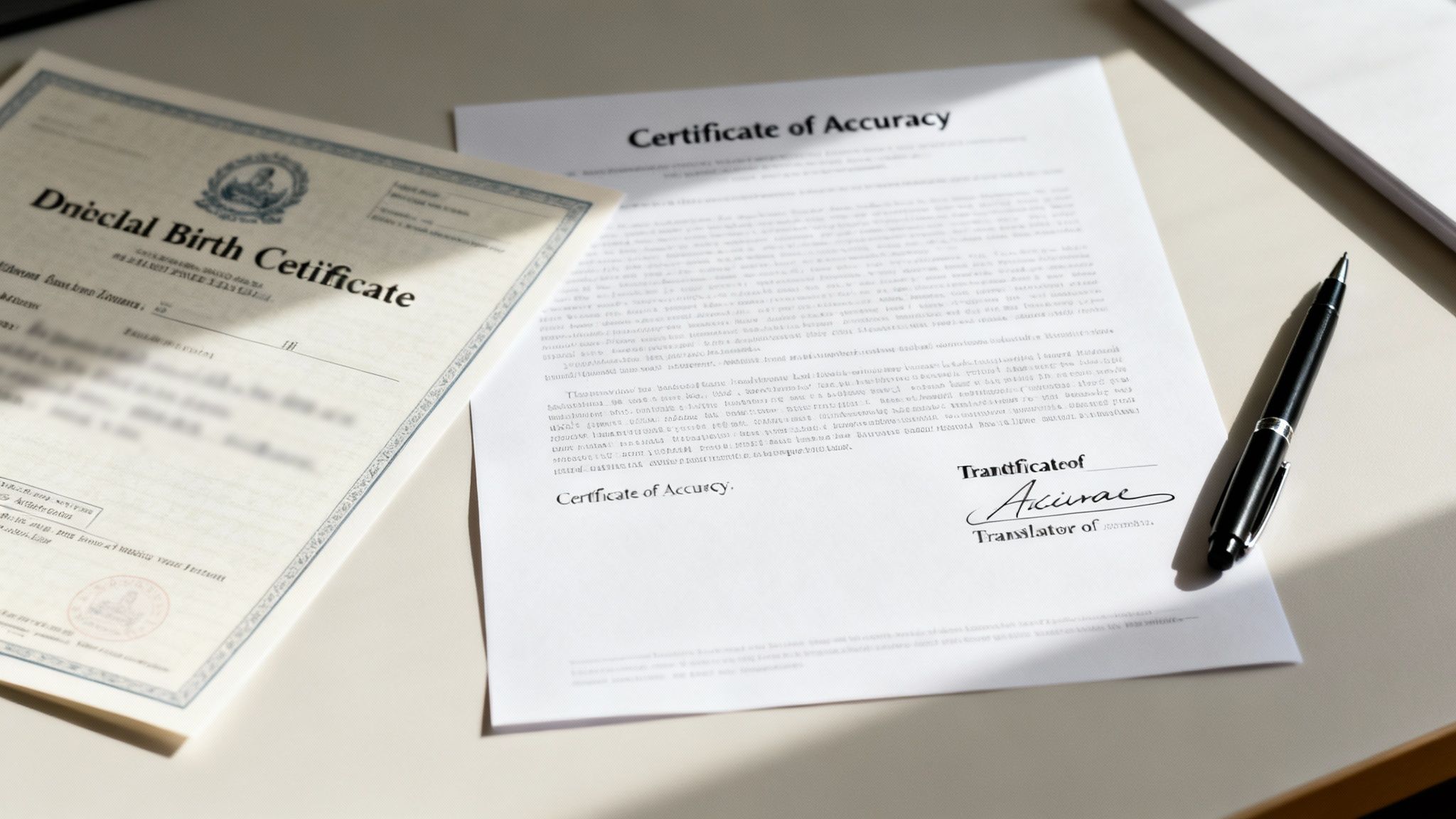
Imagine submitting your application for a Green Card. You’ve included your birth certificate from your home country, which is in Spanish. A USCIS officer can't read Spanish, so they have no way of knowing if the information is correct. A certified translation solves this problem by providing a reliable English version they can trust completely.
It’s essentially a two-part package: the translated document and its essential partner, the Certificate of Accuracy. This certificate is a formal letter where the translator confirms the translation is accurate and complete. That’s why you can’t ask a bilingual friend to do it; USCIS needs an impartial, professional guarantee that nothing was misinterpreted or left out.
The Certificate of Accuracy Explained
The Certificate of Accuracy is the most important part of a certified translation. It’s the formal proof that your translation is reliable. To be accepted by USCIS, this statement must include a few key details:
- A statement of accuracy: A clear declaration that the translation is complete and correct.
- Translator’s qualifications: A sentence confirming the translator is fluent in both languages (e.g., Spanish and English).
- Translator’s contact details: The name, signature, and contact information of the translator or a company representative.
- Date of translation: The specific date the certification was signed.
One of the biggest myths is that USCIS requires certified translations to be notarized. This is not true. A notary stamp only verifies the identity of the person who signed the document—it says nothing about the translation's quality. For a deeper dive, check out our guide on certified and notarized translation.
To help you understand the different services, here’s a quick comparison.
Understanding Different Translation Types
| Feature | Certified Translation | Notarized Translation | Standard Translation |
|---|---|---|---|
| Primary Purpose | Required for official use (USCIS, legal, academic) | Verifies the identity of the person signing a document | For general information, not official submission |
| Key Component | Certificate of Accuracy signed by the translator | Notary's seal and signature | The translated text itself |
| Guarantees | Translation accuracy and completeness | Signer's identity | No formal guarantee of accuracy |
| USCIS Acceptance | Yes, it's the standard requirement | No, not required and adds no value to the translation | No, will be rejected |
This table shows why choosing the correct type of translation is crucial for your application's success.
Why This Matters for Your Application
The need for accurate translations is massive. In Fiscal Year 2023, U.S. Citizenship and Immigration Services (USCIS) processed nearly 11 million applications. A huge number of these, including over 878,500 citizenship cases, relied on certified translations for foreign documents like marriage and birth certificates. Since USCIS requires a certified English translation for any non-English document, getting it right is essential for a smooth process. You can find more details in the USCIS application statistics on thelanguagedoctors.org.
Ultimately, a proper certified translation shows you are serious and that your application is trustworthy. It removes any doubt, giving the reviewing officer the clear information they need to make a fair and timely decision on your case.
Why USCIS Insists on Certified Translations
When you submit your application to U.S. Citizenship and Immigration Services (USCIS), an officer needs to make a life-changing decision based on your documents. They need total confidence that every piece of information is accurate, especially when it comes from another country. This is why certified translation services for immigration are not just a suggestion—they are a mandatory requirement.
For a USCIS officer, a certified translation acts as a guarantee. The signed certificate from the translator tells the officer that the English version is a complete and faithful copy of the original. It creates a clear line of accountability, so there's no question about the document's integrity.
The Need for Unquestionable Accuracy and Consistency
USCIS handles millions of applications annually, and consistency is key. A certified translation ensures that an officer in California interprets your birth certificate the exact same way as an officer in New York, regardless of its original language.
Imagine a situation where a marriage certificate is translated incorrectly, changing the date of the marriage. This small error could lead an officer to question the legitimacy of the relationship, potentially leading to a denial. A certified translation prevents these kinds of mistakes by ensuring every detail is perfectly preserved.
How to Avoid Costly Delays and Denials
Submitting a translation without proper certification is one of the fastest ways to delay your application. The consequences can be frustrating and expensive:
- Request for Evidence (RFE): USCIS will likely send you an RFE, which officially pauses your case until you provide a compliant translation. This can add weeks or months to your wait time.
- Application Delays: Any small mistake can push your file to the bottom of the pile, extending an already long and stressful process.
- Outright Denial: If the translation is seen as unreliable or unprofessional, USCIS has the authority to deny your application. This often means you have to start the entire process over, losing both time and money.
These aren't minor issues. While the Executive Office for Immigration Review (EOIR) managed to complete a record 722,000 cases in the first eleven months of FY2025, the backlog remains huge. The average national wait time is around 636 days. As noted in a report on how legal translation shapes immigration case viability on languageconnections.com, language barriers significantly impact case outcomes. Getting your certified translation right from the start helps you avoid becoming another statistic.
Keeping the Process Fair for Everyone
At its core, the USCIS certified translation requirement is about fairness. It ensures every applicant's documents are judged by the same high standard of accuracy. This rule protects the integrity of the U.S. immigration system.
The core idea is simple: USCIS must be able to trust the English translation as if they were reading the original document themselves. The certification is that bridge of trust, making it an essential part of your immigration journey.
This requirement isn't meant to be a burden. It's a safeguard to ensure your story is told correctly and your case is judged on its true merits. To build a strong application, it’s vital to understand the full scope of the USCIS requirements for translations and ensure every document is perfect from day one.
The 3-Step Process for a Perfect Certified Translation
Navigating official document translation can feel overwhelming, but it doesn't have to be. The process is straightforward and can be broken down into three simple steps. Let's walk through it together to see how you can get a perfect, USCIS-compliant translation without the headache.
The entire process is logical: you prepare your document, send it to a professional for translation, and receive a fully certified package that is guaranteed to be accepted.
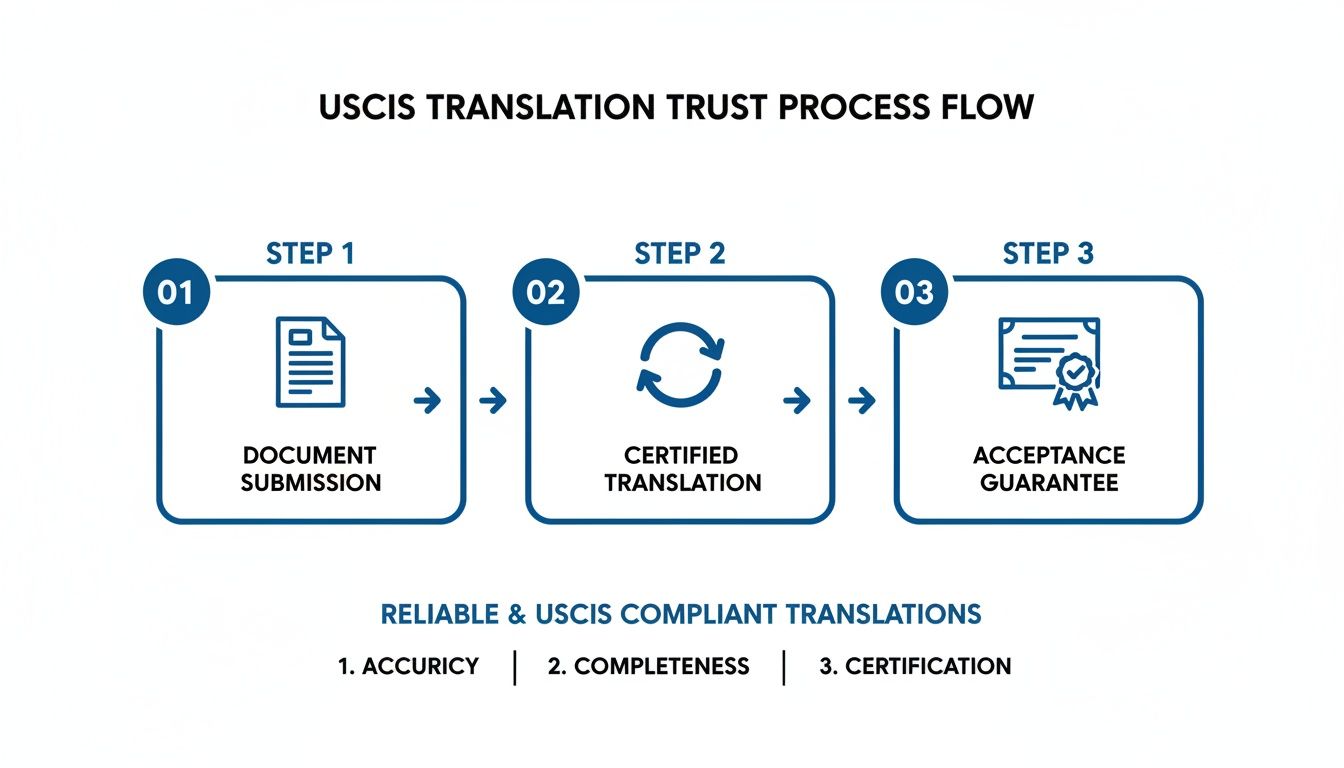
This workflow is your roadmap from a foreign-language document to a submission-ready translation that immigration officials will approve.
Step 1: Prepare Your Original Documents
Before you even think about translation, the first step is in your hands. You need to provide the translator with the clearest possible copy of your document. A blurry photo or an incomplete scan is a recipe for delays and inaccuracies.
Follow these simple rules to get it right:
- Get Clear Scans or Photos: Use a scanner or your phone's camera. Lay the document flat in good lighting and capture the entire page, including all four corners. Avoid shadows and strange angles.
- Check for Legibility: Look closely at the image. Can you read every word, stamp, and signature? The translator must account for everything, including handwritten notes and faint official seals. If you can't read it, they can't either.
- Include Every Single Page: If you're submitting a multi-page document like a university transcript or legal contract, make sure you include every page. A partial document results in a partial translation, which is an automatic rejection from USCIS.
Step 2: Find a Reputable Translation Service
With your documents ready, it's time to choose the right partner. This isn't a place to cut corners; you need a service that understands the strict rules of immigration authorities. To ensure you get it right, utilize a professional translation service that specializes in this field.
Here’s a checklist of what to look for in a provider of certified translation services for immigration:
- A USCIS Acceptance Guarantee: This is non-negotiable. Any reputable service will offer a 100% guarantee that USCIS will accept their certified translations. It’s their promise to stand behind their work.
- Transparent Pricing: You should know the exact cost before you commit. Look for a simple, per-page rate with no hidden fees. The best services allow you to upload your document for an instant quote.
- Real Human Translators: Automated tools are not suitable for official documents. You need a qualified human translator who understands the nuances, cultural context, and specific terminology that software misses.
- A Clear Process and Fast Turnaround: The company should explain its process clearly and provide a firm deadline. For most standard documents (1-3 pages), a 24-hour turnaround is a realistic option for meeting tight immigration deadlines.
Step 3: Review and Receive Your Certified Translation
Once you submit your files, the translation team takes over. What you receive should be a complete, professional package ready for your application.
Your final delivery must include two key items:
- The Translated Document: A professional, word-for-word translation of your original document. The formatting should mirror the original as much as possible, making it easy for an official to compare them.
- The Certificate of Translation Accuracy: This is a separate page containing a signed statement from the translator or company. It confirms the translation's accuracy, states the translator's competence in both languages, and includes their contact information.
This certification is exactly what USCIS officials look for. Take a moment to review both documents, checking that names, dates, and other key details are perfect. With this package, you're ready to submit with confidence.
Your Certified Translation Submission Checklist
Here's a quick checklist summarizing what your final package needs. Following this helps prevent unnecessary delays with your application.
| Component | Description | Why It Is Important |
|---|---|---|
| Original Document Scans | Clear, high-resolution copies of every page of your original document. | The immigration officer may need to compare the translation against the original to verify its contents. |
| Word-for-Word Translation | The complete English translation of your document, matching the original in content and format. | Ensures nothing is misinterpreted or omitted, which is a strict USCIS requirement. |
| Certificate of Accuracy | A signed statement from the translator or translation company attesting to their qualifications and the translation's accuracy. | This is the official proof that your translation was done by a competent professional and is trustworthy. |
| Contact Information | The name, address, and phone number of the translator or company on the certificate. | Allows USCIS to contact the provider for verification if they have any questions. |
Once you have these components, you can confidently add them to your immigration paperwork, knowing you've met all official requirements.
What Kinds of Documents Usually Need a Certified Translation?
As you gather your paperwork for immigration, you might wonder, "Which of these documents actually need to be translated?" The USCIS rule is simple: any official document that isn’t already in English needs a complete, certified translation.
To stay organized, let's break down the common documents into key categories. Think of this as your checklist to ensure nothing is missed.
Vital Records and Civil Certificates
These are the most common documents and form the foundation of your personal history. They prove who you are, your family connections, and your legal status. Civil certificates are official records issued by a government authority.
Imagine a couple, Marco and Sofia, applying for a marriage-based Green Card. Their marriage certificate is from Italy and is in Italian. For their application to succeed, they will need certified translation services for immigration for key documents like:
- Birth Certificates: This is the primary proof of your identity, birthplace, and parents.
- Marriage Certificates: Essential for any application based on marriage, this document proves your legal union.
- Divorce Decrees: If you were previously married, you need this to prove that the marriage legally ended.
- Death Certificates: Often required to prove the death of a spouse or parent relevant to your immigration case.
A tiny mistake in a translated name or date can cause serious delays. A flawless translation of a birth certificate is absolutely crucial. You can dive deeper into what that involves in our guide on birth certificate translation services.
Official, Legal, and Police Records
This category includes documents related to your history with government and legal systems. USCIS needs to verify your background to ensure you meet the character requirements for immigration to the U.S.
Because these documents carry legal weight, they must be translated with absolute precision.
Common documents in this category include:
- Police Clearance Certificates: These reports show your criminal history (or lack thereof) from every country where you have lived.
- Court and Prison Records: If you have any past legal issues, the related paperwork must be fully translated.
- Military Records: These papers detail your service history if you were in another country's armed forces.
- Passports and National ID Cards: While the main page is often multilingual, any stamps, visas, or official notes in another language may require translation.
Academic and Financial Documents
Depending on your visa type, you may need to prove your education or financial stability. This is especially common for work-based visas. An academic transcript, for instance, is the official record of your courses and grades from a school or university.
Let's say a software engineer from India is applying for an H-1B visa. He needs to prove he has the required degree. This means he will need certified translations for:
- University Diplomas and Transcripts: Essential for verifying degrees and academic credentials.
- Bank Statements: Often required to show you have the financial resources to support yourself.
- Affidavits of Support: If someone is sponsoring you, any supporting letter in another language must be translated.
- Professional Licenses: Any licenses or certifications required to practice your profession.
By sorting your documents into these categories, you can create a clear list of everything that needs a professional, certified translation, ensuring your application is complete and ready for review.
Common Mistakes That Can Delay Your Application
The immigration process requires careful attention to detail. A small mistake on your translated documents can cause a major headache and bring your application to a halt. The last thing you want is a Request for Evidence (RFE) from USCIS.
Let's review the most common slip-ups and how to avoid them to keep your application on track.
Mistake 1: Using a Friend or Family Member
It’s tempting to ask a bilingual friend or family member for help to save money. However, for USCIS, this is a major red flag. They cannot verify if your relative is truly fluent or if they might be biased.
Even if the translation is accurate, the lack of a professional certification from a neutral expert raises doubts about its reliability.
- What Happens: Your translation is rejected, you receive an RFE, and your case is delayed for weeks or months.
- How to Fix It: Always use professional certified translation services for immigration. A reputable agency provides the official Certificate of Accuracy and guarantees its work meets USCIS standards. The risk of rejection is not worth the small savings.
Mistake 2: Ignoring Every Single Detail
A certified translation must be a complete mirror of the original document. This includes not just the main text but also every stamp, seal, signature, and handwritten note. If there’s a faint, hard-to-read stamp, the translator must note its presence.
The rule is simple: "if it's on the page, it gets translated." This meticulous approach assures the immigration officer that nothing has been hidden or altered, which is crucial for building trust.
Mistake 3: Falling for "Too Good to Be True" Pricing
Everyone loves a deal, but if a translation service’s price seems impossibly low, be cautious. In 2026, certified translation for immigration documents generally costs between $18 and $70 per page, with most reputable services falling in the $20 to $40 range.
Services offering rock-bottom prices may be cutting corners by using machine translation without human review or hiring unqualified translators. A bad translation could lead to delays of two to six months or a denial, which could cost you $5,000 to $15,000 or more to fix.
- What Happens: You receive an inaccurate translation that USCIS rejects. You've wasted money and precious time, and you still have to pay for a new translation.
- How to Fix It: Choose a service with clear pricing and a solid USCIS acceptance guarantee. Paying a little more for quality work is a smart investment that saves you from costly problems later.
Mistake 4: Submitting an Incomplete Package
This mistake is simple but surprisingly common. You must submit the translated document and a copy of the original source document together. The immigration officer needs to be able to compare the two. Forgetting to include the original creates confusion and invites an RFE.
Navigating complex parts of the immigration system, like an adjustment of status, requires getting every detail right. If you need in-depth legal help, you might consider Hiring an Adjustment of Status Attorney.
By avoiding these common pitfalls, you can feel confident that your translated documents are solid and ready for a smooth review.
Your Certified Translation Questions Answered
When you’re dealing with immigration paperwork, questions are bound to come up. Let's clear up some of the most common ones about certified translations so you can move forward with confidence.
Does USCIS Require My Translation to Be Notarized?
This is a widespread myth. The short answer is no. USCIS requires a certified translation, but they do not require it to be notarized. A notary stamp simply verifies the identity of the person signing a document; it does not say anything about the quality or accuracy of the translation itself. What USCIS cares about is the Certificate of Translation Accuracy—the professional guarantee from the translator. Sticking with a proper certification will save you time and money.
How Fast Can I Get a Certified Translation?
You might be surprised by the speed. For standard documents like a birth certificate or marriage license (usually 1-3 pages), many professional services can deliver a completed, certified translation within 24 hours. This can be a lifesaver when you're facing a tight submission deadline. For larger documents, like a multi-page legal file, it may take longer. A reputable provider will always give you a clear delivery estimate upfront. You can learn more about how our pricing and turnaround times work to see how quickly we can get your documents ready.
Can I Just Translate My Own Documents for My Application?
Even if you are perfectly bilingual, you cannot translate and certify your own documents for your immigration case. USCIS considers this a conflict of interest. The purpose of a certification is to have a neutral, qualified third party vouch for the translation’s accuracy. Using an independent professional ensures your translation meets the objective standards USCIS requires and maintains the integrity of your application.
Think of it this way: a judge wouldn't let a defendant act as their own witness to verify their alibi. Similarly, USCIS needs an impartial professional to vouch for the translation's accuracy, not the applicant themselves.
What Is the Difference Between Certified and Sworn Translations?
People often confuse these terms, but they refer to different processes depending on the country. A certified translation is the standard for the U.S. A professional translator provides an accurate translation and attaches a signed Certificate of Accuracy. No government appointment is needed. A sworn translation, on the other hand, is common in many countries in Europe and South America. A sworn translator is officially appointed by their government, and their translations are considered legally binding documents in that country.
For any U.S. immigration case, a sworn translation is not necessary. A certified translation from a trusted provider is exactly what you need to meet all official requirements. Our guide to our main certified translation services explains this in more detail.
At TranslateDay, we specialize in providing fast, accurate, and USCIS-guaranteed certified translations that take the stress out of your immigration process. Our expert linguists and streamlined online system ensure your documents are perfectly translated and certified, every single time.


