
Navigating the U.S. immigration system means getting every single detail right. When your essential documents—like a birth certificate from your home country or a marriage license—are in a language other than English, you'll need something called a certified translation. So, what exactly is that? It's not just a word-for-word conversion; it's a precise English translation of your foreign-language document accompanied by a signed statement from the translator or translation company. This key declaration, known as a Certificate of Translation Accuracy, serves as your guarantee to U.S. Citizenship and Immigration Services (USCIS) that the translation is both complete and accurate.
Your First Step: Understanding Certified Translation for USCIS
Think of a certified translation as a bridge. It connects the official records from your home country, such as civil certificates like birth or marriage records, to the U.S. legal system in a way immigration officers can trust. If you're submitting an application to USCIS—the U.S. government agency that handles immigration cases—every official document that isn't already in English must be accompanied by one.
It’s easy to get confused by the word "certified" and assume the translator needs a special government license. In reality, for USCIS, the focus is on accountability. The certification statement is a formal pledge from a competent translator confirming that the English version is a true and faithful mirror of the original document. This ensures that every piece of your story is presented clearly and professionally.
Why USCIS Insists on This Standard
The immigration process is built on a foundation of verifiable facts. USCIS officers review thousands of documents daily, from birth certificates proving family ties to academic transcripts validating educational qualifications. To judge each case fairly and prevent fraud, they need a consistent, reliable standard for every piece of evidence.
A certified translation for immigration accomplishes three critical goals:
- Verifies Accuracy: It provides assurance that crucial details like names, dates, and locations have been translated precisely, with no personal interpretations.
- Ensures Completeness: The certification attests that every single part of the original document has been translated—including stamps, seals, and handwritten notes.
- Assigns Responsibility: It clearly identifies the translator or agency responsible for the work, complete with contact information, making them accountable for its quality.
This system has become more important than ever. With USCIS processing millions of applications annually, there is no room for error. An unclear or inaccurate translation can cause significant delays or even lead to a denial of your application.
Certified vs. Notarized: What You Actually Need
Another common point of confusion is the difference between a certified translation and one that has a notary stamp. They might sound similar, but they serve completely different purposes.
A certified translation guarantees the accuracy of the translation itself. In contrast, a notarized translation only verifies the identity of the person who signed the document. A notary public doesn't review the quality of the translation; they just confirm that the signer is who they claim to be.
For nearly all immigration filings, USCIS requires a certified translation. Notarization is rarely requested. Paying extra for a notary stamp when it isn't required is an unnecessary expense that adds no value to your application. If you want to dive deeper, our guide on certified and notarized translation breaks down the specifics.
To help you avoid common mistakes, let's clear up what USCIS actually requires versus some persistent myths that can derail an application.
USCIS Certified Translation Requirements vs. Common Myths
This table quickly breaks down what USCIS really wants compared to the incorrect assumptions that can cause serious problems for your case.
| USCIS Requirement | Common Misconception |
|---|---|
| The translation must include a signed statement of accuracy from the translator. | The translator must be government-approved or have a special license. |
| The translator must be a competent third party, not the applicant. | A bilingual friend or family member can provide the translation to save money. |
| Every part of the original document must be translated, including seals and stamps. | Only the main text needs to be translated; visual elements can be ignored. |
| The translation must be a word-for-word copy, not a summary. | A summary of the document is acceptable as long as the key information is there. |
| Certification is mandatory; notarization is almost never required. | Getting the translation notarized makes it more official and increases acceptance. |
Sticking to the official requirements is the surest way to prevent your documents from being questioned. When it comes to USCIS, clarity and compliance are everything.
Key Documents You Must Get Translated for USCIS
When you’re putting together your immigration packet, think of it as building a case file for a USCIS officer. Each document is a piece of evidence, and if it's in a language other than English, it needs a certified translation to make sense. Submitting something in its original language is like handing over a critical clue that no one can read. It brings everything to a halt.
While every application is a little different, there's a core set of documents that pop up in almost every immigration case. These aren't just papers; they are the official records that prove your identity, family connections, and personal history.
Vital Records: The Foundation of Your Case
These documents, often called civil certificates, are the bedrock of most applications, whether it's a family-based Green Card or a citizenship claim. They're non-negotiable for proving who you are and how you're related to your family members.
- Birth Certificates: This is the primary proof of identity. It establishes your name, date and place of birth, and who your parents are. A certified translation is absolutely essential for proving family relationships in sponsorship cases. For a deeper dive, check out the specifics on birth certificate translation services.
- Marriage Certificates: This is the legal proof of your marriage. You’ll need a translated version for any spousal visa, a Green Card application based on marriage, or any time you’re adding a spouse to your case.
- Divorce Decrees: If you or your spouse were married before, you must provide translated divorce decrees for every prior marriage. This shows USCIS that those marriages were legally terminated, making your current one valid for immigration.
- Death Certificates: If a previous marriage ended because a spouse passed away, a translated death certificate is required. This proves you are eligible to remarry or apply under a widow(er) category.
Legal and Personal History Documents
Beyond proving who you are, USCIS needs to verify your background and character. These documents create a timeline of your personal history and are closely reviewed to make sure you meet the legal requirements for entry or residence.
- Police Clearance Certificates: Many applications require a police certificate from every country you lived in for more than six months after you turned 16. A translated version confirms your criminal record—or lack thereof—which is a major factor in admissibility.
- Court and Prison Records: If you've ever been arrested or convicted of a crime, you absolutely must provide translated copies of all court documents and prison records. These are critical for assessing your eligibility, and they must be translated with 100% accuracy.
- Military Records: Served in the armed forces of another country? Your military records will need to be translated. They give USCIS a detailed look at your service history.
- Adoption Decrees: For any case involving an adopted child, the official adoption decree must be translated to legally establish the parent-child relationship in the eyes of U.S. law.
Why This Matters: A USCIS officer needs to see the whole picture. A translated police report doesn't just say "no record"—it confirms that an official check was performed according to that country's legal standards. This kind of detail is what builds trust and makes your application credible.
Financial and Academic Documents
Finally, some applications require you to prove you can support yourself or that you have the right qualifications for a specific visa.
- Financial Statements: For sponsorship applications (like Form I-864, Affidavit of Support), you may need to submit translated bank statements or employment letters to prove you meet the income requirements.
- Academic Transcripts and Diplomas: Applying for an employment-based visa or to a U.S. university? Your degrees and academic transcripts—the official record of your courses and grades—will need to be translated so that U.S. schools and credential evaluators can understand and verify your education.
While this covers the main documents for USCIS, remember that other countries have their own unique rules. It's always a good idea to stay on top of all documentation to avoid problems, for instance, when understanding specific visa requirements, like those for a Schengen visa.
Ultimately, each document tells a piece of your story. Getting them all translated perfectly is the best way to present a clear, strong case to immigration officials.
How to Get Your Documents Translated and Certified
Getting a certified translation for immigration can feel like a daunting task, but it really just breaks down into a few straightforward steps. The trick is to be methodical and pick the right translation partner from the start.
Let's walk through it together. Imagine you're Maria, preparing your Green Card application. You have a marriage certificate and a university diploma from Mexico, both in Spanish. You have a tight USCIS deadline and need them translated perfectly. Here's your action plan.
The whole point of this process is to ensure your documents are presented in a way that U.S. authorities can understand and trust without question.
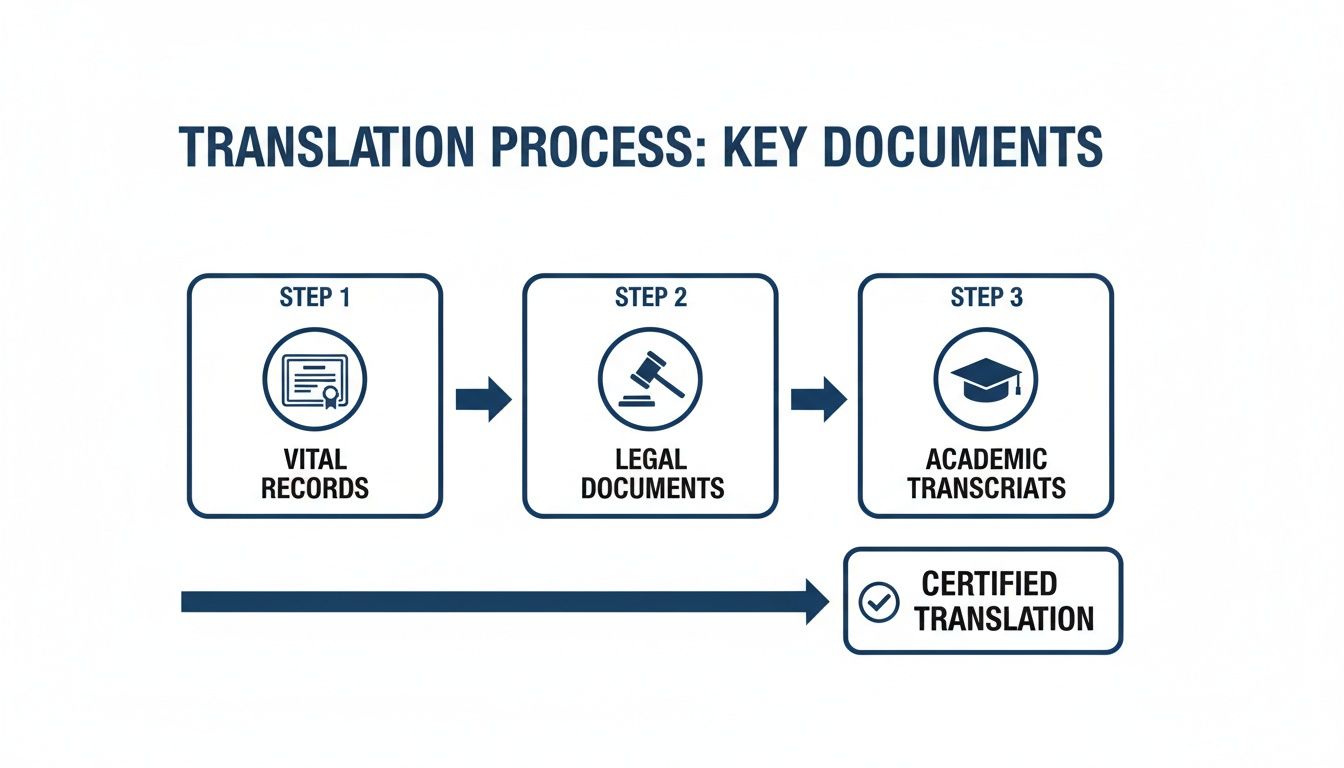
This flowchart neatly shows how all kinds of documents—from birth certificates to legal papers and academic records—all funnel into the same certified translation process. It's a critical step for almost every part of an immigration case.
Step 1: Prepare Your Documents for Translation
First, Maria needs to get her original documents ready. The quality of her scans is everything here. A blurry or cut-off image can easily lead to mistakes, which is a huge red flag for a USCIS officer.
Here’s her simple checklist for getting perfect copies:
- Use a Flatbed Scanner: This is the best way to get a clear, flat image. A quick trip to a local library or office supply store usually does the trick.
- Scan in Color and High Resolution: She needs to scan both the front and the back of every page, even if the back looks empty. An important stamp or watermark could be hiding there.
- Double-Check for Legibility: Before saving, Maria zooms in on the file. She makes sure every word, date, stamp, and signature is crisp and easy to read.
Getting this step right is the foundation for a hassle-free process. Clear documents mean the translator can work quickly and accurately.
Step 2: Find a Reputable Translation Service
With her crystal-clear scans ready, Maria's next move is finding a professional translation service she can trust. She knows she can't ask her bilingual cousin—USCIS requires a formal certification from an impartial, professional source.
Her search focuses on companies that specialize in immigration translations. She looks for these key signs of quality:
- USCIS Acceptance Guarantee: This is non-negotiable. A reputable company will stand behind their work and guarantee their translations meet all USCIS rules.
- Clear Pricing: Maria steers clear of any service with fuzzy pricing. A transparent, per-page rate means she knows exactly what she's paying for.
- Solid Customer Reviews: She specifically looks for reviews from others who used the service for immigration. Their experiences are the best indicator of what she can expect.
Step 3: Get a Secure Quote and Place Your Order
Maria finds a service with an instant online quote system. She uploads her high-quality PDF scans through their secure portal. The system instantly counts the pages and gives her a clear, upfront price.
She confirms her order, feeling confident that her personal documents are in safe hands. Any professional service will use encrypted platforms to protect client confidentiality.
Step 4: The Translation and Certification Process
Once Maria's order is in, the real work begins. Her project is assigned to a professional translator who is a native speaker of both Spanish and English and has deep experience with official documents like hers.
The translator meticulously recreates every element of her documents in English. This is a word-for-word, mirror-image translation that includes all stamps, seals, and even handwritten notes.
After the translation is done, a second linguist proofreads it. Finally, the service drafts and signs the all-important Certificate of Translation Accuracy. This document, which you can learn more about in our guide to the specific USCIS translation requirements, is what makes the translation official.
Step 5: Review Your Final Translation Package
In less than 24 hours, an email lands in Maria's inbox. Her completed translation package is ready. She downloads the files to give everything one final look-over.
The final package contains three key parts, all organized neatly:
- A copy of her original Spanish documents.
- The complete, word-for-word English translations.
- The signed Certificate of Translation Accuracy on official company letterhead.
Everything is formatted perfectly and ready to go. By following these clear steps, Maria has turned what could have been a confusing chore into a simple, checked-off item on her immigration to-do list.
Common Mistakes That Can Derail Your Application
One small mistake on a translated document can create a massive headache, leading to months of delays or even an outright denial of your immigration case. The good news? These errors are almost always preventable. Once you know what to watch for, you can make sure your application sails through the review process.
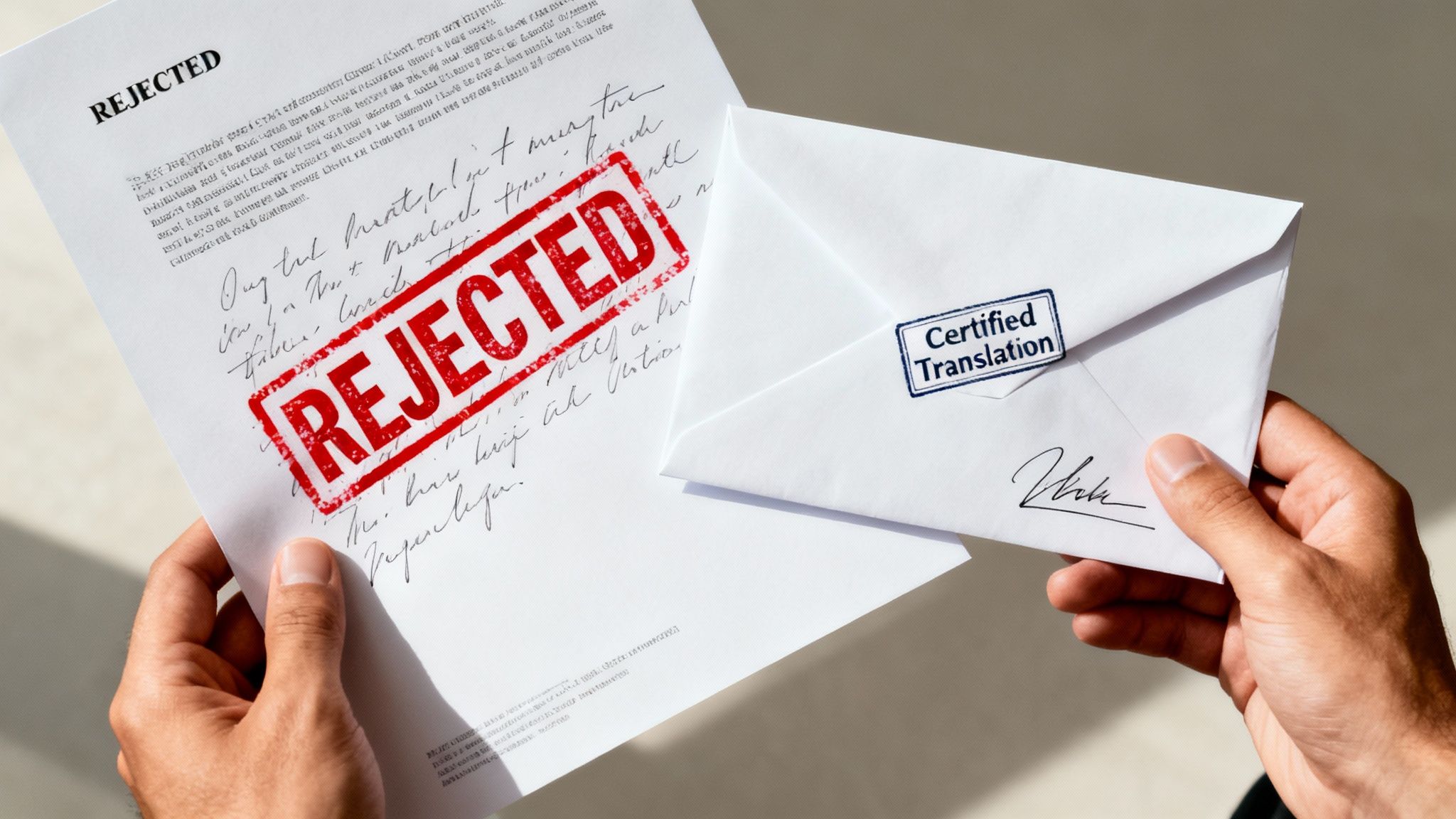
Let's walk through the most common missteps we see and, more importantly, how you can sidestep them completely.
Relying on a Friend or Family Member
It’s tempting to ask a bilingual friend or family member to handle your translation. It seems like a simple way to save money, right? Unfortunately, this is one of the biggest—and most common—mistakes you can make.
USCIS needs the translation to be certified by an impartial third party. Someone with a personal connection to your case, like your spouse or parent, creates a conflict of interest.
Imagine this real-world scenario: Ahmed was applying for a Green Card through marriage. He had his cousin, fluent in Arabic and English, translate his birth certificate. While the translation itself was perfect, USCIS flagged it immediately. The certifier—his cousin—had the same last name. This triggered a Request for Evidence (RFE), stalling his application for three long months until he got a new translation from a professional service.
The Takeaway: Always use a professional, impartial translator or a reputable translation agency. It completely removes any doubt about objectivity and proves you're meeting the formal standards USCIS expects.
Submitting a Summary Instead of a Full Translation
Some people assume that as long as the key information is there—names, dates, places—a summary of the document is good enough. This is a critical error. The USCIS regulations are crystal clear: you must provide a complete, word-for-word translation of the entire document.
This includes every last detail on the page:
- Stamps and Seals: Any official markings must be described (e.g., "[Seal of the Civil Registry]").
- Signatures: Even scribbled signatures need to be noted (e.g., "[Signature]").
- Marginalia: Those handwritten notes in the margins? They have to be translated, too.
- Illegible Text: If a part of the original document is unreadable, the translator should mark it as "[Illegible]".
Skipping these details can make an officer question your document's authenticity. A complete translation shows you have nothing to hide. To see how a professional service handles this, you can learn more about our certified translation services.
Confusing Certification with Notarization
This one trips up a lot of people. A certified translation is about accuracy. It's a guarantee from the translator that they are fluent in both languages and that the translation is a true and correct copy of the original.
A notarized translation, on the other hand, is only about identity. A notary public simply verifies the identity of the person who signed the certification statement. They aren't checking the translation itself.
For immigration, USCIS almost always requires certification. Notarization is rarely needed and adds no real value to your filing. Paying for a notary stamp is usually just an unnecessary expense. If you're trying to budget, our pricing information provides a clear breakdown of what you actually need.
Forgetting the Certification Statement
Simply handing over the translated text isn't enough. Every certified translation must come with a formal Certificate of Translation Accuracy. Forgetting to include it is like turning in an unsigned contract—it makes the document invalid.
This statement must confirm the translator's competence and formally attest that the translation is complete and accurate. Any professional agency will automatically include this. For a closer look at what this certificate must contain, check out our guide on USCIS and immigration translation.
A Quick Do's and Don'ts Checklist
To keep your application on the right track, run through this simple checklist before you submit anything.
| Do's ✔️ | Don'ts ❌ |
|---|---|
| Do use a professional, impartial translation service. | Don't ask a friend or family member to do it. |
| Do make sure the translation is a complete, word-for-word copy. | Don't submit a summary or leave out details like stamps and seals. |
| Do confirm a signed Certificate of Translation Accuracy is included. | Don't send the translation without the formal certification statement. |
| Do provide clear, high-quality scans of your original documents. | Don't upload blurry or incomplete copies that are difficult to read. |
When the Stakes Are Highest: Asylum and Academic Translations
While every piece of paper in an immigration file matters, some documents carry a much heavier weight. For asylum claims and academic applications, the quality of a certified translation can literally make or break your case. This isn't just about ticking a box; it's about navigating high-stakes situations where futures, careers, and even personal safety hang in the balance.
In these critical fields, a standard translation just won't cut it. You need a translator who is also a subject-matter expert—someone fluent in the specific legal, medical, or academic language of your documents. A tiny error or a poorly chosen word can warp the meaning of crucial evidence and lead to devastating outcomes.
The Lifeline of Translation in Asylum Cases
For someone seeking asylum, translated documents are often the core of their entire case. They are the tangible proof of a person's story. We're not talking about simple birth certificates here; these are complex, often harrowing documents that need to convey a narrative with unwavering clarity and accuracy.
Common documents in asylum cases include:
- Police Reports: A precise translation is essential to establish a pattern of threats or official persecution.
- Medical Records: These are critical for documenting physical injuries or psychological trauma directly linked to the events in the claim.
- Personal Affidavits: The applicant’s own sworn testimony must be translated with incredible nuance to preserve its credibility and emotional impact.
- News Articles: Translated media reports can provide independent, third-party corroboration of the dangerous conditions in the applicant's home country.
The human cost in asylum translation is immense. Asylum and humanitarian-based immigration cases are among the fastest-growing areas needing certified translations, with application volumes soaring. If the translations don't meet the strict USCIS standards, this vital evidence is inadmissible and won't even be considered. You can discover more insights about these immigration trends and what they mean for translation services.
Accuracy is Everything in Academic and Professional Translations
In the world of academia, precision is just as non-negotiable. When you're applying to a U.S. university or seeking a professional license, your foreign credentials must be evaluated by an agency like World Education Services (WES). These evaluators depend entirely on the certified translation to understand and assess your educational history.
Even a seemingly minor mistake can have a major ripple effect. A mistranslated course title could make it appear you’re missing a prerequisite for that engineering program you’re eyeing. A simple misunderstanding of a foreign grading system could incorrectly lower your GPA, damaging your chances for admission or a much-needed scholarship.
Beyond transcripts, you'll need perfectly crafted supporting documents for college, grad school, or scholarship applications. For help on that front, check out these tips for writing academic personal statements.
Whether your path is through asylum, academia, or professional licensing, using a service with specialized translators isn't a luxury—it’s a necessity. These experts ensure your documents are not just translated word-for-word, but are also contextually and culturally accurate, giving your application the best possible chance of success.
Your Questions About Certified Translations Answered
Navigating the world of immigration paperwork can feel like learning a whole new language, full of confusing terms and high-stakes questions. In this final section, we’ll tackle the most common questions we hear about certified translations, giving you clear, direct answers to help you move forward with confidence.
Certified vs. Notarized: What Is the Difference?
It’s incredibly easy to mix these two up, but they serve completely different purposes. Getting this right from the start can save you from unnecessary costs and frustrating delays in your immigration journey.
A certified translation is all about accuracy. It's a translation that comes with a signed statement—a "Certificate of Translation Accuracy"—from the translator or translation company. This statement is their professional guarantee that the English version is a complete and true reflection of the original document.
A notarized translation, on the other hand, is all about identity. A notary public doesn't read or verify the translation itself. Their only job is to watch the translator sign the certification statement and officially verify that the person signing is who they claim to be.
For nearly every immigration filing, USCIS requires a certified translation. The extra step of notarization is almost never needed for your application package.
How Much Does a Certified Translation Cost?
The cost of a certified translation for immigration isn't a mystery. Most professional services use a simple, transparent pricing model, usually a flat rate per page, which typically covers up to 250 words.
A few things can influence the final price:
- Document Length: A standard one-page document like a birth certificate or driver's license is straightforward. Longer documents, like detailed academic transcripts or multi-page legal contracts, will naturally cost more.
- Language Complexity: Translations from less common languages might have a slightly higher rate due to the specialized expertise required.
- Turnaround Time: Standard delivery for short documents is often within 24 hours. If you're in a real time-crunch, expedited or rush services are usually available for an extra fee.
You should always look for a service that gives you an instant, upfront quote with no hidden fees. You can explore our clear pricing and turnaround time to get a precise cost for your specific documents.
Can I Translate My Own Documents?
This is one we hear all the time, and the answer is a firm and simple no. Even if you are perfectly fluent in both English and the original language, you cannot translate your own documents for a USCIS application.
USCIS rules require the certification to come from a neutral, impartial third party. This is to ensure objectivity and avoid any conflict of interest. Since you have a personal stake in the outcome of your application, a translation you provide for yourself could be seen as biased.
Key Takeaway: The certification must come from someone else—a professional translator or a reputable agency—who can objectively vouch for the translation's accuracy without being personally involved in your case.
What Happens If USCIS Rejects My Translation?
Submitting a translation that doesn't meet USCIS standards can throw a serious wrench in your immigration case, leading to frustrating and often costly setbacks. The stakes are simply too high to risk it.
If an immigration officer finds a problem with your translation, one of two things will likely happen:
- Request for Evidence (RFE): This is the most common outcome. USCIS will send you a formal notice demanding that you resubmit the document with a proper certified translation. An RFE slams the brakes on your case, adding weeks or even months to your processing time.
- Application Denial: In more serious situations, especially if the bad translation is for a critical piece of evidence, USCIS could deny your application outright. This is a worst-case scenario that could force you to start the entire process over from scratch.
This is exactly why choosing a professional service that offers a USCIS acceptance guarantee is so important. It’s the safest path to ensuring your documents meet every requirement and your application keeps moving forward. For a deeper dive into compliance, check out our guide to USCIS and immigration translation.
At TranslateDay, we specialize in providing fast, accurate, and USCIS-guaranteed certified translations. Our expert team understands these requirements and knows how critical it is to get every detail right for your case.


