
When you're preparing for immigration, applying to a university abroad, or handling legal matters, you can't just run your birth certificate through a free online tool. Official bodies require something more: a translation that is legally valid and guaranteed to be accurate. This is where online document translation services come in. They act as the official bridge between languages for your most important documents, ensuring that authorities like U.S. Citizenship and Immigration Services (USCIS) will accept them without issue.
Your Guide to Online Document Translation
Think of online document translation services as on-demand specialists who make your critical paperwork valid and understandable in another country. Imagine you're rushing to meet a USCIS deadline for your Green Card application. Instead of the old-school hassle of finding a local translator and setting up appointments, you can simply upload a photo of your documents from your phone and have a certified translation back in as little as 24 hours.
This convenience is a game-changer when you're facing deadlines for legal cases, academic admissions, or immigration. For example, when you're preparing a citizenship case for USCIS, every single one of your foreign-language documents—from a marriage certificate to a police record—must be submitted with a complete, word-for-word English translation. The translation must also be "certified," which is a formal guarantee of its accuracy.
More Than Just Words
Professional translation services do far more than just swap out words. They create a translated document that is a perfect mirror of the original, maintaining its exact meaning, layout, and legal weight. This is all done by experienced human translators who understand the strict standards of organizations like USCIS.
The most critical part of this service is the certified translation. This isn't just a translated document; it's the translated text plus a formal, signed statement from the translator or the company. This statement, often called a "Certificate of Translation Accuracy," is a professional guarantee that the translation is complete and accurate.
This certificate is the seal of approval that official bodies require. It signals that the translation is trustworthy, helping you avoid the frustrating delays or outright rejections that can derail your immigration case or academic application. For anyone dealing with high-stakes paperwork, that peace of mind is priceless.
Who Needs These Services?
The need for accurate, official translations pops up in all sorts of important life events. Online providers are set up to handle a massive variety of documents for these exact situations.
Here are a few real-world scenarios:
- Immigration: Translating birth certificates, marriage licenses, and divorce decrees for USCIS green card and visa applications.
- Academic: Getting foreign high school or university transcripts and diplomas translated accurately for U.S. admissions offices.
- Legal: Preparing translated contracts, witness statements, or court documents for legal cases in another language.
- Medical: Making sure medical records or doctor’s reports are understood by healthcare providers or insurers in another country.
Using a dedicated online certified translation service means your documents will meet the necessary official standards. Knowing the pricing and turnaround times upfront helps you plan, turning a complex requirement into a straightforward, manageable task.
The Critical Difference Between Certified and Standard Translations
Understanding the difference between a standard and a certified translation is like knowing when to send a text message versus a formal, signed letter. One is for casual understanding, while the other is for official situations where accuracy is legally required. Getting this wrong isn't a small mistake—it can lead to serious delays and rejections of your application.
A standard translation is all about getting the general meaning across. It’s perfect when you need to understand a business email from an international colleague or read a news article from another country. The goal is simply comprehension.
A certified translation, on the other hand, is a legally valid document. It comes with a "Certificate of Translation Accuracy," which is a signed statement from the translator or translation company swearing that the translation is a complete and exact match to the original.
This certificate is the key that unlocks acceptance by official bodies. For an agency like U.S. Citizenship and Immigration Services (USCIS), it's not just a recommendation; it's a mandatory requirement.
When Is a Certified Translation Required?
You will absolutely need a certified translation anytime you're submitting documents to an official entity that demands legal validity.
Let's imagine you're applying for a U.S. visa and have a birth certificate from your home country written in Mandarin. You can't just type up an English version yourself and send it in. USCIS will reject it immediately. You need that certified translation to prove the English version is a true and faithful copy of the original.
This requirement is common in many scenarios:
- Immigration: Submitting vital records like birth certificates, marriage licenses, divorce decrees, or police records to USCIS.
- Academic Applications: Providing foreign academic transcripts, diplomas, and degree certificates to universities and credential evaluation services.
- Legal Proceedings: Presenting evidence like contracts, affidavits, or witness statements in a court of law.
- Medical and Insurance: Submitting patient records or medical reports to doctors or for insurance claims.
This flowchart shows the essential journey a document takes from its original form to getting the green light from an official body like USCIS.
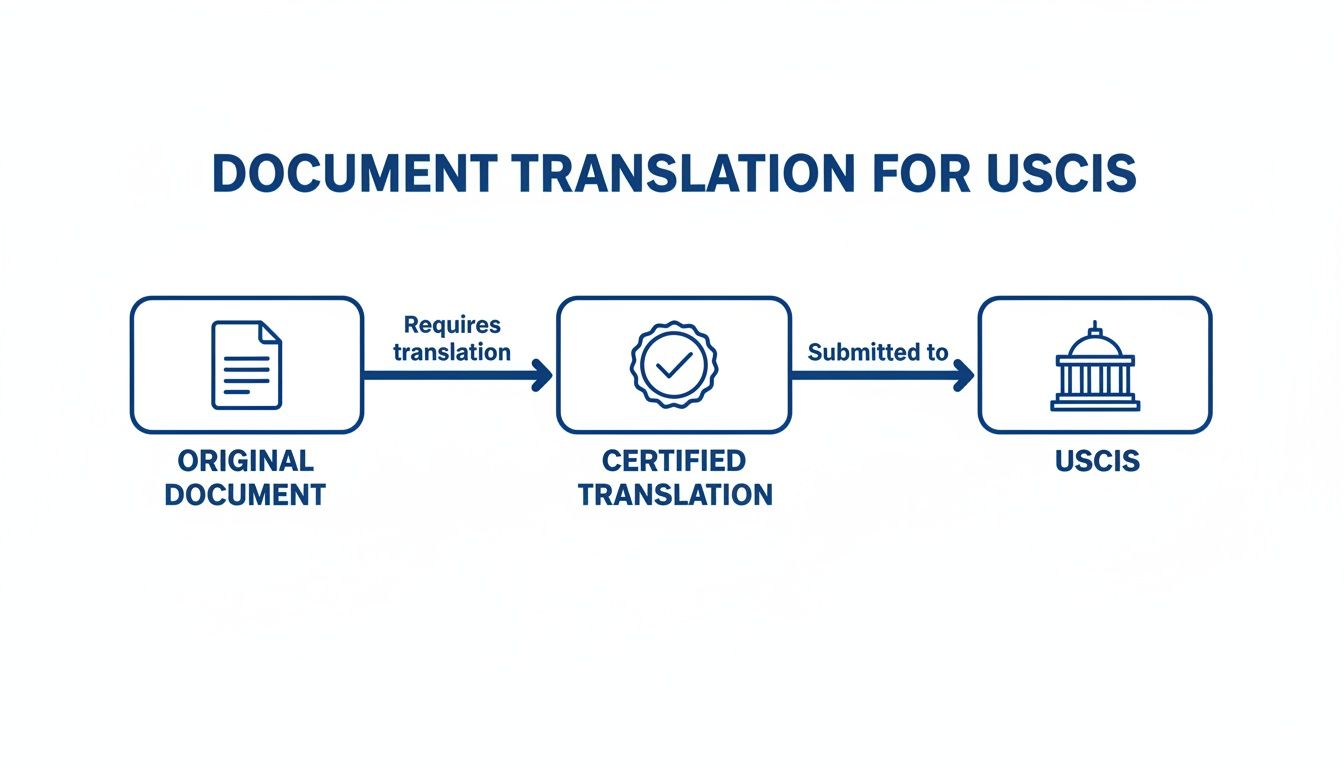
As you can see, the certification step is a mandatory checkpoint. It's what assures officials that your document meets their strict standards for review and acceptance.
Clarifying Related Terms
While looking for online document translation services, you'll probably encounter terms like "sworn" or "notarized" translations. They sound similar to "certified," but they each have distinct meanings and are used for different purposes.
A sworn translation is performed by a translator who has been officially appointed by their government to provide legally binding translations. This is a common requirement in many European and South American countries but is not a standard practice in the United States.
A notarized translation adds another layer of formal verification. A Notary Public simply watches the translator sign the Certificate of Accuracy, confirming the signer's identity with a notary stamp. It’s important to understand that the notary does not check the quality of the translation itself, only that the signature is legitimate. Some institutions might ask for this extra step on certain legal papers, but for USCIS, it's generally not required.
For a deeper look into what goes into an official certification, feel free to check out our detailed guide on what is a certified translation.
To make things even clearer, here's a quick comparison to help you choose the right service for your needs.
Certified Translation vs Standard Translation At a Glance
This table breaks down the core differences, helping you pinpoint exactly what kind of translation your document requires.
| Feature | Certified Translation | Standard Translation |
|---|---|---|
| Primary Goal | Legal and official accuracy | General understanding |
| Key Component | Certificate of Translation Accuracy | The translated text itself |
| Best For | USCIS, universities, courts, government | Internal emails, personal letters, articles |
| Official Acceptance | Required by most official institutions | Not accepted for official purposes |
| Accountability | Legally accountable for accuracy | No legal accountability |
Ultimately, it all boils down to your document's purpose. If it's headed for any kind of official, legal, academic, or governmental review, a certified translation isn't just an option—it's a necessity.
Your Step-by-Step Guide to the Translation Process
Getting a document translated online might feel like a big undertaking, but modern services have made the process surprisingly straightforward. The system is designed for simplicity and speed, breaking down a potentially stressful task into just a few manageable steps. You are in control the entire time, from uploading your document to receiving the finished, certified translation.
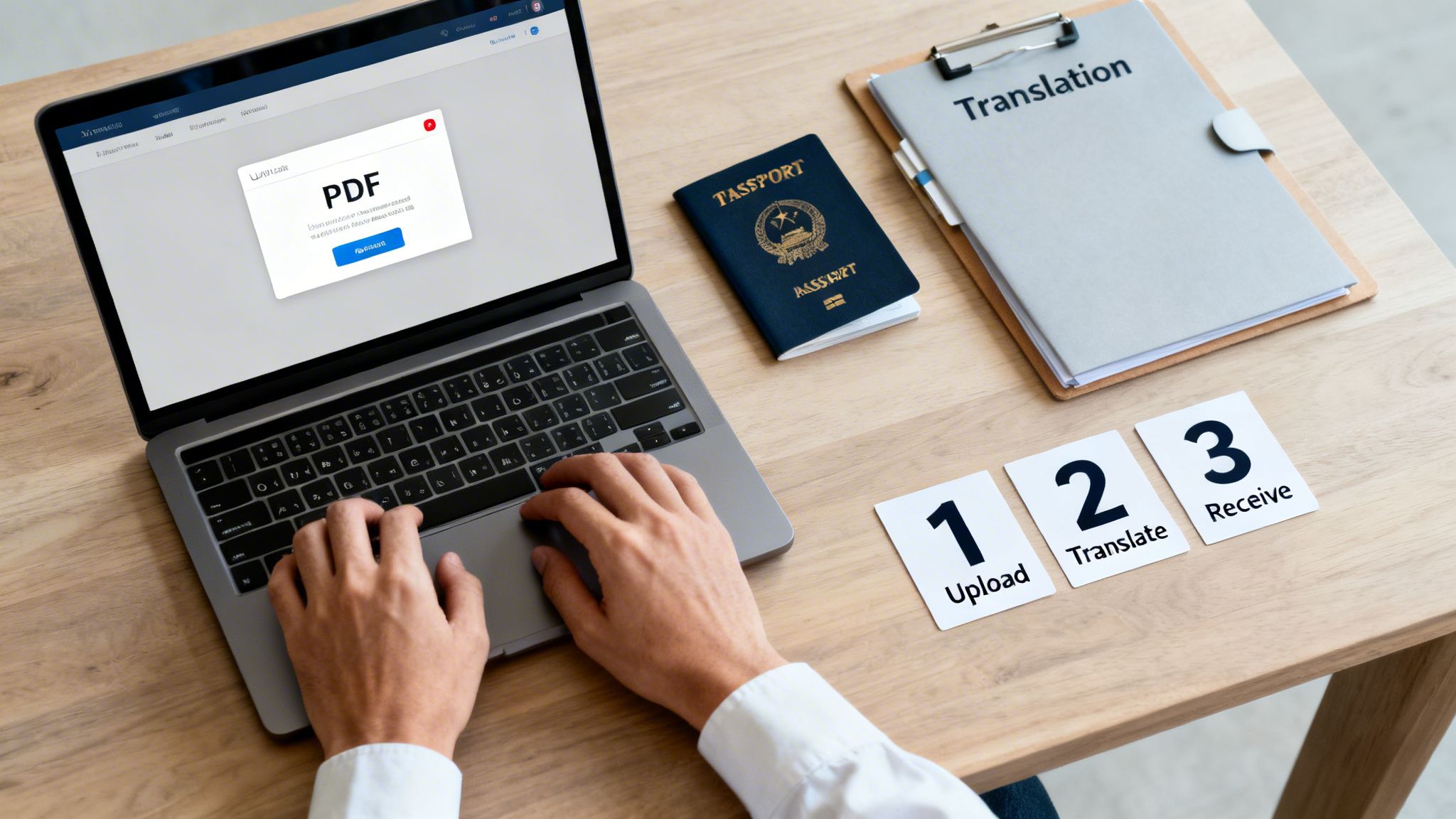
This simple workflow is a direct response to a world that's more connected than ever. With people and businesses crossing borders constantly, the demand for quick and trustworthy translations has skyrocketed. The market for certified translations is set to keep climbing through 2026, a trend you can read more about by exploring the size of the translation industry on blog.pangeanic.com.
Step 1: Upload Your Document
The process begins the moment you upload your document. You don't need a professional scanner; a clear photo from your phone or a basic scan is all it takes to get started.
For the best results, follow this simple checklist:
- Use common file types: Most services accept standard formats like PDF, JPG, PNG, and DOCX.
- Clarity is essential: Make sure the entire document is visible. Check for blurry text, shadows, or cut-off corners. Every single stamp, signature, and detail must be perfectly readable.
- Keep multi-page documents together: If your document has multiple pages, like a bank statement or an academic transcript, combine them into a single file (like a multi-page PDF). This prevents any mix-ups.
After you've uploaded the file and selected your languages (e.g., Spanish to English), you'll get an instant quote. This means you can see the final cost and turnaround time right away, with no obligation to move forward until you're ready.
Step 2: The Translation Stage
Once you confirm your order, your document is assigned to a real person—a professional, certified human translator. This is a critical point. Automated tools like Google Translate cannot handle the nuance, legal precision, or specific formatting required for official documents.
The translator gets to work, meticulously creating a word-for-word translation. Their job is to ensure nothing is added, removed, or misinterpreted. They also replicate the original layout exactly, right down to the placement of stamps, seals, and signatures. For agencies like USCIS, this mirror-image formatting is non-negotiable as it allows officials to easily compare the translation to the original.
Expert Insight: A professional translator isn't just swapping words. They are cultural and legal interpreters, ensuring the tone, context, and official terminology are perfectly adapted for the target language and its specific standards. This preserves the document's integrity.
Step 3: Receive Your Certified Translation
The final step is receiving your completed translation. For most standard documents (1-3 pages), you can expect a digital PDF copy in your email within 24 hours. This file is ready to be printed and submitted with your application.
Your final package will contain two crucial components:
- The Translated Document: A precise, formatted translation of your original.
- The Certificate of Translation Accuracy: A formal statement on company letterhead, signed by the translator or a company representative, that vouches for the translation's accuracy and completeness. This is the part that satisfies USCIS and other legal purposes.
That certified digital document is often all you need. With it in your inbox, you can move ahead with your application, knowing your paperwork is in perfect order.
Ready to get started? You can request a certified translation right now.
Meeting Official Requirements for USCIS and Other Institutions
Dealing with a major government agency like U.S. Citizenship and Immigration Services (USCIS) can be a nerve-wracking experience. One small mistake on your paperwork can bring everything to a halt, causing frustrating delays or even an outright rejection. This is precisely why a compliant, professionally certified translation isn't just a good idea—it's one of the most vital parts of your application.
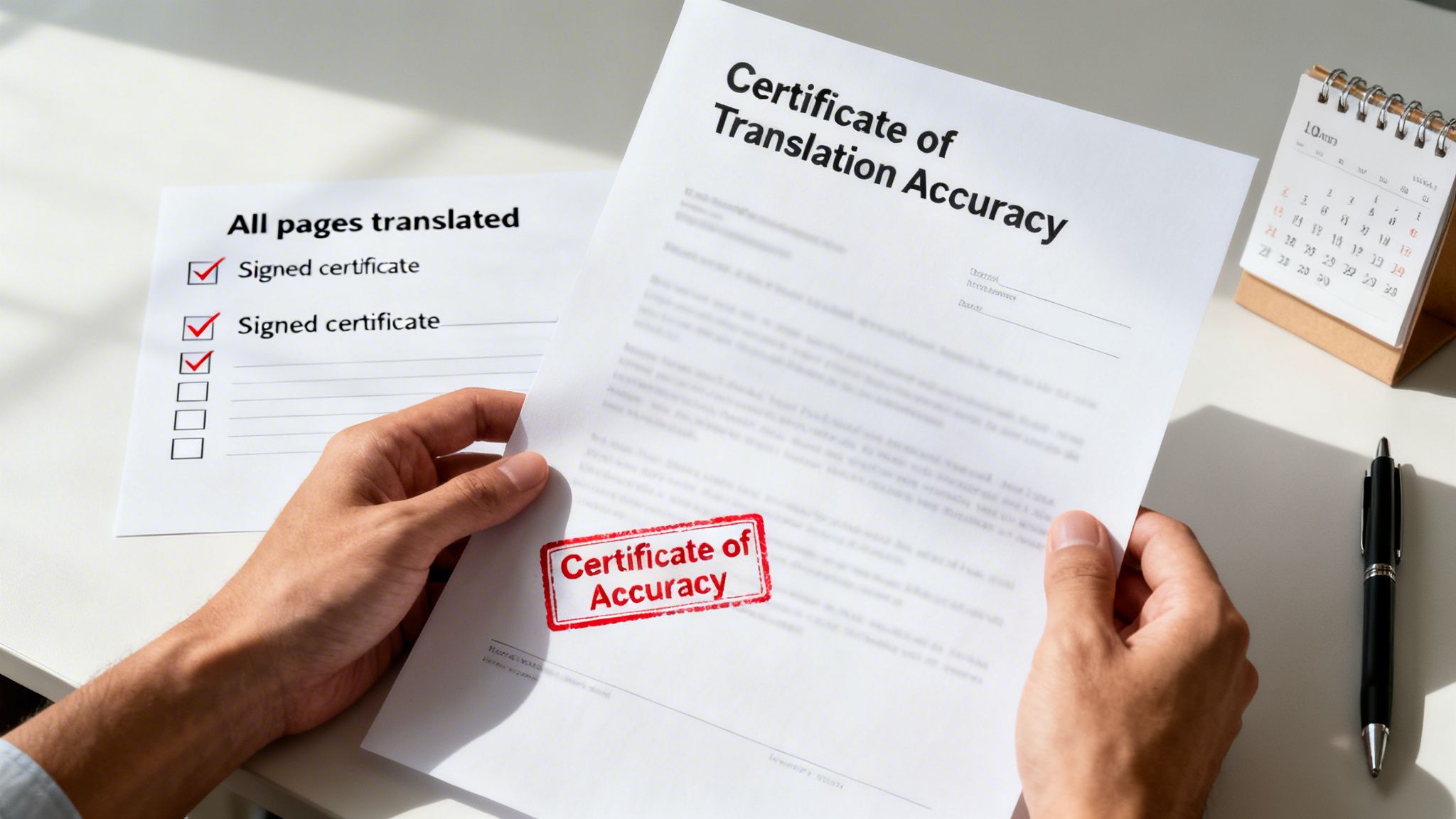
The rules are strict, but they are also very clear. USCIS requires that any document not in English must be submitted with a complete, word-for-word English translation. In addition, the translator must certify that the translation is both complete and accurate, and this statement must include their name, signature, address, and the date.
Maria’s Green Card Application: A Real-World Example
Let's walk through a common scenario. Maria was applying for a Green Card through her spouse, a U.S. citizen. She needed her birth and marriage certificates, both originally in Spanish, translated for her application. She knew that a sloppy or incorrect translation could trigger a dreaded Request for Evidence (RFE), which would put her entire case on hold.
An RFE is USCIS's way of pausing your application because they need more information. It stops the clock on your case until you provide the correct documents, often adding months to an already long wait. Maria wanted to avoid that at all costs.
Instead of trying to translate the documents herself or using a cheap, unverified service, she found a professional online provider that guaranteed USCIS acceptance. Here’s what the process looked like:
- She uploaded clear photos of her original certificates.
- A certified translator meticulously translated every single word—including all stamps, seals, and handwritten notes.
- She received two key documents: the full English translation formatted just like the original, and a signed Certificate of Translation Accuracy.
Maria submitted her original Spanish documents right alongside the certified English translations in her application package. Because everything was done correctly from the start, her paperwork sailed through the initial review. No RFE, no delays. Her case moved forward smoothly.
The Universal Checklist for Document Acceptance
Maria's experience isn't unique to immigration. The standards she met are nearly identical to what most official bodies require, whether you're applying to a university, navigating a court case, or submitting medical records.
In fact, the global market for these services is growing, and it's projected to continue expanding through 2026. This huge demand is fueled by countless situations just like Maria's, where compliant translations are absolutely non-negotiable.
Here’s a quick checklist to ensure your translation will pass muster:
- Is it a complete translation? Every single word must be translated, from the letterhead to the fine print on seals and stamps. No summaries or omissions allowed.
- Does it include a certification statement? The translation needs a signed statement from the translator or translation company vouching for its accuracy and completeness.
- Is the translator identified? The certification must clearly state the translator’s name and contact information.
- Does it match the original format? A professional translation should mirror the layout of the source document, making it simple for an official to compare the two side-by-side.
By ticking these boxes, you can be confident that your online document translation services provider has delivered something that will meet the high standards of official institutions. For a deeper dive into immigration-specific rules, check out our guide on USCIS translation requirements.
How to Choose the Right Translation Provider
Picking the right online document translation service is a crucial decision. The success of your immigration application, university admission, or legal case can depend on the quality of your translated documents. With so many options available, it’s easy to feel overwhelmed, but knowing what to look for can help you identify a reliable partner and avoid costly mistakes.
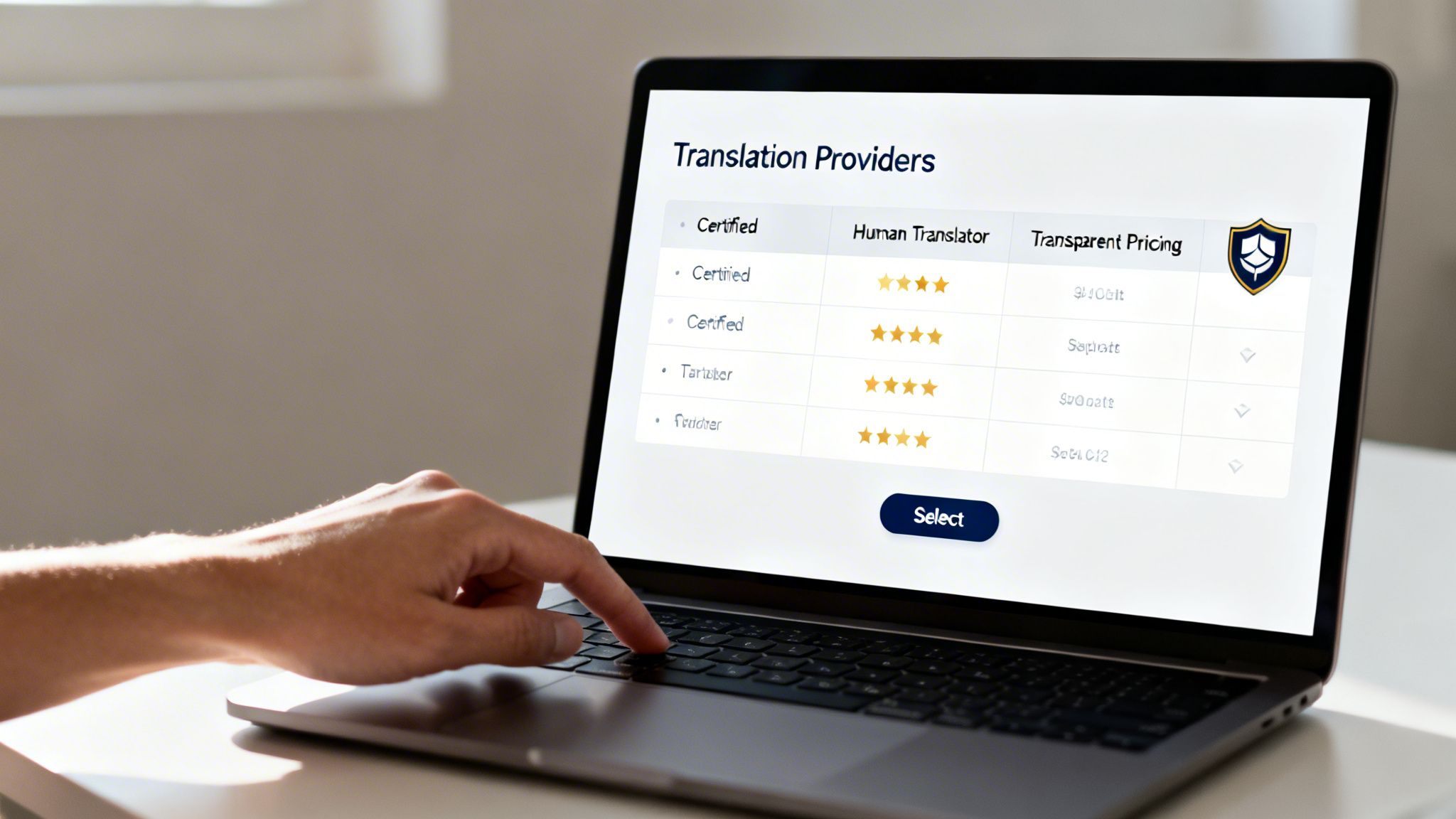
It's a choice more people are facing every day. The global translation services market is booming and is expected to continue its growth through 2026. This reflects our increasingly connected world, where certified translations are essential for everything from business contracts to immigration paperwork. You can dig deeper into the numbers in the translation services market report from researchandmarkets.com.
Your Vetting Checklist: The Must-Haves
Think of choosing a translation service like conducting an important interview. You need a partner who is professional, transparent, and capable of meeting strict official standards.
Here’s your checklist:
- USCIS Acceptance Guarantee: This is non-negotiable. The provider must clearly and confidently guarantee that their certified translations will be accepted by USCIS and other government bodies. This is their promise of compliance.
- 100% Human Translators: For any official document, machine translation is a recipe for disaster. Ensure the service uses professional human translators who are fluent in the nuances of legal, academic, and official language.
- Upfront, Transparent Pricing: You should know exactly what you're paying before you commit. Look for a clear per-page or per-word rate with no hidden fees. A reputable company has nothing to hide.
- A Rock-Solid Certification Process: The company must provide a formal Certificate of Translation Accuracy with every document. This statement must be signed and include the credentials of the translator or the company.
Red Flags to Run From
Knowing what to look for is only half the battle; you also need to know what to avoid. If a service sounds too good to be true, it almost certainly is, and the consequences can be severe.
Be cautious of any service that:
- Has Rock-Bottom Prices: An unbelievably cheap price is a major warning sign. It often means they're cutting corners by using unqualified translators, automated software, or skipping quality checks. That's a huge risk to take with your important documents.
- Is Vague About Certification: If a provider can’t give you a straight answer about their certification process or what their guarantee actually covers, walk away.
- Lacks Real, Verifiable Reviews: Look for independent reviews on sites like Trustpilot or Google. A company with no real customer feedback might be unreliable or hiding bad experiences.
- Hides Behind Jargon: A good service explains its process in plain English. If their website is a maze of confusing buzzwords, they might be trying to distract you from a subpar service.
Key Takeaway: The best providers make your choice easy. They are confident in their process, transparent about their costs, and stand behind their work with a solid guarantee. Your peace of mind is worth the effort of finding a service that checks all these boxes.
Making the right choice protects your time and money. More importantly, it ensures your official applications move forward without frustrating and costly delays. A dependable online certified translation service will give you accurate documents that meet every requirement, giving you the confidence to take your next steps.
Your Top Questions About Online Document Translation, Answered
When you're dealing with official paperwork, you want to get it right the first time. It's completely normal to have questions. Getting a certified translation online is a simple process, but understanding the details will help you move forward with confidence. Here are some plain-English answers to the questions we get asked most often.
How Long Will My Certified Translation Take?
This is usually the biggest concern, especially when you're up against a tight deadline for a USCIS application or a university submission. The good news is that for most common documents, the process is remarkably quick.
A reputable online document translation service can typically turn around a certified translation for a 1- to 3-page document like a birth certificate, marriage license, or academic transcript in about 24 hours. The entire workflow is built for speed, from getting an instant quote to receiving the final digital files. If you have a longer document, it might take more time, but you will always get a clear delivery estimate before you commit.
What’s the Real Difference Between Certified and Notarized?
These two terms sound alike but mean very different things. Knowing which one you need is crucial.
A certified translation is all about accuracy. It comes with a signed statement—a Certificate of Translation Accuracy—from the translator or company, swearing that the translation is a complete and true reflection of the original. This is the standard requirement for institutions like USCIS. You can learn more about our USCIS-compliant process for immigration documents.
A notarized translation, on the other hand, is about verifying the translator's identity. A Notary Public watches the translator sign the certificate and then stamps it, confirming the signature is legitimate. The notary does not check the translation; they only verify who signed it. This is less common and usually only requested for certain high-stakes legal documents.
The Bottom Line: For almost any immigration, academic, or medical need in the U.S., a certified translation is what you'll need. You should only get a notarized translation if the organization you're submitting to specifically asks for it.
Can I Just Translate My Own Documents for a USCIS Application?
Absolutely not. USCIS has a very strict rule on this: you cannot translate your own documents for an application, even if you're a professional translator or fluent in both languages. The translation must come from an impartial third party.
This rule exists to avoid any potential conflicts of interest or accidental bias. Submitting a document you translated yourself is a common mistake that will almost guarantee a Request for Evidence (RFE), which can delay your application by weeks or even months. Always use a professional service to ensure compliance. We cover all the details on our certified translation service page.
How Much Should I Expect to Pay for a Certified Translation?
Pricing for certified translations is usually straightforward. Most online services charge a flat, per-page rate. A "page" is typically defined as having up to 250 words.
For a single-page document like a driver's license, passport, or birth certificate, you should expect a clear, fixed fee. This price should be all-inclusive, covering:
- The translation by a professional human translator.
- The signed Certificate of Translation Accuracy.
- Digital delivery of the final documents in PDF format.
A good provider will have transparent pricing information right on their website, with no hidden fees. This way, you know exactly what you're paying for and can avoid any surprises.
At TranslateDay, we keep the process simple, fast, and 100% compliant. Get the official translations you need with guaranteed acceptance.


