
When you need to translate medical documents, it’s not just about swapping words from one language to another. This is about real-life stakes: patient safety, legal compliance, and life-changing opportunities. A single mistake in a patient's history, a lab result, or a vaccination record can have serious consequences—from a denied immigration visa for your family to a dangerous medical error.
That’s why getting a professional, certified translation isn't just a good idea; it's an absolute must-have for any official use. Whether you're preparing paperwork for immigration, an academic application, or a legal case, understanding the process is the first step toward getting it right.
Why You Can’t Afford a Mistake in Medical Translation
When your health is on the line, every detail matters. A small error in a medical document can quickly turn into a major problem, affecting everything from an insurance claim to a person's ongoing medical care. The stakes are simply too high.
Imagine a family in the middle of their Green Card application. They submit their child's immunization records, but a minor mistranslation of a vaccine name triggers a Request for Evidence (RFE) from USCIS. Suddenly, their entire case is delayed, causing incredible stress and uncertainty. In a hospital, the risk is even more direct. A mistranslated prescription could lead to the wrong dosage, while a flawed patient history might cause a doctor to make a dangerous misdiagnosis. These real-world scenarios show why precision is critical.
Patient Safety and Getting Continuous Care
In a world where people travel and move more than ever, accurate medical translations are the foundation of patient safety. When someone needs care in a new country or sees a specialist who speaks a different language, their medical records must be perfectly clear.
- Getting the Right Diagnosis: Doctors rely on past medical histories, lab reports, and imaging results to understand a patient's condition. Any error in these documents can send them down the wrong path.
- Ensuring Proper Treatment: Details about allergies, pre-existing conditions, and current medications must be translated perfectly to prevent dangerous drug interactions or incorrect treatments.
- True Informed Consent: A patient cannot truly agree to a medical procedure if they don't fully understand the consent form. A poor translation can create serious legal and ethical problems.
Ultimately, the goal of translating medical documents is to ensure language is never a barrier to receiving safe, effective, and continuous care, no matter where someone is in the world.
Meeting Legal and Immigration Standards
For official organizations like USCIS (United States Citizenship and Immigration Services) or the courts, accuracy isn’t just a preference—it’s a strict requirement. These institutions demand certified translations to verify that the documents are authentic, complete, and professionally handled. A certified translation is a document translated by a professional who then attaches a signed statement, or "certificate of accuracy," attesting to its correctness and completeness. A quick translation from a friend or a free online tool will be rejected immediately. You can learn more about the unique challenges in this field in our guide on translating complex medical terms.
For example, in a personal injury lawsuit, the translated medical reports from doctors are crucial evidence. Any hint of an error could undermine the entire case. The same is true for USCIS, which relies on certified translations of medical exam reports for visa and Green Card applications. They need 100% certainty that the information is correct before making a decision that will shape a person's entire future.
Key Medical Documents Requiring Certified Translation
When you’re dealing with official processes, the amount of paperwork can feel overwhelming. Figuring out which of your medical documents need a formal, certified translation is a key step, and getting it right can save you from major headaches and delays.
The documents you'll need depend entirely on why you need them. What USCIS asks for is often different from what an insurance company or a foreign university will require. Let's walk through the most common situations so you know exactly what to prepare.
Documents for Immigration and USCIS
If you're applying for a U.S. visa, Green Card, or citizenship, medical records are a mandatory part of your application. USCIS is famously strict: any document not in English must be submitted with a complete and certified translation.
Here are the most common documents required:
- Vaccination Records: This is your proof that you meet U.S. public health standards. A certified translation is critical to ensure every vaccine name and date is perfectly understood.
- Medical Examination Reports: While the main I-693 form is in English, any supporting notes or records from your doctors in your home country must be translated. This could include details about a chronic condition or records of past surgeries.
- Doctor's Letters: If you have a specific medical condition that needs to be explained, a letter from your physician is your best tool. A professional translation makes that information credible and clear to the immigration officer reviewing your case.
A common mistake is submitting a partial translation. For USCIS, everything on the page must be translated—stamps, seals, signatures, and even handwritten notes. Missing these details is a fast way to get a Request for Evidence (RFE), which can stall your application for months.
Translations for Insurance and Legal Needs
It's not just about immigration. Certified translations are essential in other high-stakes situations. If you needed medical care while traveling and want to file a claim with your insurance provider back home, they need to know exactly what services you received.
The same goes for legal proceedings, where medical records are often the foundation of a personal injury or malpractice case.
- For Insurance Claims: You'll almost certainly need to translate hospital bills, treatment summaries, and diagnostic reports (like MRI or lab results). Without a clear, certified translation, your claim will likely get stuck or be denied.
- For Legal Cases: The accuracy must be perfect. Physician’s notes, detailed expert witness reports, and extensive medical histories must be translated flawlessly to be accepted in court.
Even documents from UK online doctor consultation services can become official records in these situations, and they’ll need the same level of professional translation if they're not in the required language.
Academic and Professional Licensing Requirements
Are you a student enrolling in a foreign university or a professional seeking a license to practice abroad? Your medical history is often part of your application package.
- University Admissions: International students are frequently asked for translated immunization records or a general health certificate from their doctor. This is similar to providing an academic transcript, where every detail must be accurate for admission.
- Professional Licensing: This is especially true for medical professionals. Doctors, nurses, and other specialists looking to work in a new country must provide their entire medical history, mental health evaluations, and certificates of good health—all professionally translated.
To get a better sense of what these different documents might be and when they're needed, here’s a quick-reference table.
Common Medical Documents and When You Need Them Translated
This table breaks down the most frequently requested documents and the scenarios where a certified translation is typically mandatory.
| Document Type | Commonly Required For | Key Considerations |
|---|---|---|
| Vaccination/Immunization Records | Immigration (USCIS), university enrollment, some employment | Must be a complete, word-for-word translation. Vaccine names can vary by country, so accuracy is critical. |
| Medical Examination Reports | Green Card applications (I-693), certain visa types, professional licensing | The official form may be in English, but all supporting documents from your home country must be translated. |
| Hospital Records (Discharge Summaries, Bills) | Insurance claims, legal cases (personal injury), visa applications requiring proof of medical treatment | The translation must include all line items, codes, and physician notes to be accepted by insurers or courts. |
| Doctor's Letters & Prescriptions | Immigration (to explain a condition), insurance pre-authorizations, traveling with medication | Provides crucial context. The translation needs to be clear and use accurate medical terminology. |
| Lab Results & Diagnostic Reports (X-rays, MRIs) | Second opinions from foreign doctors, insurance claims, legal proceedings | Every value, note, and conclusion must be translated perfectly to avoid misinterpretation. |
Knowing which documents to prepare ahead of time makes the entire process feel much more manageable.
To see exactly what a finished, properly formatted document looks like, take a look at this certified translation example. It’s a great way to ensure the service you choose provides a final product that meets all official requirements.
How to Get Your Medical Documents Translated Correctly
Getting a medical document translated can feel like a high-stakes task, especially when you’re on a tight deadline for a USCIS application or an insurance claim. The stress often comes from not knowing where to start. But the process can be simple and straightforward if you follow a logical workflow.
Let's walk through the practical steps to take you from a stack of papers to a perfect certified translation, with no surprises along the way.
Prepping Your Documents for a Flawless Translation
This is the most important step, and it happens before you even contact a translator. The quality of your final translation is directly linked to the quality of the documents you provide. A few minutes of prep work can save you days of back-and-forth later.
- Make Sure Everything is Crystal Clear: Are your scans high-resolution? Look for shadows, blurry spots, or text that gets cut off. If you're dealing with a doctor’s messy handwriting, try to get a typed version. If not, just make sure the scan is as readable as possible.
- Check for Missing Pages: Go through the document and confirm you have every single page. Applications have been rejected because a seemingly unimportant back page was missing. For any official submission, completeness is non-negotiable.
- Give Your Files Sensible Names: Instead of "scan_001.jpg," use a clear name like "Maria_Gomez_Vaccination_Record_Page1.pdf." This simple organization helps you and the translation team avoid mix-ups.
Choosing the Right Translation Partner
With your documents in order, it’s time to find the right people for the job. This isn't the time for general freelance sites. For medical records, you need a provider who understands what's at stake.
First, look for an explicit USCIS acceptance guarantee. This is your safety net. It means the company is confident in its work and knows the specific certification and formatting rules that government bodies require.
Next, prioritize privacy. You're sharing sensitive personal health information (PHI), so your provider must be HIPAA compliant. This is a legal standard ensuring they use secure, encrypted systems to protect your data. A trustworthy service will be transparent about its security measures.
This visual breaks down the most common reasons people need these translations.
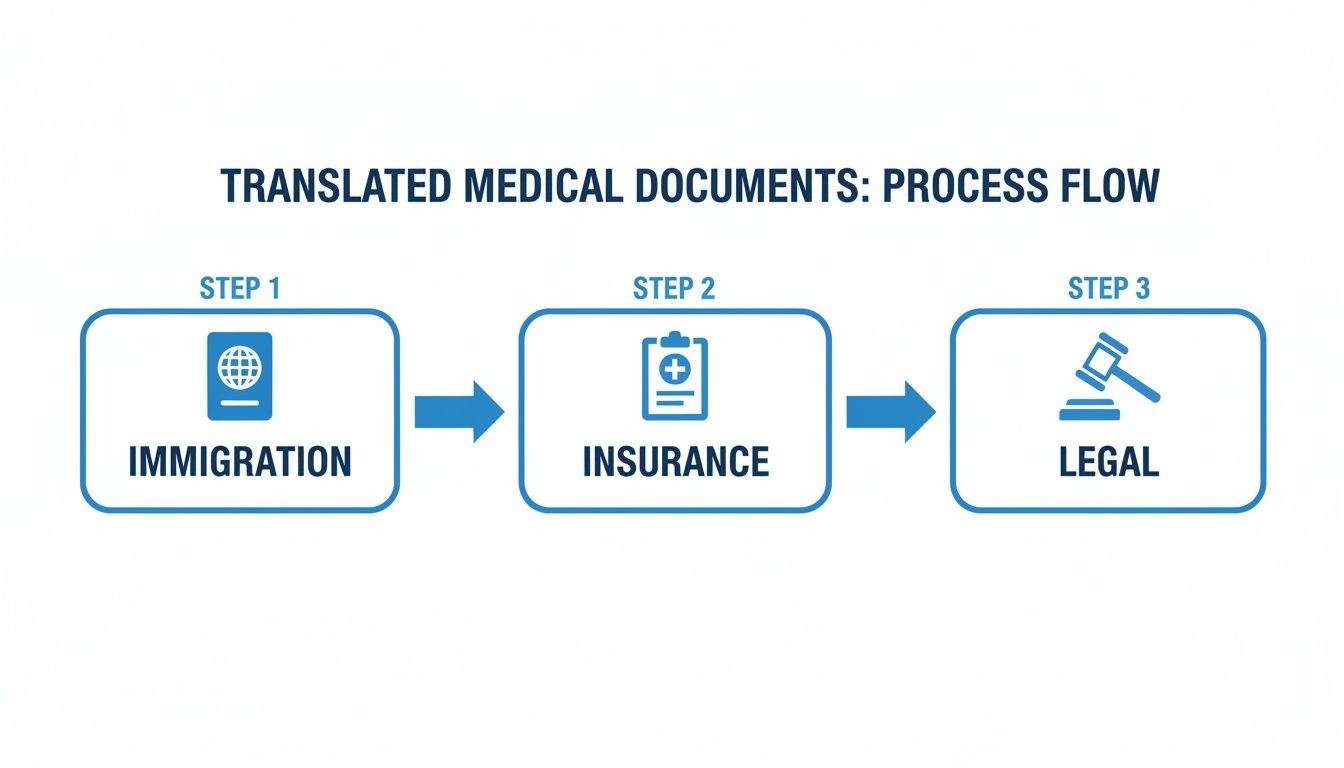
As you can see, whether it's for immigration, insurance, or legal matters, the demand for precise, compliant translations is a common thread.
The Quote and Upload: What to Expect
A professional service should make it incredibly simple to get a quote and submit your documents. If the process feels confusing, that's a red flag. Typically, you'll upload your files to a secure online portal.
You should then receive a clear, itemized quote. Here at TranslateDay, we base it on a straightforward per-page rate. This transparency is vital—it means you won't get hit with surprise fees for the certification or standard formatting. The global demand for these reliable services is growing; the medical translation market is expected to hit US$ 805.7 million by 2030. This growth shows how many people need trustworthy partners for this work. You can explore the numbers yourself in the full market report.
Reviewing the Final Product: The Certificate of Accuracy
When the work is done, you'll receive your translated documents. The most important part of the package is the Certificate of Translation Accuracy.
This isn't just a formality. It’s a signed statement from the translator or agency that formally confirms three things:
- The translation is a complete and accurate version of the original document.
- The translator is fluent in both languages.
- The translator is a qualified professional.
This signed certificate is what officially makes the translation "certified." It’s precisely what USCIS and other institutions are looking for.
A Quick Note: Certified vs. Notarized
People often confuse these terms. A certified translation focuses on accuracy. A notarized translation focuses on identity—a Notary Public simply confirms the identity of the person signing the certificate. The notary doesn't check the translation itself. For USCIS, certification is required, but a notary stamp is almost never needed.
Always double-check that this certificate is included and properly signed. To see how our process works, you can find details on our pricing and turnaround times. From there, the next step is to request a certified translation of your medical documents.
When you hand over your medical records for translation, you're trusting someone with your health story and your privacy. Any translation service worth using understands this and builds its entire process on three core principles: quality from human experts, absolute precision, and airtight confidentiality.
You simply can't get true quality from an algorithm. It has to come from a professional human translator—a subject matter expert who understands medical terminology and can navigate the complex language of healthcare.
Why Accuracy Can Be a Matter of Life and Death
In medical translation, "mostly right" isn't good enough. This is about conveying the exact medical meaning to prevent dangerous mistakes. A skilled translator knows the context, understands abbreviations, and recognizes subtle differences in medical terms that can change everything.
A devastating real-world example highlights this: the case of the Spanish word "intoxicado." A young man was rushed to a hospital, and his family told staff he was "intoxicado." They meant he felt sick from something he ate. But the hospital staff interpreted it as "intoxicated," assuming a drug overdose.
That single mistranslation caused a critical delay in treating a brain hemorrhage, which ultimately left him quadriplegic. This powerful story is a reminder of why precision isn’t just a professional standard; it can literally be a matter of life and death.
In medical translation, there's no such thing as a "minor" error. Every term, number, and note carries immense weight. The goal is a translation so precise that a doctor reading it gets the exact same understanding as if they were reading the original document.
The Human Touch vs. Machine Translation
As global R&D in complex fields like oncology and genomics continues to expand in 2026, the need for hyper-accurate scientific and medical translation is skyrocketing. While tools like Google Translate are improving, they are no replacement for a professional’s judgment.
One study found that Spanish medical instructions translated by Google Translate were 94% accurate. That sounds impressive, but the remaining 6% can hide life-threatening errors. This is exactly why certified human oversight is non-negotiable for any official medical document.
Protecting Your Private Health Information
Beyond accuracy, confidentiality is essential. Your medical records contain Personal Health Information (PHI), which is some of the most sensitive data about you. Protecting it isn't just good practice—it's the law.
Any reputable translation service must be HIPAA compliant. The Health Insurance Portability and Accountability Act (HIPAA) is a U.S. federal law that establishes the national standard for keeping patient health information safe and secure.
Choosing a HIPAA-compliant provider means they have specific safeguards in place:
- Secure Workflows: All your documents are handled through encrypted channels from upload to delivery.
- Confidentiality Agreements: Every professional translator is legally bound by strict non-disclosure agreements (NDAs).
- Data Protection: Your files are never stored longer than necessary or shared with anyone who isn't authorized.
Upholding these standards requires a serious commitment to robust cybersecurity practices for protecting patient data. When you work with a service that prioritizes these protocols, you can have peace of mind that your sensitive information will remain private. If you're dealing with these kinds of documents, our guide on translating medical records offers more specific advice.
Navigating Costs and Turnaround Times
Two questions always come up first: "How much will this cost?" and "How quickly can I get it back?" These are practical concerns, especially when you're on a tight deadline for a USCIS application or dealing with an urgent health matter. You need clear answers to plan effectively.
Let's break down what you can realistically expect for pricing and timelines.
Decoding Translation Pricing
The good news is that pricing for medical document translation is usually straightforward. Reputable services have clear models, so you should know the full cost upfront, without any surprises.
Here’s how it typically works:
- Per-Page Pricing: This is the most common model. Many services charge a flat fee for each page, usually defined as up to 250 words. It’s a simple approach for standard documents like a birth certificate or a single-page medical report.
- Per-Word Pricing: For larger files, like a complete patient history or a dense clinical study, you might get a quote based on a per-word rate. This ensures you pay for the exact amount of text translated.
A quick word of advice: be skeptical of quotes that seem too good to be true. A rock-bottom price often means you'll be hit with extra charges for things that should be standard, like the Certificate of Translation Accuracy or rush delivery. A trustworthy provider will give you one all-inclusive price.
Setting Realistic Turnaround Expectations
We understand you often need things back quickly. But a quality, accurate translation isn’t something to rush without risking serious mistakes—and with medical or legal documents, there’s no room for error.
Here are some realistic timelines:
- Standard Documents (1-3 pages): For something like a vaccination record or a short doctor's note, a 24-hour turnaround for translation and certification is very common.
- Medium-Sized Projects (4-10 pages): For a multi-page lab report or a small patient file, plan for 2-3 business days.
- Large-Scale Documents (10+ pages): Translating an extensive medical history or detailed hospital discharge summary is a meticulous job. Expect it to take a week or more.
The demand for fast, reliable translations has grown significantly. Experts predict this trend will continue into 2026, underscoring why efficient yet precise translation workflows are so critical. You can discover more insights about these translation trends if you're curious.
When to Choose an Expedited Service
Sometimes, waiting isn't an option. That's what expedited or "rush" services are for. They cost more, but when facing a critical deadline, that extra investment can be a lifesaver.
Common scenarios for rush translations include:
- An Urgent USCIS Request for Evidence (RFE): USCIS may send you an RFE for a translated document with a short deadline. A rush job can be the difference between approval and denial.
- Emergency Medical Care Abroad: If you need an emergency procedure while traveling, the local hospital will need your medical history immediately. An expedited translation ensures doctors have what they need to provide proper care.
- Last-Minute Legal Filings: When medical records are part of a court case, missing a filing deadline is not an option.
By understanding these cost and time factors, you can budget properly and avoid the stress of a last-minute scramble. For a more detailed breakdown, feel free to look at our page on translation pricing and turnaround times.
Your Top Questions About Medical Document Translation
Even with the process laid out, you probably still have questions. That's completely normal. When dealing with sensitive medical records for an immigration case or legal matter, you want to be sure you're doing things right.
Let's walk through some of the most common questions we get every day.
Do I Really Need to Translate My Entire Medical History?
This is a great question we hear all the time, especially from people dealing with USCIS. The short answer? Almost certainly not.
The agency requesting your documents is looking for specific information. For a Green Card medical exam, USCIS cares about your vaccination records and the official I-693 report. They don't need to see records from when you sprained your ankle in high school.
If you get a Request for Evidence (RFE), it will pinpoint exactly which document they need. Translating more than what's explicitly asked for is a waste of time and money.
My best advice is to carefully read the instructions from whoever is asking for the documents—whether it's USCIS, a university, or a court. If anything is unclear, check with your immigration attorney. Get clarity before you start the translation process.
What's the Real Difference Between a Certified and Notarized Translation?
It's easy to mix these up, but they serve completely different purposes.
A Certified Translation is all about accuracy. It includes a signed statement from the translator or company guaranteeing the translation is a true and complete version of the original. This "Certificate of Translation Accuracy" is the standard for USCIS and most official bodies.
A Notarized Translation is all about identity. A notary public doesn't check the translation's quality. Their job is to witness the translator signing the certificate and then add their official stamp. They verify the signer's identity, not the translation itself. For example, some foreign universities might require this for an academic transcript, but it's rarely needed for U.S. immigration.
For any U.S. immigration case, a certified translation is a must-have. Notarization is rarely required.
My Friend is Bilingual. Can't They Just Translate My Documents?
It seems like an easy way to save money, but for any official purpose like a USCIS application, the answer is a firm no. Submitting a translation from a friend or family member is one of the fastest ways to get a rejection.
Official organizations need to know the translation was done by a qualified, objective third party. This rule prevents conflicts of interest and ensures the document is translated accurately and without bias. Your friend, no matter how fluent, cannot provide the formal certification that these institutions demand.
Think of the certification as a professional seal of approval. It tells the reviewer that an expert has vouched for the translation's integrity. A document from a friend carries no official weight and will cause serious delays for your case.
At TranslateDay, we specialize in this work. We provide fast, accurate, and USCIS-guaranteed certified translations of medical documents every day. Our entire process is built to handle your sensitive records with the required confidentiality and precision.
Ready to move forward? Get an instant quote and see how simple it can be.


