
When you're dealing with official matters like immigration, legal cases, or university applications, translating medical documents correctly is non-negotiable. A single mistake can cause serious problems, from a patient's health being put at risk to an insurance claim being denied or a critical immigration application from U.S. Citizenship and Immigration Services (USCIS) being rejected. For these high-stakes situations, a certified translation isn't just a good idea—it's a requirement. This is the official seal of approval that institutions demand, ensuring your sensitive health information is understood perfectly, no matter the language.
Why Precise Medical Translation is Mission-Critical
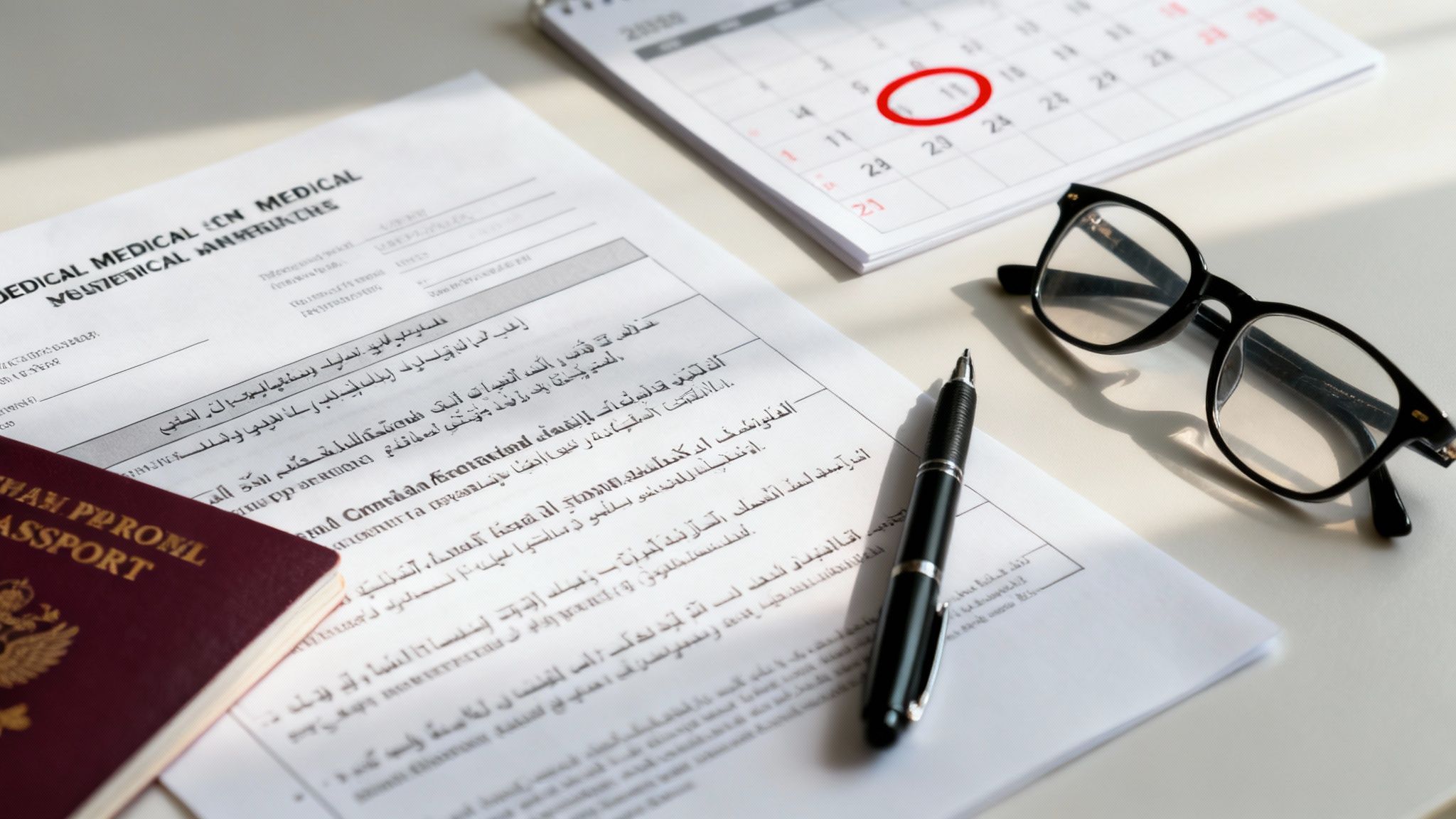
In healthcare and official processes, language barriers can create serious obstacles. The stakes in medical translation are much higher than in other fields. A poorly translated marketing slogan is embarrassing; a poorly translated medical term can lead to an incorrect diagnosis, a rejected insurance claim, or a denied visa.
Imagine this real-world scenario: you're applying for a Green Card for your elderly father. USCIS, the U.S. agency handling immigration, requires his complete medical history, which is in Spanish. You hire a freelance translator who isn’t a medical specialist. They confuse "hipertensión" (high blood pressure) with "hipotensión" (low blood pressure). That one error could trigger a Request for Evidence (RFE) from USCIS, delaying your entire case for months and causing unnecessary stress.
The Human and Legal Stakes
Getting the translation right is more than just a procedural step; it directly impacts people's lives, health, and legal futures. Every detail, from a medication dosage to a doctor's handwritten note, is crucial.
- Patient Safety: In a clinical setting, a mistranslated prescription or allergy warning can have devastating health consequences for a patient.
- Legal Validity: For a personal injury lawsuit, medical reports are often the core evidence. Any error or ambiguity in the translation can weaken or even destroy the case.
- Immigration Success: USCIS has strict rules. A certified translation acts as a formal guarantee that the translated document is a complete and accurate copy of the original. This helps you avoid rejections and delays caused by questionable paperwork.
For any official body, a translation without a certification is often considered unreliable. The certification statement from a professional translator is the proof they need to trust the document for legal and administrative purposes.
More Than Just Words on a Page
Medical translation is a highly specialized skill. It requires more than just fluency in two languages; the translator must have a deep understanding of complex medical terminology, clinical procedures, and the specific regulatory requirements of different countries. A general translator probably won't know the difference between a Phase I and Phase II clinical trial or grasp the subtle terminology in a psychiatric evaluation. You can read more about the impact of mistakes while translating medical documents in our detailed article.
That's why you need a professional medical translator. These specialists ensure that the meaning, context, and technical precision of your original document are perfectly preserved. Investing in a professional service is an investment in accuracy and peace of mind, ensuring your documents are accepted without issue, whether by a doctor, a lawyer, or an immigration officer.
Figuring Out Which Medical Documents Actually Need Translation
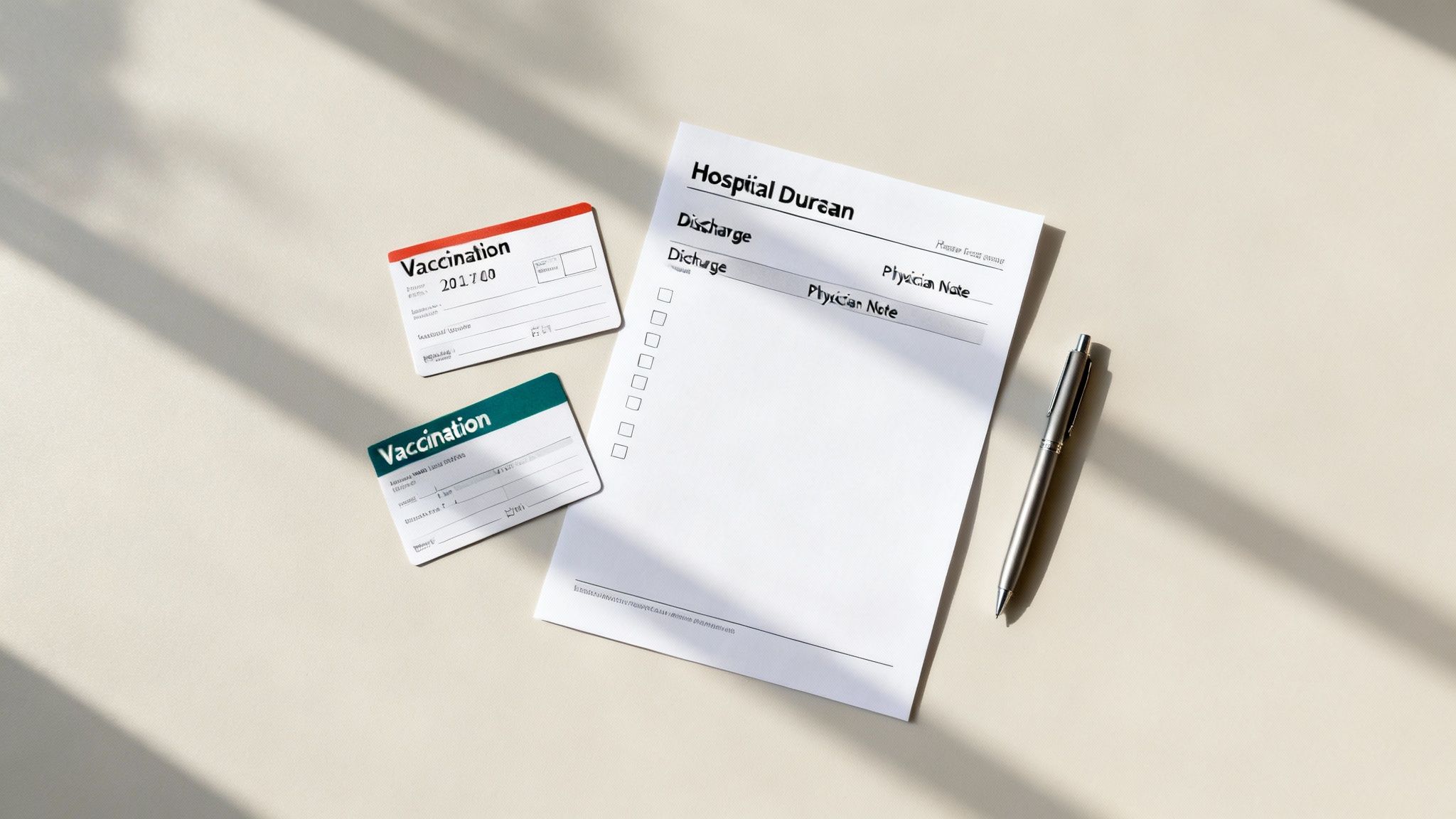
Before you rush to translate every medical paper you have, take a moment to think strategically. The first and most important step is to identify which documents you actually need to translate. It’s almost never everything.
Your goal is to provide exactly what the specific authority—be it USCIS for an immigration case, a university for admission, or an insurance company for a claim—is asking for. Knowing the purpose of your request will save you time, money, and unnecessary hassle.
Documents for Immigration and Official Use
When dealing with government agencies like USCIS, your medical documents are treated as legal evidence. They prove your health status, eligibility for benefits, or family relationships. This is why they require a formal certified translation to be considered valid. A certified translation is one that includes a signed statement from the translator attesting to its accuracy.
- Vaccination and Immunization Records: These are essential for school and university enrollment, and especially for the USCIS Form I-693 medical exam required for Green Card applications. A certified translation ensures vaccine names and dates are clear to U.S. officials.
- Birth Certificates: Often issued at a hospital, these civil certificates contain medical details and are fundamental for proving identity and family ties in visa and Green Card cases.
- Medical Examination Reports: If you had a medical exam in your home country, translating it can provide valuable context for the Civil Surgeon conducting your U.S. immigration medical exam.
Documents for Insurance and Healthcare Continuity
Seeking medical care in another country can be stressful. Translating the resulting paperwork is crucial for continuing treatment back home and getting reimbursed by your insurance company. These documents are filled with technical jargon, making a professional translation essential.
For example, when you're faced with the challenge of understanding specific blood test results from another country, an expert translator is the only way to prevent critical misinterpretations.
I’ve seen this happen countless times: someone submits an emergency room report for a travel insurance claim. A single, poorly translated diagnosis code gets flagged, and the entire claim is denied. Suddenly, they're responsible for thousands of dollars in unexpected medical bills.
Here are the most common documents you'll encounter in these situations:
- Hospital Discharge Summaries: This document tells the story of a hospital stay—diagnosis, treatments, and follow-up care instructions. It’s vital for your doctor at home and for your insurer.
- Physician’s Notes and Specialist Reports: These provide in-depth information about a specific condition and are often needed for getting a second opinion or supporting a disability claim.
- Prescription Information: A clear translation of your medications, including the drug name and dosage, is critical for your safety when visiting a new doctor or pharmacy.
Common Medical Documents and Their Translation Purpose
Here’s a quick-reference guide to help you identify which documents you might need and why.
| Document Type | Common Use Case | Key Information to Verify |
|---|---|---|
| Vaccination Records | Immigration (USCIS), school/university enrollment | Patient's full name, date of birth, vaccine names, dates administered |
| Hospital Discharge Summary | Insurance claims, continuity of care with a new doctor | Diagnosis, procedures performed, prescribed medications, follow-up plan |
| Physician's Notes | Legal cases (personal injury), second medical opinions | Detailed observations, patient history, treatment recommendations |
| Lab/Radiology Reports | Specialist consultations, ongoing treatment monitoring | Test results, reference ranges, radiologist's findings, patient identifiers |
| Birth Certificate | Immigration, proof of identity, establishing family relationships | Child's name, parents' names, date/time of birth, hospital name |
| Psychiatric Evaluation | Asylum claims, immigration waivers (e.g., I-601), custody cases | Diagnosis (DSM/ICD codes), professional assessment, treatment history |
This table should help you quickly pinpoint what you need for your situation. Always double-check that all key information, especially names and dates, is clear on your original document before sending it for translation.
Documents for Legal and Academic Purposes
In legal proceedings, medical records can be the deciding factor in personal injury, workers' compensation, or disability cases. A certified translation ensures your medical situation is presented accurately and without any ambiguity in court.
For academic programs, especially in medical fields, translated records like academic transcripts of medical courses or vaccination histories are often a standard part of the application process.
- Medical Reports for Legal Cases: Your medical history becomes a central piece of evidence where every detail matters.
- Psychiatric Evaluations: In sensitive cases like asylum claims or immigration waivers, a professionally translated psychiatric report can be the most critical evidence you submit.
- Clinical Trial Records: Researchers in global studies rely on perfect translations of everything from trial protocols to patient outcomes to get approvals from agencies like the FDA.
Handling Your Private Medical Records with Care
Handing over personal documents like a psychiatric evaluation or a detailed patient history requires a great deal of trust. You need assurance that your information will be handled professionally and confidentially. This isn't just good practice; it's a matter of adhering to strict legal and ethical standards designed to protect your privacy.
When you're translating medical documents for a critical purpose like an immigration waiver or a legal case, a privacy breach can have serious consequences. That's why investigating a translation service's privacy protocols is an essential first step.
Your Security Checklist Before You Upload Anything
Before you send any files, take a few minutes to perform a security check on the translation provider. A trustworthy service will make this information easy to find.
Here’s what to look for:
- Secure, Encrypted Platforms: How will you send your documents? Avoid services that ask you to email sensitive files. Look for a secure portal that encrypts your documents during upload and download.
- Signed Non-Disclosure Agreements (NDAs): Every translator and staff member who might see your documents should be bound by a strict NDA. This is a legally binding promise of confidentiality.
- A Clear Privacy Policy: The company's website should have a straightforward privacy policy that explains how your data is collected, handled, and protected.
- Professional Memberships: Membership in organizations like the American Translators Association (ATA) often means the service adheres to a professional code of ethics, adding another layer of accountability.
This focus on security is a major factor in the industry. The global market for life sciences translation, which includes translating medical documents, was valued at USD 1.70 billion in 2025 and is projected to reach USD 3.27 billion by 2033, according to Grandview Research. This growth is driven by the need for accurate, secure translations for regulatory submissions and global clinical trials, where there is zero room for error.
Why This Compliance Stuff Really Matters
Compliance isn't just corporate jargon; it's the framework that keeps your sensitive information safe. In the U.S., the Health Insurance Portability and Accountability Act (HIPAA) sets the standard for protecting patient health data.
While a translation company may not be a "covered entity" like a hospital, a service that is HIPAA-compliant (or follows its principles) demonstrates a serious commitment to security. It means they have invested in the technology and training to prevent your records from being compromised.
A provider that is transparent about its security measures is one that values your privacy. If you have to dig for this information or get vague answers, it's a red flag.
Think about it: if you are translating psychiatric records for an asylum case, the content is deeply personal. A HIPAA-aware service will ensure those files are stored on secure servers, that access is restricted and logged, and that the entire digital footprint is protected. You can learn more about how we handle this in our guide to medical records translation services.
Ultimately, a professional service builds its reputation on trust. By choosing a provider that prioritizes encrypted platforms, NDAs, and high professional standards, you can proceed with confidence, knowing your private information will remain private.
How to Get Your Medical Documents Translated Correctly
The process of getting your medical documents translated can feel overwhelming, but it breaks down into a few simple steps. By handling each stage correctly—from preparing your documents to knowing what the final product should look like—you can avoid common delays and receive a translation that gets accepted every time.
It all starts with the quality of your original document. A blurry photo or an incomplete scan can stop the process before it even begins.
Preparing Your Documents for Translation
Before requesting a quote, carefully review your documents. A translator can only work with what they can clearly read, so a high-quality, complete copy is essential. Getting this right from the start prevents frustrating delays.
For instance, if you submit a hospital discharge summary for an insurance claim and your scan cuts off the doctor's signature or the official hospital stamp, the insurance company can reject it as an incomplete record.
Here are a few tips to prevent this:
- Use a Real Scanner: While your phone is convenient, a flatbed scanner provides the best results. It keeps the page flat, ensures even lighting, and avoids the distortions and shadows common with phone photos.
- Check Every Detail: Zoom in on the scanned image. Can you read everything, including small print, handwritten notes, and stamps? If it's blurry to you, it will be unreadable to the translator.
- Capture the Whole Page: Make sure all four corners of the document are visible. Do not crop out headers, footers, or official seals, as they are part of the official record.
Here's a simple rule: if you have to squint to read any part of your document, the scan isn't good enough. A high-resolution, complete image is the foundation of a quality translation.
Getting a Transparent Quote
Once your documents are scanned and ready, it's time to get a price. A reputable translation service will make this process simple and transparent, with no hidden fees.
The process is typically straightforward:
- Securely Upload Your Files: Use the company's secure online portal to upload your documents. This is much safer than emailing sensitive medical records.
- Select Your Languages: Choose the source language (the original language) and the target language (the language you need it translated into, like English).
- Get Your Price: The system should provide an instant quote. Many professional services charge a flat rate, such as $23 per page (for pages up to 250 words), which makes budgeting easy.
A good agency will also have a clear security process. Ours involves a simple three-step verification to protect your privacy.
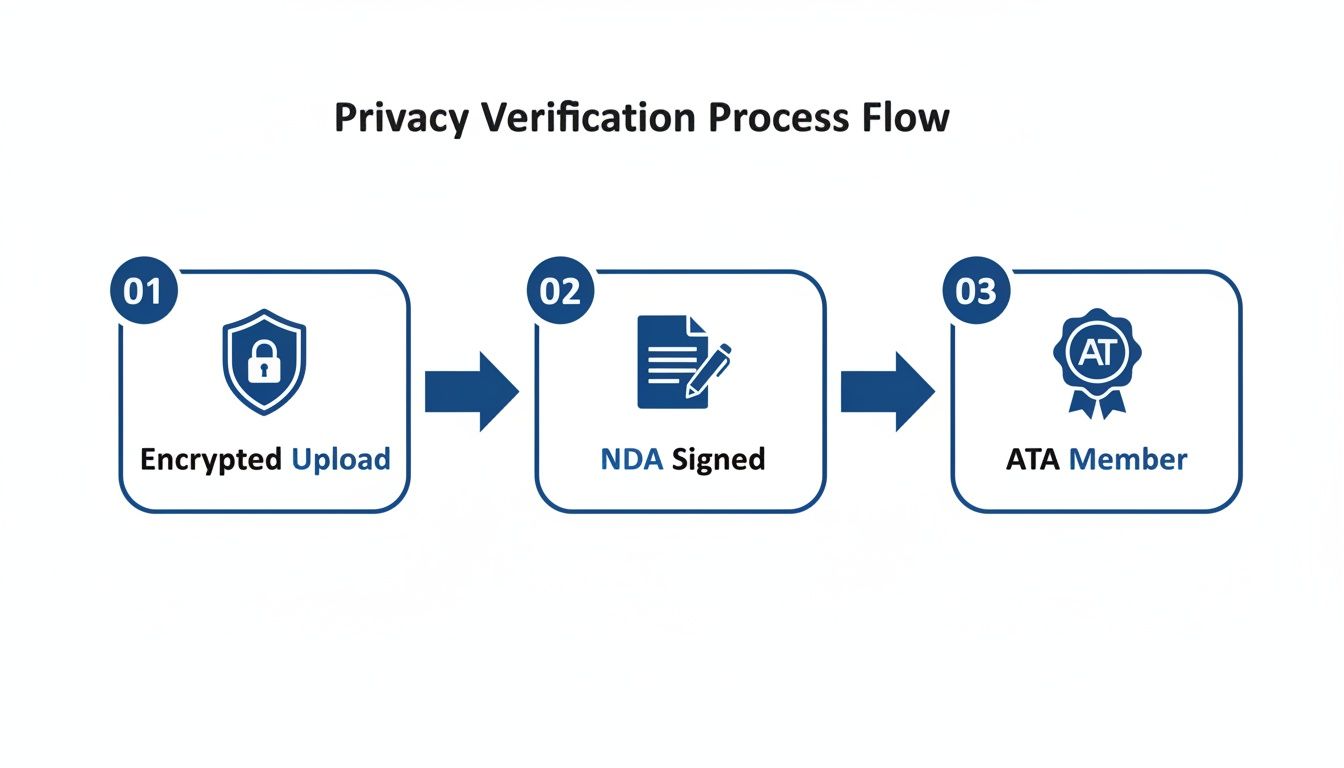
This workflow demonstrates a commitment to keeping your sensitive information safe from the moment you upload it.
Inside the Translation Workflow
After you approve the quote, your document is assigned to a translator who specializes in medical terminology. This is crucial—you need someone who understands the specific jargon of a cardiology report versus a psychiatric evaluation.
The translator creates a line-by-line translation while carefully preserving the original document's format. This is very important for official bodies like USCIS, which need to be able to compare the translation to the original easily. The first draft then goes to a second linguist for a quality assurance (QA) review to check for any errors in terminology, grammar, or formatting. You can see more about our simple, secure process on our translation pricing page.
What to Check in the Final Delivery
When the translation is complete, you will receive a package of files ready for official submission.
Here’s what you should always get:
- The Translated Document: A precise, word-for-word translation of your medical record that mirrors the original's layout.
- The Certificate of Translation Accuracy: This is a formal statement on company letterhead, signed by the translator or an authorized representative, confirming the translation's completeness and accuracy.
- The Translator's Credentials: The certificate should also include information about the translator's qualifications, showing they were competent to perform the translation.
Before submitting it, do a final review yourself. Make sure all names, dates, and important medical terms are spelled correctly. A professional agency will offer free revisions to fix any errors. This final check ensures your certified translation is perfect.
Getting It Right: Certification, Notarization, and USCIS Rules
People often confuse the terms "certified" and "notarized," but for official submissions to an agency like U.S. Citizenship and Immigration Services (USCIS), the difference is critical. Understanding this distinction can prevent major delays in your application.
A certified translation is what you almost always need for official purposes. This doesn't mean the translator has a special government license. It means the final translated document comes with a signed statement from the translator or translation company. This statement, often called a Certificate of Translation Accuracy, is a professional guarantee that the translation is a complete and accurate reflection of the original document.
So, What's the Real Difference?
A notarized translation adds an extra step: a Notary Public witnesses the translator signing the certificate and verifies their identity with a stamp. The notary stamp has nothing to do with the quality or accuracy of the translation itself—it only confirms that the signature is authentic.
Here’s a simple breakdown:
- Certification: This is about the accuracy of the translation. It's the translator's professional guarantee. This is what USCIS requires.
- Notarization: This is about verifying the identity of the person who signed the certificate. It is rarely required by USCIS, though some other institutions like foreign courts or universities might ask for it.
For almost all U.S. immigration purposes, a certified translation is exactly what you need. You can learn more about the official USCIS translation requirements to see how this applies to your specific case.
A Real-World USCIS Scenario
Let's look at a common mistake. Maria is applying for a visa for her mother and submits her translated medical records from Mexico. However, the translation is missing the signed certification statement. Months later, she receives a Request for Evidence (RFE) from USCIS.
The RFE flags the problem: her foreign-language document lacks a proper certified translation. Her entire case is now on hold. This simple oversight could add months of frustrating delays to her application.
A proper Certificate of Translation Accuracy is mandatory for USCIS. The statement must be signed, dated, and clearly state that the translation is complete and accurate. Without it, your document will likely be rejected.
This is why getting the certification right is so important. With more people seeking healthcare across borders, the demand for high-quality medical translations has grown significantly. The global medical translation market was valued at USD 2.21 billion in 2023, according to global medical translation market trends on WiseGuyReports. For official gatekeepers like USCIS, a proper certification is the only trusted method for verifying foreign documents.
By ensuring your translation is properly certified from the start, you provide USCIS with exactly what they need to process your case smoothly.
Common Questions About Translating Medical Documents
When you need a medical translation, practical questions about turnaround time, cost, and official rules are common. Here are direct answers to the most frequent questions we receive.
How Long Does Medical Record Translation Take?
The turnaround time for a medical translation depends on the document's length, complexity, and legibility. A single-page, clearly typed vaccination record can be translated much faster than a ten-page hospital discharge summary with handwritten notes.
For most standard documents of 1-3 pages, a 24-hour turnaround is often possible. However, larger files, like a complete patient history, will naturally take longer.
Pro Tip: Always confirm the delivery time when you request a quote. If you have an urgent deadline, ask if the service offers an expedited option. A good agency can often prioritize your project to help you meet a critical deadline.
Remember to allow yourself a little time to review the final translation and double-check that all names and dates are correct before you submit it.
What Is the Cost to Translate a Medical Document?
Pricing for translation services should be transparent and straightforward. You need to know the full cost upfront without worrying about hidden fees.
Most reputable services use one of two pricing models:
- Per Page: This is the simplest model. You pay a flat rate, such as $23 per page, where a "page" is typically defined as up to 250 words.
- Per Word: This model is more common for very long or text-heavy documents where a per-page rate might not be accurate.
Be aware that some services may try to charge extra for the certification statement. This should always be included in the price of a certified translation. Always ask for a final, all-inclusive quote before you commit. For a clear breakdown, you can review our pricing and turnaround information.
Can I Translate My Own Documents for USCIS?
The answer is an emphatic no. USCIS, along with nearly all other official bodies, requires a translation from a neutral third party. This rule is non-negotiable and exists to prevent conflicts of interest and ensure objectivity.
You cannot translate your own documents, and neither can a friend or family member, no matter how fluent they are in both languages.
The process relies on the Certificate of Translation Accuracy, a signed statement from a professional translator or agency confirming their competence and the accuracy of the translation. This certificate is what gives the document its official standing and is a key part of the USCIS certified translation process.
What if I Find an Error in My Translation?
Even with expert translators and quality checks, mistakes can happen. A professional and reliable agency will stand by its work and have a clear process for corrections.
If you receive your translation and find an error—such as a misspelled name or an incorrect date—contact the provider immediately. Any reputable service will offer free revisions for their mistakes. They should correct the issue promptly and provide you with a new, accurate certified document at no additional cost. This is why it's always a good idea to carefully review your translated medical records one last time before submission.
At TranslateDay, we understand that getting your medical documents translated correctly is a critical step in your journey. We’re here to make the process simple, secure, and fast.
Get an instant quote


