
Navigating official paperwork for immigration, academics, or legal matters can feel overwhelming, especially when your documents are not in English. You'll often hear the term "certified translation," which is much more than just changing words from one language to another. A certified translation is an official document that includes a signed statement from a qualified translator or translation agency, guaranteeing it is a complete and accurate copy of the original. This signed declaration, known as a Certificate of Translation Accuracy, is what gives your documents the legal weight they need to be accepted by official bodies like U.S. Citizenship and Immigration Services (USCIS), courts, and universities.
Why Certified Translation is Your Document's Official Passport
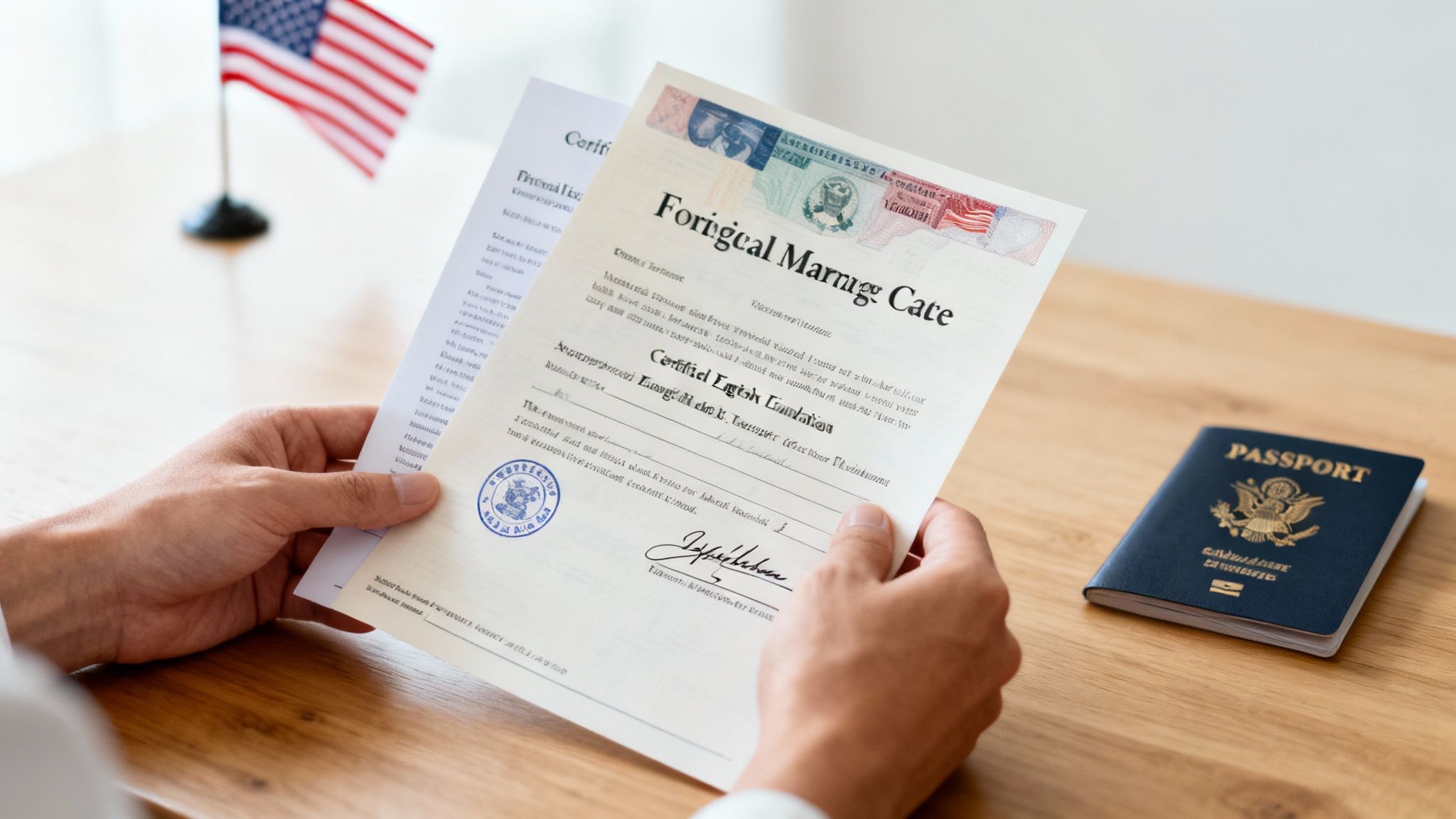
Think of a certified translation as a passport for your important paperwork. A passport allows you to cross international borders legally. In the same way, a certified translation allows your foreign-language document—like a birth certificate or academic transcript—to "cross the border" and be officially recognized in a new country's legal or administrative system. Without this certification, your documents are essentially stuck, unable to be processed because officials can't verify their authenticity or content.
For government agencies like USCIS (the U.S. agency handling immigration and citizenship), courts, and universities, this is a strict requirement. They need absolute assurance that the information they are using to make life-changing decisions—like granting a Green Card or admitting a student—is a true and faithful copy of the original document.
A Real-World Story: Maria's Green Card Application
Imagine Maria, an engineer from Brazil, is applying for a U.S. Green Card. Her application package is filled with crucial documents in Portuguese: her birth certificate, university diploma, and marriage license. If she simply submitted these documents in Portuguese, her application would be immediately rejected. The USCIS officer reviewing her case cannot read Portuguese and has no way to verify the information.
This is where certified translation services become essential. Maria hires a professional service to translate each document. Each translated page is delivered with a signed "Certificate of Translation Accuracy." This statement confirms that a professional translator, fluent in both Portuguese and English, has created an exact and complete translation. With these certified documents, Maria's application sails smoothly through the system.
This single step accomplishes three critical things:
- Guarantees Accuracy: A professional translator ensures every detail—names, dates, official seals, and even the fine print—is translated perfectly.
- Ensures Compliance: The documents now meet the strict submission rules of USCIS, preventing an automatic rejection.
- Prevents Delays: Submitting correctly certified documents from the start helps avoid stressful "Requests for Evidence" (RFEs), which can stall an application for months.
Beyond Immigration: When Else You Need It
While essential for immigration and USCIS applications, the need for certified translations extends to many other areas. For instance, a student from Japan applying to an American university will need certified translations of their high school transcripts. Someone involved in an international business dispute might need foreign contracts translated for a U.S. court. Even personal milestones, like adopting a child from another country, require certified translations of all foreign legal paperwork.
Understanding the pricing and process is the first step toward a hassle-free experience. This certification is the official stamp of approval that makes your documents understandable and, more importantly, trustworthy to the people making critical decisions.
Certified vs. Sworn vs. Notarized: Understanding the Difference
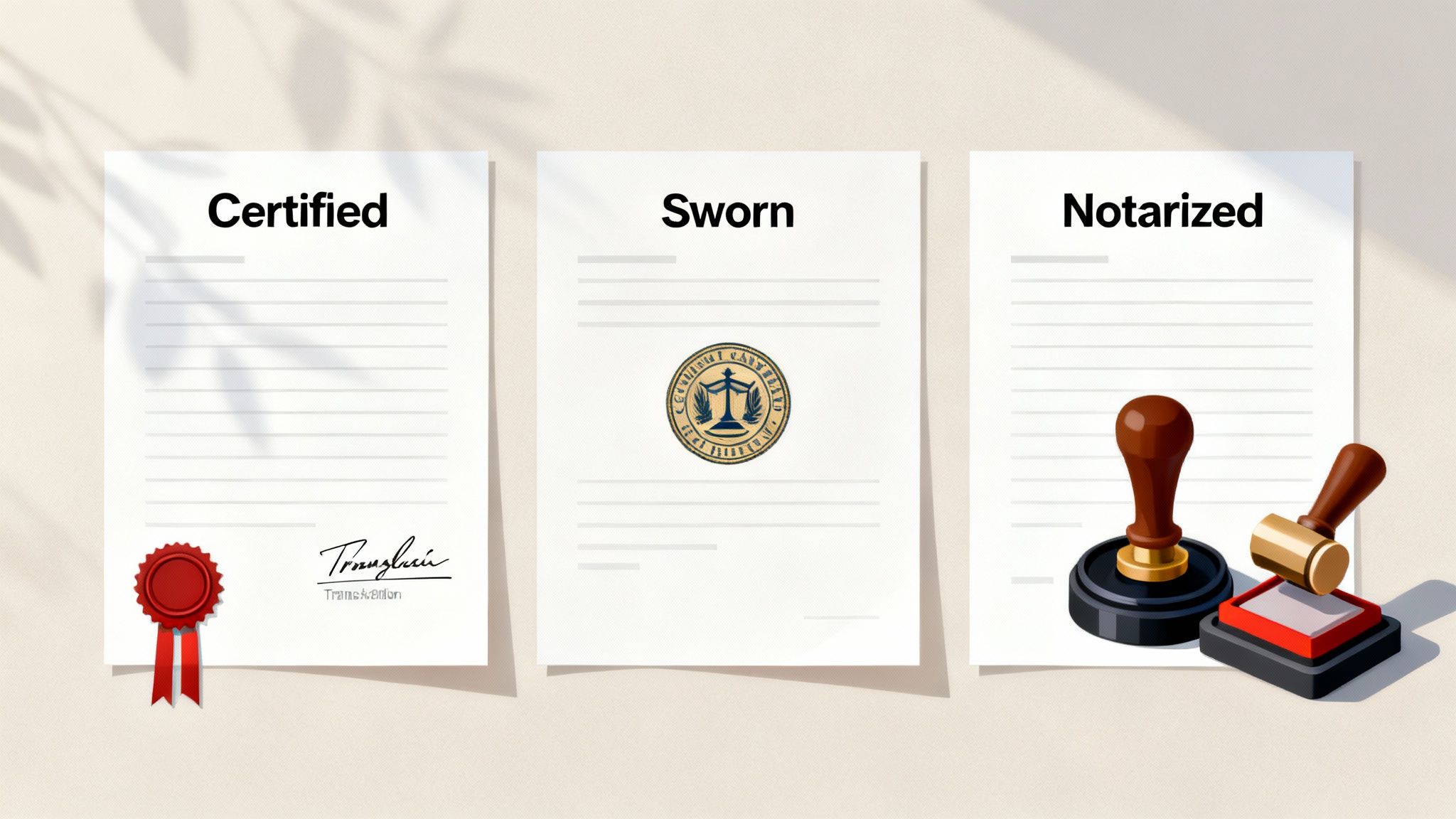
When dealing with official documents, you'll encounter terms like "certified," "sworn," and "notarized." They sound similar, but they mean very different things. Choosing the wrong one can lead to frustrating rejections and costly delays. Let's break down what each one means in simple terms so you can get it right the first time.
Certified Translations: The U.S. Standard
For most official purposes in the United States, a certified translation is the requirement. This is the gold standard for USCIS immigration paperwork, federal agency applications, and academic admissions.
What it is: A certified translation includes a signed statement (an affidavit) from the translator or translation company declaring that the translation is a complete and accurate reflection of the original document. The translator is staking their professional reputation on its quality. In the U.S., the translator does not need a special government license to provide this certification.
Sworn Translations: The International Standard
A sworn translation is a more formal process typically required outside the United States, especially in Europe and South America.
What it is: In many countries, certain translators are officially appointed by a government body (like a court or Ministry of Foreign Affairs). These "sworn translators" act as public officials. Their translations are stamped with an official seal, giving them the same legal value as the original document. If you're submitting paperwork to a consulate in Italy or a university in France, you will likely need a sworn translation.
The key difference is the source of authority. A U.S. certified translation is backed by a professional's declaration of accuracy. A sworn translation is backed by the legal authority granted to the translator by a government.
Notarized Translations: An Extra Layer of Verification
A notarized translation adds another step, but it's often misunderstood. A notary's stamp has nothing to do with the quality of the translation.
What it is: A Notary Public simply verifies the identity of the person who signed the Certificate of Translation Accuracy. The notary watches the translator sign the statement and then adds their own stamp and signature to confirm, "Yes, this person is who they say they are." This is an anti-fraud measure, not a guarantee of translation quality. While some institutions require it, it’s less common than a standard certification.
You can learn more about specific use cases in our guide on certified and notarized translation. It's also distinct from services like legal transcription, which involves creating a written record of spoken legal proceedings.
Certified vs. Sworn vs. Notarized at a Glance
| Feature | Certified Translation (U.S. Standard) | Sworn Translation (International) | Notarized Translation (U.S. Add-On) |
|---|---|---|---|
| Primary Purpose | To attest to the accuracy and completeness of the translation. | To create a translation that has the same legal standing as the original document. | To verify the identity of the person signing the certification statement. |
| Who Performs It? | Any professional translator or translation company. | A translator officially appointed and "sworn in" by a government authority. | A licensed Notary Public witnesses the translator's signature. |
| Key Component | A signed Certificate of Translation Accuracy (affidavit). | An official stamp or seal from the sworn translator. | An official stamp and signature from the notary. |
| Authority Source | The translator's or agency's professional reputation. | The government body that appointed the translator. | The government body that commissioned the notary. |
| Geographic Use | Primarily the United States, Canada, UK, and Australia. | Common in civil law countries (e.g., Spain, France, Germany, Brazil). | An optional extra layer in the U.S. for certain legal or financial documents. |
| Verifies What? | The linguistic quality of the translation. | The legal validity of the translated document. | The authenticity of the signature on the certification. |
Always confirm the specific requirements with the institution you are submitting documents to. Sending the wrong type is one of the most common—and easily avoidable—mistakes.
A Checklist of Documents That Require Certified Translation
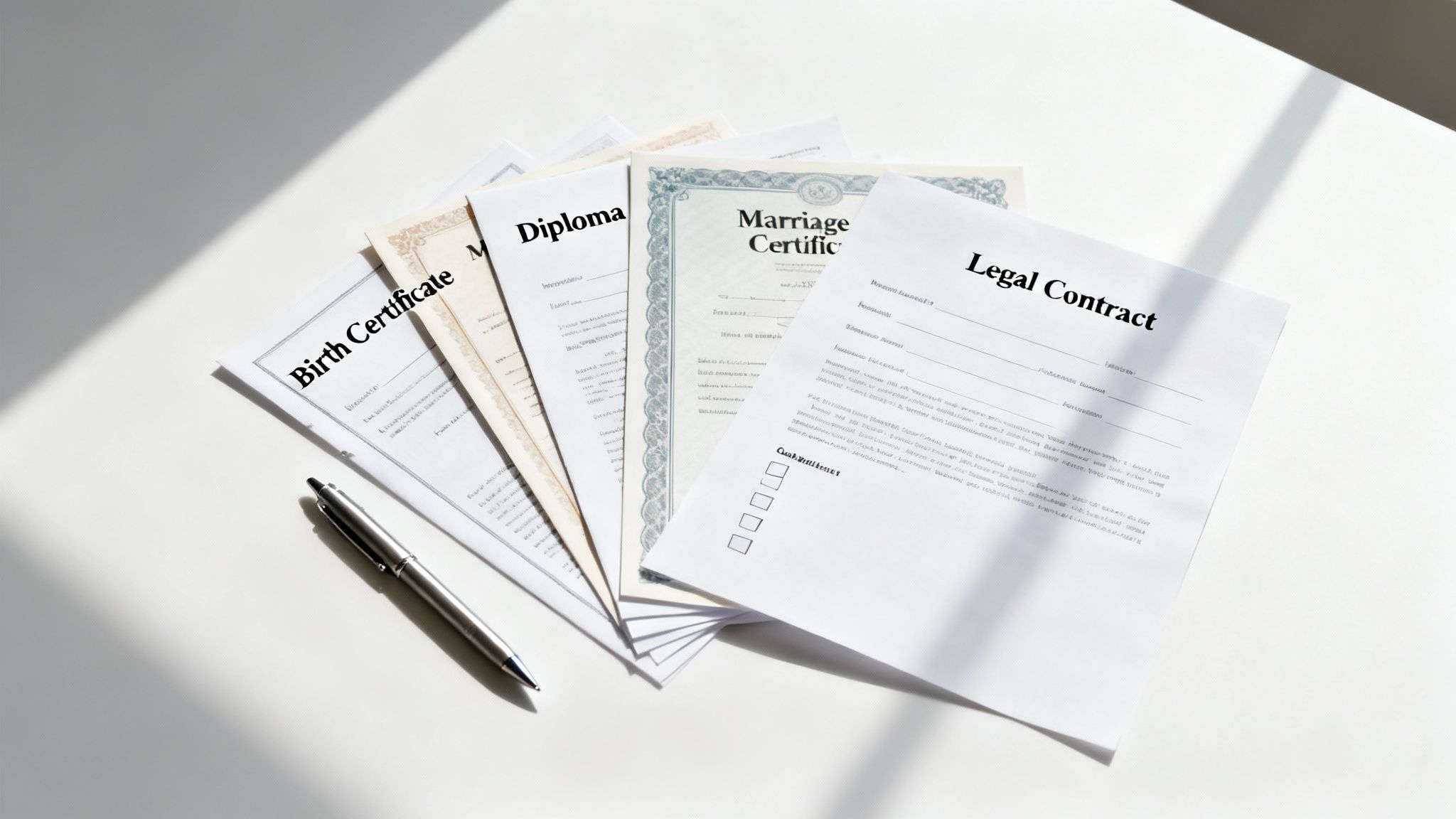
Certain documents are too important to leave to chance. For any high-stakes submission to government bodies, universities, or courts, a certified translation is non-negotiable. Trying to save money with a simple, uncertified translation is a common mistake that almost always leads to rejections, delays, and frustration. Knowing which documents need this official stamp of approval from the start will save you time, stress, and headaches.
For Immigration (USCIS)
U.S. Citizenship and Immigration Services (USCIS) has a zero-tolerance policy for documents not in English. To ensure they can accurately assess your case, they require a certified translation for every foreign-language document you submit.
Common USCIS documents include:
- Birth Certificates: This is the primary proof of your identity, age, and family relationships for visa, Green Card, and citizenship applications. These are often called civil certificates.
- Marriage Certificates: Essential for proving the validity of a marriage in spousal visa and other family-based cases.
- Divorce Decrees: If you were previously married, you must provide this to prove that the marriage was legally dissolved.
- Passports and Visas: Previous passports and visas help establish your travel and immigration history for the reviewing officer.
- Police Clearance Certificates: This document shows your criminal record (or lack thereof) from every country where you have lived for a significant period.
The importance of these documents is highlighted in real-world legal challenges, such as a Texas lawsuit concerning the issuance of birth certificates, which underscores how critical certified translations of foreign immigration documents like birth certificates are in legal and civil rights contexts.
For Academic Admissions and Credential Evaluation
When you apply to a U.S. university or need your foreign credentials evaluated by an agency like WES, they must have a clear understanding of your educational background. Any academic records not in English must be accompanied by a certified translation.
These typically include:
- Academic Transcripts: These detailed records of your courses and grades are critical for universities to assess your academic performance. An accurate translation is a must.
- Diplomas and Degree Certificates: This is your official proof of graduation and a core requirement for admission to college or graduate programs.
- Resumes or CVs: Especially for graduate school applications, a translated CV provides the admissions committee with a complete picture of your academic and professional history.
For Legal and Court Proceedings
In the legal world, a single word can change the outcome of a case. That’s why courts, attorneys, and government agencies demand certified translations. It guarantees that any foreign-language document presented as evidence is a true and accurate reflection of the original.
Legal documents often requiring certification include:
- Legal Contracts and Agreements: Crucial for international business deals or personal legal disputes.
- Court Transcripts and Judgments: Necessary when a U.S. legal case involves court proceedings from another country.
- Wills and Testaments: When an estate involves international assets or heirs, a flawless translation is essential for the probate process to proceed correctly.
- Affidavits and Sworn Statements: For a written statement to be admissible as evidence in court, its translation must be certified and beyond reproach.
For Personal and Civil Records
It’s not just about immigration or court cases. Many routine life events in the U.S. require certified translations of personal documents, from getting a driver's license to signing up for health insurance.
This category includes:
- Adoption Papers: If you are adopting a child from abroad, all foreign legal paperwork must have a certified English translation.
- Driver's Licenses: Many DMVs require a certified translation when you are converting a foreign license to a U.S. one.
- Medical Records: Critical for insurance claims or for continuing medical care in the United States. They are also sometimes required for visa medical examinations.
If any of your documents fall into these categories, a professional certified translation isn't just a good idea—it's your only path to acceptance. For a detailed walkthrough of one of the most common requests, see our guide on birth certificate translation.
The Certified Translation Process: A Simple 3-Step Guide
Getting an official document translated might seem complicated, but professional services have streamlined the process to be fast, secure, and clear. You can get from a foreign-language document in your hand to a submission-ready certified translation without any guesswork. Here's a look at how it works, step by step.
Step 1: Prepare Your Document for Submission
This first step is the most important one on your end. The quality of the final translation depends entirely on the clarity of the document you provide. You don’t need a fancy scanner—your smartphone is powerful enough if you follow these simple rules.
Your pre-submission checklist:
- Get a Clear Photo: Place your document on a flat, well-lit surface. Make sure there are no shadows and that every word, stamp, and seal is sharp and easy to read.
- Capture Everything: You must include every single page, front and back. Even pages that seem blank or only have a small stamp are part of the official record and must be included.
- Double-Check for Legibility: Before uploading, zoom in on the image. Can you read every word and number clearly? If it’s blurry to you, it will be unreadable for the translator.
A common mistake is submitting an incomplete document, like forgetting the back of a birth certificate. This is a frequent cause for rejection by authorities like USCIS, who require a translation of the entire document.
Step 2: Place Your Order Online in Minutes
Once your document scans are ready, the rest of the process is simple and can be done from your computer or phone. Modern certified translation services have made their platforms user-friendly and secure.
Here’s the typical online ordering process:
- Upload Your Files: Use a secure portal to upload your document images or PDFs.
- Select Your Languages: Choose the original language and the language you need it translated into (e.g., Spanish to English).
- Get an Instant Quote: The system will calculate the cost based on the number of pages. Reputable services offer transparent, per-page pricing, so there are no surprises.
- Submit and Pay: Complete the secure checkout. You'll receive an email confirmation immediately with an estimated delivery time.
This seamless digital workflow is powered by sophisticated Translation Management Systems (TMS). The global market for this technology was valued at USD 2.16 billion in 2024 and is projected to grow significantly by 2026, reflecting the industry's shift toward efficiency, security, and customer convenience. These systems keep your sensitive documents confidential while ensuring a high-quality, accurate translation.
Step 3: Receive Your Certified Translation
This is the final and most exciting step. For most standard documents (1-3 pages), you can expect to receive a digital copy of your certified translation within 24 hours.
Here’s what you'll get:
- Digital PDF Copy: This file will contain both the translated document and the signed Certificate of Translation Accuracy. For most online submissions to USCIS or universities, this is all you need.
- Physical Copies (Optional): If the institution requires a hard copy, most services can mail physical copies to you for a small additional fee.
Important Reminder: Never attempt to translate official documents yourself, even if you are fluent in both languages. Official bodies like USCIS require an impartial, third-party certification to ensure the translation is objective and free from personal bias. Our guide on USCIS translation requirements explains this crucial rule in more detail.
By following these three simple steps, you can navigate the process smoothly and be confident that your important documents will be translated correctly and accepted the first time.
How to Choose a Reliable Certified Translation Service
Choosing the right partner for your certified translation is a critical decision. A small error, a missed deadline, or a subpar translation from a cheap provider can lead to the rejection of your entire application by USCIS, a university, or a court. This means facing major delays, stress, and the cost of starting over. This guide provides a practical checklist to help you identify a top-tier certified translation service and avoid common pitfalls.
Think of this as hiring a specialist for a crucial task—because that's what it is. You are entrusting a provider with sensitive personal documents that are vital to your future. Knowing how to distinguish a professional agency from an unqualified freelancer is key to protecting your information and ensuring your paperwork is handled with the accuracy it deserves.
Your Non-Negotiable Checklist for a Translation Provider
When comparing services, don't let price be your only guide. The true cost of a cheap, inaccurate translation is rejection and having to do everything twice. A reliable service will proudly display its credentials and guarantees.
Here’s what to look for:
- 100% USCIS Acceptance Guarantee: This is the most important promise for any immigration paperwork. It means the company guarantees its translations meet the strict certification and formatting rules of U.S. Citizenship and Immigration Services and will stand behind their work.
- Membership in Professional Organizations: Affiliation with respected bodies like the American Translators Association (ATA) demonstrates a commitment to professional ethics, quality standards, and industry best practices.
- Transparent Per-Page Pricing: Reputable companies are upfront about costs. Look for clear, per-page pricing (typically for up to 250 words). You should be able to get an instant quote without hidden fees.
- Fast and Reliable Turnaround: For standard documents like birth certificates (usually 1-3 pages), a 24-hour turnaround should be the standard. The service should also offer clear expedited options if you have an urgent deadline.
Security and Confidentiality Are a Must
You are about to upload copies of your most private documents—birth certificates, passports, and financial records. Data security is not just a feature; it's an absolute necessity.
A trustworthy agency must use a secure, encrypted platform for file uploads and payments. They should have a clear privacy policy and use technology that protects your personal information from start to finish.
The entire process should be confidential. This means their professional translators are bound by strict non-disclosure agreements to keep your private information secure.
Look for a Simple, Clear Process
Getting a document translated should not be a complicated ordeal. Expect a simple, three-step process from any professional online service.
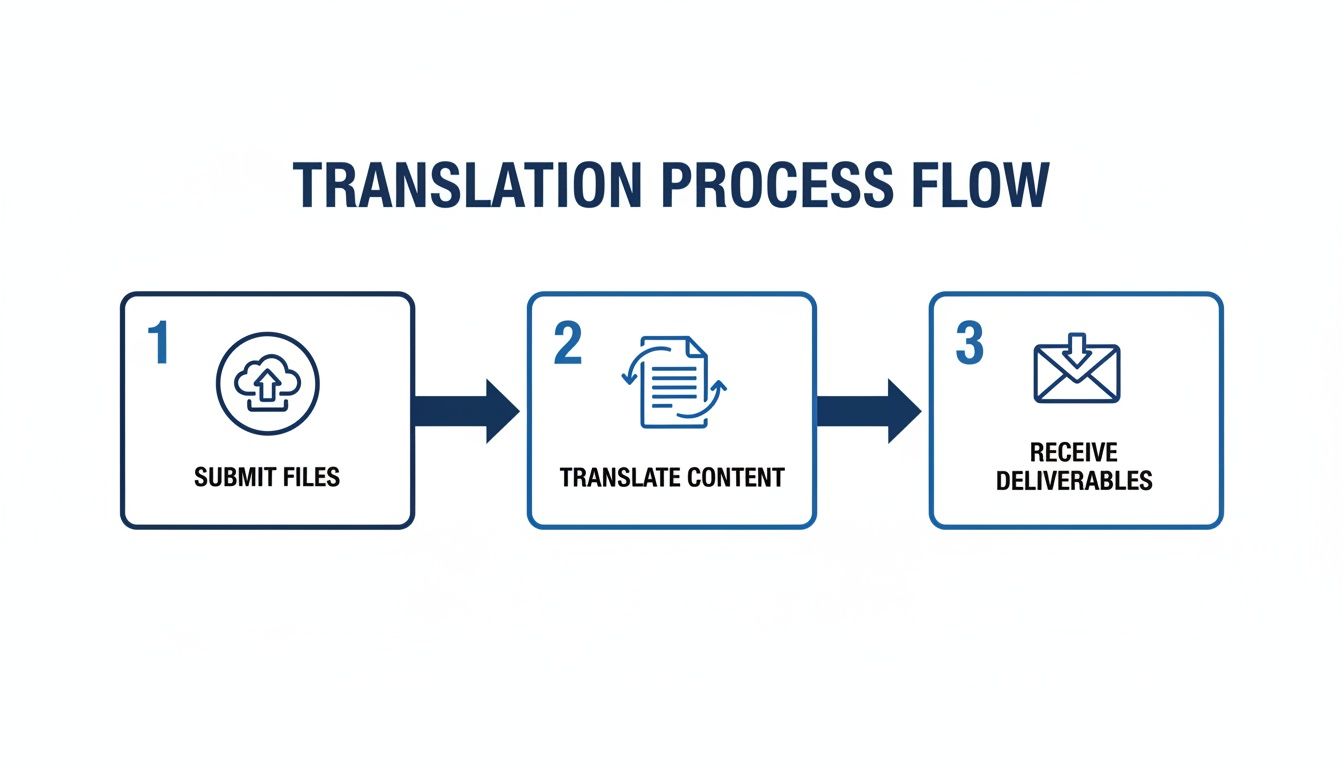
This "Submit, Translate, Receive" model is designed for efficiency, cutting out unnecessary steps and getting you what you need without the headache.
Final Questions to Ask Before You Commit
Before making a decision, ask these final questions about the provider:
- Are they accessible? Is their contact information easy to find? Do they offer responsive customer support, or does it feel like you’re sending emails into a void?
- What are real customers saying? Look for positive, verifiable reviews. Focus on testimonials from people who needed the same service as you, such as certified translations for USCIS.
- Is their website professional and secure? A clean, easy-to-use website is often a good sign that the company is well-run and values its customers' experience.
By using this checklist, you can confidently select a certified translation service that delivers accurate, compliant documents on time. Taking a few extra minutes to vet your options will save you significant trouble and give you peace of mind that your application is in expert hands.
Your Top Questions About Certified Translation Answered
When you're dealing with official paperwork, you need clear, straightforward answers. The world of certified translation can seem confusing, but it doesn't have to be. Here, we tackle the most common questions people ask when preparing immigration applications, university submissions, or legal documents. Our goal is to provide practical information so you can move forward with confidence.
How much does a certified translation cost?
The good news is that reputable agencies have standardized pricing to be transparent and predictable. The industry has largely moved to a simple, flat per-page fee, so you know the cost upfront.
Most professional services, including TranslateDay, charge a straightforward fee per page. A "page" is typically defined as up to 250 words, which covers most standard documents like a birth certificate, diploma, or driver's license. This model means no hidden fees or surprise charges for "complexity" or "administrative work." You simply count the pages to know your total cost. You can see a full breakdown on our translation pricing page.
How quickly can I get my documents translated?
Time is often a critical factor, especially with firm deadlines from USCIS or an admissions office. Professional certified translation services are designed for speed without sacrificing accuracy.
For standard documents (1-3 pages), such as birth certificates or marriage licenses, you should expect a 24-hour turnaround. This means you will receive a digital PDF of your certified translation in your email inbox within one business day. For most online submissions, this digital copy is all you need. If you're in a real rush, most agencies also offer expedited services for an additional fee to handle last-minute emergencies.
Is the translation guaranteed to be accepted by USCIS?
This is the most important question for anyone navigating the U.S. immigration process. The only acceptable answer is a firm "yes." A 100% USCIS acceptance guarantee is the most crucial promise a translation provider can make.
What does this guarantee actually mean?
- Full Compliance: It ensures the translation adheres to every USCIS regulation, including providing a complete, word-for-word translation.
- Proper Certification: It includes a correctly formatted and signed Certificate of Translation Accuracy that states the translation is complete and correct, and provides the translator's or agency's contact information.
- Ongoing Support: The guarantee is the company's promise to stand by its work. In the rare event that USCIS has a question or requests a clarification, the agency will provide support and make any necessary revisions at no extra cost.
This guarantee is your safety net, ensuring your documents will be accepted without any translation-related issues. It’s what separates professional, reliable agencies from the rest.
Can I translate my own documents if I'm fluent?
This is a common question, especially for those who are bilingual. However, for official submissions to bodies like USCIS, courts, or universities, the answer is a definite no.
These institutions require an impartial third party to perform the translation for one key reason: objectivity. They need absolute certainty that the translation is an accurate, unbiased copy of the original. If you translate your own documents, you are considered a biased party. The official reviewing your case cannot be sure that you haven't unintentionally misinterpreted a term or intentionally altered information to benefit your application. A certificate from an independent, professional service removes all doubt and serves as trusted proof of the document's integrity. This is a non-negotiable requirement for nearly all certified translations for USCIS.
At TranslateDay, we understand that getting your documents translated correctly and on time is a critical step in your journey. Our entire process, from transparent pricing to our USCIS acceptance guarantee, is designed to eliminate stress and provide you with complete peace of mind.
Ready to take the next step? Get an instant quote today and have your certified translation ready in as little as 24 hours.


