
When you search "certified document translation near me," you're not just looking for a local office. You're searching for a trustworthy partner to handle critical documents where perfect accuracy is non-negotiable. For most people in 2025, the best and fastest solution isn't a physical storefront but a reputable online service that delivers translations with a guaranteed acceptance for official bodies like USCIS, often within 24 hours. This guide will walk you through everything you need to know to get it done right.
Navigating Your Translation Needs: Local vs. Online Services
Imagine this common scenario: you've received a Request for Evidence from U.S. Citizenship and Immigration Services (USCIS), the U.S. agency handling immigration matters. They need an English translation of your foreign birth certificate, and the deadline is tight. A few years ago, this meant finding a local translation agency, driving there, leaving your original documents, and waiting.
Today, the concept of "near me" has changed. It's about immediate access, not physical location. For official documents like a birth certificate translation, that access comes from specialized online services designed for speed, security, and compliance with official requirements.
Choosing Your Path: Local or Online?
So, how do you decide? Do you prefer a face-to-face meeting, or is efficiency and convenience your top priority? Each path has its own set of trade-offs.
This flowchart can help you think through the decision and see which route makes the most sense for your situation.
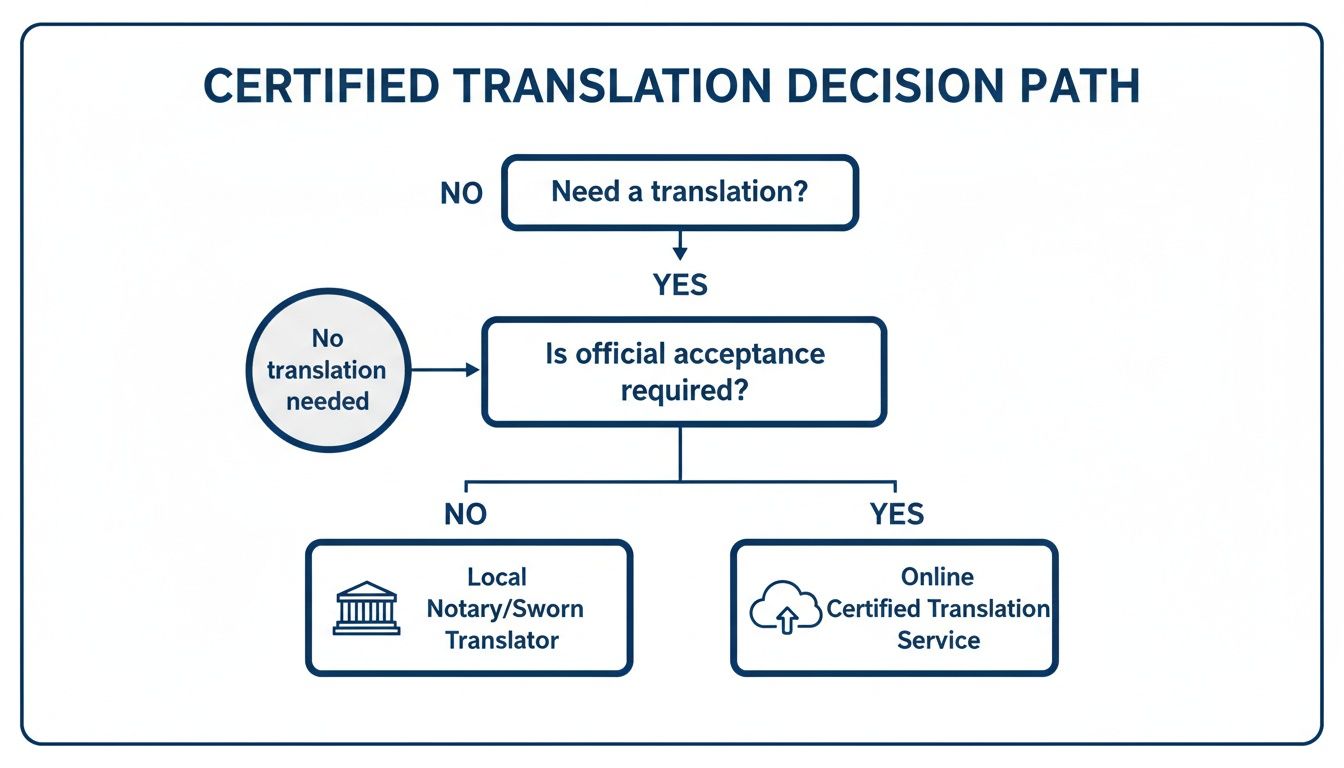
As you can see, the fundamental difference comes down to the workflow. Online services are built around a fast, secure digital process, while local services are centered on traditional, in-person consultations.
Local vs. Online Certified Translation: A Quick Comparison
To help you weigh your options, this table breaks down the key differences between walking into a local agency and using a dedicated online provider.
| Feature | Local In-Person Service | 100% Online Service |
|---|---|---|
| Turnaround Time | Typically several days to a week | Often within 24 hours for standard documents |
| Convenience | Requires travel and adherence to office hours | Accessible 24/7 from anywhere; just upload a file |
| Cost | Often higher due to overhead (rent, staff) | More competitive pricing; transparent, per-page rates |
| Document Handling | May require handing over original documents | Securely upload a scan or photo; originals stay with you |
| Service Scope | Limited to the expertise of local staff | Access to a global network of specialized translators |
| Acceptance Guarantee | Varies by provider; must verify credentials | Reputable services offer a money-back guarantee for USCIS |
While a local agency might feel reassuring, it often comes with slower service and rigid 9-to-5 business hours. In contrast, a 100% online service is designed for the pace of modern life, offering a simple, direct process for everything from an academic transcript translation to urgent legal paperwork.
You just snap a picture or upload a scan of your document, and a professional, certified translation lands in your inbox, ready to go. This approach is a lifesaver for time-sensitive needs, including:
- Immigration: Translating birth certificates, marriage certificates, or other civil certificates for Green Card, visa, or citizenship applications.
- Academic: Submitting foreign diplomas or transcripts for university admissions.
- Legal: Presenting foreign-language contracts or affidavits in court.
- Medical: Sharing medical histories with doctors or insurance providers abroad.
In the end, the best "certified document translation near me" is the one that fits your deadline, meets all official requirements, and keeps your private information safe. For the vast majority of people, a trusted online service strikes the perfect balance of all three.
What Makes a Translation Officially Certified?
When dealing with official paperwork, terms like "certified," "notarized," and "sworn" can be confusing. Let's simplify them so you know exactly what you need.
A certified translation is not a government-issued seal. It is a professional guarantee from the translator or translation company. It includes a signed statement, called a Certificate of Translation Accuracy, which declares that the translation is a complete and accurate reflection of the original document. For an organization like USCIS, this certificate is the essential proof they need to accept your documents.
Certified vs. Notarized vs. Sworn Translations
Understanding the difference is crucial; choosing the wrong type can cause serious delays in your application. Each one serves a specific purpose.
- Certified Translation: This is about accuracy. A language expert confirms the translation is a true and faithful copy of the original. This is the standard for USCIS and most U.S. institutions.
- Notarized Translation: This adds identity verification. A Notary Public—an official who witnesses signatures—watches the translator sign the accuracy certificate and then adds their own notary stamp and signature. The notary does not check the translation; they only confirm the identity of the person who signed the certificate.
- Sworn Translation: This is mainly used outside the U.S. A sworn translator is an individual who has been officially authorized by a foreign court or government to certify their own translations, making them legally valid in that country.
Real-World Example: Maria is applying for her Green Card and needs her birth certificate from Colombia translated. For USCIS, she simply needs a certified translation. However, if she is also applying to a university, the admissions office might ask for a notarized translation of her academic transcript (her official record of grades) for their own internal procedures. You can explore the details of certified and notarized translation to determine what you need.
The demand for these precise services is growing. The translation industry in the United States is projected to reach a market size of $10.7 billion by 2026. This growth is fueled by global business and the over 1 million Green Card applications filed each year. With so much on the line, finding a reliable and compliant service is more important than ever.
Why Online Services Are the Modern Answer
When you search for "certified document translation near me," the fastest, most secure, and most reliable solution is likely already at your fingertips. The idea of "near me" has shifted from a physical address to immediate online access.
Imagine you get a last-minute Request for Evidence (RFE) from USCIS with a ticking clock. The old way involved finding a local translator, driving across town, and hoping they were open. The modern way? You take a clear picture of your document with your phone, upload it to a secure website, and get a quote in minutes. This is why online services are now the standard.
The Unmatched Convenience Factor
The greatest advantage of online translation services is their simplicity. You can start the process from home at 10 PM or from your office during your lunch break, without being tied to a 9-to-5 schedule.
This digital approach eliminates frustrating steps:
- No Travel Required: Forget traffic, parking, or taking time off work. You save both time and money.
- Instant Access: These services operate 24/7, which is a lifesaver for urgent translations.
- Simple Process: If you can take a picture or scan a document, you're ready. A clear photo or PDF is all it takes to begin.
Faster Turnarounds for Critical Deadlines
When facing a tight deadline for an immigration filing or university application, every hour counts. Online providers are built for speed. It's common to receive a certified translation for a standard one-page document, like a birth certificate, in just 24 hours.
They achieve this by using a global network of professional translators. A small local shop might have one person available for your language, creating a bottleneck. An online agency can instantly assign your project to the next available, qualified expert, ensuring prompt service without sacrificing quality.
Security and Confidentiality in the Digital Age
Handing over personal documents—passports, bank statements, medical records—requires a serious level of trust. Established online services understand this. They use encrypted platforms for everything, from file uploads to payments, ensuring your information is protected.
Crucially, your original documents never leave your possession. This digital process is often more secure than handing your only copy of a vital record to someone in person. You can learn more about the online translation tools that help maintain both speed and confidentiality.
Ultimately, a reputable online service offers the best of both worlds: a fully compliant, professional translation delivered with modern speed and simplicity.
A Step-by-Step Guide to Getting Your Documents Translated Online
Getting a certified translation online is a secure, streamlined process you can complete from home. Here’s a practical guide to turning a physical document into an officially accepted certified translation.
Step 1: Capture a Clear Digital Copy
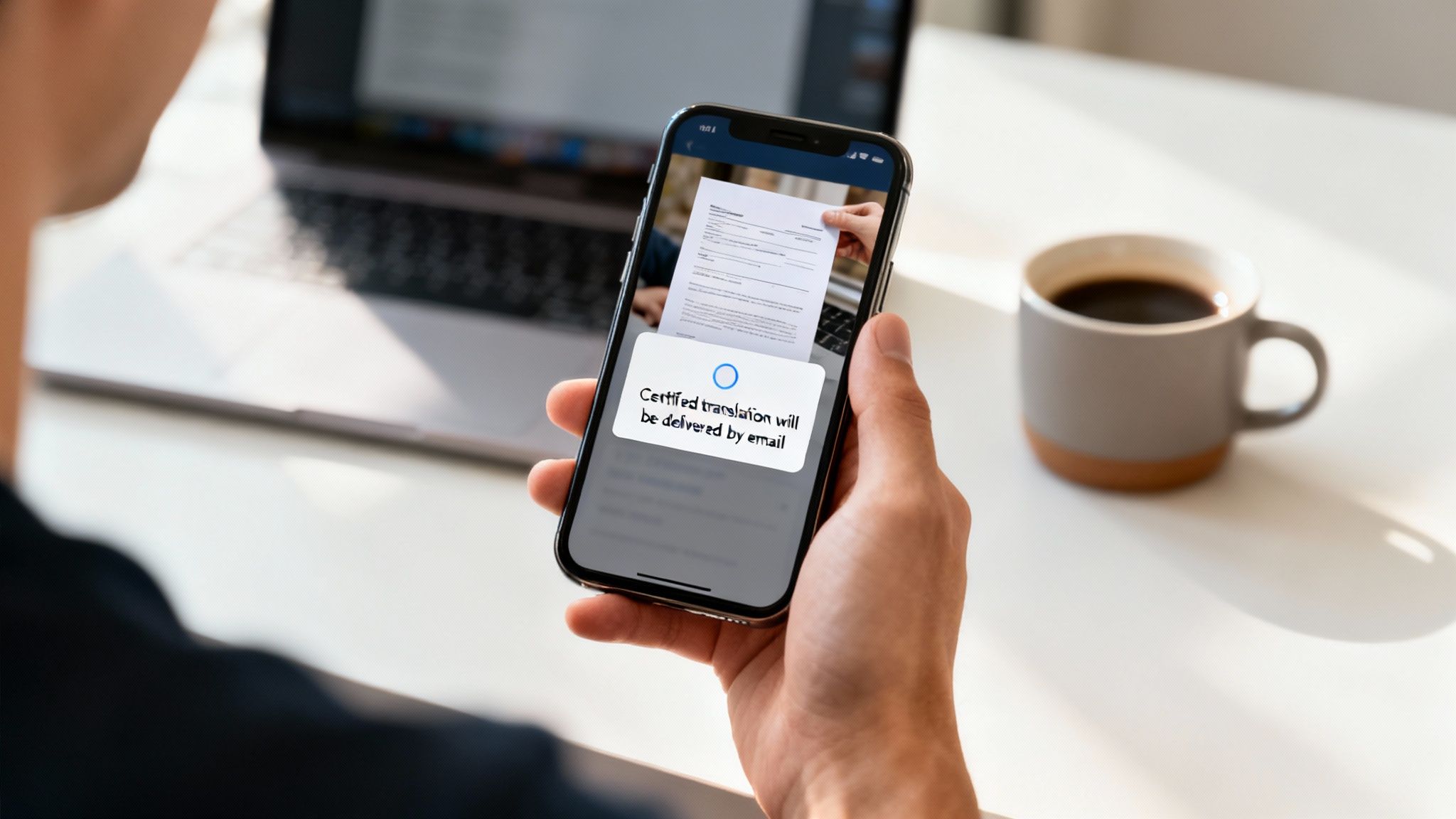
You don't need a fancy scanner; your smartphone is perfect for the job.
- Find good lighting: Place your document on a flat surface in a well-lit area to avoid shadows that could hide text.
- Check for clarity: Zoom in on the photo to ensure every word, stamp, and signature is sharp and readable. If it’s blurry to you, it will be unreadable to the translator.
- Capture the whole page: Make sure you include the entire document, from corner to corner. The translation must be an exact representation of the original.
Step 2: Upload Your Files and Get a Quote
Next, visit the translation provider's website. A trustworthy service will use a secure, encrypted portal for uploads to protect your personal information.
Simply upload your photo or scan, select the original and target languages, and you should receive a clear, upfront quote almost instantly. Our certified translation service page guides you through this exact process.
Step 3: Review and Receive Your Certified Translation
Once you approve the quote, a professional human translator begins working. This is not a task for automated software. The global translation market is projected to reach $75 billion in 2025, largely because of the need for human precision in legal, medical, and immigration documents.
A single mistake on a USCIS form can cause months of delays, which is why a human expert is essential. You can read more about the key trends in online translation to understand why quality is so critical.
When the translation is complete, you’ll receive an email with a digital package, usually a PDF file. This is your full, official set of documents.
Your final delivery should always contain:
- A digital copy of the original document you provided.
- The professional translation, formatted to mirror the original.
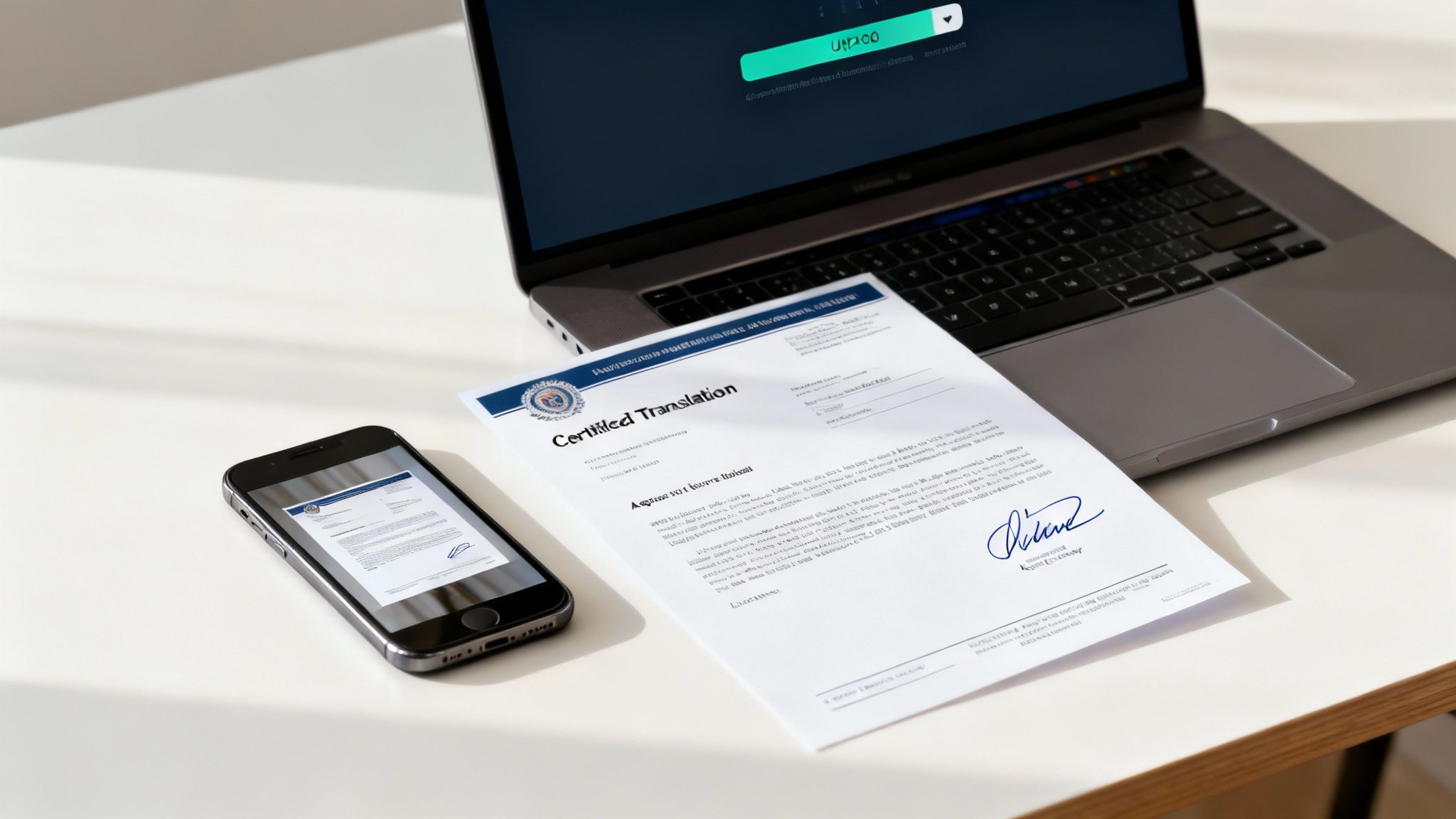
- The signed Certificate of Translation Accuracy on the company's official letterhead.
This certificate is the crucial component that guarantees authenticity and is required by official bodies like USCIS. For something as important as legal document translation, this certification is non-negotiable.
Before submitting, do a quick final review to confirm all names and dates are correct.
How to Choose a Reputable Translation Service
Not all translation services are created equal, and choosing the wrong one can lead to rejected applications, missed deadlines, and significant stress. When you look for "certified document translation near me," you need a reliable partner. Here’s how to identify a true professional.
Key Trust Signals to Look For
A professional service is transparent about its qualifications and guarantees. Look for these positive signs:
- A Rock-Solid USCIS Acceptance Guarantee: This is non-negotiable for immigration paperwork. A reliable service will state they guarantee USCIS acceptance and back it with a full refund if the translation is rejected due to accuracy issues.
- Straightforward Pricing: You should know the total cost upfront. Reputable companies offer clear, per-page or per-word pricing with no hidden fees. You can see an example of this on our translation pricing page.
- Real Customer Reviews: Look for reviews on independent platforms like Trustpilot, not just testimonials on the company's site. These provide unfiltered feedback on their reliability, speed, and customer service.
- Professional Memberships: Membership in organizations like the American Translators Association (ATA) indicates a commitment to high industry standards and professional ethics.
Red Flags to Avoid
Knowing what to avoid is just as important. These warning signs can put your application at risk:
The biggest mistake is using a service that relies on machine translation (like Google Translate) for official documents. These tools are useful for casual use but lack the precision required for legal and immigration paperwork and are almost certain to be rejected.
Here are other major red flags:
- No Clear Certification Process: If they can't explain what their "Certificate of Translation Accuracy" includes or won't provide a sample, be cautious.
- Vague or Hidden Fees: Avoid any service that won't provide a firm, itemized quote before you commit.
- No Mention of Human Translators: The translation must be done by a professional, human translator to ensure accuracy and context. This is essential for a certified translation service.
- Hard-to-Find Contact Info: A legitimate business has a physical address, a phone number, and real people to talk to. If you can only find a generic contact form, it's a warning sign.
By keeping these points in mind, you can confidently choose a translation partner who will get the job done right the first time.
What to Expect for Pricing, Turnaround Times, and Special Cases
When you need a certified translation, two key questions are "How much will it cost?" and "How fast can I get it?" Knowing the answers helps you manage your budget and deadlines without stress.
Most online translation services have adopted a simple pricing model: a flat rate per page, where a page is typically defined as up to 250 words. This transparent approach eliminates guesswork, allowing you to see the full cost from the start. A provider's translation pricing page is a great place to understand this model.
How Fast Can You Get a Standard Translation?
For urgent deadlines from USCIS or a university, speed is critical. This is where online services excel. With their global networks of professional translators, they can often deliver a certified translation for a standard document—like a birth certificate or diploma—in as little as 24 hours.
This rapid turnaround is possible because the entire process is digital. You upload your document, a vetted translator begins working almost immediately, and the final certified PDF is delivered directly to your email.
What If You Need Something More?
Sometimes, a standard certified translation isn't enough. Depending on the receiving institution, you may need additional layers of verification.
- Notarized Translation: Some institutions, particularly in legal or academic contexts, may require the translation to be notarized. This means a Notary Public verifies the translator's identity as they sign the Certificate of Accuracy, adding another seal of approval.
- Apostille: This is for international use. If you need to submit your document in a foreign country that is part of the Hague Convention, an Apostille may be required. It's a special certificate that authenticates your document for recognition across borders.
The golden rule is to always double-check the specific requirements with the organization receiving the documents. A good translation service can offer guidance, but knowing exactly what you need beforehand is the best way to prevent rejections and delays.
Common Questions About Certified Translations
Navigating official translations can feel complicated. Here are answers to the most common questions people ask when seeking certified document translations.
Can I Translate My Own Documents for USCIS?
No. Even if you are a fluent, professional translator, U.S. Citizenship and Immigration Services (USCIS) will not accept a translation you have done yourself.
USCIS requires an impartial translation to avoid any personal bias or conflict of interest. You must use a neutral third party—a professional translator or a reputable agency—who can issue the formal Certificate of Translation Accuracy.
What’s the Difference Between a Certified and a Notarized Translation?
This is a common point of confusion. They sound similar but serve very different functions.
- A Certified Translation is about accuracy. The translator or their company provides a signed statement confirming the translation is a complete and faithful version of the original document. This is what USCIS requires.
- A Notarized Translation is about identity. A Notary Public does not review the translation. Their only role is to witness the translator sign the certificate and then stamp it, officially verifying the signer's identity.
USCIS almost never requires notarization. However, other institutions, like certain universities or foreign embassies, might. Always confirm the requirements with the receiving office.
How Can I Tell if an Online Translation Service is Legit?
Before uploading sensitive documents, look for clear signs of trustworthiness.
A reputable service will have transparent, upfront pricing, a strong history of positive reviews on third-party sites, and a clear, money-back guarantee of acceptance by agencies like USCIS. Reputable companies, like us, also make it easy to understand their certified translation service process.
Pro Tip: A trustworthy provider will gladly explain their certification process and show you a sample. If a company is evasive about its credentials or guarantees, consider it a major red flag and look elsewhere.
What Format Will My Finished Translation Come In?
You will almost always receive your certified translation as a high-quality PDF delivered to your email. This digital package includes a copy of your original document, the formatted translation, and the essential signed Certificate of Translation Accuracy.
This PDF format is the standard for USCIS and most other U.S. institutions. If you need a physical copy, most online services can mail one to you for a small shipping fee.
When you need a translation that’s fast, accurate, and guaranteed to be accepted, trust the experts. Our simple online process delivers the certified documents you need with clarity and confidence.


