
When you're navigating the complex world of U.S. Citizenship and Immigration Services (USCIS), every detail matters. One small mistake on your paperwork can lead to frustrating delays or even rejection. That’s why professional uscis document translation services are essential. A certified translation ensures that your vital documents—like birth certificates or academic transcripts—are not only translated perfectly but also come with the specific certification USCIS requires for a smooth and successful application.
Why Certified USCIS Document Translation is Non-Negotiable
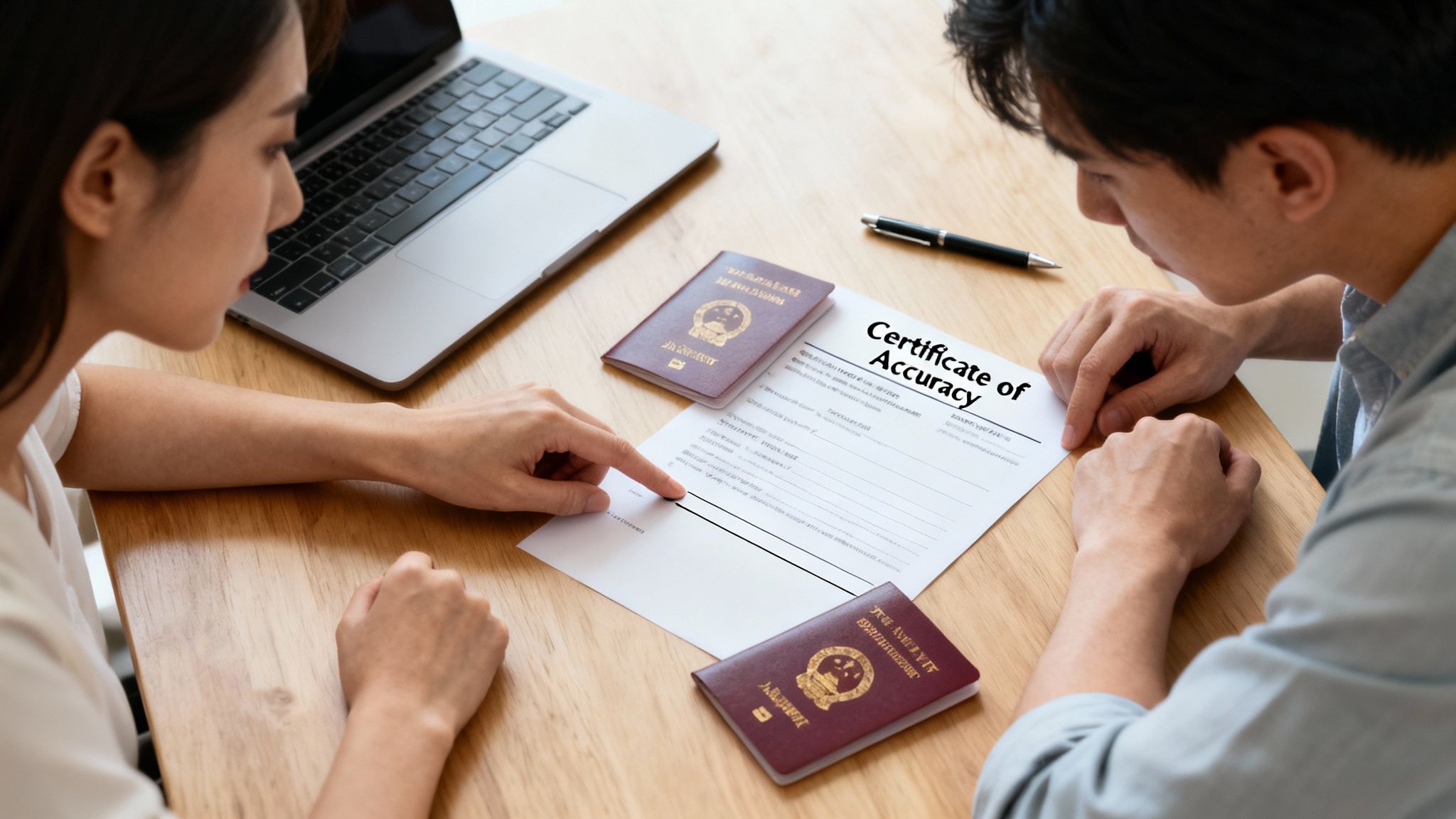
Think of your immigration application like building a house. Your personal documents are the foundation. If they're in a language other than English, they need a special kind of translation to be considered valid by USCIS, which is the U.S. government agency that handles immigration and citizenship.
This is where the term certified translation comes in, and it's a major point of stress for many applicants. Let’s make it simple.
Demystifying the "Certified" Requirement
What does USCIS mean by "certified"? It’s simpler than you might think. Many people imagine a complex, government-stamped document. This misunderstanding can lead to unnecessary costs and delays.
In reality, a certified translation for USCIS is a translated document accompanied by a signed letter from the translator or translation company. This letter, called a Certificate of Accuracy, makes a formal promise.
It must state two key things:
- The translation is a complete and accurate copy of the original document.
- The translator is competent to translate from the original language into English.
Think of it like a translator's official guarantee to the U.S. government. They are staking their professional reputation on the fact that the English version of your document is a true and faithful match. This adds a critical layer of trust to your application.
There's a lot of confusing information online. Let's separate the facts from fiction.
USCIS Translation Facts vs. Fiction
This table clarifies the actual USCIS rules versus common myths, helping you save time, money, and stress.
| What You Might Think | The Official USCIS Requirement | What This Means for You |
|---|---|---|
| "I need a notary stamp on every translation." | Notarization is not required by USCIS. A signed Certificate of Accuracy from the translator is all you need. | You can skip the extra cost and hassle of finding a notary. The focus is on the translator's signed statement, not a notary stamp. |
| "The translator must be state-certified." | The translator simply needs to be competent in both languages. No specific government license is needed for USCIS purposes. | You can use any professional translator who can confidently vouch for their skills and the accuracy of their work. |
| "I can translate my own documents." | You cannot translate your own documents, even if you are fluent. The translation must be certified by an impartial third party. | You must use a professional service or another qualified individual to handle the translation and provide the required certification. |
| "Only the original documents can be translated." | You should submit a photocopy of the original document with its certified translation. USCIS advises against sending originals. | Keep your precious originals safe! Provide clear, readable copies for the translator to work from. |
Understanding these distinctions is a crucial first step. It's an area within the broader field of immigration law where small details have big consequences.
In this guide, we'll walk you through the official USCIS translation requirements, step-by-step. We’ll show you exactly what makes a translation acceptable, which documents you'll need, and how to avoid common pitfalls on your immigration journey.
What Exactly Makes a Translation 'Certified' for USCIS?
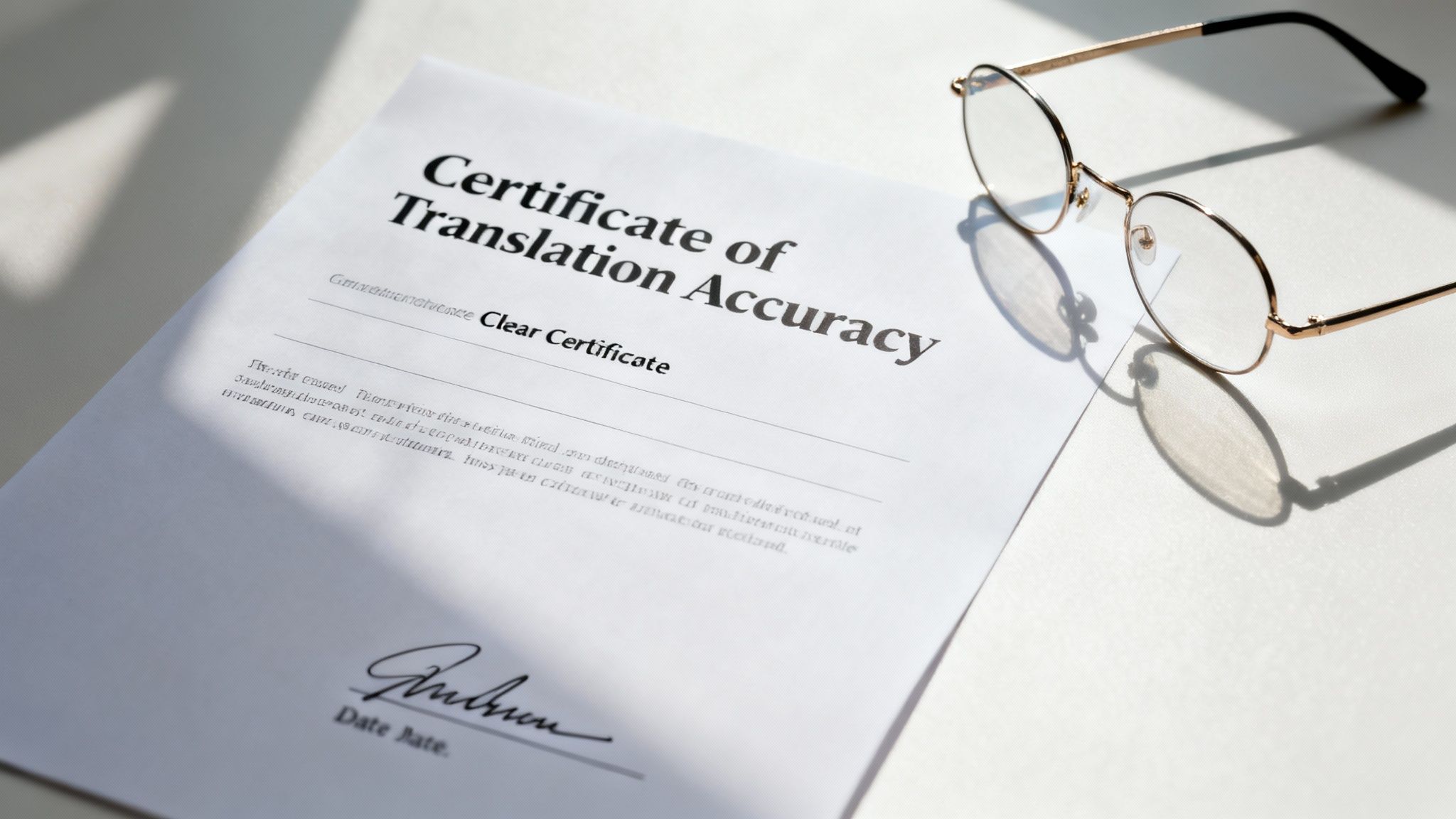
When USCIS asks for a “certified translation,” what are they really looking for? It's not about a government seal. It's about accountability.
A certified translation is a translated document attached to a formal statement from the translator or translation agency. This statement is the Certificate of Translation Accuracy.
This certificate does two critical jobs: it declares that the translation is a complete and accurate version of the original, and it confirms the translator is competent in both languages. This signed statement gives USCIS the confidence it needs to accept your documents as fact.
Breaking Down a USCIS-Approved Certification Letter
The certification letter is your proof. If it's missing key details, USCIS might send you a Request for Evidence (RFE), which means delays.
A compliant certification letter must include:
- A Statement of Accuracy: A clear sentence stating the translation is a true and complete word-for-word rendering of the original.
- A Statement of Competence: A sentence confirming the translator is fluent in both the source language and English.
- The Translator's Details: The translator's full name, signature, and contact information.
- The Date: The date the certification was signed.
This letter assures USCIS that your information has been translated faithfully by a qualified professional.
The Magic Words: What a Certificate of Accuracy Should Say
To make this crystal clear, a proper certification statement should look something like this:
Sample Certification Wording:
"I, [Translator's Full Name], certify that I am fluent in the English and [Source Language] languages, and that the foregoing document is a true, complete, and accurate translation of the attached document titled [Original Document Title]."Signature: [Translator's Signature]
Printed Name: [Translator's Full Name]
Address: [Translator's Address]
Date: [Date]
This simple format meets all of USCIS's requirements and provides the written guarantee they need.
Certified vs. Notarized: Don't Pay for What You Don't Need
A common and costly mistake is confusing a certified translation with a notarized one. A notarized translation means a notary public has witnessed the translator signing the Certificate of Accuracy.
Let's be clear: USCIS does not require notarization for translations. You only need the signed Certificate of Accuracy.
A notary only verifies the signer's identity; they don't check the translation's quality. While some institutions (like certain universities) might ask for notarization, it’s an unnecessary extra step and expense for your USCIS application. You can explore the differences between a certified and notarized translation to ensure you only get what your case needs.
What Kinds of Documents Usually Need to Be Translated?
While every immigration case is unique, a standard set of documents almost always requires a certified translation if not originally in English. These documents form the core of your USCIS application, telling your personal, legal, and professional story.
Vital Records and Civil Documents
These are official government-issued papers that prove major life events. For USCIS, these civil certificates are essential evidence.
Common examples include:
- Birth Certificates: This is the most fundamental document. It proves your identity, birth date, and parentage. A certified translation is almost always needed for Green Cards and citizenship. For example, a family applying from Mexico will need a certified translation of each child's birth certificate. Learn more about getting a notarized birth certificate translation if other institutions require it.
- Marriage Certificates: Essential for applications based on marriage to a U.S. citizen. USCIS scrutinizes this document to confirm the legality of your relationship.
- Divorce Decrees or Death Certificates: If you or your spouse were previously married, you must provide translated proof that those marriages ended, proving you were legally free to marry.
- Adoption Papers: For applications involving an adopted child, the official adoption records must be fully translated to establish the legal parent-child relationship.
Legal and Government Paperwork
USCIS needs to verify your background to ensure you meet all legal requirements. This includes any official documents related to law enforcement or court proceedings.
- Police Clearance Records: Many applications require a police certificate from every country where you lived for more than six months after turning 16. This shows your criminal history (or lack thereof) and must be fully translated.
- Court and Prison Records: If you have ever been arrested, you must provide translated copies of all related court paperwork. This is non-negotiable. For example, an individual seeking asylum who was detained for political reasons must provide translated court documents to support their case.
- Military Records: If you served in another country's armed forces, those records must be translated.
- Passports and National ID Cards: While the main page is often in English, any stamps, visas, or handwritten notes in another language might need translation to clarify your travel history.
Academic and Professional Credentials
For employment-based visas (like the H-1B) or any application where your education is relevant, you must prove your qualifications.
- University Diplomas and Degrees: Proof of your educational attainment.
- Academic Transcripts: An academic transcript is a detailed record of your courses and grades. A skilled translator ensures course titles are translated correctly to reflect your expertise.
- Professional Licenses: For fields like medicine or engineering, translated licenses are needed to prove you are qualified.
Imagine a software engineer from India applying for an H-1B visa. To get approved, she needs to prove her bachelor's degree is equivalent to a U.S. degree. She submits certified translations of her diploma and academic transcripts. The translator accurately converts her technical course names into their English equivalents, allowing the credential evaluation agency to quickly validate her qualifications, a key step in her visa approval.
A Step-By-Step Guide to Getting Your Documents Translated
The process of getting your documents translated for USCIS can seem daunting, but it follows a clear, manageable path. Following these practical steps will keep you organized and help you submit your application with confidence.
Step 1: Gather and Prepare Your Original Documents
First, make a checklist of all the documents you need translated: birth certificate, marriage license, academic records, etc. Once you have the physical papers, create high-quality digital copies. A scanner is best, but a clear, well-lit photo from your phone will work. Professional uscis document translation services work from these digital files, so ensure every word and stamp is readable.
Step 2: Find a Trusted Translation Service
Choose a service that specializes in certified translations for USCIS and guarantees their acceptance. This isn't just marketing—it's a promise that they understand the specific rules and stand behind their work.
Look for these signs of a trustworthy service:
- Clear Pricing: Reputable companies offer straightforward pricing, usually per page, with no hidden fees.
- Positive Customer Reviews: See what other immigration applicants say about their reliability and quality.
- Stated Turnaround Times: A professional service will provide a clear estimate of when your translation will be ready.
Step 3: Get a Clear Quote and Timeline
Upload your scanned documents to the service's secure website. They will review your files and provide a final price and an estimated delivery date. This step is crucial for managing your budget and meeting application deadlines.
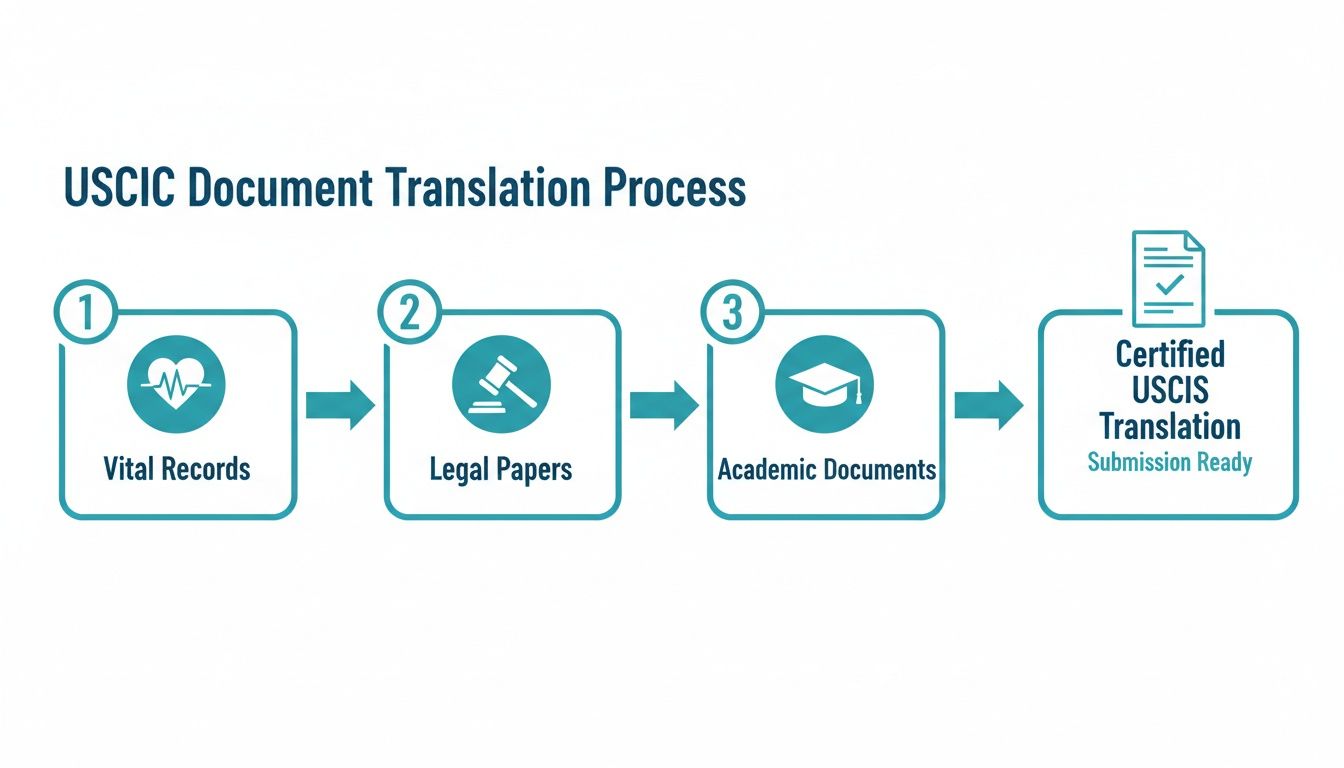
Whether it's a personal certificate, legal paper, or academic transcript, each document follows this same fundamental path to becoming a USCIS-ready translation.
Step 4: Submit and Await Translation
Once you approve the quote, a professional linguist will meticulously translate your document, formatting it to mirror the original's layout. Accuracy is everything. In Fiscal Year 2023, USCIS handled over 10 million cases. With that volume, even tiny errors can cause major delays. For more details, you can read the full research about USCIS statistics.
Step 5: Carefully Review the Final Translation
You will receive the final English version along with the signed Certificate of Accuracy. Take a moment to review it yourself. Check that all names, dates, and places are spelled correctly. A good company will gladly make swift corrections if needed.
Step 6: Submit Everything to USCIS
Here is the golden rule: you must submit both the certified English translation and a clear copy of the original foreign-language document. Don't forget the Certificate of Accuracy—it's the official proof USCIS is looking for. Bundle them together in your application package for a complete submission.
How to Avoid Mistakes That Delay Your Application
A single mistake in your translation paperwork can bring your immigration case to a halt. USCIS will issue a Request for Evidence (RFE), pausing your application until you fix the problem. The key to a smooth process is getting your uscis document translation services done right the first time.
Let's review the most common pitfalls to avoid.
Forgetting the Signed Certification Letter
This is the most critical error. A translation without the signed certification letter is just an unofficial document to USCIS. That letter is the translator’s promise of accuracy.
Real-world example: An applicant for a marriage-based Green Card submitted a perfectly translated marriage certificate but forgot the signed certification. The result? A three-month delay while they tracked down the translator for a signature. This simple oversight put their life on hold.
Submitting a Summary Instead of a Full Translation
USCIS requires a complete, word-for-word translation. Submitting a summary is an automatic red flag. Every stamp, seal, and handwritten note must be translated or noted (e.g., "[Seal]"). Leaving out these details makes the translation incomplete.
Using a Family Member or Yourself as the Translator
While it may seem like a way to save money, USCIS considers translating your own documents a conflict of interest. The certification must come from an impartial third party. Using a professional service eliminates any doubt about the translation's objectivity.
This is also a matter of legality. Serious cases, like a United States lawyer charged with forging an immigration document, underscore the importance of submitting legitimate, properly certified paperwork.
Forgetting to Include the Original Document
Another common mistake is failing to include a copy of the original non-English document with its translation. The USCIS officer needs to compare the two side-by-side. Always include a clear photocopy of the original.
The need for accurate translations is significant. As of 2025, translation services in the U.S. have grown into a $10.7 billion market, highlighting how vital professionals are in helping people avoid these costly mistakes.
By sidestepping these traps, you build a stronger, more credible case for your approval.
Why a Professional Service Is Your Best Investment
When dealing with USCIS, trying to save a few dollars on translation can be a costly mistake. Using professional uscis document translation services is not an expense—it's a critical investment in your future.
A professional service acts as your safety net. Their primary benefit is a 100% USCIS acceptance guarantee. This is their promise that they know the agency's strict rules and will deliver a translation that meets every requirement. From the precise wording on the certification letter to correct formatting, they get it right, eliminating the risk of rejection.
Unwavering Accuracy from Vetted Linguists
Professional services use expert linguists trained in the specific terminology of legal, medical, and academic documents. They understand that a birth certificate translation requires the same precision as a complex legal contract. This accuracy is ensured through a quality control process where a second linguist often reviews the work, catching subtle errors.
Complete Confidentiality for Your Sensitive Data
Your personal documents contain your most private information. Entrusting them to a service requires confidence in their security.
Established agencies operate under strict confidentiality protocols:
- Secure Platforms: They use encrypted websites for document uploads and communication.
- Privacy Agreements: All translators sign non-disclosure agreements (NDAs), legally binding them to protect your data.
- Data Protection: They have robust security practices to protect your identity from potential breaches.
Choosing an established service means your application is supported by an accountable team. It's a commitment to quality that protects your data and improves your chances of a smooth application process. You can learn more about our simple and secure translation pricing and process.
When it comes to something as life-changing as your immigration case, the peace of mind from professional expertise is invaluable.
Got Questions About USCIS Translations? We've Got Answers.
The USCIS process can be confusing, and document translations are a common source of questions. Here are clear answers to the most frequent inquiries.
Do I Really Need to Get My Translation Notarized?
No. This is one of the biggest myths. USCIS does not require notarization for translated documents. A notary stamp only verifies the identity of the person signing the document; it doesn't confirm the translation's quality. What USCIS requires is the signed Certificate of Accuracy from your translator.
I'm Fluent in Both Languages. Can I Just Translate My Own Documents?
No. Even if you are perfectly bilingual, USCIS considers this a conflict of interest. The translation and its certification must come from a neutral third party who has no personal stake in the outcome of your immigration case. This rule ensures the translation is objective and trustworthy.
How Long Will It Take to Get My Documents Translated?
Turnaround time depends on the document's complexity. For standard, single-page documents like birth certificates or marriage licenses, many professional services offer a 24-hour turnaround. For longer documents, such as multi-page legal contracts or full academic transcripts, it will take more time. Always ask for a clear timeline upfront to avoid surprises and meet your deadlines.
Speak with a translation specialist today to ensure your documents are prepared correctly and on time.
Get an instant quote and have your USCIS-ready certified translation back in as little as 24 hours.


