
Getting a translation certified can feel like a complicated step, but it's simpler than you might think. Imagine you're applying for a Green Card and need to submit your birth certificate from another country. Officials at U.S. Citizenship and Immigration Services (USCIS) can't read the original language, so they need an English version they can trust completely. That's where a certified translation comes in. It’s a professional translator's signed promise that the English version is a complete and accurate copy of the original. This guide will walk you through everything you need to know, using real-world examples to make the process clear and stress-free.
What a Certified Translation Really Means
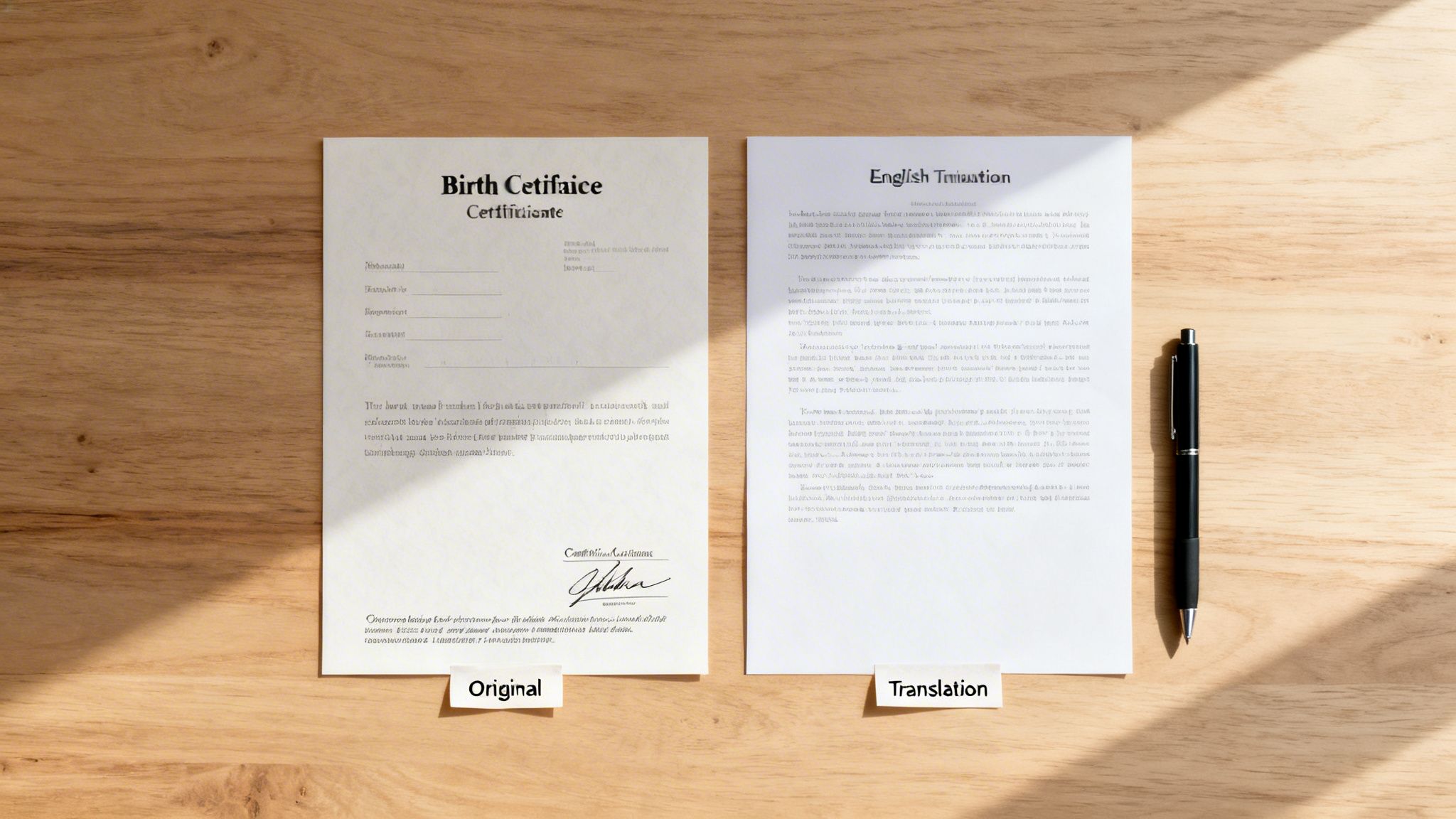
Many people think a "certified translation" needs a government stamp or goes through a complex legal process. In the U.S., it's actually much more straightforward. A certified translation is simply a translated document attached to a formal statement from the translator or translation agency. This statement, often called a "Certificate of Accuracy," is their professional guarantee.
Think of it as a translator’s seal of approval. The certificate confirms two key things:
- The translator is fluent in both the original language (like Spanish) and the target language (like English).
- The translation is a complete and precise word-for-word copy of the original document.
For example, a student from Japan applying to an American university needs their academic transcripts translated. The university admissions office needs to be certain that the grades and course names are translated correctly. The Certificate of Accuracy provides this assurance. Without it, the application could be delayed or even rejected, potentially causing the student to miss an entire semester.
The Essential Parts of a Certification Statement
To be accepted by official bodies like USCIS or universities, the certification statement must contain specific information. It's not just a quick note; it’s a formal document with a clear purpose.
Here’s a simple checklist of what every valid certification must include:
| Requirement | What It Means | Why It's Important |
|---|---|---|
| Statement of Accuracy | A clear declaration that the translation is a complete and precise version of the original. | This is the core of the certification. It's the translator's professional guarantee of quality. |
| Translator's Credentials | The full name, signature, and contact information of the translator or company representative. | This makes the translator accountable and allows officials to verify the source if needed. |
| Document Identification | The name of the document (e.g., "Birth Certificate") and the language pair (e.g., "Spanish to English"). | This links the certification directly to your specific document, preventing any confusion. |
| Date of Certification | The date the translator signed the statement. | This establishes a clear timeline for when the translation was certified as accurate. |
The signature is what makes the document official. Whether it's a physical ink signature or a secure digital one, it's the element that confirms the translator's accountability. You can learn more by understanding the nuances of a wet signature and its digital equivalents.
Certified vs. Notarized vs. Sworn Translations
It’s easy to mix up these terms, but they mean very different things. Submitting the wrong type can cause serious delays.
Certified Translation: As we've discussed, this is a translation with a statement of accuracy from a professional translator. This is the standard requirement for USCIS, U.S. universities, and most legal purposes in the United States.
Notarized Translation: This adds one extra step. A Notary Public watches the translator sign the Certificate of Accuracy and then adds their own stamp and signature. The notary is only verifying the identity of the signer, not the quality of the translation. USCIS does not require notarization. It's usually only needed for specific legal or international documents, like certain adoption papers or real estate contracts abroad.
Sworn Translation: This is a more formal process common in countries outside the U.S. (especially in Europe and South America). A "sworn translator" is someone who has been officially appointed by a court or government body. Their translations have special legal status within that country. This is not a requirement in the U.S. system.
For instance, if a couple from France is moving to the U.S., they would need their French marriage certificate translated for their visa application. A standard certified translation is all they need—not a sworn or notarized one. Any reputable agency offering USCIS immigration translation can provide this correctly.
Getting Your Documents Ready for Translation
The biggest cause of delays in the translation process isn't the translation itself—it's starting with a poor-quality copy of your original document. A translator can only work with what they can see. A blurry, cropped, or hard-to-read file will lead to questions, delays, and potentially an inaccurate translation.
Remember, the official reviewing your case will compare the translation directly against your original document. A photo taken in a dark room with a shadow across it doesn't just make the translator's job difficult; it can make the document look suspicious.
The Best Way to Digitize Your Documents
Turning your paper document into a digital file is a critical first step. While snapping a quick photo with your phone is tempting, it often results in glare, shadows, and distorted angles that hide important details.
For the best results, use one of these methods:
- High-Resolution PDF Scan: This is the gold standard. Using a flatbed scanner (found at home, the office, or a copy shop) creates a clean, flat, and sharp PDF that preserves the original layout perfectly. This is essential for multi-page documents like academic transcripts or legal agreements, as it keeps everything in the correct order.
- Smartphone Scanning App: If you don’t have a scanner, a dedicated scanning app (like Adobe Scan or the one built into your phone's Notes app) is the next best option. These apps are designed to correct perspective, remove shadows, and enhance clarity, producing a much better result than a simple photo.
Pro Tip: Before you upload, name your file clearly. Instead of "IMG_2026.jpg," use something descriptive like "Maria-Garcia-Birth-Certificate-Mexico.pdf." This simple step helps keep your project organized and prevents mix-ups, especially if you're submitting multiple documents.
A Quick Pre-Submission Checklist
Before you hit "send," take a minute to review your digital file. This small check can save you days of back-and-forth later. Imagine the frustration of having your visa application stalled for weeks because a page was missing from your translated police record.
Run through this quick checklist:
- Is it complete? Make sure all pages are included. For a passport, that means the front and back covers and any pages with visas or stamps. For a transcript, double-check that every single page is there.
- Is it legible? Can you clearly read every word, date, signature, and stamp? If a part of the original document is genuinely unreadable, the translator will mark it as "[illegible]," which is the correct procedure.
- Is it unobstructed? Check the corners and edges to ensure your fingers, a shadow, or the corner of a desk isn't covering any information. Every part of the document must be visible.
For legal professionals managing sensitive client files, an organized system is key. Using reliable document management software for law firms can help ensure documents are secure, organized, and ready for a smooth translation process.
How to Choose a Reputable Certified Translation Provider
Knowing you need a certified translation is the first step. Finding a provider you can trust is the next. A quick search will give you dozens of options, but they are not all the same. The company you choose directly impacts whether your immigration application, university admission, or legal case proceeds smoothly.
Imagine you're facing a tight USCIS deadline for your citizenship paperwork. The last thing you need is a rejection because you chose a cheap, inexperienced translator. It’s crucial to look past flashy websites and focus on what truly matters: expertise, guarantees, and a proven track record.
Why Your Bilingual Friend Can't Do This
It's tempting to ask a friend or family member who is fluent in both languages for help. "They speak perfectly, what could go wrong?" This is one of the most common—and costly—mistakes people make.
Official bodies like USCIS require the translation to be certified by an impartial third party. A friend or relative has a personal connection to you, creating a conflict of interest. More importantly, they likely lack the professional training to format the document correctly and write a certification statement that meets official standards.
A professional translation agency doesn't just change words from one language to another. They provide a guarantee of acceptance, expertise in official formatting, and a formal certification that will stand up to scrutiny.
Your Vetting Checklist: What to Look For in a Provider
When comparing translation services, use this checklist to separate the reliable agencies from the risky ones.
Here are the non-negotiables:
- A Rock-Solid USCIS Acceptance Guarantee: Any service specializing in immigration documents should offer this. A 100% acceptance guarantee is a huge sign of confidence and experience with federal requirements.
- Membership in Professional Organizations: Look for affiliations with respected bodies like the American Translators Association (ATA). Membership shows a commitment to professional ethics and quality standards.
- Clear, Upfront Pricing: The cost should be simple and transparent. Trustworthy companies often charge a flat rate per page (usually up to 250 words) and don't add hidden fees for the certification itself. You should be able to get an instant quote online.
- Specialization in Your Document Type: Does the company have proven experience with academic transcripts, legal contracts, or medical records? A provider familiar with the specific terminology and formatting for your document will deliver a more accurate result.
For a deeper dive, check out this guide on how to choose the best online certified translation service.
Real-World Scenarios: Where the Right Choice Matters
Let's look at two common situations.
First, there’s Maria. She needs her university diploma from Argentina translated for a U.S. master's program. To save money, she asks her cousin, a native Spanish speaker, to do it. The language is correct, but the document lacks the proper formatting and, crucially, a valid certification statement. The university rejects it, and Maria misses the application deadline for the entire semester.
Then there's Chen. He’s applying for a Green Card and needs his marriage certificate from China translated. He finds a professional agency online that offers a 100% USCIS acceptance guarantee. Within 24 hours, he has a perfectly formatted translation with a signed Certificate of Accuracy. His application moves ahead without a single translation-related hiccup.
These stories show why the provider of your translation is so important. A professional service isn't just a language expert; they are a compliance partner, ensuring your documents meet the exact standards of official institutions.
What Happens After You Click "Upload"? A Look Inside the Translation Process
So you’ve chosen a provider and uploaded your documents. What happens next? Understanding the process can reduce stress, especially when you're on a tight deadline. A professional workflow is designed to be fast, transparent, and predictable.
Let's say you're submitting a foreign marriage certificate for a USCIS application, and your deadline is just a week away. You can't afford any mistakes or delays. A clear process gives you confidence that everything will be handled correctly and delivered on time.
From Quote to Confirmation
The moment you upload your document, the process begins. You should receive an instant quote based on clear, upfront pricing—often a flat rate per page (usually covering up to 250 words). This means no surprise fees.
Once you accept the quote and complete the payment, you'll get an order confirmation email. This is your receipt and proof that the project is underway. Your document is then assigned to a professional translator who has experience with your specific document type, whether it's a legal contract, academic transcript, or birth certificate.
Understanding Turnaround Times
"How long will this take?" is usually the first question people ask. For most common documents, there are reliable industry standards.
- The 24-Hour Standard: For documents like birth certificates, driver's licenses, or single-page diplomas (typically 1-3 pages), a 24-hour turnaround is standard. This is ideal for most USCIS and university submissions.
- Urgent Translations: What if your deadline is even tighter? Many agencies offer an expedited service. This puts your project at the front of the queue, often delivering the finished translation in as little as 12 hours. It's a lifesaver for last-minute legal filings or unexpected travel needs.
These fast timelines are possible thanks to efficient online platforms that connect you directly with a global network of vetted translators.
What Your Final Delivery Looks Like
Your completed translation will arrive as a digital PDF in your email inbox. This isn't just a text file; it's a complete, professionally formatted package ready for official submission.
The PDF typically includes two main parts:
- The Translated Document: This page is designed to mirror your original document. The layout, formatting, stamps, and even signatures are carefully replicated. This makes it easy for an official to compare it side-by-side with your source document.
- The Certificate of Accuracy: This is the signed statement from the translator or translation agency. It formally attests that the translation is complete and correct and includes all the necessary credentials.
To see how these elements come together, you can view a complete certified translation example. This all-digital format is perfect for uploading directly to online portals used by USCIS, universities, and other government bodies.
Reviewing and Requesting Revisions
When the PDF arrives, take a moment to review it. Professional translators are highly accurate, but it's always good to double-check critical details like names, dates, and places to ensure they match the original perfectly.
If you happen to find a typo, don't worry. Reputable agencies have a simple revision process. Just contact their support team, point out the issue, and they will correct it quickly at no extra cost. This final check ensures your document is flawless before submission.
Common Mistakes That Can Derail Your Application
Getting your certified translation is a major step, but a simple mistake can send your entire application back to the start. A delayed visa, a missed semester—these are real consequences of small errors. By 2026, as digital submissions become even more common, the need for flawless documentation will only increase. Knowing the common pitfalls is the key to a smooth process.
According to reports on translation industry trends, a significant percentage of application rejections are tied to translation errors, a number that has been rising with the increase in global mobility.
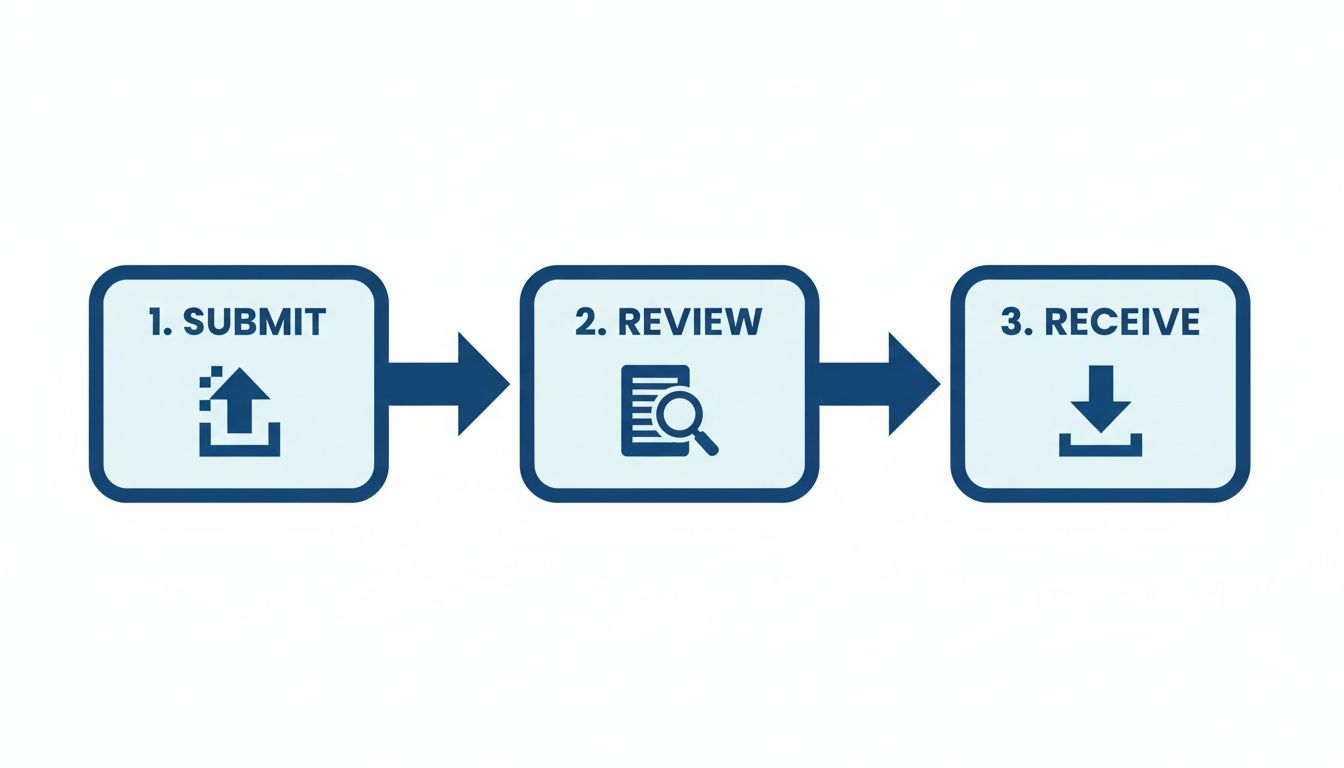
This simple process is designed for speed, but mistakes can jam the gears. Let's walk through the most common blunders so your application sails through without a hitch.
Using a Friend or Family Member as a Translator
This is the number one reason for rejection. It might seem like a practical way to save money, but official bodies like USCIS strictly forbid it. Your friend or family member is not an impartial third party, which creates a conflict of interest that will get the translation thrown out immediately.
Furthermore, a non-professional translator likely won't know the specific legal wording required for the certification statement or how to mirror the original document's format—both of which are non-negotiable. For something as critical as a USCIS immigration translation, using a professional service is the only way to ensure compliance.
Forgetting to Translate Everything on the Page
The person reviewing your documents needs to see that every single element from the original has been accounted for. This doesn't just mean the main text.
It's a common mistake to overlook things that seem minor but are crucial:
- Stamps and seals: Every official marking must be described and translated (e.g., "[Seal of the Ministry of Foreign Affairs]").
- Signatures: Even if they are illegible, they must be noted as "[Signature]".
- Faded or illegible text: Don't skip it. A professional translator will note it as "[illegible]" to show it was acknowledged.
- Headers, footers, and notes: Any text outside the main body is part of the official record and must be included.
A complete translation is a literal one. The reviewer expects to see a corresponding entry for every mark on the original document. Omitting even a faint stamp can make it seem like you are hiding something, leading to delays or rejection.
Submitting a Poorly Formatted Translation
Accuracy isn't just about words; it's also about visual presentation. A certified translation must be a "mirror image" of the original. The formatting—the placement of text, tables, seals, and logos—should match the source as closely as possible.
Imagine an academic transcript with multiple columns for course codes, titles, credits, and grades. If the translation is just a block of text, the university official can't easily compare it to the original. This makes their job harder and raises doubts. Professional services meticulously replicate the layout, which is a hallmark of a high-quality translation.
Providing an Incomplete or Incorrect Certification Statement
The Certificate of Accuracy is the legal foundation of your certified translation. A missing or improperly worded statement is an automatic deal-breaker. A simple note saying "this is accurate" is not enough.
Your certification statement must include:
- The translator's full name and signature.
- A clear statement affirming the translation is complete and accurate.
- The translator's or translation company's contact information.
- The date the certification was signed.
Forgetting even one of these elements invalidates the entire document. When you work with a professional agency, this statement is a standard part of the service, crafted to meet all legal requirements. You can learn more about what this includes on our page about translation pricing and process.
By avoiding these common mistakes, you clear the path for a smooth and successful application.
Ready to get it right the first time? Request a certified translation today and let our experts handle all the details for you.
Your Top Questions About Certified Translations, Answered
Navigating official paperwork can be confusing. When it comes to certified translations, many questions come up. Let's tackle the most common ones.
Can I Certify My Own Translation for USCIS?
No. Even if you are perfectly fluent in both languages, you cannot certify your own translation for USCIS or any other official body. The certification must come from an objective, impartial third party. Certifying your own work is a direct conflict of interest and will lead to an automatic rejection of your document. A professional service provides the neutral validation that officials require.
What's the Difference Between a Certified and a Notarized Translation?
This is the most common point of confusion.
- A certified translation focuses on the accuracy of the translation. The translator signs a statement guaranteeing that the translation is a true and complete copy of the original.
- A notarized translation focuses on the identity of the signer. A Notary Public watches the translator sign the certificate and then adds their seal to confirm the signer's identity. The notary does not check the translation itself.
Key Takeaway: For USCIS and most U.S. applications, certification is what matters. Notarization is rarely required.
How Much Does a Certified Translation Cost and How Long Does It Take?
Pricing and timelines should be clear and upfront. Most reputable online services charge a flat rate per page (typically up to 250 words). The certification itself should always be included in the price, with no extra fees.
For standard documents of 1-3 pages, like a birth certificate or diploma, you should expect a turnaround time of 24 hours. For urgent needs, expedited services can often deliver in as little as 12 hours. You can see a full breakdown of our straightforward pricing and turnaround times here.
Does the Certified Translation Need to Look Exactly Like the Original Document?
Yes, absolutely. The goal is for the formatting to be a "mirror image" of the original as closely as possible. This includes replicating the placement of stamps, seals, signatures, and tables. This consistency makes it easy for the official reviewing your file to compare the two documents side-by-side, which demonstrates professionalism and helps your case move forward smoothly. This attention to detail is crucial across all fields, with trends showing a significant rise in demand for precise technical, legal, and medical translations projected through 2026. You can read more about these language industry trends on kent.edu.
Our entire process is designed to take the guesswork and stress out of getting your documents certified. Our experts ensure your translations are accurate, properly formatted, and guaranteed to be accepted by USCIS and other institutions worldwide.
Get an instant quote and have your certified translation in your hands within 24 hours.


