
Navigating the world of official paperwork for immigration, university applications, or legal matters can feel overwhelming. When you're asked for a certified translation of your birth certificate or academic transcript, what does that actually mean? It’s simpler than it sounds. You need a word-for-word translation of your original document, and it must come with a signed statement from the translator or translation company confirming that the translation is accurate and complete. This statement, often called a "Certificate of Translation Accuracy," is what makes the translation official and acceptable for bodies like USCIS.
What a Certified Translation Really Means
Seeing a request for a "certified translation" can be daunting, but the concept is straightforward. It’s a formal guarantee that the translated text is a faithful and accurate representation of the original document.
Imagine you're applying for a Green Card in the United States, and your marriage certificate is in French. You can’t just ask a bilingual friend to type it up in English. That version, no matter how accurate, has no official standing with U.S. Citizenship and Immigration Services (USCIS), the government agency that handles these applications.
Instead, a professional translator must create the English version and attach a signed certificate. This certificate attests to the translator's competence and the accuracy of their work, giving your translated document the legal weight it needs for official review.
When You Absolutely Need a Certified Translation
Certified translations are essential in any high-stakes situation where an official body needs to trust the information in your foreign-language documents. They’re non-negotiable in a few key areas:
- Immigration Proceedings: This is the most common scenario. Any document you submit to USCIS for a visa, Green Card, or citizenship application that isn't in English must be accompanied by a certified translation. This applies to civil certificates like birth certificates, marriage licenses, divorce decrees, and police records. We cover this in-depth in our guide to USCIS translation requirements.
- Academic Applications: When you apply to universities or use credential evaluation services, they need certified translations of your academic transcripts, diplomas, and course descriptions to accurately assess your educational background.
- Legal Cases: In court, any evidence, contracts, or other legal paperwork not in the local language will require a certified translation to be admissible. For example, a contract written in German would need a certified English translation to be presented in a U.S. court.
- Medical Situations: Doctors and insurance companies often need certified translations of foreign medical records to ensure they fully and correctly understand a patient's history, which is critical for providing safe and effective care.
To help clarify what makes a translation "certified," here’s a quick summary of the key components that authorities like USCIS are looking for.
Certified Translation Key Requirements at a Glance
| Component | What It Means | Why It's Important |
|---|---|---|
| Accuracy Statement | A formal declaration that the translation is accurate and complete. | This is the core of the certification. It's a promise of quality. |
| Translator's Name & Signature | The full name and signature of the person or company representative. | Provides accountability and a clear point of contact for the work. |
| Contact Information | The address, phone number, or email of the translator/company. | Allows the requesting authority to verify the translation's source if needed. |
| Date of Translation | The date the certification statement was signed. | Establishes a timeline and confirms the document is current. |
This table shows that certification isn't just a stamp; it's a formal process that ensures every translated document is reliable, accountable, and ready for official review.
Certified vs. Notarized Translations
It's easy to get these two confused, but they serve very different purposes.
A certified translation vouches for the quality and accuracy of the translation itself. The person signing is guaranteeing their work.
A notarized translation, on the other hand, involves a notary stamp from a public official who verifies the identity of the person signing the certificate. The notary isn't confirming the translation is correct—only that the signer is who they claim to be. For most U.S. official bodies, including USCIS, certification is the primary requirement; notarization is usually not necessary.
A great real-world example is the process for permanent residence in Canada, where the government explicitly requires certified translations of foreign-language documents to meet their strict standards.
As global mobility increases, so does the demand for these official translations. With the global language services market projected to grow significantly by 2026, the need for professional, certified documents in legal and immigration contexts is more critical than ever. Understanding what certification entails is your first step to getting it right and avoiding frustrating delays.
Getting Your Certified Translation: A Step-by-Step Guide
If you're dealing with official paperwork for immigration, university applications, or legal matters, getting a certified translation can feel like just one more hurdle. But the process is designed to be straightforward. Let's walk through a practical roadmap, breaking down the steps so you can get it done right and move forward with confidence.
From start to finish, the entire process is designed to guarantee accuracy and meet official requirements. This visual gives you a quick look at the core stages.
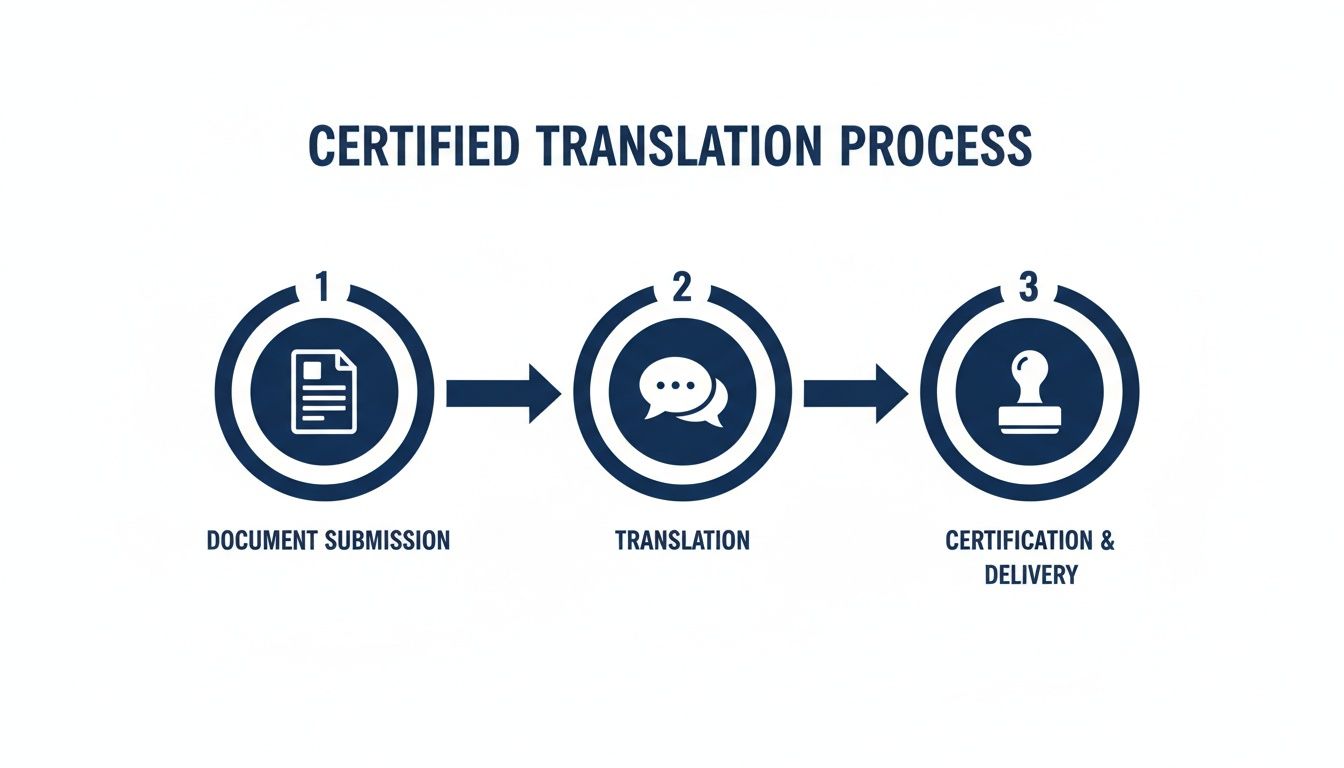
As you can see, it’s a systematic service. You provide the original document, and you get back an officially validated translation that’s ready for submission.
First Things First: Prepare Your Documents for Success
The quality of your final translation hinges on the quality of the documents you provide. This first step is more important than most people think. Before you even start searching for a translation service, get your source files in order.
Imagine sending a blurry photo of your birth certificate where the official stamp is a faint smudge. A translator can only work with what they can see. If text is illegible, they must note it as such, which could easily lead to an official body like USCIS questioning the entire document.
To ensure your files are ready for a smooth process, run through this quick checklist:
- Get High-Resolution Scans: Use a real scanner or a quality scanning app on your phone. Make sure the lighting is even, with zero shadows covering the text.
- Capture the Entire Page: Don't crop anything! Every corner, stamp, signature, and handwritten note needs to be visible. Those official seals are part of the legal document.
- Double-Check for Legibility: Zoom in on your digital file. Can you easily read every single word, number, and seal? If it's fuzzy to you, it will be impossible for the translator.
- Organize Multi-Page Documents: If you're translating something like an academic transcript, scan the pages in the correct order and, if possible, save them as a single PDF. This prevents confusion.
A few extra minutes here will save you from major headaches and delays down the road. A clean, complete source document is the foundation of a perfect certified translation.
Choosing a Reputable Translation Provider
With your documents prepped and ready, it’s time to find a translation service. The right choice offers more than just words on a page; they provide peace of mind. Think of Maria, a student from Brazil racing to meet a university deadline for her academic document translations. She needs a service that guarantees not just accuracy but also on-time delivery to secure her spot.
Here are the key things to look for in a trustworthy provider:
- USCIS Acceptance Guarantee: For any immigration paperwork, this is non-negotiable. It’s the company's promise that their translations meet the strict standards of USCIS and that they'll stand by their work.
- Clear, Upfront Pricing: You should know exactly what you're paying before you commit. Reputable services often charge a flat per-page rate (e.g., for a page of up to 250 words) with no surprise fees. If a quote seems vague, be cautious. You can see a great example of a clear breakdown in our translation service costs guide.
- Professional Affiliations: Look for memberships in respected organizations like the American Translators Association (ATA). It signals a commitment to professional ethics and high standards.
- Real Customer Reviews: Don't just look for five-star ratings. Look for reviews where people specifically mention that their documents were successfully accepted by official bodies like USCIS or for legal proceedings. That's the real proof of quality.
Expert Tip: Don't fall into the trap of choosing a service based on price alone. A rejected translation will end up costing you far more in delays, re-application fees, and stress than the few dollars you might save with a cheaper, unvetted provider.
The Online Ordering and Review Workflow
Once you’ve picked your provider, the ordering process is usually quick and painless. You’ll upload your prepared documents through their secure website, select the source and target languages, and choose your turnaround time. For a standard one-page document like a marriage certificate, many professional services can deliver within 24 hours.
After the translator completes their work, you’ll receive a digital draft for your review. This is your chance to be the final quality check. Don't skim it—review every single detail meticulously.
- Names: Are all names spelled perfectly, matching the original exactly?
- Dates: Are all dates of birth, marriage, etc., correct and in the proper format?
- Numbers: Have all passport numbers, ID numbers, or registration codes been transcribed without any typos?
If you spot an error, no matter how small, notify the provider right away. A professional service will have a clear revision process and will make corrections quickly at no extra charge. Your diligence here ensures the final version is flawless.
As soon as you give your approval, you’ll receive the final certified files, complete with the signed Certificate of Translation Accuracy. Now, you're ready to submit it to the authorities with total confidence.
What Goes into a Certificate of Translation Accuracy?
Let's focus on the single most important page in your certified translation package: the Certificate of Translation Accuracy. This is the first thing an official at USCIS or a university admissions officer will examine to determine if your documents are valid. Getting this part right is non-negotiable.
Think of it as the legal glue holding your translation to the original document. Without it, you just have a piece of paper in another language. With it, you have an officially recognized record, ready for submission.
This certificate isn't just a formality—it's a legally binding statement. When a translator or agency signs it, they are attesting that their work is a true and accurate reflection of the original.
The Anatomy of a Proper Certification Statement
So, what makes a certificate valid? There are a few key elements that absolutely must be there. When you get your translation back, run through this checklist immediately. Even a tiny missing detail can lead to a rejection of your entire application.
Here’s exactly what to look for:
- A Clear Statement of Accuracy: The wording must be specific, stating the translation is a “complete and accurate” rendition of the source document.
- Translator’s Full Name and Signature: The person who did the work (or an authorized representative of the company) must sign the certificate and print their full name.
- Contact Information: The certificate needs a way for officials to get in touch—an address, phone number, or email for the translator or agency. This is for verification purposes.
- Date of Certification: The date the certificate was signed is crucial.
- Identification of the Document: It should clearly name the document being translated, such as "Birth Certificate of Jane Doe."
These details create a paper trail, giving the receiving authority confidence that your translation is reliable and professionally done.
A Small Mistake with Big Consequences: A Real-Life Example
A few years back, we worked with a client named Carlos who was applying for a work visa. He had obtained a certified translation of his professional credentials from another provider. The translation itself was fine, but the certificate was missing the translator's phone number.
Predictably, USCIS issued a Request for Evidence (RFE), halting his application due to the incomplete certificate. That one missing detail caused an eight-week delay and immense stress while he scrambled to get a corrected version. It nearly cost him the job offer.
This story drives home a critical point: The administrative details on the certificate are just as important as the translation itself. Always, always double-check that every required piece of information is present and correct.
The need for meticulous translation services is booming. With the growth of the language services market expected to continue through 2026 and beyond, the demand for certified translations to connect people, businesses, and governments worldwide is stronger than ever.
By knowing what to look for, you can spot potential problems before they derail your plans. A complete, compliant certificate is your best defense against frustrating and preventable delays. To see what a properly formatted certificate looks like, check out our examples for USCIS immigration documents.
Common Mistakes That Can Derail Your Application
A simple misstep in the certified translation process can cause serious delays, unexpected costs, and a whole lot of unnecessary stress. Learning how to get a certified translation is just as much about learning what not to do. Based on years of experience, here are the most common pitfalls we see and how you can steer clear of them.
Asking a Friend or Family Member for the Translation
It’s tempting to ask a bilingual friend or relative to help with your documents. While their intentions are good, this is one of the fastest ways to get your application rejected by official bodies like USCIS.
Why? Authorities require an impartial, third-party translator to avoid any potential conflicts of interest or accidental bias. They need absolute confidence that the translation is a direct, objective rendering of the original—not someone's interpretation.
Submitting Blurry or Incomplete Source Documents
The quality of your certified translation is only as good as the document you provide. A blurry scan of a birth certificate where names or dates are unreadable forces a translator to either guess or mark the text as "illegible."
This immediately raises red flags for any official reviewing your file. They might question the document's authenticity or simply return it, demanding a clearer copy and a new translation. Always provide crisp, high-resolution scans that capture the entire page, including all stamps, seals, and signatures.
Choosing a Service Based Only on Price
When you're already dealing with application fees, it's natural to want to save money. But choosing a translation service just because it’s the cheapest option is a huge risk. Rock-bottom prices often come with hidden costs: inaccurate translations, missing certification elements, or no guarantee of acceptance.
Consider Sofia, who was applying for a professional license. She chose an ultra-cheap online service to translate her university diploma. The translation came back with her name misspelled and was missing a proper certification statement. By the time she realized the error, she had missed a critical submission deadline, delaying her career by months.
The lesson is clear: a rejected translation is far more expensive than paying a reasonable fee for a guaranteed, professional service from the start.
Ignoring the Fine Print of the Certification
Not all "Certificates of Translation Accuracy" are created equal. A common mistake is receiving the translated document and assuming the certification is compliant without checking the details.
For instance, a valid certificate for USCIS absolutely must include the translator's name, signature, contact information, and a clear statement of accuracy. If even one element is missing, the document can be rejected. Always review the certificate to ensure it meets the specific requirements of the institution you're submitting to. Our guide on how to obtain a certified birth certificate translation offers a clear example of a compliant document.
Common Translation Pitfalls and How to Solve Them
| Common Mistake | Potential Consequence | Simple Solution |
|---|---|---|
| Using a friend or relative | Rejection due to conflict of interest. | Always use a professional, impartial translation service. |
| Providing poor-quality scans | Inaccurate translation and official queries. | Scan documents in high resolution, ensuring all text is clear. |
| Choosing the cheapest option | Delays, rejection, and extra costs to re-do the work. | Prioritize providers with a USCIS acceptance guarantee. |
| Not reviewing the final files | Submitting a document with errors in names or dates. | Meticulously check every detail before submitting your application. |
Avoiding these mistakes is straightforward with a bit of foresight. By being diligent and choosing a reputable partner, you can ensure your application process is smooth and successful.
What to Expect for Turnaround Times and Pricing
When you’re up against a tight deadline for a USCIS application or a university admission, two questions jump to mind: How much will this cost, and how quickly can I get it back? Understanding typical timing and pricing for certified translations is key to planning ahead and avoiding last-minute panic.
The good news is that most professional services have simplified the quoting process. You no longer have to submit a document and wait days for an estimate.
How Translation Pricing Works
Today, the most common and transparent model is a flat per-page rate. For instance, a service might charge a single price for any standard page with up to 250 words. This model works perfectly for the documents most people need:
- Birth certificates
- Marriage licenses
- Driver's licenses
- Single-page diplomas
This approach removes guesswork. You know exactly what you’ll pay before you even upload your file, which is a massive relief when you're juggling other application fees. You can see a great example of these clear, upfront translation service prices and how simple it should be.
Of course, a dense legal contract or a highly technical medical report might need a custom quote. The same goes for less common language pairs, which can sometimes cost more than a straightforward Spanish-to-English translation.
Estimating Your Translation Turnaround Time
Speed is often just as important as price. Luckily, for most standard documents, the turnaround is incredibly fast.
For shorter documents—think one to three pages—many top-tier services can deliver a fully certified translation within 24 hours. This standard delivery window is usually more than enough time for anyone planning ahead.
But life happens. Imagine a student gets a last-minute scholarship offer but needs their transcripts translated over the weekend to be considered. That's when expedited services are a lifesaver.
For those "I need it yesterday" moments, most professional agencies offer rush delivery. This can get your certified translation back in your hands in just a few hours, helping you hit impossible deadlines without sacrificing quality.
When you place your order, you'll almost always see an option to choose your delivery speed. Standard is the most budget-friendly, while rush options provide a crucial safety net for when time is tight.
Your Certified Translation Questions Answered
When you're dealing with official documents, questions are bound to come up. Getting clear answers is key. Here are the most common questions we receive about certified translations to help you move forward with confidence.
Can I Just Translate My Own Documents for USCIS?
This question comes up all the time, and the answer is a firm no. Even if you are fluent in both languages, USCIS requires an impartial, third-party professional to handle the translation to avoid conflicts of interest. This rule ensures objectivity and prevents any potential for bias or accidental misinterpretation. The translator cannot be you, your spouse, or any other close relative. The only surefire way to meet this requirement is to use a professional service.
What’s the Difference Between a Certified and a Notarized Translation?
It’s easy to confuse these two, but they serve different functions.
A certified translation guarantees the quality and accuracy of the translation. It's a formal statement from a translator or company vouching for their work. Think of it as a quality guarantee.
On the other hand, a notarized translation verifies the identity of the person who signed the certification. A Notary Public watches the translator sign the certificate and then adds their official stamp. The notary isn't checking the translation itself; they're just confirming the signer is who they say they are.
For USCIS, certification is mandatory. Notarization is almost never required.
How Will I Get My Finished Translation?
Modern services are designed for speed and convenience. You will almost always receive your certified translation as a secure PDF delivered to your email. This digital file is ready for online submission to USCIS and most other official bodies.
This PDF is a complete package that includes:
- A clear copy of your original source document.
- The professionally translated version, formatted to look like the original.
- The official signed Certificate of Translation Accuracy on company letterhead.
Having it all in one file makes it simple for the reviewing official to compare the documents. If you need a physical hard copy mailed to you, most services offer that for a small extra fee. You can find more details on our FAQ page.
What if I Find a Mistake in the Translation?
Any reputable translation provider is focused on 100% accuracy, but on rare occasions, human error can occur. That’s why it’s so important to review your documents the moment you receive them. Check every detail—especially the spelling of names, all dates, and any official numbers.
If you find a clear error, like your name misspelled, let the translation service know immediately. A professional agency will have a straightforward revision policy to fix their mistakes quickly and at no cost to you. Catching these things early gives you plenty of time for corrections before you submit. This final check is your best defense against a Request for Evidence (RFE) from USCIS over a small, preventable typo on a birth certificate translation.
At TranslateDay, we’ve built our entire process around making certified translations simple and stress-free. Our expert translators handle every document with the precision it deserves, guaranteeing it will meet official standards.
Get an instant quote and you can have your finished certified translation in as little as 24 hours.


