
Imagine this: you're moving to the U.S. for a new job and need to enroll your child in school. The administration asks for their complete immunization history, but all the documents are in your native language. Or perhaps you're applying for a Green Card, and U.S. Citizenship and Immigration Services (USCIS) needs proof of a medical examination you had back home. This is where professional medical record translation becomes essential. It's the highly specialized process of converting sensitive health information—like doctor's notes, lab results, or hospital summaries—from one language to another with perfect accuracy, ensuring it's accepted by official institutions.
What is Medical Record Translation and Why is it So Important?
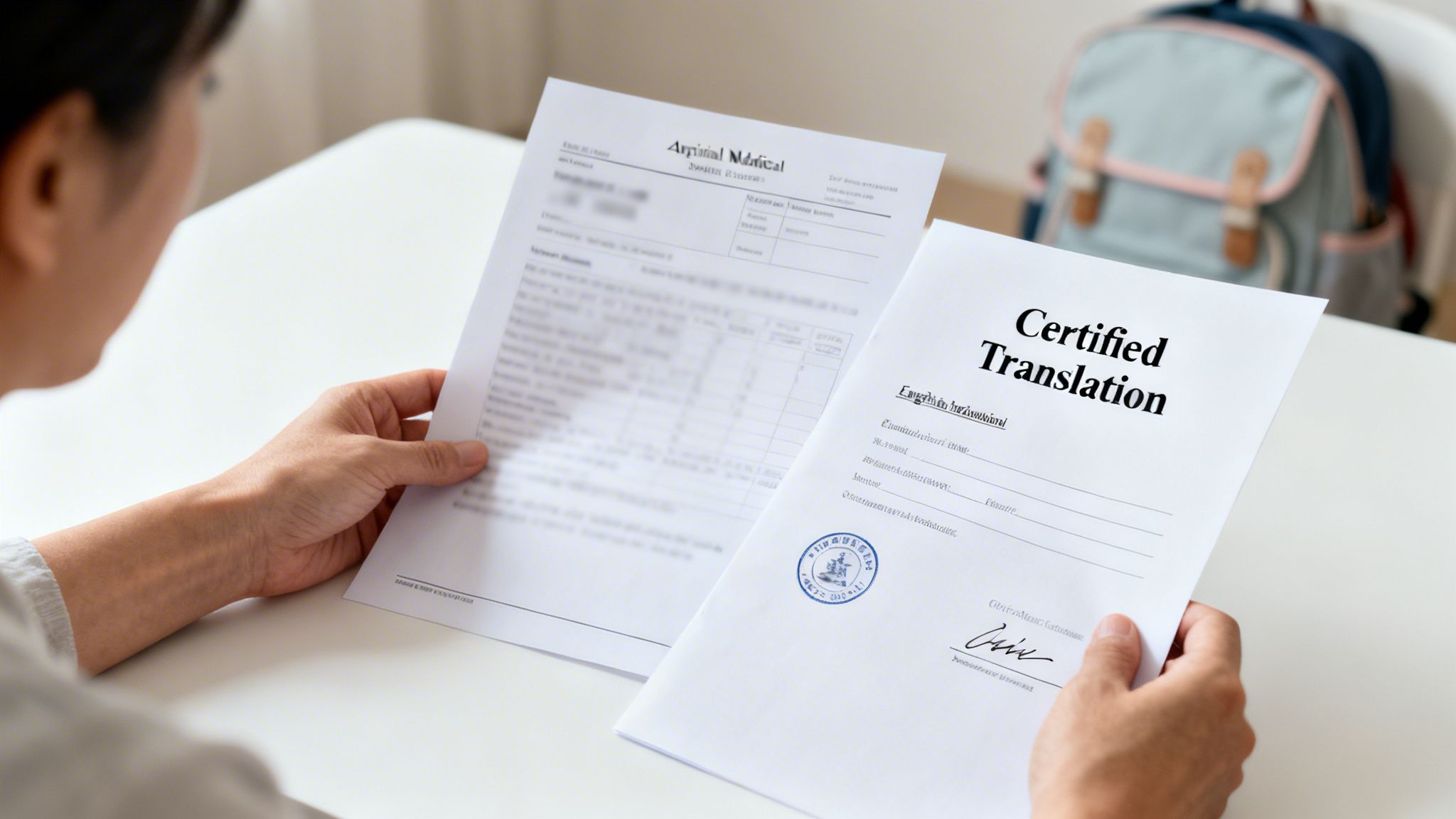
This isn't just about swapping words. Medical record translation is a meticulous service that ensures every diagnosis, prescription, and piece of medical advice is perfectly understood by healthcare providers, insurance companies, or government agencies like USCIS (the U.S. agency handling immigration and citizenship).
Let's be clear: this is not a job for Google Translate or a bilingual relative. The stakes are too high. A single misplaced decimal in a lab result or a misunderstood dosage can have serious consequences, from a delayed immigration case to a life-threatening medical error. This is why official bodies demand a certified translation. This isn't just a translation; it's a formal document where a professional translator signs a statement guaranteeing its complete accuracy, making it legally valid for official use.
The Growing Need For Accuracy
As the world becomes more connected, the demand for precise medical translations is surging. The global market for these specialized services is projected to reach US$ 805.7 million by 2030. This growth is fueled by global mobility—people relocating for work, family, or continuing their education—who all need their health history to travel with them, accurately and reliably.
The initial creation of these records is already a complex task. For those interested in how technology is helping on the front end, tools like voice recognition software for medical transcription offer a glimpse into how medical data is first captured before it ever needs translating.
Key Scenarios Requiring Medical Record Translation
You might be surprised how often the need for professional medical translation arises. Here are some real-world examples where a certified translation is non-negotiable.
| Scenario | Primary Purpose | Why Accuracy Is Critical |
|---|---|---|
| Immigration & Visas (USCIS) | Proving health status for a Green Card, visa, or citizenship application. | A minor error can lead to application delays, a Request for Evidence (RFE), or outright rejection of your case. |
| Continuing Medical Care | Ensuring a new doctor in a different country understands your full medical history. | Prevents misdiagnosis, medication errors, and ensures safe, effective treatment. |
| Insurance Claims | Getting reimbursed for medical treatment received while traveling or living abroad. | Inaccurate reports or invoices can cause claim denials, leaving you with unexpected medical bills. |
| School & University Enrollment | Providing proof of immunizations for international students. | Incomplete or unclear vaccination records can prevent a student from registering for classes. |
For example, Maria recently moved from Colombia to Florida. To enroll her daughter in middle school, she needed to provide an official English version of her daughter's vaccination record. A simple, certified translation allowed her to complete the registration in one day, avoiding weeks of potential delays.
Key Medical Documents You Will Need to Translate
When an official asks for your "medical records," they're referring to a collection of documents that tell your complete health story. Knowing which documents to gather and translate can save you from major headaches.
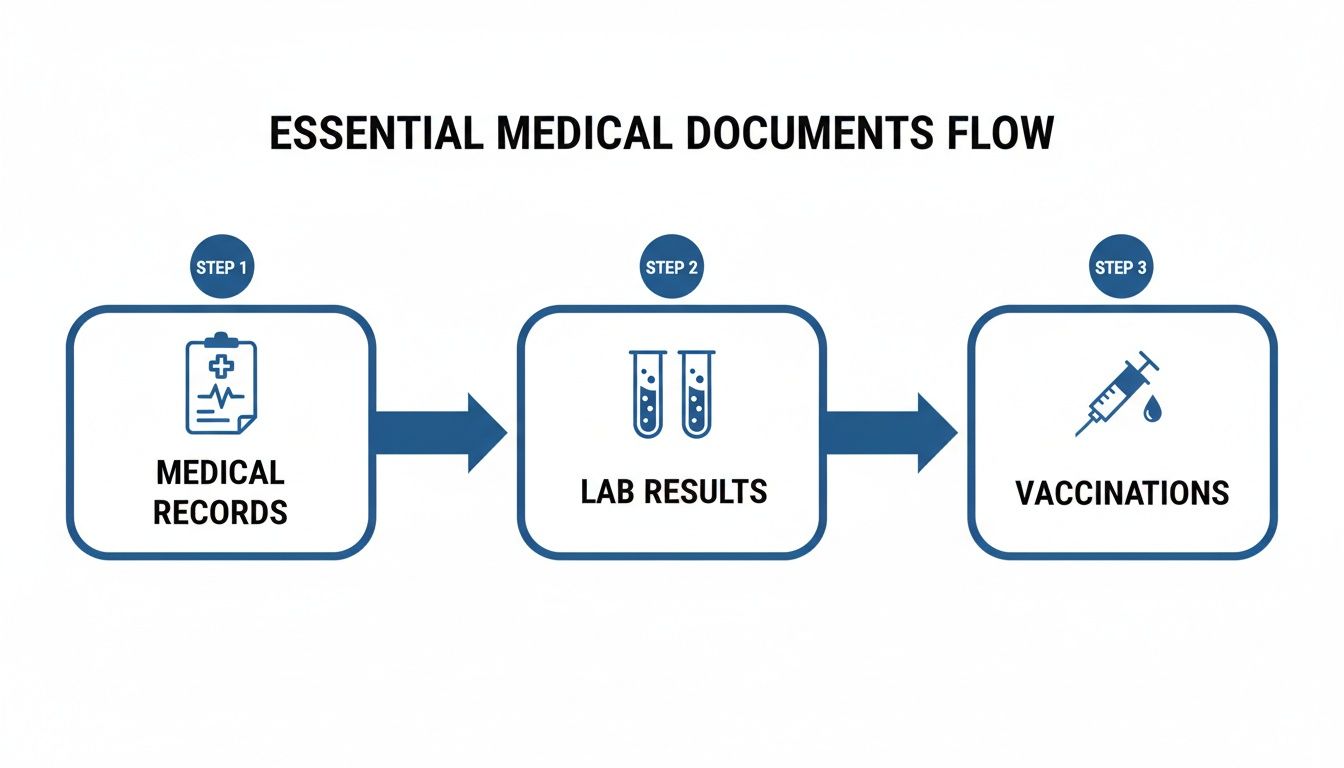
Patient Histories and Admission Notes
Your patient history is the biography of your health. It details past illnesses, surgeries, chronic conditions, and treatments. This is one of the first things a new doctor will want to see. For patients with chronic illness moving to a new country, a perfectly translated history is essential for safe and continuous care.
Admission notes are a snapshot of your condition when you entered a hospital. A certified translation ensures every detail, from your first symptoms to the doctor's initial assessment, is perfectly clear.
Lab Reports and Test Results
These documents are packed with technical data.
- Blood work panels with specific values and ranges.
- Imaging reports from MRIs or X-rays full of detailed observations.
- Biopsy results that diagnose conditions with microscopic accuracy.
Even a tiny error—a misplaced decimal point—can completely change the meaning. This is why a professional medical record translation requires a human expert who understands the stakes and guarantees every number is spot-on.
Vaccination and Immunization Records
If you're dealing with immigration or school enrollment, this is often the first document you’ll need. USCIS requires proof of specific immunizations for Green Card applications, and schools need it to register new students. A certified translation ensures the names of the vaccines and the dates they were administered are recognized and accepted, preventing frustrating delays.
Physician’s Notes and Diagnoses
These documents contain a doctor's professional opinion: the official diagnosis, recommended treatment plan, and prescriptions. When seeking health insurance coverage or continuing treatment with a new specialist, an accurate translation is non-negotiable. It allows your new provider to understand your previous care and continue treatment seamlessly and safely.
Hospital Discharge Summaries
A discharge summary wraps up a hospital stay. It covers why you were admitted, the treatments you received, your condition upon leaving, and instructions for follow-up care. For insurance claims or legal matters, this document is the official record of what happened. A word-for-word certified translation ensures insurers and lawyers have a completely accurate account, which is a core part of our medical translation services.
A Look Inside The Certified Translation Process
Getting official documents translated can feel complicated, but the process is surprisingly straightforward when you work with a professional service. It's a clear, secure journey designed to turn your original file into an officially accepted, certified translation in just a few steps.
Step 1: Securely Upload Your Documents
It all starts with you. Simply upload your medical documents—a PDF scan or even a clear photo from your phone—to a secure, encrypted platform. A trustworthy service ensures your sensitive health information is protected from the very first click, eliminating the old-fashioned hassle of mailing original documents.
Step 2: A Human Expert is Assigned to Your Project
This is where human expertise makes all the difference. Your documents aren't fed into an automated program. Instead, a project manager reviews them and assigns the job to a professional translator who specializes in medical terminology. Your files go to someone who understands the context—the abbreviations, the complex terms, and the critical nuances of a doctor’s notes versus a pathology report.
Step 3: The Translation and Certification Work Begins
The translator carefully converts the text, ensuring every word is accurate while keeping the formatting as close to the original as possible. This makes it easy for officials to compare the translation to your source document.
Once the translation is complete, the translator prepares and signs a Certificate of Translation Accuracy. This is the official statement that government bodies like USCIS require. It’s a formal declaration that the translation is a complete and accurate reflection of the original document, performed by a qualified professional. You can learn more about what this involves in our guide on how to get a translation certificate.
Step 4: Your Certified Documents Are Delivered
You'll receive a secure digital package containing both the translated document and its signed Certificate of Translation Accuracy. This digital format is perfect for uploading directly to an online immigration portal or emailing to a new clinic. For most common documents, like a single-page vaccination record or a brief lab result, this entire process is often completed in as little as 24 hours—a lifesaver when you're facing a tight deadline.
This need for fast, flawless medical translation is only growing. In fact, professional translation is projected to make up a 40.4% share of the global healthcare language services market by 2026, a trend driven by a zero-tolerance policy for errors in patient care.
Why Certification and Confidentiality Are Non-Negotiable
When dealing with personal health information, two things matter above all else: official validation and complete privacy. For any medical record translation to be useful, it must deliver on both.
The Power of a Certified Translation
Let's break down what certified translation really means. It’s a formal, legally recognized guarantee. When an organization like USCIS asks for a certified translation, they need a professional translator to attest in writing that the translation is a complete and accurate mirror of the original. This certification transforms a simple translation into an official document they will accept.
This formal stamp of approval is the bedrock of the entire life sciences translation market, a sector projected to hit USD 1.70 billion globally by 2026. North America holds the largest share, driven by strict U.S. requirements for certified English translations in hospitals, insurance claims, and immigration. You can dig deeper into these trends in this report from Grand View Research.

A Certificate of Translation Accuracy is a signed statement where the translator or agency puts their professional reputation on the line. It always includes:
- A statement confirming the translation is complete and accurate.
- The translator's name and signature.
- The date of translation.
- Identification of the original document and language.
This simple paper is what separates a professional, institution-ready translation from an informal one that will be instantly rejected.
Protecting Your Most Sensitive Information
The second pillar is confidentiality. Your medical records contain some of the most private details of your life. Protecting that information is a legal and ethical obligation. Reputable translation services operate under strict protocols compliant with regulations like the Health Insurance Portability and Accountability Act (HIPAA). This ensures your personal health information is secure throughout the entire process.
Here's how trusted providers keep your data safe:
- End-to-End Encryption: Your documents are encrypted from upload to delivery.
- Secure Servers: Files are stored on protected servers, often based in the U.S. to comply with federal data privacy laws.
- Strict Non-Disclosure Agreements (NDAs): Every translator signs a legally binding NDA, committing them to total confidentiality.
These steps are exactly how our medical translation services deliver not just precision, but also the ironclad security your information requires.
How to Choose the Right Medical Translation Service
Picking the right partner to translate your medical records is a critical decision. A poor translation can lead to rejections, delays, and unnecessary stress. Here’s a practical checklist to help you choose wisely.
Checklist for Vetting a Translation Service
USCIS Acceptance Guarantee: If you're dealing with immigration, this is non-negotiable. The provider should explicitly guarantee their certified translations will meet all USCIS requirements. This means they stand behind their work and will correct any issues at no cost.
100% Human Translators: AI tools are not reliable for high-stakes medical documents. A machine might confuse similar-sounding terms with drastically different medical meanings. Always choose a service that uses human experts specializing in medical terminology.
Simple and Transparent Pricing: You shouldn't have to guess the cost. Look for a clear, upfront pricing model, like a flat rate per page (typically up to 250 words). This transparent approach means no surprise fees. You can learn more in our guide on choosing the right medical document translation service.
Reliable Turnaround Times: Deadlines are crucial. A trustworthy provider will offer clear and dependable delivery times, such as a 24-hour turnaround for standard documents (1-3 pages), and should provide rush options for urgent needs.
Serious Data Security: Your privacy is paramount. Ensure the service uses end-to-end encryption, is HIPAA-compliant, and requires all translators to sign strict NDAs.
Positive Customer Reviews: Check third-party sites like Trustpilot or Google. Look for reviews from people in similar situations—like applying for a Green Card or submitting insurance claims—to confirm the service is reliable, accurate, and professional.
By following this checklist, you can confidently find a provider who will deliver accurate, secure, and compliant translations, letting you move forward with peace of mind.
Common Questions About Medical Record Translation
It's normal to have questions. Here are clear answers to the most common concerns about cost, speed, and official requirements.
How Much Does It Cost to Translate Medical Records?
Reputable services use a simple, flat-rate price per page, where a "page" is defined as up to 250 words. This means a one-page lab result or vaccination card has a predictable cost. For example, if a service charges $25 per page, a two-page doctor's note would cost $50. This transparency eliminates surprise fees.
How Long Does It Take to Get a Translation?
For most standard documents (1-3 pages), a 24-hour turnaround is the industry standard. A 50-page hospital record will naturally take longer, but a reliable provider will give you a clear delivery timeline upfront. Many also offer rush services if you need it done even faster.
Do I Need a Notarized Translation for Medical Records?
This is a common point of confusion. For nearly all official uses in the U.S.—including USCIS applications—you need a certified translation, not a notarized one.
- A certified translation includes a statement from the translator guaranteeing its accuracy. This is what official bodies require.
- A notarized translation only means a notary public witnessed the translator's signature. The notary does not verify the translation's quality.
Notarization is rarely needed for medical or immigration paperwork in the U.S. and adds an unnecessary step. In over 99% of cases, certification is what matters. You can find more details on our FAQ page.
Can I Translate My Own Documents for USCIS?
The answer is a firm no. USCIS rules strictly prohibit you from translating your own documents, even if you are fluent in both languages. The same rule applies to translations done by family or friends. Official agencies require an impartial, professional third party to ensure the translation is objective and free from any conflict of interest. Submitting a self-translated document is a common reason for application delays or rejections.
Speak with a translation specialist to ensure your documents meet all official requirements from day one.


