
When you're preparing documents for international use, two terms pop up constantly and often cause confusion: apostille and translation. Getting these two steps right is crucial for any immigration, academic, or legal filings. Think of an apostille as your document's official passport—it proves to foreign governments that the document is real. A certified translation is its personal interpreter, ensuring every word is perfectly understood in the new language. This guide will walk you through the process, using real-world examples to make it simple.
Understanding Apostille vs. Translation: The Core Difference
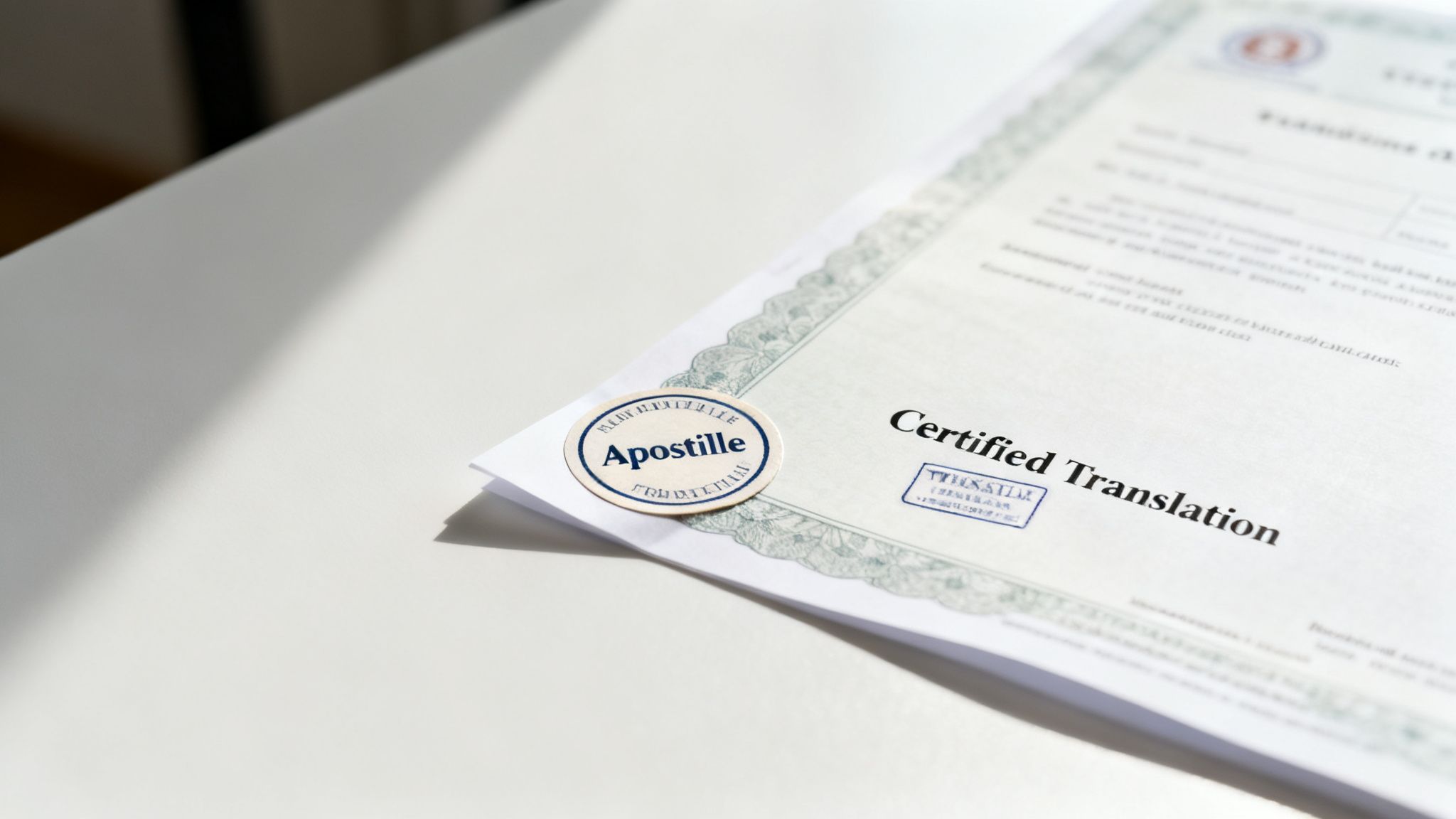
Navigating official paperwork for another country can feel complicated, but it's much simpler when you remember this key difference: the apostille is all about authenticity, while the translation is all about language.
Let's use a common scenario. Imagine Maria is applying for a Green Card in the United States and needs to submit her marriage certificate from Italy. The U.S. government, specifically an agency called USCIS (U.S. Citizenship and Immigration Services), has no easy way of knowing if her Italian document is genuine.
The Apostille: A Government Seal of Approval
This is where the apostille comes in. It’s a special certificate that a designated government authority in the issuing country (Italy, in this case) physically attaches to Maria's original marriage certificate. This certificate confirms that the signature, seal, or stamp on her document is authentic. It's the Italian government's way of saying, "Yes, we confirm this is a real and valid document from our country."
This process is standardized by the Hague Apostille Convention, an international treaty that simplifies document verification between member countries. Whether it's a civil certificate (like a birth or marriage record) or an academic transcript (your university grades), the apostille makes it officially recognized abroad.
The Certified Translation: Your Document's Official Voice
Once the document's authenticity is confirmed with an apostille, U.S. officials still need to read it in English. That’s the job of a certified translation. This isn't just a simple word-for-word swap; it’s a precise, formal translation that comes with a signed declaration from the translator or translation company.
This declaration, often called a "Certificate of Accuracy," formally states that the translation is complete and accurate to the best of the translator's ability. For organizations like USCIS, this is a strict requirement. They must be certain that every detail on a translated document, like a birth certificate translation, is 100% correct. Our certified translation services are designed to meet these exact standards for immigration, legal, and academic needs.
To make it even clearer, here's a quick side-by-side comparison.
Apostille vs. Certified Translation: At a Glance
This table breaks down the fundamental differences, helping you see their unique roles instantly.
| Aspect | Apostille | Certified Translation |
|---|---|---|
| Purpose | Authenticates the origin of the document (verifies the signature/seal is real). | Guarantees the linguistic accuracy of the document's content. |
| Who Issues It | An authorized government body (like a Secretary of State in the U.S.). | A professional translator or translation agency. |
| What It Applies To | The original document and its official seals or signatures. | The text and content written on the original document. |
| Real-World Example | Verifying a Spanish birth certificate for a U.S. Green Card application. | Translating that same Spanish birth certificate into English for USCIS. |
Ultimately, an apostille validates what the document is (an authentic government record), while a certified translation clarifies what the document says. Both are essential for your international journey, but they serve different purposes and are never interchangeable.
What an Apostille Actually Does for Your Documents
An apostille is an international seal of approval for your official documents. It’s a special certificate that tells a foreign government, "Yes, the signature, seal, or stamp on this document is legitimate and comes from a real authority."
Imagine you’re applying for a work visa in Spain using your university diploma from the United States. The Spanish consulate can't easily verify if your diploma is authentic. The apostille, issued by a U.S. authority like the Secretary of State, solves this problem. It verifies your diploma's authenticity so Spanish officials can trust it.
The Power of the Hague Apostille Convention
This system works because of the Hague Apostille Convention, an international treaty that simplified how documents are verified between member countries. Before the convention, the process was a bureaucratic nightmare called "legalization," which involved getting stamps from multiple government agencies and foreign embassies.
The Hague Convention replaced that lengthy process with a single, standardized certificate: the apostille. It's been a massive help for international business, education, and immigration. As of 2025, the convention includes 128 member countries, with major economies like China and Canada recently joining, simplifying life for millions. You can learn more about the global impact of the Apostille Convention and how it has streamlined these processes.
What Kinds of Documents Typically Need an Apostille?
You won't need an apostille for every piece of paper, but it’s a must-have for most official documents you plan to use in another Hague Convention country.
Here are some common examples:
- Civil Certificates: Birth certificates, marriage licenses, divorce decrees, and death certificates.
- Academic Documents: Diplomas, university transcripts, and professional licenses, especially when applying to a school or for a job overseas.
- Legal and Corporate Papers: Powers of attorney, court orders, and articles of incorporation.
- Federal Documents: Any document issued by a U.S. federal agency, such as an FBI background check.
This process is similar to getting other official international clearances, like a USDA Certificate for Pet Travel, where an official body validates information to meet a foreign country's requirements.
Key Takeaway: An apostille doesn’t check the content of your document. It only verifies the origin—that the signature or seal on it is authentic.
The Difference Between Apostille and Legalization
Knowing this difference can save you a lot of trouble. The apostille is the simplified option, but it only works if your document is going to a country that’s part of the Hague Convention.
If the destination country is not a member, you'll need to use the older method: consular legalization. This is a longer process where your document is certified by the Secretary of State and then authenticated by the embassy or consulate of the destination country. Always check if your destination country is a Hague member first—it's the critical first step.
Why a Certified Translation Is Non-Negotiable
A certified translation is more than just words swapped from one language to another. It's a formal, legally recognized guarantee that the translation is a perfect mirror of the original. This is essential for official bodies like USCIS, foreign universities, and courts.
This guarantee comes in a signed statement called a Certificate of Translation Accuracy. It’s the translator’s professional promise that the document is complete and correct. Without this certificate, your translated document has no official standing.
What Makes a Translation "Certified"?
For a translation to be accepted by official institutions, especially in the U.S., it must meet a few key standards. This isn't about a fancy stamp; it's about professional accountability.
- A Statement of Accuracy: The translator or translation service must formally declare that the translation is a complete and accurate representation of the original document.
- Translator Credentials: The certificate must include the translator's name, signature, and contact information, making them accountable for their work.
- Third-Party Professionalism: You cannot certify your own translation, nor can a friend or family member, no matter how fluent they are. It must come from a neutral, professional third party.
This ensures every critical detail—from names on a birth certificate to the fine print in legal translations—is captured flawlessly.
Imagine you're submitting your marriage certificate from Mexico for a U.S. spouse visa. USCIS needs 100% confidence that every name, date, and detail is translated perfectly. An uncertified translation provides zero assurance and will lead to an application rejection, likely causing months of delay.
Sworn vs. Certified Translations: What's the Difference?
You might also hear the term "sworn translation." This is different from a certified translation and is typically required by countries in Europe and Latin America.
A sworn translator is an individual who has been officially authorized by their government (like a Ministry of Foreign Affairs or a court) to produce legally binding translations. Their personal seal and signature carry legal weight.
In the United States, a certified translation is the standard. Its validity comes from the professional standards of the translation provider, who attests to the translation's accuracy. For a deeper dive, our guide on how to get a translation certificate breaks down exactly what's needed.
The Misunderstood Notary Stamp
You might hear about notarized translations. A notary stamp on a translation does not verify its quality. The notary simply confirms the identity of the person who signed the Certificate of Accuracy. As of 2025, USCIS does not require notarization for translations. A standard certified translation is sufficient. However, some institutions, like specific universities or foreign courts, may still ask for it. Always double-check the exact requirements of the organization you're submitting to.
The Correct Order: Apostille First, Then Translate
When it comes to apostille and translation, getting the sequence right is the most important rule. The golden rule is always the same: get the apostille first, then translate the entire document package.
Think of it like getting a valuable painting authenticated. The apostille is the certificate of authenticity, confirming the original is genuine. The certified translation is a detailed description of both the painting and its certificate, allowing an international buyer to understand exactly what they are getting. You would never describe the painting before it was authenticated.
Why You Must Apostille First
The apostille is a government seal that verifies the legitimacy of the original document in its source language. It’s authenticating the signature on your birth certificate or the seal on your diploma.
If you translate the document first, the apostille authorities cannot process it. They can only verify original public documents, not a translation done by a private company. This means you end up with an authenticated original and a separate, unverified translation, which is a major red flag for officials.
Getting the apostille first creates a single, unified document package. The translator then works on everything—the original document and the attached apostille certificate.
Let's look at a real-world example.
Ana is an architect moving from Italy to the U.S. for a job starting in 2026. She needs to prove her qualifications for her visa.
- Step 1: Get the Apostille. Ana takes her original Italian university diploma to the correct government office in Italy to get an apostille. This seal officially verifies the signature of the university registrar.
- Step 2: Get the Certified Translation. Now she has one complete package: her diploma with the apostille attached. She sends this entire package for a certified translation into English. The translator will translate the text on the diploma and the text on the apostille certificate.
- Step 3: Submit with Confidence. Ana now has a certified English translation of her Italian diploma and its official government authentication. When U.S. officials review her application, they see a verified original document and a certified translation of that verification. The record is clear, trustworthy, and complete.
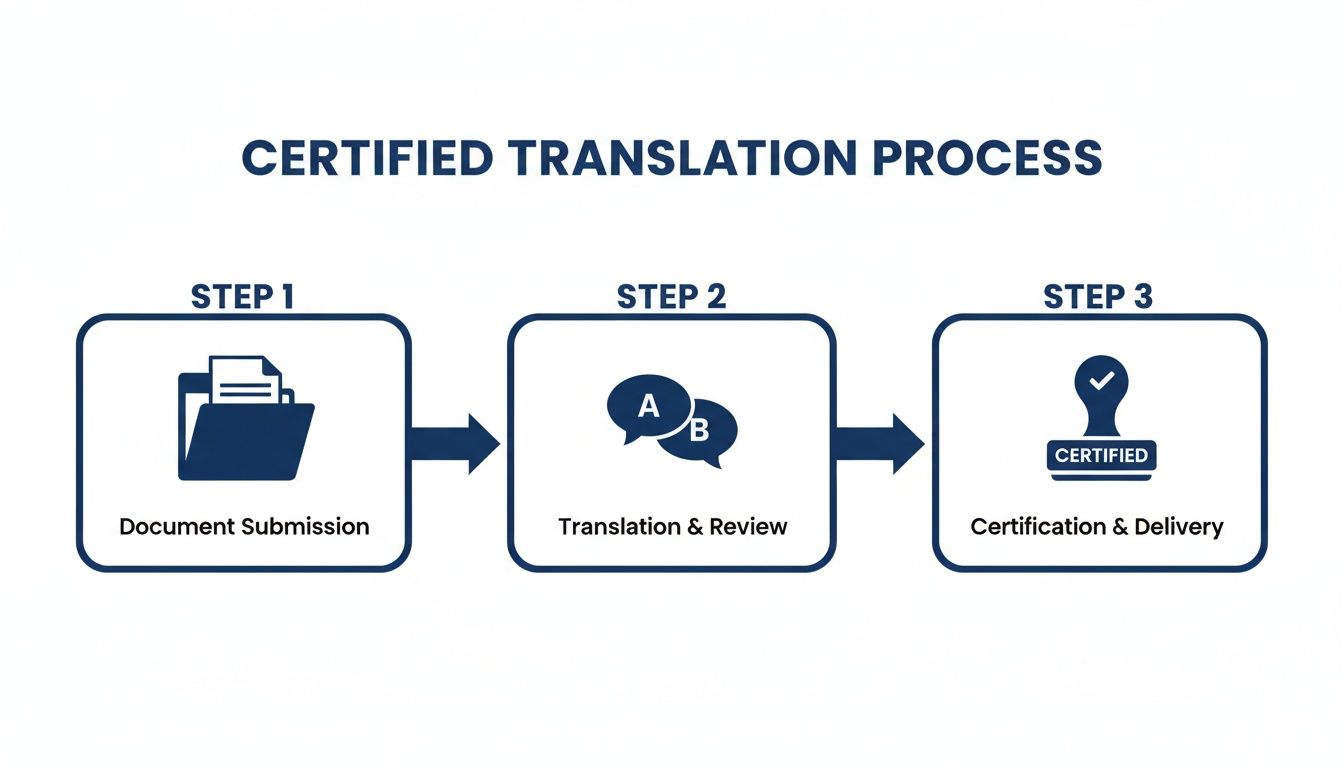
As the diagram shows, the translation and its certification are the final steps that make your authenticated document fully understandable and acceptable.
The Consequences of Translating First
Translating before you get the apostille is a critical and common mistake that leads to frustrating delays and wasted money.
Critical Mistake to Avoid: Never submit a translated document for an apostille. The apostille authority is only authorized to authenticate signatures and seals on the original public document. Your request will be rejected.
This means the money you spent on the initial translation is lost. You’ll have to go back to square one, get the original document apostilled, and then pay for a new translation of the complete package. This can cause serious delays, putting you at risk of missing deadlines for immigration or university enrollment. To avoid this, learn how to handle both the apostille and translation correctly from the start.
Practical Checklists for Common Scenarios
Let's move from theory to practice. Here are step-by-step checklists for the most common situations where you'll need both an apostille and translation.
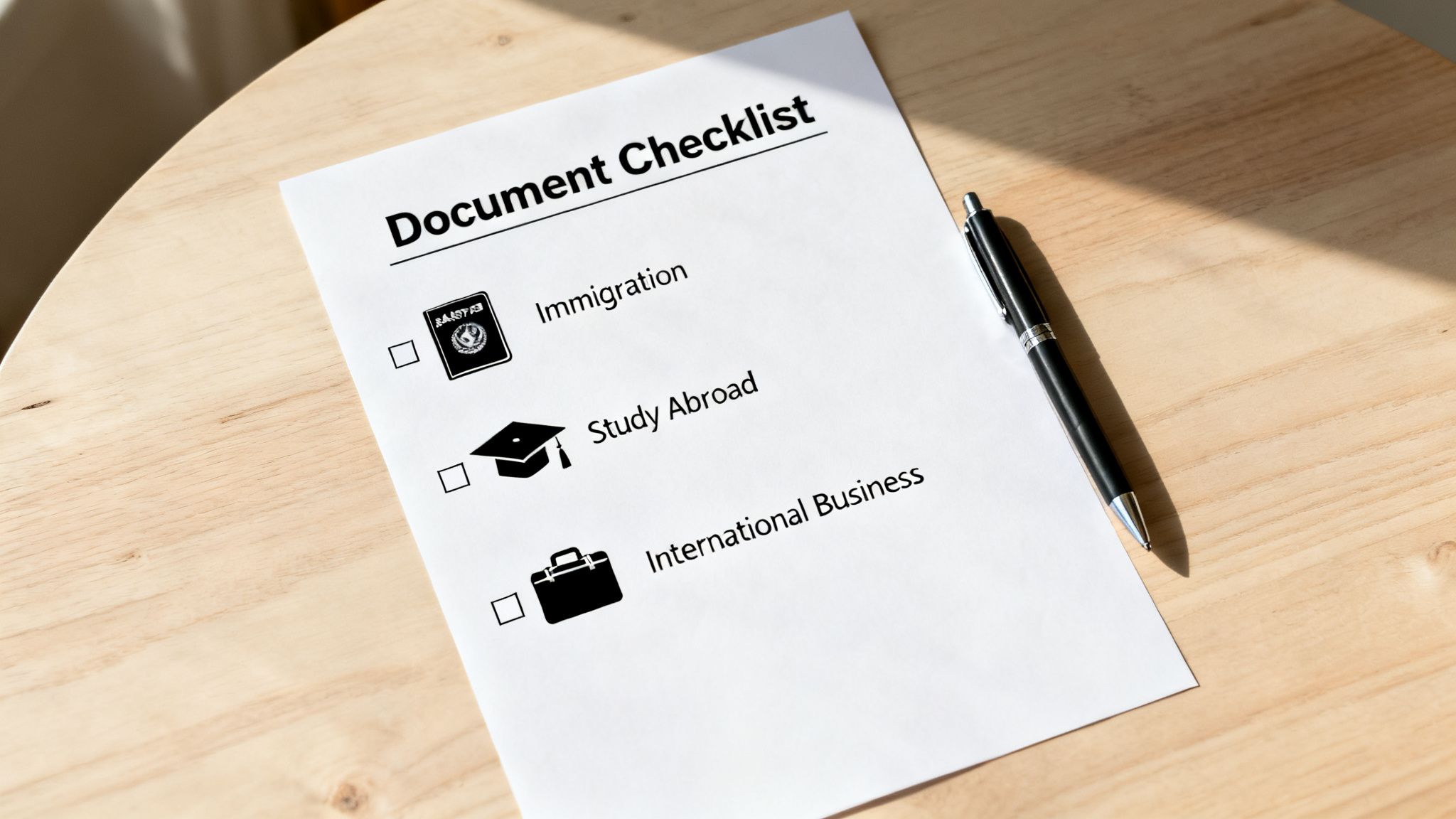
Immigration to the US for a Green Card Application
Applying for a Green Card involves strict paperwork rules. One small mistake can set you back months. Let’s walk through a real-world example: a German marriage certificate needed for a U.S. spouse-based Green Card application.
Scenario: A U.S. citizen is sponsoring their German spouse and needs to submit the German marriage certificate (Heiratsurkunde).
Step-by-Step Checklist:
- Get an Official Copy: Obtain a recent, official certified copy of the marriage certificate from the German civil registry office (Standesamt).
- Apostille it in Germany: Submit the certificate to the designated German authority for the apostille. This must be done before translation.
- Find a USCIS-Approved Translator: Look for a professional service that specializes in certified translations for USCIS.
- Translate Everything: Hand over the entire document—the original marriage certificate and the apostille page—for translation into English.
- Get the Certificate of Accuracy: The translation agency will provide the translated document along with a signed Certificate of Accuracy, which is required by USCIS. For more details, see our guide on citizenship application documents required.
- Submit Your Package: Submit a clear copy of the original German document (with the apostille) along with the certified English translation and its accuracy certificate.
Studying Abroad in a Hague Convention Country
Universities have strict requirements. Let’s imagine a U.S. student accepted into a master's program in Spain for 2026.
Scenario: An American student must submit their university diploma and transcripts to a Spanish university.
Step-by-Step Checklist:
- Request Notarized Records: Obtain official, notarized copies of your diploma and transcripts from your U.S. university’s registrar.
- Get the U.S. Apostille: Send the notarized documents to the Secretary of State's office in the state where your university is located to get an apostille.
- Get a Sworn Translation for Spain: Spain requires a "sworn translation" (traducción jurada). This must be done by a translator officially recognized by the Spanish Ministry of Foreign Affairs.
- Submit to the University: Send the complete package—the original apostilled documents plus their sworn Spanish translations—to the university's admissions office.
International Business: Power of Attorney
In international business, proper document authentication is essential. Imagine a U.S. company authorizing an agent in Japan to sign contracts. This process is similar for those preparing documents required for UK naturalisation, where foreign documents must be perfectly authenticated and translated.
Scenario: A U.S. corporation drafts a Power of Attorney (PoA) for their representative in Japan.
Step-by-Step Checklist:
- Draft and Notarize: A lawyer drafts the PoA, which is then signed by a corporate officer in the presence of a U.S. notary public.
- Apostille the PoA: The notarized document is sent to the Secretary of State to add the apostille.
- Translate for Legal Precision: The entire document (the PoA and its apostille) needs a professional legal translation into Japanese.
- Deliver to Your Agent: The final package—the original, apostilled PoA and its certified Japanese translation—is sent to the agent in Japan.
Document Checklist for Apostille and Translation
Here’s a quick-reference table summarizing which documents typically need an apostille, a certified translation, or both.
| Document Type | Apostille Required? | Certified Translation Required? | Common Use Case |
|---|---|---|---|
| Birth Certificate | Yes | Yes | Immigration, dual citizenship, overseas marriage |
| Marriage Certificate | Yes | Yes | Spousal visa applications, inheritance claims |
| Death Certificate | Yes | Yes | International estate settlement, insurance claims |
| University Diploma | Yes | Yes | Studying abroad, foreign employment visa |
| Academic Transcripts | Yes | Yes | University admissions, professional licensing |
| FBI Background Check | Yes | Yes | Long-term visas, international adoption |
| Power of Attorney | Yes | Yes | International business, overseas property sales |
| Corporate Documents | Yes | Yes | Opening a foreign bank account, establishing a branch |
Following these checklists helps ensure you get your documents right the first time, saving you from rejections and costly delays.
Common Mistakes and How to Avoid Them
Navigating the apostille and translation process can be tricky. Knowing the common mistakes can save you time, money, and stress. The most frequent error is translating a document before getting the apostille. An apostille can only be attached to an original public document, so always get the apostille first.
Translating an Incomplete Document Package
Another common mistake is forgetting to translate the apostille certificate itself. You must send the complete package—the original document and the attached apostille—for translation. Official bodies need to understand the whole record. A translation of just your birth certificate without the apostille is incomplete and will likely be rejected.
How to Get It Right: Always send the entire apostilled document to your translation provider and confirm they will translate both parts as a single package.
Submitting a Non-Certified Translation
Thinking a bilingual friend can handle the translation is a recipe for rejection. Official agencies like USCIS have strict standards for what counts as a certified translation. It must come with a signed "Certificate of Accuracy" from a professional translator or translation company, which gives it legal standing.
How to Get It Right: Use a professional translation service that specializes in official documents, whether it's a birth certificate translation for immigration or a complex legal translation for court.
Misunderstanding Timelines and Jurisdiction
Getting an apostille can take time, from a few days to several weeks, depending on the government agency. Rushing this at the last minute can cause you to miss deadlines. It's also critical to know where to get the apostille. A state-issued document, like a marriage certificate, must be apostilled by that state's Secretary of State.
How to Get It Right:
- Plan Ahead: Check the current apostille processing times and start early.
- Verify Authority: Confirm whether you need a state or federal apostille based on your document type.
- Factor in Translation Time: While many certified translations can be completed within 24 hours, it's wise to build a buffer into your schedule.
Avoiding these common mistakes will make the process much smoother.
Answering Your Top Apostille and Translation Questions
Getting the details right is crucial. Here are answers to the most common questions about apostilles and translations.
How Long Does This All Take?
The apostille is almost always the longest part of the process. Timelines can vary from a few business days to several weeks, depending on the government office. It's essential to check the current processing time with the relevant Secretary of State or federal office.
Certified translations, on the other hand, are quick. A standard 1-3 page document can typically be translated within 24 hours. Always start the apostille process first.
Does My Certified Translation Need to Be Notarized for USCIS?
As of 2025, the answer is no. For submissions to USCIS, you do not need your certified translation to be notarized. What they require is a proper certification statement—a signed letter from the translator or translation company confirming the translation is complete and accurate. However, other institutions, like foreign courts or universities, might require notarization. Always double-check the requirements with the final recipient.
What Can I Expect to Pay?
The costs for an apostille and a translation are separate.
- Apostille Fees: These are fixed government fees, typically ranging from $20 to over $100 per document.
- Certified Translation Costs: Translation is usually priced per page or per word. A transparent service will offer a simple flat rate per page, removing any guesswork. You can learn more about our pricing and turnaround for a clear idea.
Your total cost will be the government's fee for the apostille plus the fee for the translation service.
At TranslateDay, we provide fast, accurate, and USCIS-guaranteed translations to make your life easier.


