
If you've been asked for a translated copy of your birth certificate for an official purpose, you're likely wondering where to even start. The process is simpler than you might think, but there are strict rules. For any serious application—like with U.S. Citizenship and Immigration Services (USCIS) or for a university admission—you absolutely cannot translate the document yourself. A friend or family member is also not an option, no matter how fluent they are. You need a professional, impartial expert to handle it.
Your best options are professional online translation agencies, certified independent translators, or specialized local translation offices. Each has its pros and cons, but for most people needing a birth certificate translation for legal or immigration purposes, a professional agency that guarantees acceptance is the safest and fastest route.
Where to Find a Certified Translator for Your Birth Certificate
Figuring out where to get your birth certificate translated is a critical first step. Choosing the right service can save you from frustrating delays and rejections, especially when you're on a tight deadline for something important.
Imagine you're applying for a Green Card. Your whole family's future is on the line, and the last thing you need is a paperwork mistake. The agency handling your case, USCIS (U.S. Citizenship and Immigration Services), has very specific rules. They demand a certified translation. This isn't just the translated text; it's the translated document plus a signed statement from the translator or translation company. This statement is what makes the translation official.
This formal letter is called a Certificate of Translation Accuracy. It’s a simple but powerful document that promises two things:
- The translation is a complete and accurate, word-for-word copy of the original document (this includes everything—stamps, seals, and notes).
- The translator is fluent in both the original language and English and is therefore competent to perform the translation.
This certification is all about ensuring the document is trustworthy and unbiased. A translation without this certificate will almost certainly be rejected by USCIS, which could derail your application and set you back months.
This flowchart can help you visualize the path to getting an officially accepted translation.
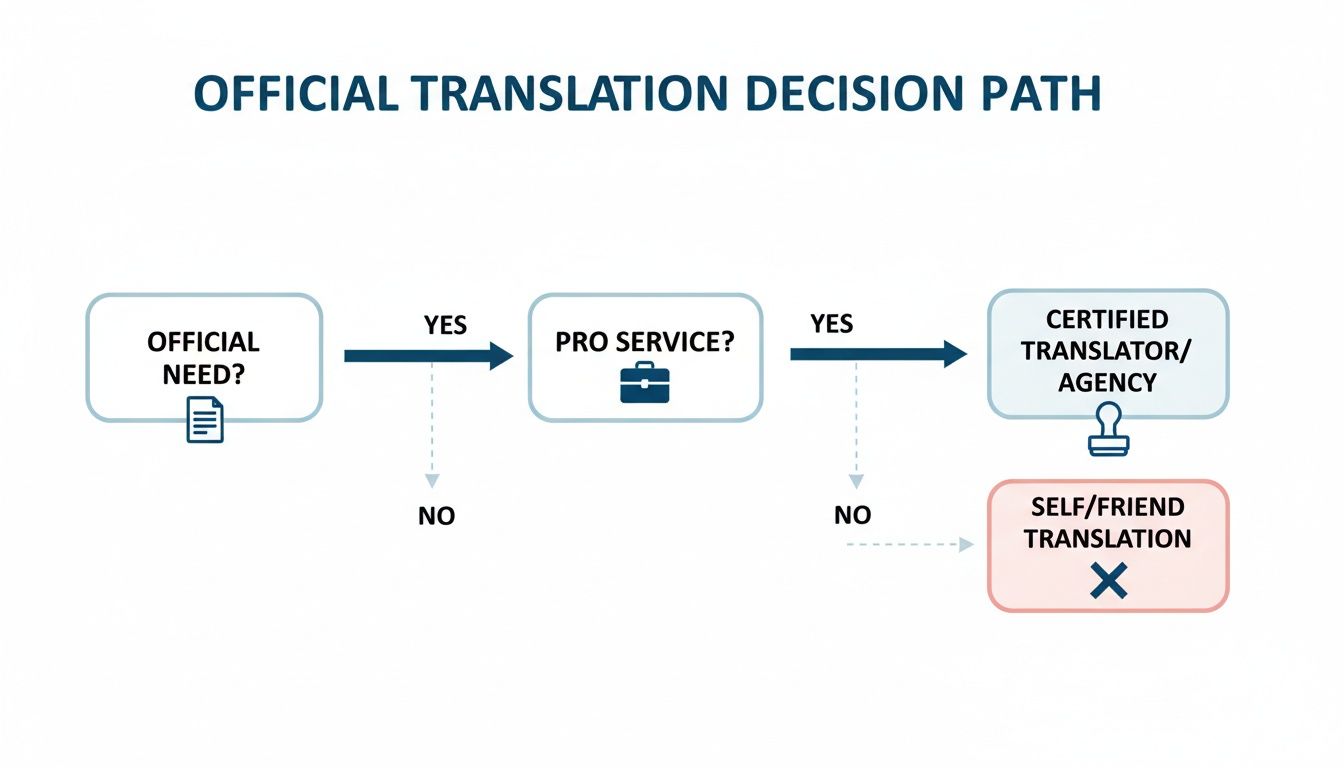
As you can see, the moment an official body is involved, a DIY translation is no longer an option. The process immediately points toward a professional service that understands how to provide the required certification.
Who Is Actually Qualified to Translate Official Documents?
Here's a common misconception: a translator doesn't need a special government-issued license to be "qualified." What they do need is proven fluency in both the source and target languages and, most importantly, to be a neutral third party.
This is why professional translation agencies are often the safest and most reliable choice. They handle official documents—like birth certificates, marriage licenses, and academic transcripts—every day. They understand the specific formatting and certification rules required by demanding institutions like USCIS, universities, and courts. To get a better sense of what makes a translation provider a trustworthy partner, you can learn more about the strict standards we follow for our birth certificate translations.
What USCIS Actually Requires for a Certified Translation
The term certified translation sounds more complicated than it is. When you're dealing with USCIS, all they need is a guarantee that the English version of your birth certificate is a complete and accurate copy of the original. That’s the entire purpose of a certified translation.
It's not a special document stamped by a government agency. A certified translation simply consists of two parts: the translated birth certificate itself, and a separate letter signed by the translator or a representative from the translation company. This letter is the Certificate of Translation Accuracy.
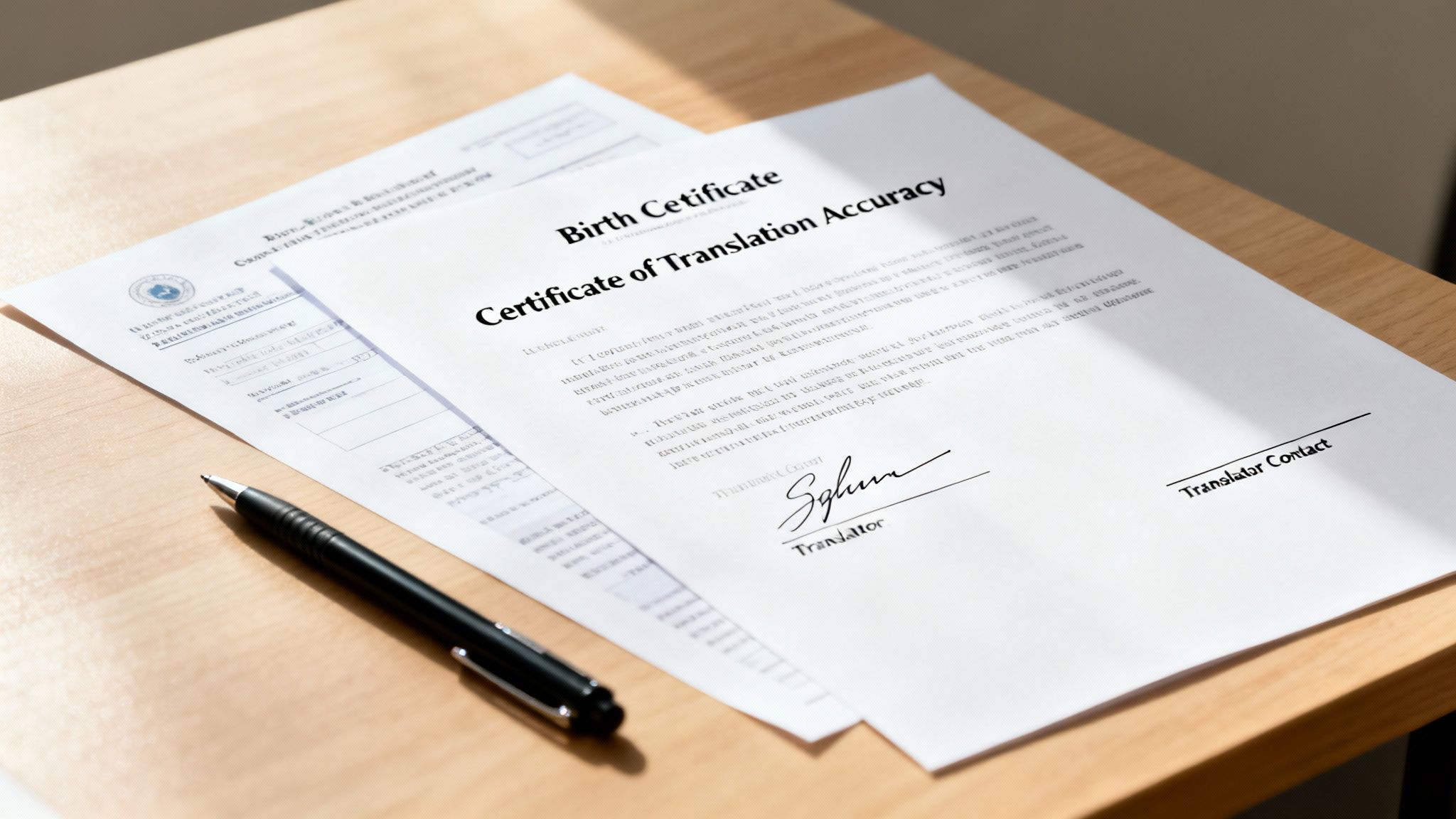
This certificate is your key to getting the document accepted. To avoid a rejection or a frustrating Request for Evidence (RFE), that certification letter must include specific details.
The Anatomy of an Acceptance-Guaranteed Certificate
Think of the Certificate of Translation Accuracy as a formal promise to USCIS. It has to clearly state a few key things to be valid. If any of these are missing, you risk serious delays.
The letter must include:
- A Statement of Accuracy: A straightforward sentence confirming the translation is a complete and accurate version of the original document.
- A Statement of Competence: A declaration that the translator is fluent in both the original language (e.g., Spanish) and the target language (English).
- The Translator's Information: The full name, signature, and contact information for the individual translator or a company representative.
- The Date of Translation: The date the certification letter was signed.
One of the biggest myths is that a translator needs a federal or state license to be "certified." USCIS does not require any specific government credentials. They just need a competent professional to stand by their work and formally declare it's accurate.
Certified vs. Notarized Translations: What's the Difference?
It's easy to confuse "certified" and "notarized" translations. While they sound similar, they serve very different purposes.
A certified translation is all about accuracy. The translator is guaranteeing the quality of their work. This is what USCIS requires.
A notarized translation, on the other hand, is about identity. A Notary Public (an official who witnesses signatures) watches the translator sign the certificate and then adds their own stamp and signature. The notary isn't checking the translation at all—they are only confirming that the person signing the document is who they claim to be. This is done with a notary stamp.
While notarization adds a layer of formality, it is almost never required by USCIS for birth certificates or other civil certificates (official documents like marriage or death certificates). You can find a complete breakdown of the official rules and learn more about what USCIS requires for certified translations in our detailed guide. This extra step is usually only needed for documents used in certain courts or for foreign embassies. For your immigration paperwork, a standard certified translation is all you need.
Comparing Your Top Options for Birth Certificate Translation
So, you know you need an official translation, but where do you actually go? Let's walk through the most common choices so you can decide what works best for your situation.
We'll break down the pros and cons of three main paths. Whether you're up against a tight USCIS deadline, submitting an academic transcript for college, or preparing documents for a court case, picking the right service from the start will save you a lot of stress.
Professional Online Translation Agencies
Think of online agencies as a one-stop shop for official document translation. Their entire process is built for speed, convenience, and ensuring the final product meets official standards. You simply upload a scan of your birth certificate, pay a clear fee, and often receive a certified translation in your email within 24 hours.
- Pros: The biggest benefit is the USCIS acceptance guarantee that many offer. This provides huge peace of mind. Their systems are designed for fast turnarounds, which is a lifesaver for last-minute needs. The pricing is also very transparent.
- Cons: You’re working with a company, not an individual. This means you likely won't speak directly with the person translating your document to discuss any unique details.
Independent ATA-Certified Translators
If your document is particularly complex or in a less common language, going directly to a freelance professional might be a good option. These are often specialists certified by organizations like the American Translators Association (ATA), and they bring a high level of expertise and a personal touch.
- Pros: You get to communicate directly with the expert doing the work. This is valuable if you need to explain context or clarify unusual wording on the document.
- Cons: It takes time and effort to find a reliable freelancer who is available when you need them. Their schedules can be full, leading to longer wait times, and their rates can vary significantly.
Local In-Person Translation Services
Finally, there's the traditional, walk-in translation office. For some people, the comfort of handing over a sensitive document in person and speaking face-to-face with staff is invaluable.
- Pros: The in-person interaction is the main draw. It can feel more secure and personal.
- Cons: These brick-and-mortar shops have higher overhead costs, which often translates to higher prices for you. They can also be slower than online services and may not have a specialist available for your specific language.
What About Cost?
A typical professional birth certificate translation will cost between $20 to $50 per page. The final price depends on factors like the language and how quickly you need it. When you consider that simple document errors are a top reason for immigration delays, it's a small price for getting it right the first time.
For most official uses like USCIS applications—where speed, guaranteed acceptance, and a clear price are essential—a reputable online agency is almost always the most reliable and efficient choice. You can review our straightforward translation pricing to see how affordable a guaranteed, compliant translation can be.
Why a Flawless Translation Can Make or Break Your Immigration Case
When navigating the immigration process, your birth certificate isn't just a piece of paper—it's the foundation of your entire application. It's the official proof of your identity, age, and family relationships. A single error in its translation, like a misspelled name or a mixed-up date, can send your case into months of delays or even lead to rejection.
Imagine the frustration of having your family's citizenship application stalled because the translator accidentally swapped the day and month of your child's birth. This isn't just a hypothetical scenario; it happens when people try to cut corners. Your future is riding on this application, and it's far too important to gamble on a subpar translation. This is just as true for other legal situations, like court cases requiring accurately translated marriage certificates or medical reports.
The Real-World Consequences of a Bad Translation
For an agency like USCIS, precision is a non-negotiable legal standard. They process millions of applications and rely on perfectly translated documents to make life-altering decisions. Any inconsistency can raise a red flag, prompting an immigration officer to issue a Request for Evidence (RFE), which brings your case to a complete stop.
The stakes couldn't be higher. A bad translation isn't just a simple mistake. To an official, it could look like an attempt to hide something or misrepresent facts, jeopardizing your entire case.
This is why investing in professional, certified translation services is a critical, not optional, step. It’s about more than just checking a box; it’s about submitting a clean, professional, and trustworthy application that can move through the system without problems.
Why USCIS Rejects Poorly Translated Documents
USCIS officers are trained to be meticulous. They review thousands of documents and have a keen eye for anything that looks out of place. An unprofessional or inaccurate translation gives them every reason to doubt the credibility of your entire submission.
Here are a few common mistakes that can get your application flagged:
- Missing Details: Forgetting to translate every single stamp, seal, or handwritten note. Everything on the page matters.
- Sloppy Formatting: The translation doesn't visually match the original document's layout, making it difficult for the officer to compare them.
- Incorrect Wording: Using literal, word-for-word translations for official titles or legal terms that have a different meaning in English.
With the massive volume of applications USCIS handles, perfect documents are more important than ever. In the 2023 fiscal year, they processed approximately 10.9 million cases. When thousands of applications are filed weekly, providing a perfect, USCIS-compliant translation is the best thing you can do to avoid unnecessary stress. You can find more USCIS processing statistics and what they mean for applicants to get a better sense of the numbers.
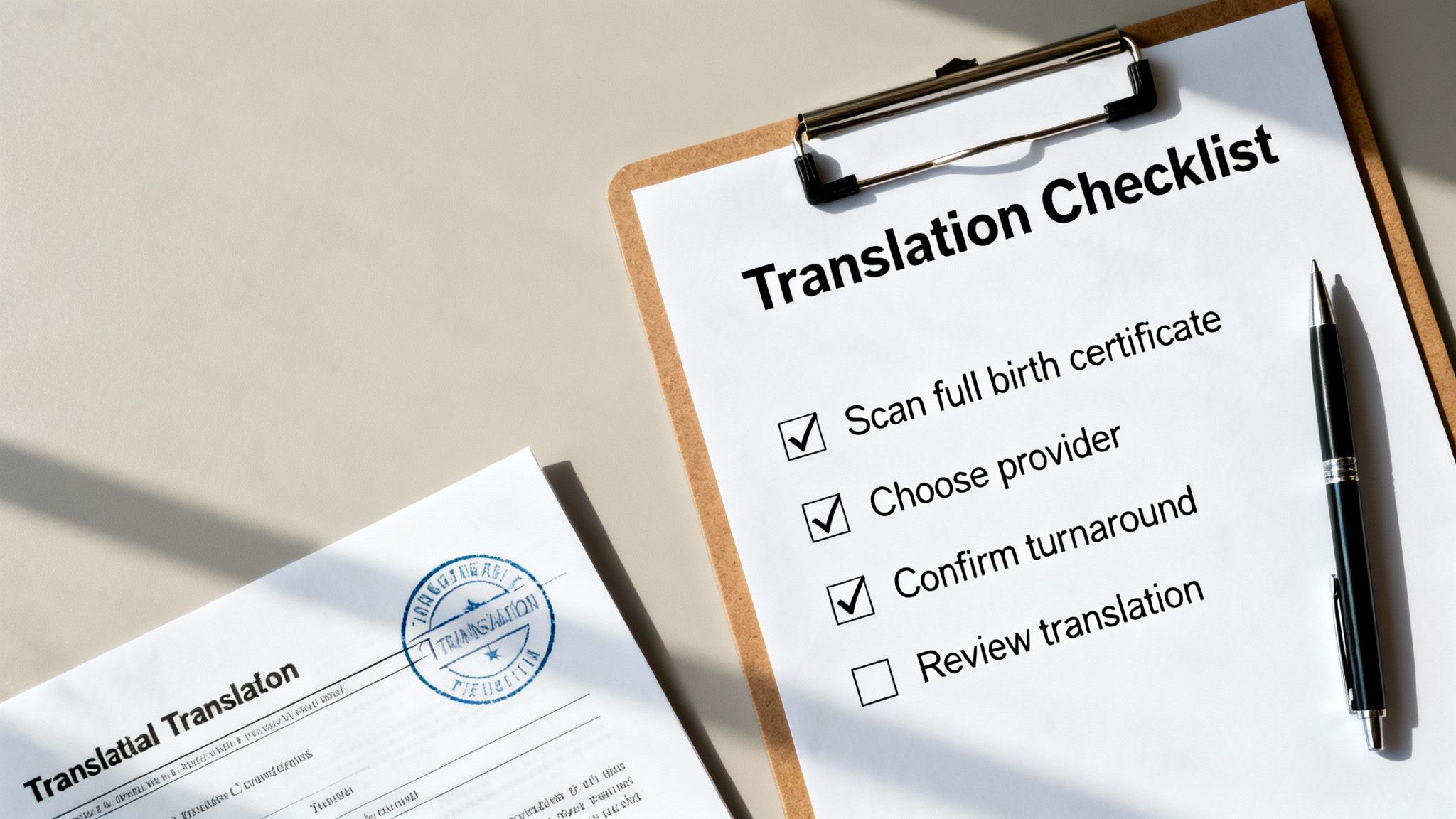
Your Step-by-Step Checklist for Ordering a Certified Translation
Getting a birth certificate translated doesn't have to be complicated. Following a clear plan can help you avoid the common mistakes that cause delays or rejections from official bodies like USCIS. Think of this as your practical checklist to getting it done right the first time.
Preparing for Your Translation Order
The quality of your final translation depends heavily on the quality of the document you provide. A fuzzy, incomplete, or hard-to-read original is a recipe for errors. Before you start looking for a translator, complete these prep steps.
-
Get a High-Quality Copy: Find your original, long-form birth certificate. Don't just snap a quick photo with your phone. Use a flatbed scanner to create a sharp, high-resolution digital copy. Make sure you capture everything—every stamp, seal, signature, and note, on both the front and back.
-
Choose a Reputable Service: Find a professional translation provider that explicitly guarantees USCIS acceptance. Look for clear, upfront pricing, positive customer reviews, and an easy ordering process. A seasoned agency knows exactly what officials are looking for.
-
Submit and Provide Key Details: Upload your scanned document to the agency's secure website. This next part is critical: provide the correct English spelling for every name on the certificate. A simple typo in a name is one of the fastest ways to get your application flagged.
A common mistake is submitting a quick phone picture. Shadows, glare, or a skewed angle can hide tiny but crucial details. For any official purpose, a clean, flat scan of the entire document is an absolute must.
Finalizing and Verifying Your Document
Once your order is placed, you’re almost done. But don't skip these final steps—they are your last chance to catch any potential problems before sending your documents off.
-
Confirm Turnaround and Cost: Before you pay, double-check the delivery time and total cost. A trustworthy service will have transparent translation pricing and turnaround information with no hidden fees.
-
Receive Your Certified Translation: Your final delivery should include two documents: the translated birth certificate itself and the signed Certificate of Translation Accuracy. You must submit both together.
-
Review Everything Carefully: This is the final, crucial check. Compare your original document side-by-side with the translation. Scrutinize every name, date, and place for accuracy. Ensure the certification statement is properly signed and dated. Once you're confident it's perfect, you’re ready to submit.
The Growing Need for Professional Translation Services in 2026
As people increasingly move abroad for jobs, study internationally, and build lives across borders, the world feels smaller than ever. This global mobility has created a massive demand for professional document translation, a trend expected to accelerate through 2026 and beyond.
In response, government bodies like USCIS are tightening their requirements to maintain the security and reliability of their systems. This means that getting a professional translation is no longer just a good idea—it's a mandatory step for most official processes.
Why Professionalism Is the New Standard
The days of asking a bilingual friend to write out a translation are over. Official agencies now demand a clear paper trail and a guarantee that the translation is accurate and from a qualified, neutral source. They need to know that every detail on your birth certificate—names, dates, and official seals—is translated flawlessly into English.
This isn't a small niche. The global market for translating immigration documents was valued at approximately $1.5 billion USD in 2025. This growth is driven by increased international migration and evolving government rules. You can learn more about the growth of the immigration translation market to see the scale of this trend.
Investing in a reputable provider is the safest way to ensure your important documents are accepted without question. It’s a small step that protects your entire application from unnecessary risk and delay.
Understanding this context makes it clear why cutting corners isn't an option. Whether you need a certified translation for official use or want to understand the specifics of our process and turnaround times, choosing an expert is the smartest and safest decision you can make.
Frequently Asked Questions About Birth Certificate Translation
When you're dealing with official documents, it’s easy to get confused by the rules. Let's clear up some of the most common questions about translating a birth certificate so you can move forward with confidence.
Do I Need to Get My Translation Notarized for USCIS?
For USCIS, the answer is almost always no. They require a certified translation, where the translator or company provides a signed statement vouching for the translation's accuracy. This certification is the standard for immigration.
Notarization is an extra step where a Notary Public verifies the translator's identity as they sign the certificate. While USCIS doesn't typically require this for birth certificates, some other institutions might, such as for certain court proceedings or documents sent to a foreign embassy. Always double-check the specific requirements of the organization you're submitting documents to.
Can a Bilingual Friend or Family Member Do the Translation?
This is a firm no. While it might seem like a quick and cheap solution, USCIS and other official bodies require impartiality. They need the translation to be done by a neutral third party with no personal connection to the applicant.
Using a friend or family member creates a conflict of interest, which can make officials doubt the document's credibility. Always use a professional translator or a reputable agency to ensure your application is taken seriously.
What Is the Difference Between a Long-Form and Short-Form Certificate?
A long-form birth certificate is the complete, official record of birth. It includes all the important details—your parents' full names, the specific hospital, the city, and all official seals and signatures.
A short-form certificate, sometimes called an abstract, is a condensed version with only the basic facts.
For any official purpose—immigration, legal cases, or university applications—you must use the long-form birth certificate. Submitting a translation of a short-form version is a common mistake that can lead to a Request for Evidence (RFE) from USCIS, stalling your case for months.
At TranslateDay, we take the guesswork out of the process. We specialize in fast, accurate, USCIS-guaranteed translations, making sure every detail is handled correctly so your application sails through without a hitch.


