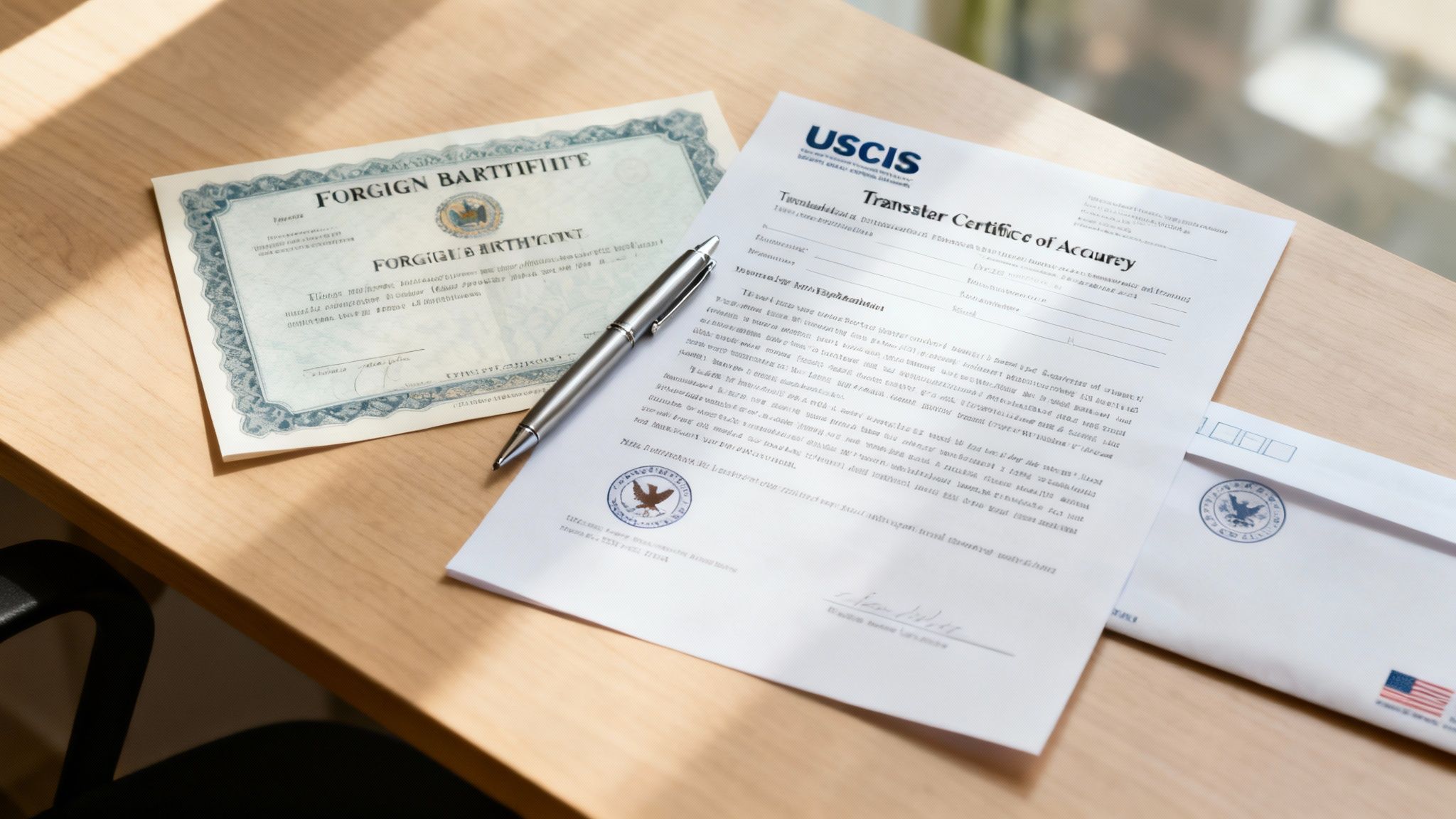
When you need to translate a birth certificate for official use, a simple word-for-word translation from a bilingual friend or an online tool won't work. For important applications like immigration, university enrollment, or legal matters, you need a certified translation. This is a formal process where a professional translator provides a signed statement guaranteeing the translation is a complete and accurate copy of the original. Think of it as a quality guarantee that official bodies like U.S. Citizenship and Immigration Services (USCIS), universities, and courts rely on to trust your documents.
Why a Standard Translation Is Not Enough
Submitting paperwork for major life events—a Green Card application, university enrollment, or even court proceedings—is stressful enough. A surprisingly common mistake people make is getting the wrong kind of translation for their birth certificate. A simple translation from a bilingual friend or an online tool is a recipe for rejection.
Picture this: Maria has spent months meticulously preparing her U.S. visa application for 2026. Then, she gets a dreaded Request for Evidence (RFE) from USCIS. The problem? Her birth certificate translation wasn't "certified." This one small oversight can add months of delay to her timeline, cause immense stress, and even put her entire application at risk. It happens all the time.
Understanding Certified Translations
So, what makes a translation "certified"? It’s more than just the translated text. A certified translation is a complete package that includes two key components:
- The translated document: An exact, word-for-word translation of the entire birth certificate, including any seals, stamps, or handwritten notes.
- A signed statement: This is a formal declaration, often called a "Certificate of Translation Accuracy," signed by the translator or a representative from the translation company.
This signed statement is the crucial part. It formally attests that the translation is a complete and accurate representation of the original document. The person or company certifying it is putting their professional reputation on the line, taking full responsibility for its correctness.
Who Requires This Level of Accuracy
The demand for certification isn't just bureaucratic red tape. Official bodies rely on it to maintain the integrity of their processes. To them, a birth certificate is a cornerstone legal document—what’s often called a civil certificate—that verifies identity, age, and parentage. There's no room for error.
The sheer volume of applications handled by government agencies is a major reason for this strictness. With a massive backlog of immigration cases, case officers don't have time to second-guess documents. As of March 2025, USCIS had over 2.39 million family-based petitions pending. An uncertified translation is an immediate red flag that can get your file pushed to the side.
A certified translation acts as a bridge of trust between you and the authorities. It tells them that the document has been handled by a qualified professional who understands the legal and administrative importance of every word, seal, and signature.
To give you a clearer picture, here are some common situations where a certified translation is non-negotiable.
When a Certified Birth Certificate Translation Is Required
| Scenario | Certified Translation Required? | Primary Authority | Potential Consequence of Error |
|---|---|---|---|
| U.S. Immigration (Green Card, Visa, Asylum) | Absolutely | U.S. Citizenship and Immigration Services (USCIS) | Request for Evidence (RFE), application delay, or denial |
| U.S. Passport Application | Yes | U.S. Department of State | Application rejection and requirement to resubmit |
| University/College Enrollment | Yes, typically | Admissions Office / International Student Services | Delayed admission, missed deadlines, or rejection |
| Marriage License Application | Often | County Clerk's Office or local marriage authority | Delay in issuing the license |
| Legal Proceedings (Inheritance, Divorce) | Yes | Courts, Legal Counsel | Evidence deemed inadmissible, case delays |
| Driver's License / DMV | Varies by state, but often yes | State Department of Motor Vehicles (DMV) | Inability to get a license until a compliant translation is provided |
This table shows just how widespread the requirement is. Getting it right the first time saves you from dealing with the headaches that come from a rejection.
Real-World Scenarios and Consequences
I’ve seen this play out many times. Take Juan, who was applying for a university scholarship in the U.S. He asked his cousin, who is fluent in Spanish and English, to translate his birth certificate. The university flat-out rejected it. Why? It lacked a formal certification from an impartial, professional third party. He had to rush to find a professional service and nearly missed his application deadline.
It's the same in legal cases. For divorce or inheritance disputes involving international parties, a court will only accept a certified translation of a birth certificate to prove family relationships. Any error or lack of certification can get a key piece of evidence thrown out, delaying the entire case. You can explore our detailed guide on what makes a notarized birth certificate translation different and when that extra step might be needed.
Ultimately, investing in a certified translation from the beginning isn’t just about following the rules. It’s a practical step to prevent costly setbacks and keep your important life plans on track.
Preparing Your Document for Translation
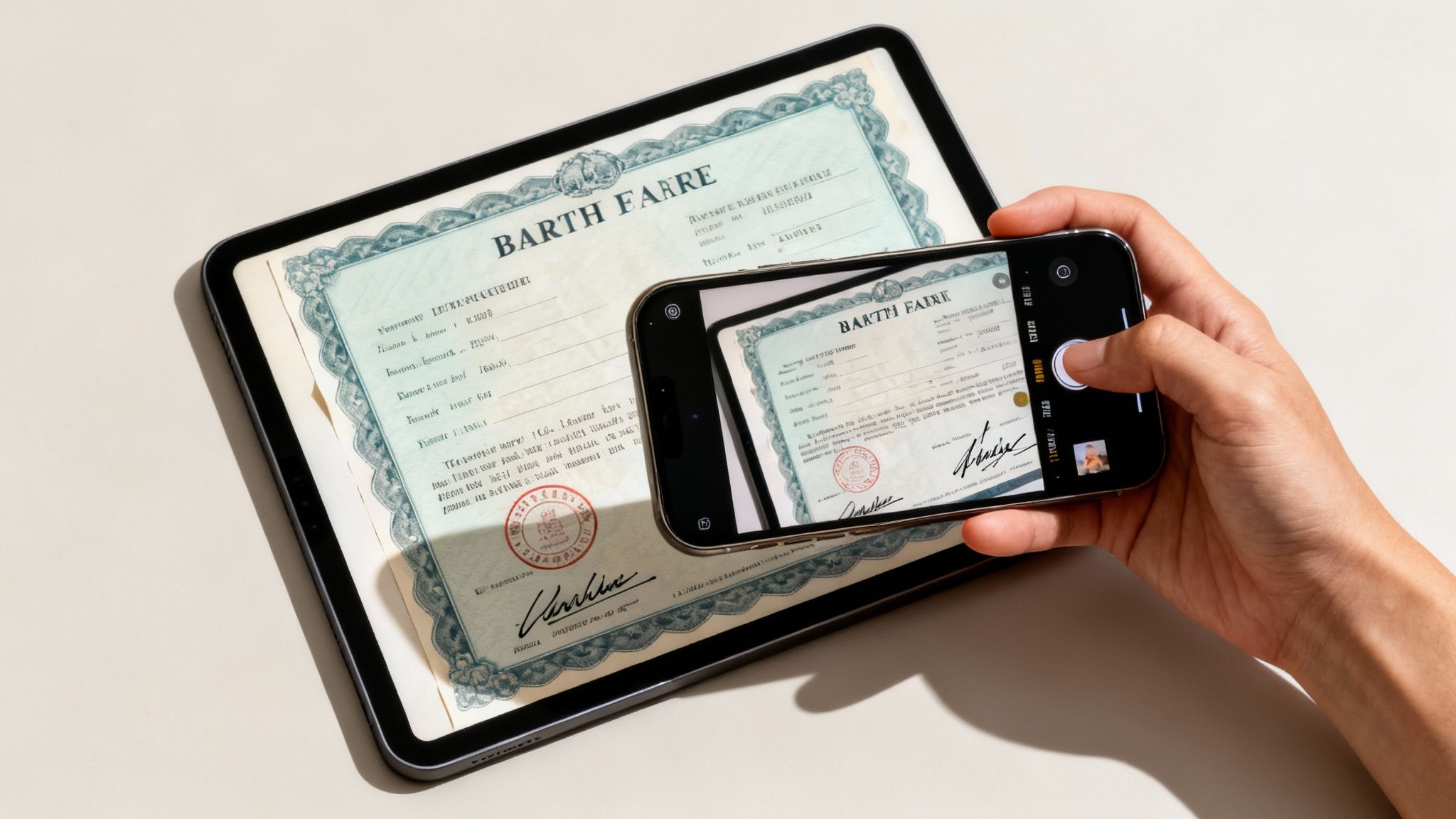
Before a translator even looks at your birth certificate, the success of your whole application comes down to one simple thing: the quality of the copy you send them. A translator can only work with what they can clearly see. A blurry photo, a cropped image, or an incomplete scan can bring your entire process to a screeching halt, causing delays you definitely don't want.
Think of it like this: handing a translator a bad scan is like asking a master chef to cook a five-star meal with spoiled ingredients. It just won't work, no matter how skilled they are. This is especially true for civil certificates—official documents like birth, marriage, or death certificates—where every single stamp, seal, and signature is a vital piece of the puzzle.
Creating a High-Quality Digital Copy
The good news? You don’t need to risk mailing your original, irreplaceable document. A professional translation agency just needs a high-quality digital copy to get started. But "high-quality" isn't just a suggestion—it's a requirement. Here’s how to nail it, whether you're using a flatbed scanner or just your phone.
Key Steps for a Perfect Scan or Photo:
- Capture the Entire Document: Make sure all four corners are visible in the shot. Don't ever crop out seals, stamps, or those little handwritten notes in the margins. They matter.
- Include Both Sides: This is a big one. Many official documents have stamps or signatures on the back. You must provide a scan of the reverse side, even if it looks blank to you. USCIS and other authorities expect to see everything.
- Use Good Lighting: Lay your document on a flat, dark surface in a well-lit room. Natural light is best. Watch out for shadows from your hands or phone, and always turn off the flash to avoid glare.
- Check for Legibility: Before you hit "send," zoom in on the image. Can you read every single letter and number without squinting? If you can't, neither can the translator.
Pro Tip: Don't sweat minor imperfections like old creases or tiny tears. The translator’s job is to accurately reflect the text as it is. What’s non-negotiable is that every word, stamp, and seal must be 100% legible in your digital copy.
Common Document Preparation Mistakes
I’ve seen this happen countless times. People assume that because it’s "just a copy," it doesn't need to be perfect. This is a huge mistake that can easily lead to a Request for Evidence (RFE) from USCIS, which can add weeks or even months of frustrating delays to your application.
To keep your application moving, steer clear of these common pitfalls:
- Submitting a blurry, dark photo taken in a poorly lit room.
- Forgetting to scan the back of the certificate (even if it's blank!).
- Cropping the image and cutting off official seals or signatures at the edges.
- Sending a low-resolution file that turns into a pixelated mess when magnified.
Taking a few extra minutes to prepare your document correctly is a small investment that pays off big time. Providing a crystal-clear copy empowers your translation provider to create an accurate, complete document that will sail smoothly through any official review. And this principle applies beyond just birth certificates. For instance, understanding the fundamentals of preparing content can be helpful for all sorts of projects, even something like learning how to translate a Google Form.
Choosing the Right Translation Provider
Once you have a crisp, clear copy of your birth certificate, you’ve reached the most important decision in this whole process: who’s going to translate it? This isn't just a minor detail; it's a choice that can make or break your application for immigration, a university spot, or a legal proceeding. A bad choice can lead to frustrating rejections and delays, but the right partner makes the whole thing smooth and stress-free.
You're generally looking at three main paths: a freelance translator, a local translation agency, or a specialized online service. Each has its pros and cons, and what's best for you really boils down to your deadline, budget, and what you need the translation for.
Freelancers, Agencies, or Online Services?
Let's dig into what you can expect from each one.
Freelance Translators: Going directly to an individual translator can be a great way to save a bit of money. You can find some incredibly talented professionals out there, and many are members of organizations like the American Translators Association (ATA), which is always a good sign. The catch? You have to do all the legwork yourself—vetting their experience, checking their credentials, and hoping they have the availability. If you need a certified translation in 24 hours, a freelancer might not have the bandwidth.
Local Translation Agencies: Some people just prefer doing business face-to-face, and that's where a traditional brick-and-mortar agency comes in. They usually have a team of translators on hand and can manage different types of documents. The downside is that their overhead costs often mean higher prices for you, and they might not be as quick as a service that’s built entirely online.
Specialized Online Services: These guys are built for one thing: getting official documents translated and certified, fast. They live and breathe the requirements for certified translations for USCIS and other government bodies. The whole process is handled through their website, from uploading your file to getting the finished, certified translation back in your inbox, often with a guaranteed turnaround time. For anyone on a tight deadline, this is almost always the best bet.
A Quick Word of Warning: Don't Ask a Friend
It's so tempting, I get it. Your friend, cousin, or coworker is perfectly bilingual, so why not ask them to translate your birth certificate and save a few bucks?
This is, without a doubt, one of the biggest mistakes you can make.
Official bodies like USCIS have a strict rule: the translator must be a neutral, impartial third party. A translation from a relative or friend is automatically seen as biased and will be rejected on the spot, no matter how accurate it is. The rule is there to guarantee the translation is completely objective.
Trying to cut this corner almost always ends in your application being delayed, and you'll have to pay a professional to do it right anyway.
Why Professional Expertise Is a Non-Negotiable
The need for high-quality, professional translation isn't just a hunch; it's a massive global trend. The translation market hit an incredible USD 956.81 billion in 2025, with a huge chunk of that growth coming from legal and judicial needs. In fact, the slice of the market dedicated to civil certificates—like the birth certificate you're holding—is expected to grab over 25.5% of the pie by 2035. This just goes to show how critical accurate, professionally prepared documents have become. You can read more about the expanding legal translation market to see just how intertwined our world has become.
Let's make this real. Imagine an international student scrambling to meet a university's admissions deadline. They need their birth certificate and academic transcripts translated and certified within 48 hours. A freelancer might be booked solid, and the local agency might have a five-day queue. A specialized certified translation service designed for exactly this kind of urgent request is the only way they'll make that deadline.
It's the same story with immigration. We see it all the time with our USCIS translations—every single document has to be perfect. Using a provider who knows the exact certification wording and formatting that immigration officers expect is a game-changer. They don't just translate the words; they prepare the document to pass official inspection without a hitch. Feel free to check out our pricing and turnaround times to see how simple and transparent it can be.
At the end of the day, you're not just looking for someone who speaks two languages. You're looking for an expert who understands the stakes and can deliver a compliant, rejection-proof document every single time.
What to Expect When You Order a Certified Translation
So, you've found a translation provider you trust. What happens next? Getting your birth certificate translated is usually a pretty smooth process, especially if you're working with an online service built for this exact purpose. Let's pull back the curtain on the step-by-step journey, from uploading your document to getting the finished, certified translation in your hands.
First Things First: Getting a Quote
Before you commit, you need to know the cost. Thankfully, the pricing for standard documents like birth certificates is usually very transparent. You'll likely see a per-page pricing model, which is perfect for this kind of work. It’s a simple, flat rate for each page, so there are no surprises.
You might also see per-word pricing, but that’s far more common for lengthy legal contracts or dense academic papers. For a birth certificate, per-page is the industry standard and makes getting an instant quote easy—you just upload a file or select the page count on the provider's website.
Placing Your Order: The Secure Upload
Once you’re happy with the price, it's time to place the order. This is where you’ll upload that clear, high-quality digital copy of your birth certificate you prepared. Any reputable service will use a secure, encrypted platform for this, so you can be confident your personal information is kept private.
You'll also fill out a quick form with the basics: your name, contact details, and the languages involved (e.g., from Spanish to English). This is your chance to provide any crucial details, like the precise English spelling of names. This simple step can prevent a lot of headaches later on by avoiding any guesswork with transliteration.
This flowchart breaks down the different routes you can take to find the right translator for your needs.
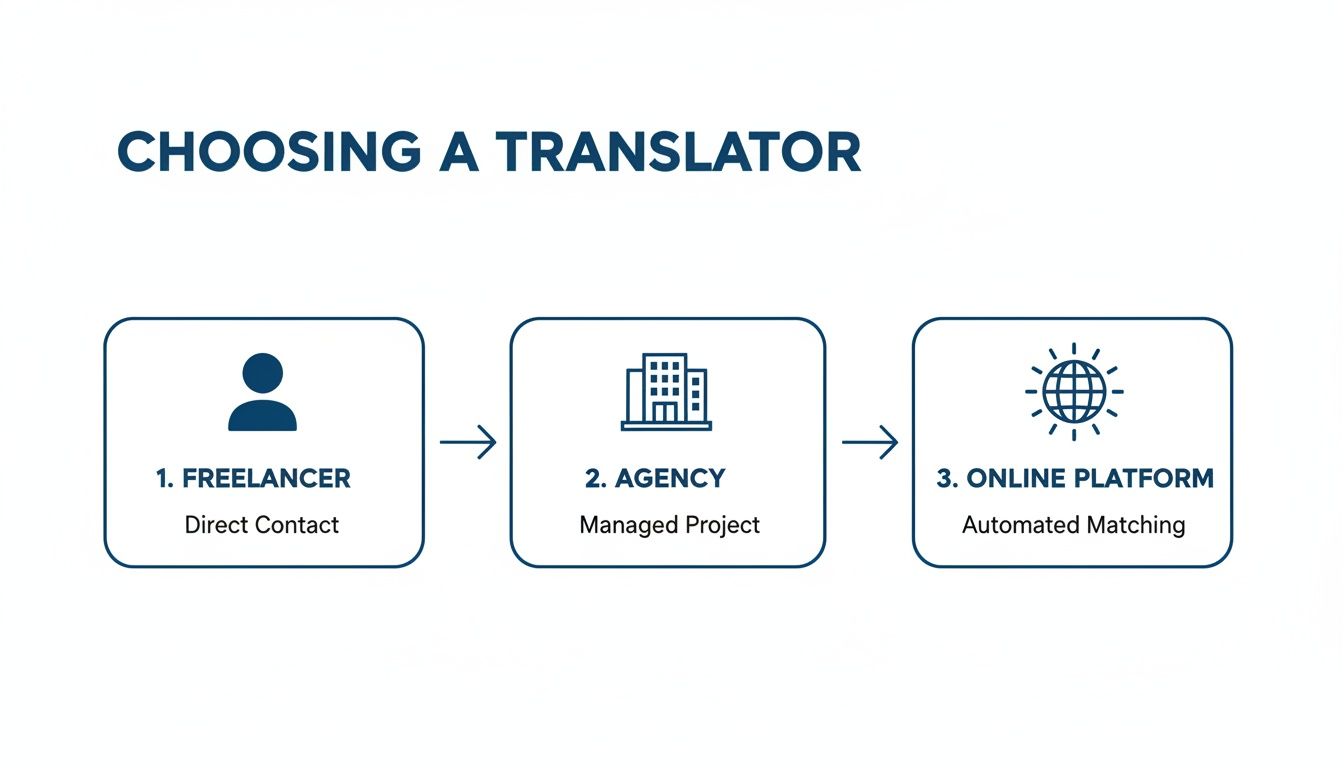
As you can see, while freelancers and traditional agencies are certainly an option, specialized online platforms often offer the most direct path for certified documents required for official use.
The Real Work: Translation and Quality Check
After you click "submit," your document is assigned to a real human translator. This isn't just someone who knows both languages; they are a professional linguist, typically a native speaker of the target language, who understands the nuances of official documents. They don't just swap words—they ensure the final translation is a precise and accurate mirror of the original.
But a professional job doesn't end there. The secret sauce is the quality assurance (QA) stage. A second linguist reviews the finished translation, carefully comparing it line-by-line with your original document. They're looking for any tiny error in a name, a date, or a stamp. This two-step process is what separates a professional service from a simple bilingual helper and is critical for meeting the strict standards of bodies like USCIS. You can read more about what they demand by reviewing the official USCIS requirements for document translations.
Final Delivery: What You'll Receive
For a standard one or two-page birth certificate, you can often expect the entire process to be completed within 24 hours. When it's ready, you’ll get an email with your complete digital package, almost always delivered as a secure PDF.
Here’s exactly what should be inside that file:
- A digital copy of your original birth certificate.
- The complete and accurate word-for-word translation.
- The signed Certificate of Translation Accuracy.
This certificate is the most important part. It’s a formal declaration, or affidavit, from the translator or agency stating that the translation is a true and accurate representation of the original document. It includes their credentials and contact info, and it’s what makes your translation "certified" and officially valid. With this package in hand, you’re all set.
Common Mistakes That Can Derail Your Application
I've seen it happen time and time again: a single, tiny mistake on a translated birth certificate brings an entire application to a screeching halt. A small error can lead to frustrating delays or, in the worst-case scenario, an outright rejection. When you're dealing with official bodies like USCIS, precision is everything. Let's run through a final pre-flight check to make sure your paperwork is flawless.
Even when you've hired a professional, it pays to know what to look out for. Understanding these common pitfalls is the best way to prevent them and keep your application moving forward.
Submitting a Partial or Summary Translation
This is probably the most frequent error I see. People often think that translating just the key details—names, dates, places—is enough. It's not.
Official authorities demand what I call a "mirror image" translation. This means every single word, stamp, and scribble has to be accounted for. Don't forget to include:
- Stamps and Seals: The text inside any official government stamp or embossed seal is mandatory.
- Handwritten Notes: Any little notes, signatures, or scribbles in the margins are part of the document and must be translated.
- Boilerplate Text: All that fine print and standard legal wording has to be there.
A summary will get your application bounced back immediately. The person reviewing your file needs to be able to hold the translation next to the original and see that they match line for line.
Misspelled Names and Incorrect Dates
Typos seem small, but they can create huge problems. Imagine your birth certificate says "Yuliya," but your passport says "Yulia." To an immigration officer, that’s a red flag. The same goes for dates. Getting the day and month mixed up (like writing 04/05/2026 instead of 05/04/2026) is a classic error that can cause serious confusion.
Pro Tip: When you order your translation, give the translator a spelling guide for all proper names. Type out the exact English spellings of names and places as they appear on your passport or other key documents. This leaves no room for error and ensures consistency across your entire application.
This one simple step can save you from a world of headaches down the road.
Forgetting to Translate the Back of the Document
You would not believe how often this happens. So many official civil certificates, including birth certificates, have stamps, signatures, or other official markings on the back. It’s so easy to miss, especially if the reverse side looks mostly empty.
But for USCIS and other agencies, the entire document—front and back—is the official record. If you only scan and submit the front, your translation is incomplete. Always, always scan both sides, even if one looks blank. To learn more about how easily small oversights can cause big issues, check out these other common translation mistakes to avoid.
Using a Friend or Family Member for the Translation
I get it, asking a bilingual friend or relative to do the translation seems like an easy way to save a few bucks. But for any official submission in the U.S., this is a guaranteed path to rejection.
Authorities like USCIS have a strict rule: the translator must be a competent and impartial third party. A translation from someone you know personally is automatically considered biased, no matter how fluent they are. You absolutely must use a professional and neutral translation provider to meet this core requirement.
What to Do When Your Translation Arrives
Getting that translated document back is a great feeling, but don't rush to send it off just yet. A few minutes of review at this stage can save you from major headaches and potential rejections down the line, especially with detail-oriented agencies like USCIS.
Before you do anything else, pull up the translation and compare it, line-by-line, with the original birth certificate. You're the one who knows the details best, so you’re the final line of defense against any small errors.
Your Final Review Checklist
Look closely at the most critical information. From my experience, these are the areas where a tiny mistake can cause the biggest problems:
- Names: Are all first, middle, and last names spelled exactly right? Even one incorrect letter can cause a mismatch with other application forms.
- Dates: Confirm that all dates—especially the date of birth and the issue date—are correct. Pay attention to the format (e.g., DD/MM/YYYY vs. MM/DD/YYYY) to ensure it’s clear and accurate.
- Places: Is the city, region, and country of birth translated correctly and consistently?
If you catch an error, no matter how small, contact your translation provider immediately. Any professional translator or reputable agency will fix their mistakes promptly and at no extra cost.
Assembling Your Documents for Submission
Once you're confident everything is perfect, it's time to put your submission packet together. For USCIS and most other official requests, you'll need to submit the translation and a copy of the original document it was translated from.
Here’s the standard way to assemble it:
- Print the entire certified translation packet. This should include both the translated birth certificate and the signed Certificate of Translation Accuracy.
- Make a clean, high-quality copy of the original birth certificate.
- Staple or clip the certified translation to the copy of the original document. The two should always stay together.
Pro Tip: Never, ever send your original birth certificate unless you are explicitly told to. Always submit a clear photocopy. The certified translation you've just received is what makes that photocopy an officially accepted document.
Save It for a Rainy Day
After you’ve submitted everything, don't just delete the files. Save a digital copy of the complete certified translation in a secure place you'll remember—think a dedicated folder in your cloud storage for vital records.
You'd be surprised how often you might need it again. Future needs like getting a driver's license, enrolling in university, or dealing with the Social Security Administration often require the same documentation. Having it on hand will save you a ton of time and money later.
Your certified translation is now ready to confidently support your application. If you’re ready to get started on your own documents, our team is here to help. Request a certified translation today and let our experts take it from here.
Common Questions, Answered
Navigating the world of official document translation can bring up a lot of questions. Let's tackle some of the most common ones people ask when they need a birth certificate translated for immigration or other official purposes.
What's the Typical Cost to Translate a Birth Certificate?
When it comes to pricing, you'll find that most professional services keep it simple. For a standard, one-page document like a birth certificate, you can expect a flat fee, usually somewhere between $20 and $50. This per-page rate is the industry standard and makes it easy to know the cost upfront.
Of course, a few things can nudge that price up or down:
- Language Pair: Translating from a widely spoken language like Spanish to English will be on the lower end, while a rarer language might cost a bit more.
- Turnaround Time: Need it yesterday? Most services offer expedited options, like a 24-hour turnaround, which usually comes with a rush fee.
- Document Complexity: If your birth certificate is unusually dense with text or covered in hard-to-read official stamps, it might require a custom quote.
The best way to avoid surprises is to get an instant quote. Most providers let you upload your document to see the exact cost before you place an order. For a real-world example, you can check out our clear, flat-rate pricing and turnaround schedule.
Does My Translation for USCIS Need to Be Notarized?
This is probably the biggest source of confusion out there, so let's clear it up: No, USCIS does not require notarization for your birth certificate translation.
It's an easy mistake to make, but USCIS is very clear on this. What they demand is a certified translation. This means the translation must be accompanied by a signed statement from the translator or a representative of the translation company. This statement, often called a "Certificate of Translation Accuracy," is a formal declaration that the translation is a complete and accurate reflection of the original document.
So, what's the difference? A notary stamp doesn't verify the translation's quality, only the identity of the person who signed the certification.
Certification speaks to the accuracy of the translation.
Notarization speaks to the identity of the person signing the document.
A Notary Public simply verifies that the person signing the certificate is who they say they are; they have no idea if the Spanish-to-English translation is any good. Focusing on getting a proper certified translation saves you time, money, and potential headaches with your application. You can dive deeper into the specific USCIS requirements for translations to see exactly what they're looking for.
At TranslateDay, we live and breathe this stuff. We provide fast, accurate, and USCIS-guaranteed certified translations every day. Let us take the guesswork out of the process so you can focus on your application.