
Navigating the world of international documents can be tricky. A common and costly mistake many people make when they need to translate and apostille a document is getting the order of operations wrong. This isn't a small detail—following the correct sequence is essential if you want your immigration, academic, or legal paperwork accepted without delays. This guide will walk you through the process step-by-step, using real-world examples to make everything clear.
Translate First or Apostille First? The Critical Order of Operations
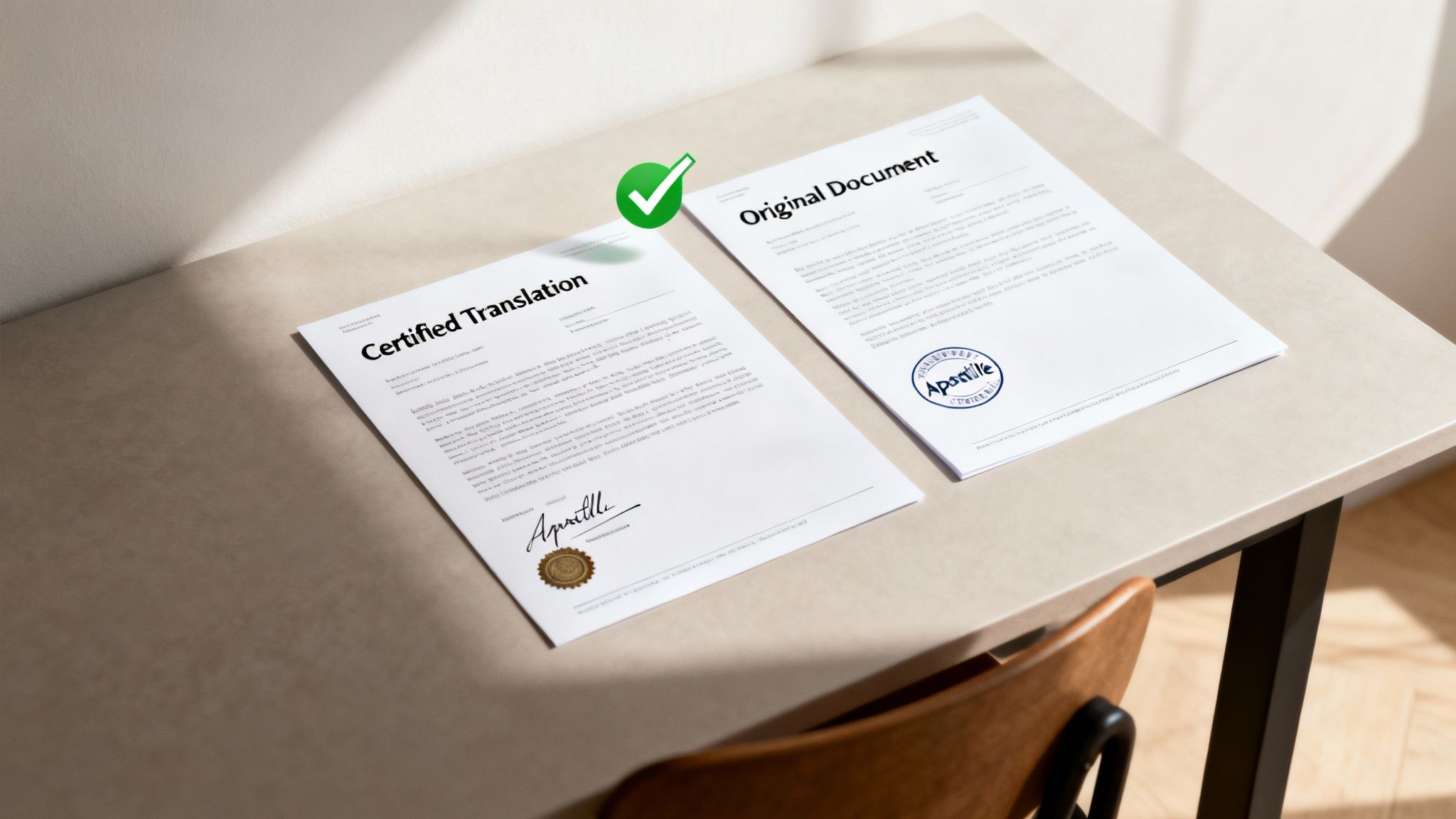
When you're preparing documents for international use—whether for an immigration application, a university admission, or a legal matter—the sequence of translation and authentication is absolutely critical. Getting it backward can lead to an outright rejection, forcing you to start over and wasting valuable time and money.
The logic behind the correct order is straightforward. An Apostille is a special certificate that verifies the signature or seal on an official document is authentic. Its only job is to prove that the person who signed your original birth certificate or diploma is a legitimate official. It does not validate the content of the document or the accuracy of any translation.
A Real-World Immigration Scenario
Let’s walk through a typical situation. Imagine Maria is applying for a U.S. Green Card from Spain. She needs to submit her Spanish birth certificate to the U.S. Citizenship and Immigration Services (USCIS), the government agency that handles immigration matters.
If Maria gets an apostille on her Spanish birth certificate first and then has the whole package translated into English, she's created a problem. The apostille is only there to verify the signature on the original Spanish document. A translation of the apostille itself is meaningless to USCIS.
Here’s the correct process for Maria:
- Get the Original Document: She obtains her official Spanish birth certificate.
- Translate It: She hires a professional service to get a certified translation of the birth certificate into English. This is a crucial step for USCIS.
- Apostille the Original: She then gets an apostille for the original Spanish birth certificate from the correct authority in Spain.
When she submits her application, she’ll provide the original document with its apostille, alongside the separate certified translation. This way, USCIS can look at the apostille to confirm the Spanish document is real and then read the certified translation to understand what it says.
Key Takeaway: An apostille authenticates the original document. A certified translation makes its content understandable. They are two separate, sequential steps that work together.
Why This Order Is Universal
This logic applies to nearly every scenario. Whether you're submitting a German academic transcript for a master's program in the UK or a French marriage certificate for a court case in Japan, the principle is the same. The foreign authority needs to trust two things: that the document is authentic (the apostille's job) and that the translation is accurate (the certified translation's job).
Mixing them up can get your entire submission thrown out. To make sure you get it right, here’s a quick-reference table that breaks down the correct order for common scenarios.
The Correct Order for Translation and Apostille
This table clarifies the proper sequence for translating and authenticating documents based on their intended use, helping you avoid common procedural errors.
| Scenario | Step 1 | Step 2 | Why This Order Matters |
|---|---|---|---|
| Immigration (e.g., USCIS) | Obtain a certified translation of your foreign document (e.g., a birth certificate). | Secure an apostille for the original document from its country of origin. | USCIS needs to verify the original document's authenticity and understand its content via the translation. |
| Academic Admissions | Get a certified translation of your academic transcript or diploma. | Obtain an apostille for the original academic document from the issuing authority. | The university needs to confirm the credential's legitimacy and understand your academic history. |
| International Legal Cases | Have the legal document (e.g., court order) translated via a certified translation. | Get an apostille for the original legal document to validate its official status. | The foreign court requires proof that the document is a valid legal instrument. |
Following this order prevents the headaches and delays that come from a rejected application. If you’re ever unsure, remember that the apostille validates the original, and the translation explains it. You can learn more about our own pricing and process for certified translations to get your first step handled correctly.
Getting Your Certified Translation Right for Official Use
If you're dealing with an official body like USCIS for the first time, the term “certified translation” can sound intimidating. You might picture a document covered in government stamps or embossed seals.
However, what USCIS and other U.S. agencies require is much more practical.
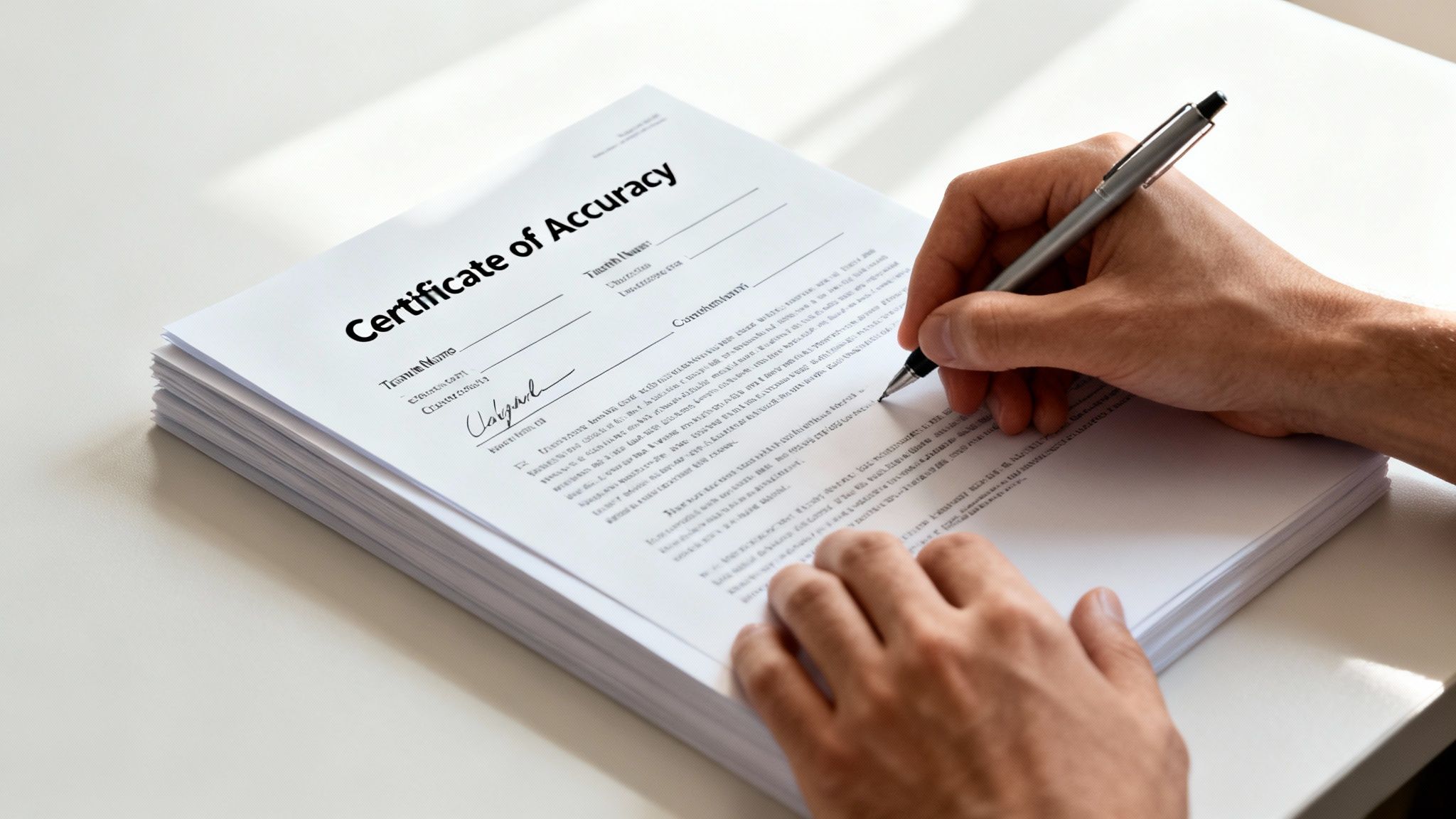
A certified translation consists of two parts: the translated document itself and a separate, signed letter from the translator or translation company. This letter, called a Certificate of Accuracy, is the key. Its purpose is simply to state that the translation is a complete and accurate reflection of the original document and to confirm that the translator is fluent in both languages.
What USCIS Actually Looks for in a Certification
When you submit your documents in 2025 or 2026, USCIS has a clear checklist for this certification letter. It’s not just a formality; it creates a paper trail and holds the translator accountable.
A compliant Certificate of Accuracy must include:
- A Statement of Accuracy: A clear sentence affirming the translation is complete and correct.
- Translator’s Credentials: The full name, signature, and contact information of the person or company responsible.
- Date of Certification: The specific date the letter was signed.
Consider this common situation: Carlos is from Mexico and is applying for U.S. citizenship. He needs his birth certificate and marriage certificate translated from Spanish to English. If he asks a bilingual friend to do it, the translation might be perfect, but it will be missing the official Certificate of Accuracy. This one missing page is enough to trigger a Request for Evidence (RFE) from USCIS, delaying his citizenship case for months. To avoid these issues, review the official USCIS translation requirements and ensure you're compliant.
Expert Tip: Never submit a translated document by itself. The separate, signed Certificate of Accuracy is what officially "certifies" your translation and makes it valid for U.S. government agencies.
Certified vs. Sworn Translations: A Critical Difference
This is another common point of confusion, especially for those dealing with European or Latin American authorities. While the U.S. uses the certified translation standard, many other countries require sworn translations.
A sworn translator is a professional linguist who has been officially appointed by their government, such as a Ministry of Foreign Affairs or a high court. Their translations are legally binding and carry an official stamp and signature that's registered with the state, making it a much more formal process.
Knowing which one you need is crucial.
- Submitting a document to USCIS? You need a certified translation.
- Submitting a document to an official body in Spain, Italy, or Germany? You will almost certainly need a sworn translation from a government-approved translator in that country.
Getting these details right from the start is the best way to prevent frustrating rejections and keep your application process moving smoothly.
What is an Apostille and When Do You Really Need One?
Navigating international paperwork often introduces new terms like "apostille." So, what is it, and when is it necessary?
An apostille is an official certificate that makes a public document from one country legally valid in another. Think of it as a universal stamp of authenticity, allowing your paperwork to be recognized across borders without complex procedures. This system only works between countries that have signed the 1961 Hague Convention, which now includes over 120 nations. If you're dealing with a country not on that list, you'll need to go through a longer process called "legalization."
Real-World Scenarios Demanding an Apostille
An apostille verifies that the signature or seal on your original document belongs to a legitimate public official. It doesn't check the document's content, only its authenticity.
Imagine a family from Texas adopting a child from Colombia. The Colombian court issues an official adoption decree. For U.S. authorities to recognize it, the decree needs an apostille from the Colombian government. That apostille tells U.S. officials, "Yes, the signature on this is from a real Colombian judge."
This principle applies to many situations:
- Studying Abroad: A student from California applying to a university in Italy will need an apostille on their diploma and transcripts.
- Getting Married Overseas: An American getting married in France will need an apostille on their U.S.-issued birth certificate.
- International Business: A U.S. company opening an office in Japan will need an apostille on its articles of incorporation.
Key Takeaway: You need an apostille when you take a document issued in one country and present it to an official body in another country. For documents used within their country of origin, an apostille is rarely needed.
Documents That Commonly Require an Apostille
While requirements vary, certain documents almost always need an apostille for international use. This is a critical step when you need to translate and apostille official documents for them to be accepted abroad.
- Civil Certificates: Birth certificates, marriage licenses, divorce decrees, and death certificates.
- Academic Credentials: University diplomas, academic transcripts, and professional licenses.
- Legal & Business Papers: Court orders, powers of attorney, articles of incorporation, and affidavits.
- Federal Documents: FBI background checks and other papers issued by U.S. federal agencies.
Apostille vs. Notarization: What's the Difference?
It’s easy to confuse notarization and apostilles, but they have different functions. A notary public confirms your identity when you sign a document, often using a notary stamp. An apostille confirms the identity of the public official who signed your document.
| Feature | Apostille | Notarization | Primary Use Case |
|---|---|---|---|
| What it Verifies | The signature and seal of a public official on an official document. | The identity of the private individual signing a document. | Authenticating a U.S. document for use in another Hague Convention member country. |
| Issuing Authority | A designated government body (e.g., the Secretary of State). | A licensed Notary Public. | Verifying signatures on contracts, affidavits, and deeds for domestic use. |
| Geographic Scope | International (valid in all Hague Convention countries). | Domestic (typically only valid within the country of issuance). | Submitting a document like a birth certificate to a foreign government. |
In short, a notarization is for domestic use, while an apostille is for taking your documents international. Understanding this distinction from the start can save you from major delays.
The Future is Here: E-Apostilles and Digital Documents
For decades, getting an apostille meant dealing with paper, ink stamps, and mail delays. That era is ending. The future of document authentication is digital, and it’s already here. The e-Apostille is revolutionizing this traditional process, making it faster, more secure, and far more convenient.
Instead of a physical stamp, an e-Apostille is a secure digital certificate attached to an electronic document. Its authenticity can be verified online in seconds, eliminating courier delays and manual checks.
How Going Digital Saves You Time and Money
Let’s look at a practical example. Imagine you're a software developer who just landed a dream job in Belgium. You need to get your U.S. university diploma authenticated for your work visa.
The old way involved mailing your original diploma to the Secretary of State, waiting for them to attach a physical apostille, and then paying for international shipping to Belgium. The process could easily take weeks.
With the e-Apostille system, you can request a digital apostille for your diploma online. After getting a certified translation of your academic documents, the authentication timeline shrinks from weeks to just a few days.
The benefits are clear:
- Speed: No more shipping delays or manual processing queues.
- Security: Digital signatures and online registries make forgery nearly impossible.
- Cost Savings: You save on courier fees and eliminate the risk of losing original documents.
- Convenience: Manage the entire process online from anywhere in the world.
The Global Move to E-Apostilles
This is a worldwide movement. As of early 2024, 41 countries—including innovators like Belgium, Colombia, and New Zealand—were fully operating this electronic system, with many more joining. The number of e-Apostilles issued globally is soaring, and this trend is set to continue. If you want to dive deeper, this case study offers some great insights.
Looking Ahead: By 2026, the e-Apostille will likely become the standard for document authentication. As more governments modernize, international paperwork will only get easier.
What This Means for You
As you prepare your documents, check if your destination country and the issuing authority support the e-Apostille program. If they do, you can take advantage of a much faster, headache-free process. This digital shift aligns with the speed of modern life—when you're on a tight deadline, waiting weeks for a physical stamp is no longer necessary. For more details, check our guide on turnaround times and processes.
Your Practical Walkthrough for Translation and Apostille
Here is a clear, practical roadmap to get your documents translated and apostilled correctly.
First, get a high-quality digital copy of your original document. Whether it's a civil certificate like a marriage license or an academic transcript, a clear scan is crucial for a smooth process.
Next, get a professional certified translation.
Securing a Compliant Certified Translation
Find a trusted translation provider and submit your document. Be sure to tell them where the document is being sent. A translation for USCIS has different requirements than one for a German university. This ensures the final product meets the specific standards of the reviewing authority.
Your "certified translation" must include a signed Certificate of Accuracy. This formal statement from the translator or company attests that the translation is complete and correct and is non-negotiable for official purposes.
Expert Tip: Always double-check that the translation service provides a Certificate of Accuracy with the translator's name and contact details. This small detail is often the deciding factor between acceptance and rejection, especially for immigration paperwork.
Let's say you need a notarized birth certificate translation for a visa application. The process is usually simple—you upload a clear scan of the document. Getting the legalities right is essential, which is why we offer guides that complement other resources offering great advice for buying a foreign property, including translating documents.
Obtaining the Apostille Correctly
With your certified translation in hand, it's time for the apostille. Remember this rule: the apostille authenticates the original document, not the translation.
You need to identify who issues the apostille. In the U.S., this is typically the Secretary of State in the state where the document was issued. A diploma from a California university must be sent to the California Secretary of State for an apostille. A New York birth certificate goes to the New York Secretary of State.
This process is rapidly evolving from paper-and-stamp to a modern, digital workflow.

The shift to the e-Apostille system is all about eliminating physical paperwork and speeding up verification.
Once you’ve found the right office, submit the original document with their required forms and payment. Be aware: processing times can vary significantly, so don't leave this to the last minute.
Assembling Your Final Document Package
When you receive your original document back with the apostille certificate attached, you’re almost done. Assemble the complete package for submission in a clear, organized manner.
Your final packet should contain three items:
- The Original Document with the apostille attached.
- The Certified Translation of your original document.
- The Certificate of Accuracy that came with your translation.
Presenting your documents this way makes the reviewer's job easy and is your best defense against delays.
Frequently Asked Questions About Translation and Apostille
It's normal to have questions when dealing with official documents. Here are answers to some of the most common ones.
To fully grasp the requirements, it helps to understand the fundamental differences between transcription and translation. This distinction highlights why a precise, professional translation is non-negotiable for legal and immigration purposes.
What’s the Real Cost to Translate and Apostille a Document?
You are paying for two separate services. The certified translation fee is from your translation provider and is usually based on page or word count. This price should always include the signed Certificate of Accuracy.
The apostille fee is a set government charge that varies by location. In the U.S., each state sets its own fee, typically between $5 and $20 per document. Check the exact cost with the relevant Secretary of State's office.
How Long Does This Whole Process Actually Take?
The translation is usually the fast part. A professional service can often translate and certify standard documents like birth certificates within 24 hours.
The apostille is typically the slower step. Since you are dependent on a government agency's schedule, the wait can range from a few business days to several weeks.
My Two Cents: Start the apostille process as soon as you know you need it. While e-Apostilles are speeding things up, it's always wise to plan for potential delays.
Can I Just Translate My Own Documents for My USCIS Application?
No. Even if you are fluent, USCIS rules require impartiality. You cannot certify your own translation because you are an interested party in your case. The translation must be done by a neutral and competent third party who can sign off on its accuracy. Using a professional service is the only way to meet USCIS requirements and avoid a rejection or a Request for Evidence (RFE).
Do I Need an Apostille for Documents I’m Sending to USCIS?
Generally, you do not need an apostille for documents submitted to USCIS from within the United States. As a U.S. federal agency, USCIS is primarily concerned that foreign-language documents are accompanied by a complete and accurate certified translation.
However, if you are sending a U.S.-issued document (like a marriage certificate or FBI background check) to a government abroad, you will almost certainly need to get it apostilled first.
At TranslateDay, we specialize in this process. We provide fast, accurate, and USCIS-guaranteed certified translations daily. If you’re ready to get your documents prepared for any official use, we're here to help.


