
When you type "USCIS translation services near me" into a search bar, you're not just looking for someone who speaks another language. You're searching for a crucial partner who understands that your entire future—a Green Card, citizenship, or a family visa—might hinge on the accuracy of the documents they handle. Let's be clear: a minor translation error can cause major delays. We're talking about stressful Requests for Evidence (RFEs) or, in the worst-case scenario, a flat-out denial of your application. The stakes are just too high to risk anything less than perfect.
Why Accurate USCIS Translations Are Non-Negotiable
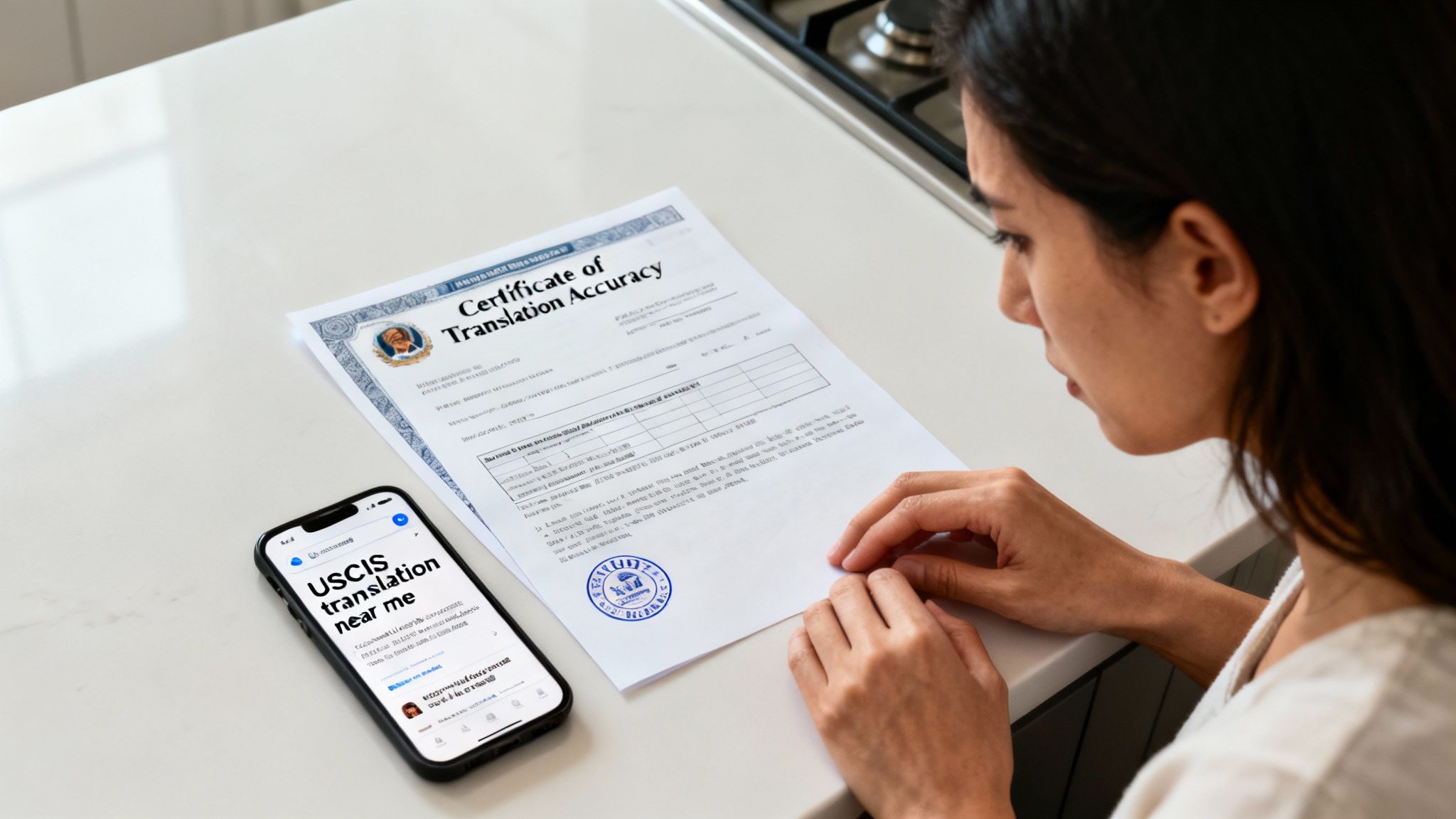
U.S. Citizenship and Immigration Services (USCIS) is the government agency that manages legal immigration to the United States. From work visas and Green Cards to citizenship applications, they process millions of documents every year. Because their decisions are so life-changing, their standards for paperwork are incredibly strict.
Here’s the bottom line: any document you submit that isn't in English must come with a complete, word-for-word English translation. This isn't a suggestion; it's a hard-and-fast rule you cannot ignore.
The Real-World Impact of Small Mistakes
Imagine Maria, who was anxiously waiting for her husband's Green Card. She paid for what she believed was a professional translation of their marriage certificate. Months later, instead of an approval, she got a dreaded Request for Evidence (RFE), an official notice from USCIS asking for more information.
The problem? The translator missed a tiny, seemingly unimportant stamp from the issuing office. That one oversight put their case on hold for another six months, piling on emotional and financial stress. Stories like Maria's are far too common. A simple mistake—a mixed-up date, a slightly misspelled name, or a seal that wasn't translated—can grind your application to a halt. This is precisely why USCIS insists on a certified translation.
A certified translation isn't just a translation. It’s a formal process where the translator or translation company attaches a signed statement, often called a "Certificate of Accuracy." This document swears that the translation is a complete and correct copy of the original, providing the layer of accountability USCIS requires.
The Modern Meaning of "Near Me"
Years ago, finding a translator meant looking through a local phone book. Today, your search for a service "near me" has a whole new meaning. It's less about your physical location and more about finding a reliable, fast, and secure online partner. The right online service can deliver USCIS-compliant translations in as little as 24 hours, no matter where you live. This guide will walk you through exactly what USCIS needs and how to find the right certified translation services to keep your immigration journey on track.
Decoding What a USCIS Certified Translation Really Means
Let's clear up a common point of confusion right away: what does "certified translation" actually mean for a USCIS application? It’s not about the translator having a special license from the U.S. government.
Instead, it refers to a specific document package. A certified translation is simply a translated document accompanied by a signed statement from the translator or translation company. This statement is the "certification," often called a Certificate of Translation Accuracy, and it’s what makes the document official in the eyes of USCIS.
What Makes a Certification Statement Valid
This certificate is the crucial piece of the puzzle. It’s a formal letter where the translator essentially swears to three things:
- Fluency: They confirm they are competent to translate both the original language and English.
- Completeness: They attest that the translation is a complete, word-for-word version of the original document, with nothing added or left out.
- Accountability: It must include their full name, signature, contact details, and the date they signed it.
That signature is everything. It puts the translator's professional reputation on the line, making them directly accountable for the work. This is exactly why you can't translate your own documents, even if you're fluent. USCIS considers that a conflict of interest and requires an impartial, professional third party to vouch for the translation's integrity.
Key Takeaway: A certified translation isn't about a government stamp of approval. It’s about a professional translator putting their name and reputation on the line to confirm the translation is a true and accurate reflection of the original document—a non-negotiable standard for USCIS.
To help you stay on track, use this checklist to double-check that your translation meets every USCIS requirement before you submit it.
USCIS Translation Requirements Checklist
Use this checklist to confirm your translation meets all official USCIS standards before you submit your application.
| Requirement | What It Means for You | Why It's Critical |
|---|---|---|
| Full English Translation | The entire document must be translated, including seals, stamps, and signatures. | Missing even a small detail can lead to a Request for Evidence (RFE), causing significant delays. |
| Certification Statement | A separate, signed letter from the translator must be included. | This is the official proof that a competent, impartial professional performed the translation. |
| Translator's Competence | The statement must affirm the translator is fluent in both languages. | USCIS needs assurance that the translation isn't just a guess; it's an expert rendering. |
| Accuracy and Completeness | The statement must attest that the translation is accurate and complete. | This confirms nothing was altered, omitted, or misinterpreted, preserving the document's legal integrity. |
| Translator's Identification | The certification must include the translator's name, signature, and contact info. | This makes the translator accountable and gives USCIS a point of contact if questions arise. |
Having this checklist handy can save you from common pitfalls and give you confidence that your documents are ready for review.
Sworn Translations and Notary Stamps: What's the Difference?
You might also hear terms like sworn translation or see a notary stamp. It's important not to mix these up with a standard USCIS certification. A sworn translation is a more formal process used in many other countries, where a translator is officially appointed by a court. The U.S. doesn't have this system; we rely on the self-certification statement instead.
A notary stamp adds another layer, but it does something different. A notary doesn't check the translation's accuracy. They only verify the identity of the person who signed the certification. While USCIS rarely requires notarization, some other agencies or specific, complex cases might. If you're unsure, always ask. You can find more detail by reviewing the full scope of USCIS translation requirements.
The need for this level of precision is driven by massive volume. In Fiscal Year 2023, USCIS received an incredible 10.9 million applications. With that kind of workload, any document that doesn't meet their exact standards can be quickly flagged, leading to frustrating delays. Understanding these rules empowers you to check any translation and know instantly if it's ready for submission. You can explore more about how application volumes impact translation needs on thelanguagedoctors.org.
Local vs. Online USCIS Translation Services: Which Is Right for You?
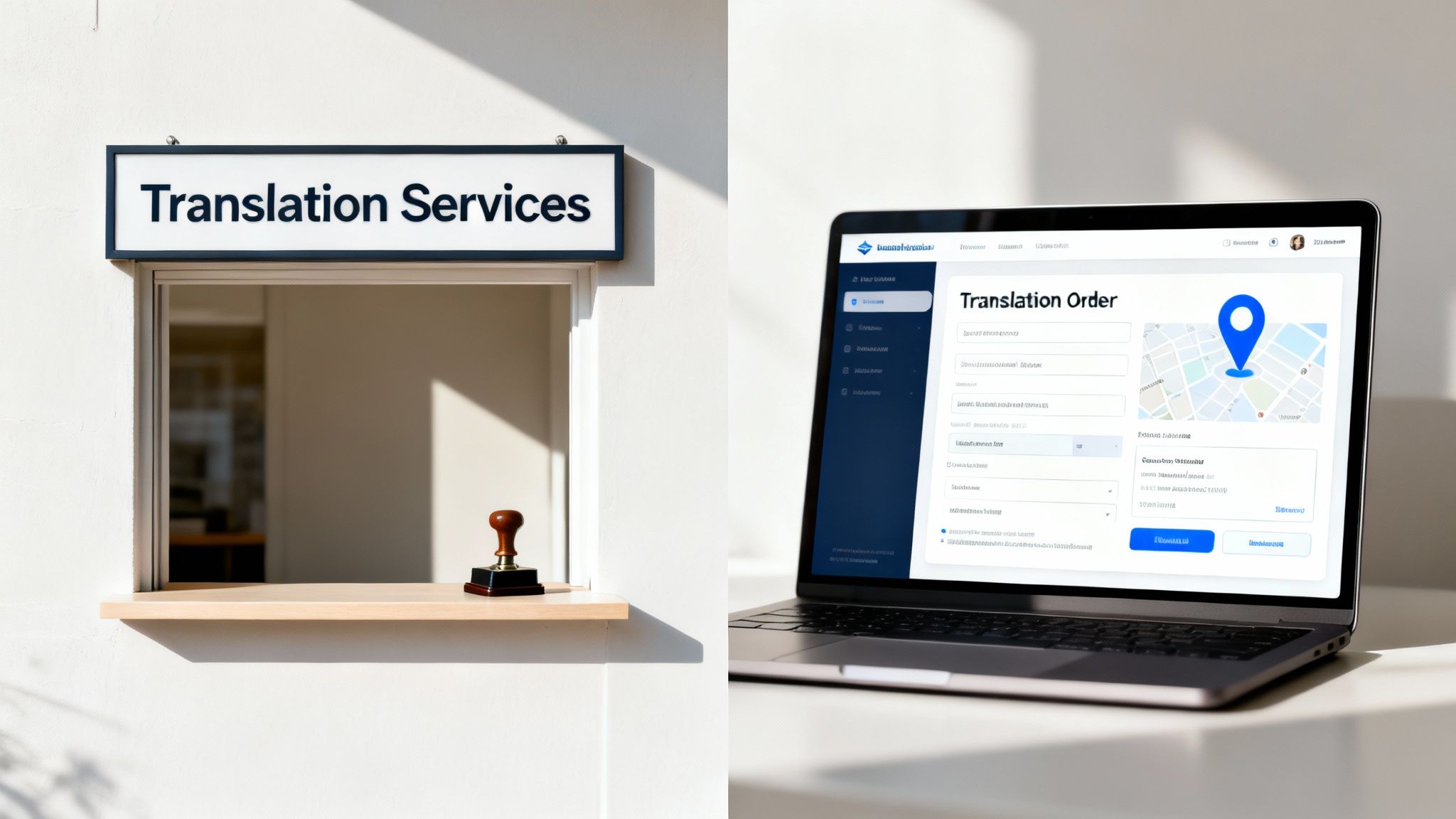
When you start searching for "USCIS translation services near me," you’ll see two main options pop up: local, in-person providers and national online services. Both can get you a USCIS-compliant translation, but the experience, cost, and speed can be worlds apart.
Deciding which route to take really boils down to your specific situation. Are you juggling complex legal documents and feel better talking to someone face-to-face? Or do you just need a standard birth certificate translated quickly and affordably? Let's get into the practical differences.
The Case for a Local Translation Agency
Going to a local translation office is the traditional, hands-on approach. The biggest draw is sitting down with an actual person. This can be a huge relief if you're dealing with a complicated set of documents—think court records or dense academic transcripts—and you want to walk through them with an expert. Another key advantage can be physical notarization. While USCIS doesn't require it, some other processes might, and a local provider can have the translator's signature notarized right there in front of you. If you find a local spot on Google Maps, make sure to read recent reviews and ask them directly about their track record with USCIS submissions.
The Power of Online Translation Services
Online services have completely changed the game. "Near me" no longer means a short drive; it means right at your fingertips. You get instant access to a massive pool of professional translators who specialize in the exact kind of paperwork USCIS needs.
This opens up some serious benefits. Let's say your spouse's visa interview is next week and you just realized you need a certified translation of your marriage certificate. An online service can often turn that around in 24 hours—a speed that most local offices just can't match. Because they have less overhead, their pricing is also usually more competitive.
The modern reality is that "near me" can mean immediate digital access. Reputable online providers deliver the same, if not a higher, level of expertise and compliance without you ever having to leave home.
Making the Final Call
Ultimately, your choice is a trade-off between your comfort level and your practical needs. The good news is that the U.S. translation industry is a massive, competitive field. The market was valued at around $10.7 billion in 2025, with thousands of firms—from small local shops to huge online agencies—vying for your business. You can get a better sense of the size of the translation market on ibisworld.com.
This competition is great for you. It means you have options. Here's a quick way to think about it:
- Local Services Are Best For: Applicants who really value face-to-face interaction, have a complex set of documents that need explaining, or require in-person notarization for other purposes.
- Online Services Are Best For: Applicants who need things done fast. They are perfect for standard documents like birth certificates and diplomas, urgent requests, and anyone who prefers a streamlined, digital process with clear translation pricing structures.
For the vast majority of people navigating the USCIS process, the speed, convenience, and guaranteed compliance of a reputable online service make it the most straightforward and reliable choice.
Breaking Down the Cost of Certified Translations
Figuring out the cost of certified translations can feel a bit like a guessing game, but it doesn't have to be. Most reputable services are quite transparent about how they charge. Once you understand the basic models, you can budget for your immigration filings without worrying about last-minute surprises.
The most common way you'll see pricing is per page. Now, a "page" isn't always just one side of a piece of paper. In the translation world, it’s usually defined as a standard word count—typically around 250 words. This is a fair system that accounts for both sparse documents, like a birth certificate, and more text-heavy ones, like a legal contract.
What Goes Into the Final Price?
Several key factors can shift the price up or down. Knowing what they are will help you ask the right questions when you're getting a quote.
- The Language Pair: Translating between common languages, like Spanish and English, is almost always more affordable. There's a much larger pool of qualified translators. If you're working with a rarer language or a specific dialect, it naturally costs more to find that specialized expertise.
- Document Complexity: A straightforward driver's license is a much simpler job than a dense academic transcript (your school records) or a medical report full of technical jargon. The more specialized the vocabulary, the more work it takes, and the price will reflect that.
- How Fast You Need It: Standard delivery is always your most budget-friendly option. But if you're up against a tight USCIS deadline and need it yesterday, you'll have to pay a premium for a rush job. This can often cut the turnaround time in half, but it comes at a cost.
A Real-World Pricing Example
Let's say a couple is applying for a Green Card. They need to get their civil certificates—birth certificates, marriage license, and two police clearance reports—translated. That’s five standard, one-page documents. With an average rate of $25 per page, their total cost would come out to around $125. It's a clear, predictable investment in their application's success.
This kind of budgeting is so important. By 2025, industry data has consistently shown that certified translation rates for immigration paperwork hover in the $20–$40 per page range for standard requests. For an entire application package, these translation fees can easily account for 5–15% of your total budget. It's a significant, but necessary, line item.
Expert Tip: Don't think of this as just another fee. It’s an investment. Paying for a professional, properly certified translation is your best insurance against costly application delays, frustrating Requests for Evidence (RFEs), and the stress that comes with immigration hiccups.
To get a precise idea of what your specific documents might cost, it's worth exploring detailed translation pricing structures which often break down services by document type and turnaround time. For a wider view on how the industry works, you can also look into general translation service pricing structures. This helps you see exactly what you’re paying for and gives you the confidence that your documents will sail through USCIS review.
Your Practical Path to Getting Documents Translated
Alright, now that we've covered the what and why, let's get into the how. This is your step-by-step plan for turning a pile of foreign-language papers into a neat, USCIS-approved set of certified translations. Forget the confusing jargon; the key is to be methodical so nothing slips through the cracks.
The whole process can be boiled down to a few straightforward stages. This visual gives you a bird's-eye view of the typical workflow.
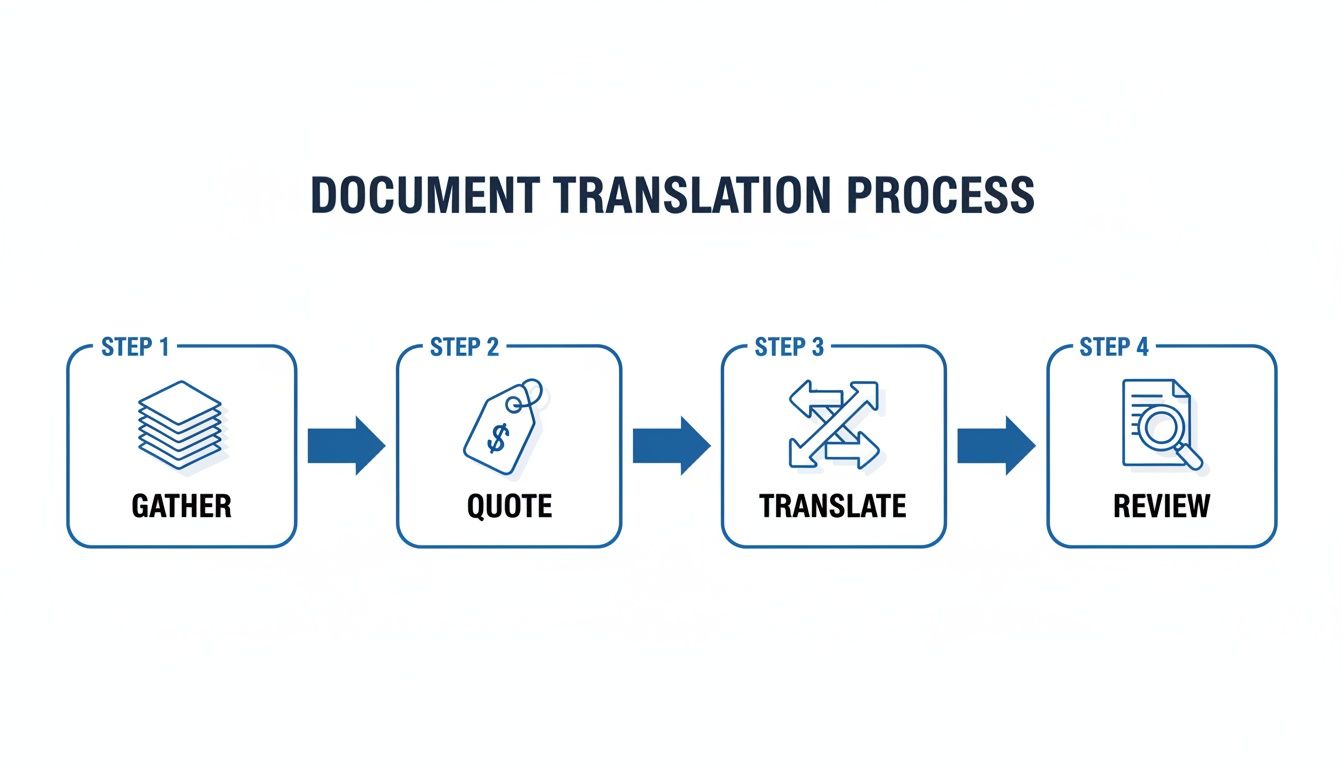
As you can see, each step logically follows the last, creating a smooth path toward a successful USCIS submission.
Step 1: Prepare Your Documents for Translation
Before you even start looking for a translator, your first task is to get organized. Pull together every single document you need translated. This might be anything from birth certificates and marriage licenses to academic transcripts or police clearance records. Once you have the physical papers, make high-quality digital copies of everything. A flatbed scanner is your best bet for this, but a good scanner app on your phone can do the trick in a pinch.
- Clarity is King: Make sure every single word, stamp, and seal is crystal clear. No blurriness!
- Get Both Sides: Scan the front and back of every page. Yes, even if the back looks blank. Sometimes there are faint official markings you don't want to miss.
- Stick to Standard Formats: Save your files as PDFs or high-resolution JPEGs.
Trust me, this prep work is crucial. Sending a blurry or incomplete scan is the fastest way to get an inaccurate translation, which will cause the exact kind of delays you're trying to prevent.
Step 2: Request and Review Your Quote
With your crisp, clear scans in hand, it's time to shop around. Reach out to a few of the translation providers you've vetted and ask for a quote. To get an accurate price and timeline, give them as much detail as you can. Here’s what to include in your request:
- A simple list of the documents (e.g., "one 2-page birth certificate, one 1-page marriage license").
- The language pair (e.g., "from Portuguese to English").
- Attach the actual files so they can see the word count and complexity for themselves.
- Let them know your deadline, especially if you're in a rush.
When the quotes come back, don't just jump at the lowest price. Look closely and confirm that the cost includes the Certificate of Translation Accuracy. This is the document USCIS requires. Any reputable service will include this standard. If you want to dig deeper, you can learn more about how to evaluate different translation service providers on our blog.
Step 3: The Final Review and Submission
Once you've given the green light on a quote, the translation agency gets to work. But when they send the completed files back, your job isn’t quite finished. The last step is a careful, meticulous review.
Pro Tip: Sit down with the original document and the new translation side-by-side. Check every name, date, and place. I've seen applications delayed over a simple typo in a birthday. It’s absolutely worth your time to double-check everything before it goes into your USCIS packet.
When you're ready to assemble your application, place each English translation directly behind its original foreign-language counterpart. This small organizational touch makes the immigration officer's job easier and shows you’ve prepared a thorough, professional application. For more tips on putting it all together, our informational FAQ page is a great resource.
Common Mistakes and Pro Tips for a Smooth Submission
Navigating the USCIS process can feel unforgiving, and a few seemingly small translation mistakes can bring everything to a halt. Learning from the common tripwires others have faced is the best way to ensure your application sails through without a hitch. The most frequent—and damaging—mistake is asking a bilingual friend or family member to do the translation. It seems like an easy fix, but USCIS sees this as a serious conflict of interest. The translation absolutely must come from a neutral, impartial third party to be considered legitimate.
Critical Errors to Sidestep
Another common oversight is sending in only the translated document. You must always include a clear, legible copy of the original source document. The USCIS officer needs to compare the two, and without the original, the translation is useless. Similarly, don't submit a summary. USCIS regulations are crystal clear: the translation must be a complete, word-for-word mirror of the original. That includes everything—stamps, seals, signatures, and even those hard-to-read handwritten notes in the margins.
Watch out for these other common deal-breakers:
- Missing Certification Statement: Without that signed Certificate of Translation Accuracy, the document is officially invalid. It's not optional.
- Incomplete Translator Info: The certification has to include the translator's full name, signature, contact information, and the date of translation. I've seen applications get RFEs just for a missing phone number.
- Using Amateur Services: Free online tools or unvetted freelancers often produce translations that don't meet the strict formatting and accuracy standards USCIS demands. It's a gamble that rarely pays off.
Here's a real-world example: an applicant’s case was stuck in limbo for three months simply because the translator forgot to add their email address to the certification statement. A professional service would never make that kind of costly mistake.
Pro Tips for a Flawless Submission
To avoid these headaches, a bit of careful organization goes a long way. Before you even think about submitting, get your documents in order. Applying some essential document management best practices can make a huge difference in keeping everything straight and preventing last-minute panic. Before you seal that envelope, create a final checklist for every single document. Does each translation have its original copy attached? Is every certification statement fully filled out, signed, and dated? Taking ten minutes for this final review is your best defense against months of preventable delays. For more in-depth advice, these tips for translating legal documents can help ensure you're meeting all the legal requirements.
Got Questions About USCIS Translations? We've Got Answers.
As you get ready to submit your USCIS application, it's completely normal for a few last-minute questions to pop up. Let’s clear up some of the most common ones so you can file with confidence.
Do My Translations Need to Be Notarized?
This is a big one, and thankfully, the answer is simple: No. USCIS does not require you to notarize the translator's certification statement. What they do care about is that signed statement from the translator, where they personally vouch for the translation's accuracy. So, why do some people get them notarized? A notary stamp simply verifies the identity of the person who signed the certification. While USCIS doesn't ask for it, another agency involved in your case—maybe a foreign consulate or a specific court—might. It's always a good idea to double-check the rules for every part of your immigration journey, not just the USCIS piece.
Can I Just Translate My Own Documents?
Even if you're a perfect bilingual speaker, USCIS has a strict rule against this. You cannot translate your own documents. Period. They see it as a conflict of interest since you're the one benefiting from the application. To keep everything fair and objective, the translation has to come from a neutral third party. That professional translator is the one who provides the signed certification, which acts as proof that the translation is accurate and unbiased.
How Long Does a Certified Translation Usually Take?
The turnaround time really depends on what you need translated.
-
For straightforward, single-page documents like a birth certificate or marriage license, a professional service can often get it back to you within 24 to 48 hours.
-
If you have something more complex, like a multi-page legal document or dense academic records, you'll need to plan for a longer timeline.
Most online services know that deadlines are real. If you're in a pinch, they usually offer rush services for an extra fee, which can often cut the standard delivery time in half.
A Quick Tip: If USCIS sends you a Request for Evidence (RFE) because of a translation error, don't panic. The first thing you should do is get in touch with your translation provider right away. Any reputable company will stand by their work. They should immediately fix the translation, provide a new certification statement, and send it back to you at no extra cost. This lets you respond to the RFE quickly and keep your application on track.
At TranslateDay, we understand how critical it is to get USCIS translations right—and fast. Our professional translators specialize in documents for immigration and deliver accurate, certified translations that meet every USCIS rule, often in just 24 hours.


